
Beyond the Datasheet: Selecting a PZT-4 Ceramic Supplier for high-reliability Applications
Introduction: The Strategic Importance of Your PZT-4 Supplier
In the world of high-performance ultrasonics, few materials are as critical as PZT-4 piezoelectric ceramics. These "hard" ceramics form the engine of devices operating under extreme electrical and mechanical stress, where failure is not an option. From the deep-sea sonar projectors that safeguard naval assets to the industrial ultrasonic welders that ensure manufacturing integrity, the performance of the final product is inextricably linked to the quality of its core piezoelectric component.
This presents a significant challenge for design engineers and procurement managers. On the surface, the datasheets for PZT-4 materials from various suppliers can appear nearly identical, listing comparable piezoelectric coefficients, coupling factors, and dielectric constants. However, the real-world performance, long-term reliability, and crucial batch-to-batch consistency of these components can vary dramatically. This discrepancy between the specification sheet and operational reality represents a substantial and often hidden source of project risk, capable of derailing timelines, inflating costs, and compromising the end-product's reputation.
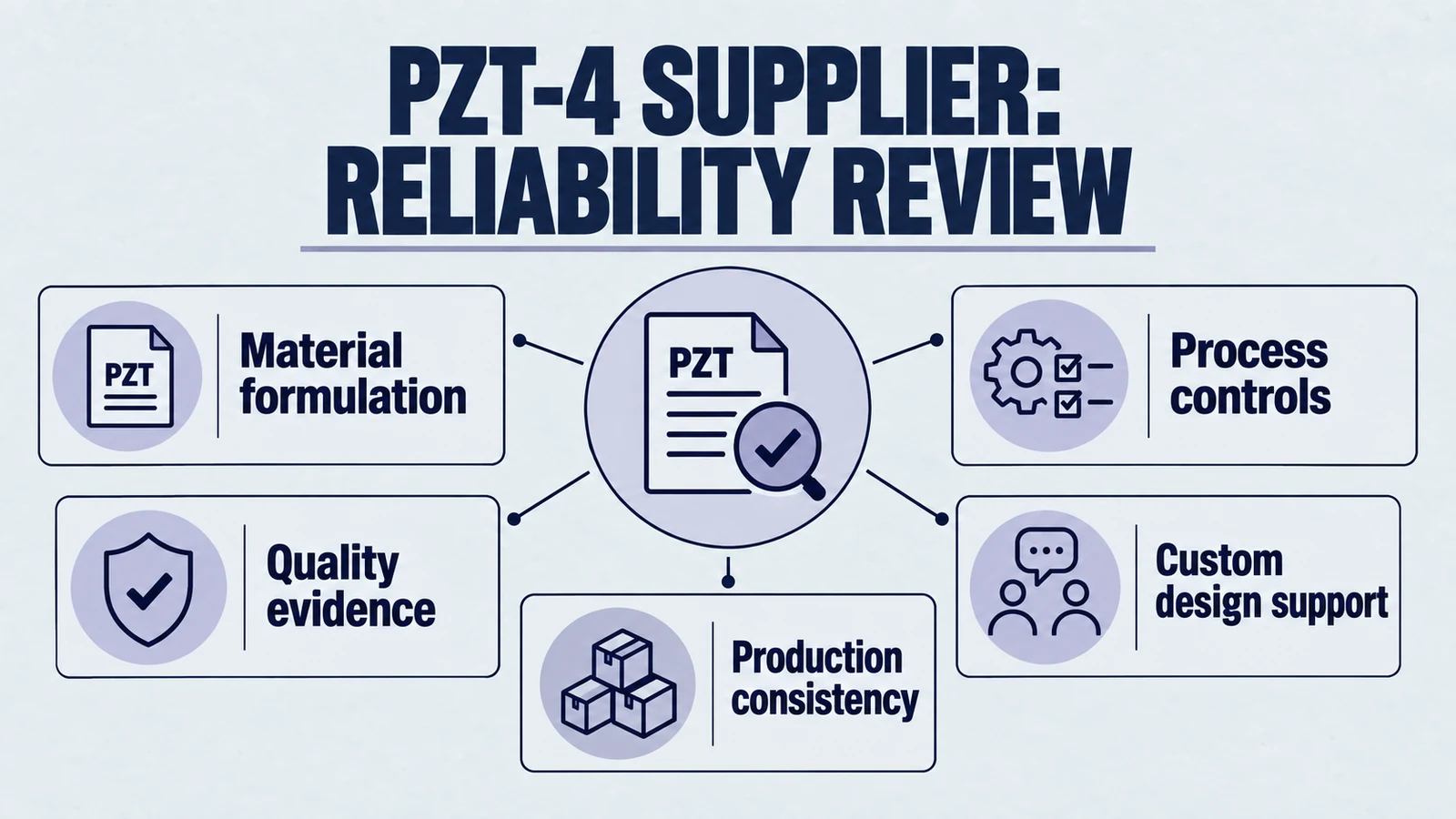
This article provides a comprehensive framework for vetting a PZT-4 ceramic supplier that moves beyond a superficial datasheet comparison. It establishes a new standard for evaluation based on three foundational pillars: deep material science expertise, rigorous and transparent process control, and a collaborative, partnership-based approach to engineering. At Yujie Piezo, we are built upon these pillars. We understand that our clients are not merely purchasing a ceramic component; they are investing in quantifiable performance, assured reliability, and a strategic partnership designed to de-risk their entire product development lifecycle.
Product path for this search intent
Match the article topic to the right YJ Piezo product page
Use this article when the choice is not just a shape, but a material tradeoff between sensitivity, loss, coupling, stability, and operating field. For "Beyond the Datasheet: Selecting a PZT-4 Ceramic Supplier for high-reliability Applications", the practical value is in turning the topic into a measurable selection or sourcing decision.
- PZT Material Hub
Material grades and application tradeoffs
- Piezoelectric Ceramics
Shapes and ceramic manufacturing options
- PZT Material Supplier Hub
Material control, grade selection, and sourcing support
Part I: Deconstructing PZT-4 Performance – Why Not All Ceramics Are Created Equal
To make an informed decision, it is essential to first understand the nuanced reality behind the PZT-4 designation. The numbers on a datasheet are outcomes, but the factors that produce those outcomes—material formulation and manufacturing precision—are where true quality is forged.
The PZT-4 "Family": Beyond a Standard Designation
The term "PZT-4" does not refer to a single, rigid chemical formula. Instead, it is a military-standard classification (Navy Type I) for a family of "hard" piezoelectric materials based on lead zirconate titanate (Pb(Zr,Ti)O3). This family is broadly characterized by properties that make it ideal for high-power transmitting applications: a high mechanical quality factor (Qm) which minimizes heat generation under load, low dielectric loss (tanδ), and excellent stability and resistance to depolarization when subjected to high electric fields. Various piezoelectric ceramic shapes are available for different application requirements—learn more in our geometry selection guide.
However, within this classification, significant performance variations exist. An expert manufacturer does not simply produce a generic "PZT-4." They develop proprietary formulations by introducing specific doping agents—such as Niobium (Nb), Antimony (Sb), or Bismuth (Bi)—in precisely controlled quantities to fine-tune material properties for specific application demands. This is the fundamental difference between a commodity-grade material and a truly engineered solution.
This distinction renders a simple datasheet comparison insufficient. An engineer might evaluate specifications from two different suppliers and see nearly identical values for the piezoelectric charge coefficient (d33) or mechanical quality factor (Qm). Yet, the underlying proprietary doping could mean one formulation is optimized for the long-duty cycles and continuous high-drive conditions of an ultrasonic cleaning tank, while another is engineered for the short, intense, high-energy pulses required by a sonar projector. The datasheet confirms that a material belongs to the PZT-4 class, but it does not reveal its suitability for a specific stress profile. The evaluation must therefore evolve from a commodity comparison to a technical consultation. The critical question for a potential supplier is not just "What are your specs?" but "What specific doping agents are used in your formulation, and how does that chemistry optimize performance for my application's unique operational demands?" This line of inquiry immediately distinguishes a true material science expert from a mere component fabricator.
Introducing Yujie's P-41: Engineered for Endurance
At Yujie Piezo, our answer to this challenge is our proprietary P-41 material. As our specialized formulation within the PZT-4 class, P-41 is the result of targeted chemical engineering and process optimization. It has been specifically developed to deliver excellent resistance to high electric fields and robust mechanical endurance under sustained stress. This makes P-41 the ideal choice for the most demanding applications, including high-power sonar transducers, industrial ultrasonic cleaning systems, and other systems where reliability and stability are paramount.
From Powder to Performance: The Manufacturing Chain of Causality
The performance potential defined by a material's formulation can only be realized through meticulous and repeatable manufacturing processes. Every step in the transformation from raw powder to a finished, functional ceramic component is a critical link in a chain of causality that determines final quality.
- Raw Material Purity: The process begins with the elemental building blocks. A manufacturer's control over their supply chain for raw materials like lead, zirconium, and titanium oxides is paramount. Qualifying only high-purity precursors (e.g., 99.9%+) is non-negotiable. As noted in manufacturing analyses, inconsistent raw material purity is the "first domino to fall" in a chain reaction that leads to unpredictable final component properties.
- Sintering: During this high-temperature firing process, the ceramic powder is densified into a solid form. The precise temperature profiles—including ramp rates, soak times, and atmospheric conditions—directly determine the ceramic's final density and grain structure. These microstructural characteristics, in turn, govern its ultimate dielectric and mechanical properties.
- Poling: In its sintered state, the ceramic's internal crystal domains are randomly oriented, resulting in no net piezoelectric effect. The poling process, which involves subjecting the material to a strong DC electric field at an elevated temperature, aligns these ferroelectric domains. The strength of the electric field, the temperature, and the duration of this process are what impart the macroscopic piezoelectric effect. Insufficient control at this stage results in low piezoelectric activity and inconsistent performance from one component to the next.
The most significant business risk for any company integrating piezoelectric components is batch-to-batch variability. A successful prototype run is meaningless if the 10,000th production unit performs differently from the first. The direct cause of this variability lies in microscopic deviations within these critical manufacturing stages. A slight variation in sintering temperature can alter the grain size, which in turn affects the mechanical quality factor (Qm) and dielectric loss. A minor inconsistency in the poling field strength can reduce the d33 coefficient. Therefore, a supplier's claim of "high quality" is unsubstantiated without demonstrable, documented evidence of Statistical Process Control (SPC) at every critical manufacturing node. A truly reliable supplier is not just selling a ceramic; they are selling a process. The value lies not in a single good batch, but in the statistical certainty that every batch will be identical.
Part II: A Framework for Supplier Vetting: The 5 Pillars of a True Manufacturing Partner
Armed with a deeper understanding of material science and process control, engineers can now apply a more rigorous framework for evaluating potential suppliers. This framework is built on five pillars that define the difference between a transactional vendor and a strategic manufacturing partner.
Pillar 1: A Culture of Absolute Quality – Beyond the ISO Certificate
A common mistake in supplier vetting is to over-rely on certifications. While an ISO 9001 certification is a necessary baseline, it only proves that a quality system exists; it does not, by itself, document the quality of the product that system produces. A supplier can be fully certified yet still ship components with wide performance variations if their internal standards are lax.
Agree critical parameters, methods, acceptance limits and risk-based inspection, including sampling where appropriate. Some checks can cover every part; destructive tests cannot. Inspection reduces risk but cannot establish zero defects or identical performance of every component.
Yujie Piezo defines quality evidence around the selected component and order. Available inspection data, sampling level, report fields, and traceability scope are confirmed during quotation. These records can support a customer's incoming inspection, but they do not replace the customer's own validation responsibilities.
Pillar 2: Application-Specific Customization and Design Collaboration
Many suppliers operate as simple order-takers, waiting for a finalized drawing from a customer before providing a quote. This passive approach places the entire burden of design, optimization, and integration risk squarely on the customer's engineering team.
A true manufacturing partner operates as a proactive extension of that team. They understand that peak performance is rarely achieved with off-the-shelf components. They offer deep customization capabilities that extend beyond simple geometry (discs, rings, plates, tubes, and hollow spheres) to include material formulation, electrode patterns, metallization techniques, and acoustic matching layers.
Yujie Piezo embodies this collaborative spirit through our comprehensive OEM and ODM solutions, rapid prototyping services, and direct engineering support. Crucially, we offer advanced simulation support, such as Finite Element Analysis (FEA). By using FEA, our engineers can model how a custom-designed PZT-4 component will behave within the client's final transducer assembly. This allows us to optimize for factors like beam profile, power output, and thermal management, and to identify potential integration issues before expensive tooling is created and physical prototypes are built.
Pillar 3: Scalability with documented consistency
Perhaps the most dangerous failure a supplier can exhibit is a drift in performance when a project moves from approved prototypes to high-volume production. When the 1,000th part behaves differently from the 10th, it can derail product launches, trigger costly recalls, and destroy profitability.
A mature manufacturer mitigates this risk with a formal, documented process for scaling. Use PPAP when required by the applicable customer/industry agreement; it is not mandatory for every supply relationship. This involves a rigorous, data-driven qualification of the mass-production line and processes to prove, with statistical evidence, that they yield parts with the same mean performance and distribution of properties as the original, approved prototypes.
Where PPAP is agreed, review the actual approval package, capability and production conformance against specified limits. It does not prove exact prototype-to-production identity or identical distributions; Yujie’s implementation and scope require project records.
Pillar 4: End-to-End Expertise – From Ceramic Powder to Transducer Assembly
A supplier whose expertise is limited to manufacturing ceramic powder or pressing basic shapes may lack the critical application context to provide meaningful design advice. They understand the material in isolation but may not fully grasp the complexities of integrating it into a functional ultrasonic device.
A vertically integrated supplier, in contrast, possesses expertise across the entire value chain. Their knowledge extends from the fundamental material science of PZT formulations to the intricate design, assembly, and testing of complete ultrasonic transducers.
Yujie Piezo's structure as a supplier of PZT materials, piezoelectric components, and complete ultrasonic transducers gives us this holistic perspective. Our engineers understand not just the material properties listed on a datasheet, but how those properties translate to real-world transducer performance metrics. This comprehensive expertise allows us to provide far more valuable and context-aware support, helping clients optimize their designs for manufacturability, reliability, and performance. Whether you need components for precision sensing, acoustic applications, or flow measurement, we deliver tailored solutions.
Pillar 5: The Partnership Mindset – Proactive Support and Supply Chain Reliability
Ultimately, the selection of a critical component supplier is an exercise in risk management. The total cost of a component is not its unit price, but that price plus the cost of any technical failures, production delays, or supply chain disruptions it may cause. A transactional "vendor" relationship effectively offloads all of this risk onto the customer; their responsibility ends when the product is shipped.
A "partner," however, actively works to mitigate these risks on behalf of the client. Proactive technical support and design collaboration (Pillar 2) mitigate technical and design risk. Rigorous 100% quality control (Pillar 1) and documented scaling processes (Pillar 3) mitigate production risk. Finally, collaborative forecasting, safety stock programs, and transparent communication about lead times mitigate supply chain risk.
This risk-mitigation framework is the foundation of Yujie Piezo's business philosophy. We are not just a vendor on a purchase order; we are an integrated part of our clients' teams, committed to ensuring their success through proactive engineering support and the construction of a resilient, predictable supply chain.
Part III: The Yujie Standard in Practice: Your PZT-4 Partner
Yujie Piezo delivers on each of the five pillars, providing a comprehensive solution that reduces risk, enhances performance, and accelerates our clients' time-to-market. The distinction between the standard vendor approach and the Yujie partnership model is best summarized in a direct comparison.
| Evaluation Criteria | The Standard Vendor Approach | The Yujie Partnership Approach |
|---|---|---|
| Material Specification | Provides generic PZT-4 datasheet. | Provides performance data for our proprietary P-41 formulation, engineered for high-drive stability and endurance. |
| Quality & Testing | Relies on ISO 9001 certification and batch sampling. | Defines critical parameters, methods, sampling level, acceptance limits, and agreed report fields for the selected component. |
| Engineering Support | Awaits a final drawing to provide a quote. | Offers collaborative design review and FEA simulation to optimize component performance and ensure manufacturability before prototyping. |
| Production Scaling | Promises to "make more" upon request, risking performance drift. | Employs a documented PPAP process to document consistency from the 10th part to the 100,000th, de-risking your production ramp. |
| Supply Chain | Quotes standard lead times and operates transactionally. | Offers collaborative forecasting, risk mitigation, and safety stock programs to ensure supply continuity and act as a reliable extension of your team. |
| Overall Philosophy | Sells a component. | Delivers a fully engineered, de-risked solution. |
Conclusion: Making a Strategic Choice for Performance and Reliability
Selecting a PZT-4 ceramic supplier is one of the most critical engineering and business decisions in the development of a high-performance ultrasonic product. The choice impacts not just the component cost, but the final product's performance, its time-to-market, and the brand's long-term reputation for quality and reliability. A decision based solely on a datasheet is a decision based on incomplete information.
Yujie Piezo is fundamentally structured to be more than a supplier. We are a dedicated engineering partner, investing our deep expertise in material science, process control, and application engineering into our clients' success. We believe that by providing superior materials, transparent data, and collaborative support, we can help our clients build better, more reliable products and achieve a decisive competitive advantage.
Your high-power application has unique demands. A generic datasheet isn't enough. Contact our engineering team today to discuss your specific operational parameters and learn how our P-41 material and collaborative approach can provide a decisive performance and reliability advantage.
Explore our detailed PZT material specifications to see the Yujie difference for yourself.
Engineering decision notes
PZT material and ceramic selection
Use this article when the choice is not just a shape, but a material tradeoff between sensitivity, loss, coupling, stability, and operating field. For "Beyond the Datasheet: Selecting a PZT-4 Ceramic Supplier for high-reliability Applications", the practical value is in turning the topic into a measurable selection or sourcing decision.
YJ Piezo coordinates PZT ceramic projects with manufacturing support, so material formulation, sintering, polarization, electrode process, and outgoing inspection can be reviewed against the final application.
Selection checks
- Separate sensing needs from high-power actuation needs before comparing d33 or coupling values.
- Check dielectric loss, Qm, Curie temperature, aging behavior, and operating field against the real duty cycle.
- Confirm whether the application needs standard PZT grades or a custom formulation and geometry.
Failure risks
- Choosing only the highest d33 can create heat, drift, or depolarization risk in power ultrasonics.
- A ceramic that performs well in free measurement can fail once bonded, clamped, or loaded.
- Material substitutions without batch testing can change capacitance, resonance, and system tuning.
RFQ details
- Is the part used for sensing, actuation, atomization, cleaning, welding, or measurement?
- What field strength, temperature, duty cycle, and mechanical load will the ceramic see?
- Which values must be controlled: d33, capacitance, resonance, impedance, Qm, or dimensional tolerance?
Relevant YJ Piezo pages
- PZT Material Hub
Material grades and application tradeoffs
- Piezoelectric Ceramics
Shapes and ceramic manufacturing options
- PZT Material Supplier Hub
Material control, grade selection, and sourcing support
Application FAQ
- Is the highest d33 always the best PZT choice?
- No. High d33 can be useful for sensitivity, but high-power ultrasonic systems often need lower loss, higher Qm, better thermal stability, and safer operation under field and stress.
- What makes PZT material selection different from catalog buying?
- The right PZT choice depends on geometry, load, drive field, duty cycle, temperature, and inspection targets. A catalog value is only useful when it is tied to the final assembly conditions.