
Beyond the Mist: Why Your Piezo Atomizer's Material DNA Defines Device Safety and Performance
The Atomizer's Deceptive Simplicity: From Household Humidifiers to Regulated Devices
Quick answer: Piezo atomizer performance is controlled by more than frequency. PZT ceramic grade, disc or ring geometry, mesh coupling, electrode design, and batch testing all affect droplet size, thermal load, output stability, and device safety.
For material background, review what PZT is and soft vs hard PZT selection. For component options, see Yujie's custom piezoelectric disc supplier range.
When you hear the term "ultrasonic atomizer," you might picture a common household humidifier, silently pushing a plume of cool mist into the air. That device uses the same basic vibration principle found in more demanding medical-device and industrial atomization systems, but the design requirements are very different. This is the component's deceptive simplicity.
The consumer market is saturated with low-cost, plug-and-play components, from simple "5V USB Ultrasonic Mist Maker" boards to mass-produced "humidifier accessories". These are perfectly suitable for their intended purpose: diffusing fragrances or adding moisture to a small room. In these applications, the demands are low, and the cost of failure is an inconvenience.
Product path for this search intent
Match the article topic to the right YJ Piezo product page
Use this article when the choice is not just a shape, but a material tradeoff between sensitivity, loss, coupling, stability, and operating field. For "Beyond the Mist: Why Your Piezo Atomizer's Material DNA Defines Device Safety and Perfo...", the practical value is in turning the topic into a measurable selection or sourcing decision.
- PZT Material Hub
Material grades and application tradeoffs
- Piezoelectric Ceramics
Shapes and ceramic manufacturing options
- PZT Material Supplier Hub
Material control, grade selection, and sourcing support
However, this same core technology is also used in precision engineering applications such as nebulizer device designs, industrial coating systems, micro-fluid delivery, and electronics manufacturing. In these systems, the mist output depends on much more than the visible plume.
For a product designer, R&D engineer, or procurement manager, the primary risk is assuming these two categories of components are interchangeable. In precision applications, the piezo atomizer ceramic element must be specified as part of a complete system: material, geometry, electrode pattern, bonding method, liquid contact design, and drive electronics all interact.
Demystifying the Core Technology: The Mechanics of Precision Atomization
To understand the critical differences in quality, one must first understand the core mechanism. Whether for a simple diffuser or a medical device, the technology relies on a sophisticated principle to create a fine, uniform mist.
The Piezoelectric Principle (The "Engine")
At the heart of every device is the inverse piezoelectric effect. A specialized piezoceramic element, typically a disc, ring, or custom plate, receives an AC electrical input. The ceramic element then oscillates at high frequency, generating the mechanical energy used by the atomization system.
The Mesh Technology (The "Nozzle")
In most modern, high-precision atomizers, this piezoelectric engine is coupled to a "microporous atomizer" disc. This disc, often made of metal, is a high-tech "mesh plate" perforated with hundreds or thousands of microscopic holes, or "micro-apertures".
Motion from the piezoelectric disc element can drive liquid through a perforated membrane. Mesh geometry, formulation, waveform and mounting jointly affect output; hole size alone does not establish a uniform aerosol distribution. For inhalation, report measured aerodynamic distribution and emitted drug mass with the test method.
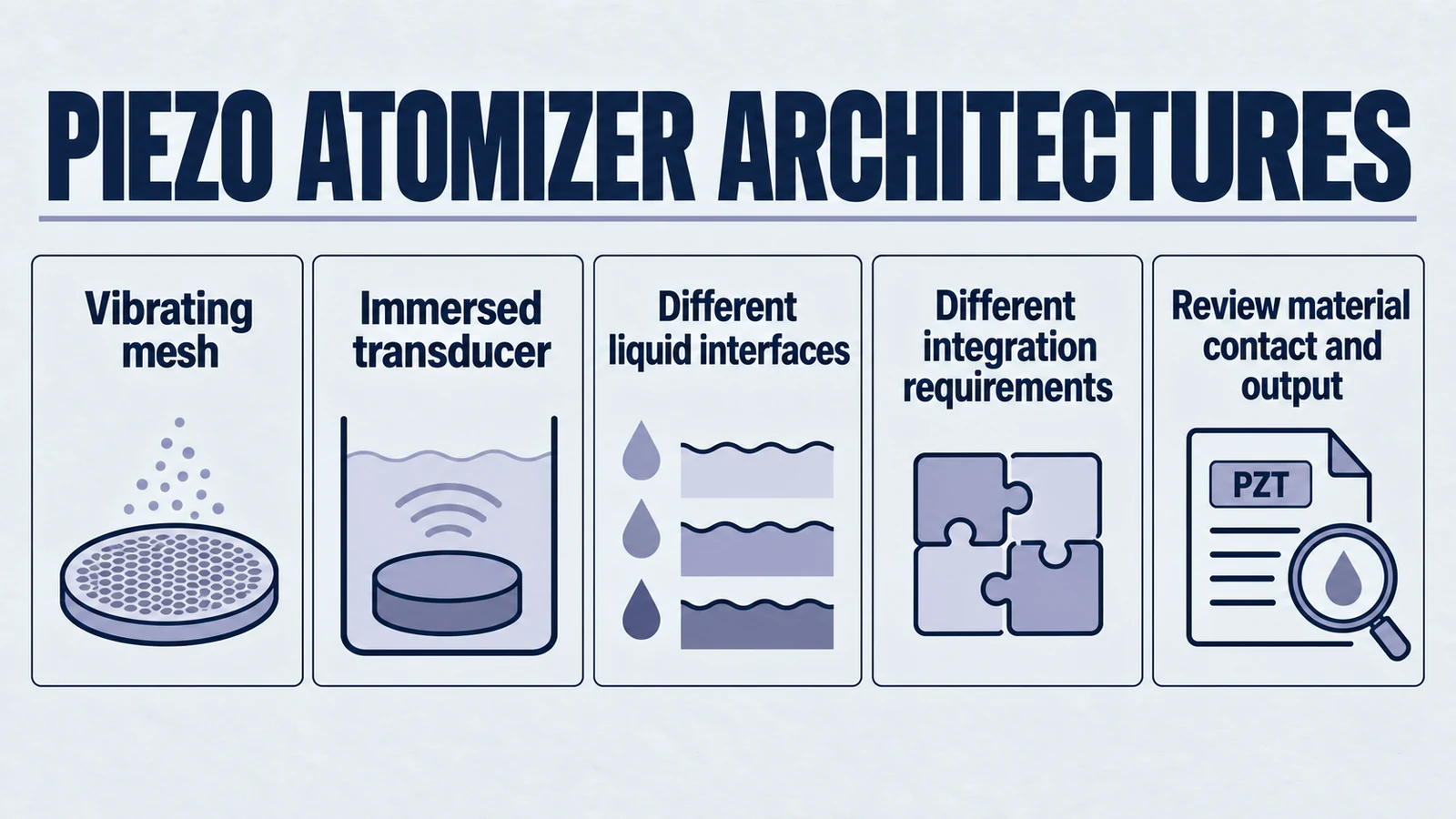
The Critical Distinction: Vibrating Mesh vs. Immersed Transducers
For an engineer designing a high-value product, it is important to understand that not all "ultrasonic atomizers" use the same mechanism. Vibrating mesh technology is fundamentally different from older, higher-power immersed-transducer designs.
- Surface-Atomizing Ultrasonic Designs: Vibration can reach the formulation through a protected face, coupling bath, cup or diaphragm; bare PZT need not contact medication. Frequency, liquid interface and thermal behavior depend on the selected device. Describe cleaning systems separately from aerosol-generation systems.
- Vibrating Mesh Technology: In many compact precision designs, the piezo actuator is coupled to a micro-perforated membrane and the finished assembly controls the fluid path. This architecture can reduce thermal load compared with immersed designs, but the final behavior must be verified in the complete device.
Validate the device–formulation combination for sensitive drugs, biologics or chemicals. Vibrating mesh can reduce heat input in some configurations, but may still warm or destabilize a formulation. Compare temperature rise, activity, aggregation and measured aerosol performance; no architecture alone establishes compatibility or universally excludes conventional ultrasonic designs.
| Feature | Vibrating Mesh Technology (Modern Precision) | High-Frequency Immersed Transducer (High-Power) |
|---|---|---|
| Operating Principle | Mechanical extrusion via vibrating membrane | "Acoustic jet" via immersed tablet |
| Liquid Integrity | Temperature and formulation stability require device-specific measurement | Temperature rise depends on device, formulation, volume and runtime |
| Power Consumption | Measure total input power for the intended workload | Measure total input power under comparable conditions |
| Droplet Size Control | Influenced by mesh, formulation and drive; verify measured distribution | Less modulation; fixed by frequency |
| Reliability | Active piezo element is isolated from liquid | Active element must be immersed; risk of breakage |
| Ideal Applications | Nebulizer device design, precision coating, controlled liquid delivery | High-power industrial cleaning, large-area fogging |
The Application-Quality Gap: When "Good Enough" is Dangerously Inadequate
The technological distinction between atomizer types is only the first part of the story. The second, more critical distinction is one of quality, traceability, and material science. The gap between a consumer-grade component and a medical/industrial-grade component is not an incremental step; it is a vast chasm.
The Nebulizer Design Imperative: Contact Path and Precision Droplet Size
In nebulizer device programs, the atomization section is part of a regulated finished device. The device manufacturer normally validates aerosol output, droplet-size distribution, liquid-path materials, cleaning method, and documentation. The piezo ceramic element contributes to this work through stable frequency, repeatable vibration, and traceable material data.
The risks of using a non-verified, low-quality component are practical and costly:
- Performance Variation: Inconsistent ceramic properties can shift vibration behavior and force extra redesign or validation cycles.
- Material Documentation Gaps: If the component supplier cannot document ceramic material, coatings, adhesives, or batch records, the finished-device team has less evidence for system-level review.
The Industrial Imperative: Durability, Power, and Reliability
In the industrial sector, the demands shift toward robustness. In applications like "industrial coating", "process control", and "precision spraying machines", the custom piezoelectric ceramic element must perform reliably, often 24/7, under heavy loads.
The component must be engineered for the expected drive level, heat load, and liquid chemistry. A failed or drifting component can mean line downtime, wasted material, and inconsistent coating quality.
The Consumer Conundrum: A Race to the Bottom
Both regulated-device and industrial applications stand in contrast to the consumer-grade components found in air humidifiers, aroma diffusers, and facial misters. Those components are designed for low cost and may not include the material traceability, lot records, or long-duty-cycle testing expected in OEM programs.
The danger for a professional engineer or designer is that the spec sheet for a commodity part can look deceptively similar to a higher-control part. A supplier on a global marketplace might list a "20mm ultrasonic atomization chip 1.7MHz" that appears to meet the initial requirement. However, the spec sheet may not show material provenance, production controls, coating details, or batch-level electrical behavior.
The Yujie Difference: Engineering Safety & Performance at the Material Level
This is where the distinction in suppliers becomes the most critical decision in the entire design process. The "Application-Quality Gap" is bridged not just by performance, but by verifiable quality, material science, and a manufacturing process built on traceability.
The PZT Problem: A Hidden Risk in Your Component Supply Chain
The core "engine" of the atomizer, the piezoceramic element, is most commonly made from Lead Zirconate Titanate, or PZT. As the name implies, this high-performance material contains lead.
When a PZT ceramic is used near a liquid path, the finished-device design should define whether the ceramic is isolated, coated, encapsulated, or outside the wetted path. This is a system-design question, not a slogan. Component suppliers can support it by providing traceable ceramic materials, stable manufacturing, and clear communication about coatings and electrodes.
The core problem is not solved by a single label. It requires traceability, material selection, isolation strategy, and finished-device validation. That is why Yujie's support starts with the ceramic material and continues through geometry, electrode, and test-data discussion.
The Yujie Solution: A Material-First, Verifiable-Quality Approach
Yujie Piezo's entire philosophy is built on mitigating this risk and delivering verifiable performance. This is achieved through three key differentiators:
- Material-First Design: Yujie does not offer a one-size-fits-all commodity. The component is engineered from the material up, whether the project needs robust hard PZT-8 or high-sensitivity PZT-5A/PZT-5H.
- Contact-Path Support: Yujie can provide ceramic material and batch documentation to support the customer's finished-device material review. The complete contact-path decision belongs to the device design and validation process.
- Verifiable Quality: For a technical buyer, useful quality data is practical evidence, not marketing wording.
- Defined Inspection Scope: Parameters, methods, sampling level, and acceptance limits are agreed for the selected component.
- Material Records: Available material and batch records are confirmed during quotation.
- Electrical Test Data: Capacitance, resonant behavior, impedance, and related checks can be included when agreed for the order.
This approach is summarized by matching the correct, verified material to the specific application, which de-risks the entire project for the end-user.
| Application Need | Yujie Material Solution | Key Properties | Yujie Quality Control Point |
|---|---|---|---|
| Nebulizer Device / Precision Aerosol | PZT-5A / PZT-5H | High-sensitivity, stable, high coupling | Agreed material records and inspection data to support finished-device validation |
| High-Power Industrial Use | PZT-8 | Robust, "hard" PZT, high power handling | Agreed batch records and electrical inspection for the selected component |
| Commodity / Unknown Origin | Unknown Material | Unclear material and coating records | Higher uncertainty for contact-path review and production scaling |
Conclusion: A Piezo Atomizer is Not a Commodity. It's a Partnership.
The difference between a repeatable end-product and a high-variation design often comes down to the material DNA of a single component. The uniform mist from a piezo atomizer ceramic element depends on material, geometry, electrode design, and the way the element is integrated.
For engineers and product designers in regulated-device and high-performance industrial fields, the choice of a piezo atomizer supplier is not a simple procurement decision. The supplier's quality management system, material traceability, and engineering communication become part of the customer's own development evidence.
Your application is too important to rely on components of unknown origin. As a custom piezoelectric component supplier, the Yujie Piezo engineering team can help review PZT material choice, disc/ring/plate geometry, electrode requirements, and sample needs. Contact us today to discuss the ceramic element inside your atomizer, sensor, cleaning, or custom ultrasonic device design.
Engineering decision notes
PZT material and ceramic selection
Use this article when the choice is not just a shape, but a material tradeoff between sensitivity, loss, coupling, stability, and operating field. For "Beyond the Mist: Why Your Piezo Atomizer's Material DNA Defines Device Safety and Perfo...", the practical value is in turning the topic into a measurable selection or sourcing decision.
YJ Piezo coordinates PZT ceramic projects with manufacturing support, so material formulation, sintering, polarization, electrode process, and outgoing inspection can be reviewed against the final application.
Selection checks
- Separate sensing needs from high-power actuation needs before comparing d33 or coupling values.
- Check dielectric loss, Qm, Curie temperature, aging behavior, and operating field against the real duty cycle.
- Confirm whether the application needs standard PZT grades or a custom formulation and geometry.
Failure risks
- Choosing only the highest d33 can create heat, drift, or depolarization risk in power ultrasonics.
- A ceramic that performs well in free measurement can fail once bonded, clamped, or loaded.
- Material substitutions without batch testing can change capacitance, resonance, and system tuning.
RFQ details
- Is the part used for sensing, actuation, atomization, cleaning, welding, or measurement?
- What field strength, temperature, duty cycle, and mechanical load will the ceramic see?
- Which values must be controlled: d33, capacitance, resonance, impedance, Qm, or dimensional tolerance?
Relevant YJ Piezo pages
- PZT Material Hub
Material grades and application tradeoffs
- Piezoelectric Ceramics
Shapes and ceramic manufacturing options
- PZT Material Supplier Hub
Material control, grade selection, and sourcing support
Application FAQ
- Is the highest d33 always the best PZT choice?
- No. High d33 can be useful for sensitivity, but high-power ultrasonic systems often need lower loss, higher Qm, better thermal stability, and safer operation under field and stress.
- What makes PZT material selection different from catalog buying?
- The right PZT choice depends on geometry, load, drive field, duty cycle, temperature, and inspection targets. A catalog value is only useful when it is tied to the final assembly conditions.