
Comprehensive Analysis of PZT Powder: Advanced Properties, Synthesis Methodologies, and Future Directions
Introduction
Lead Zirconate Titanate (PZT) powder represents a cornerstone in piezoelectric ceramic materials, acclaimed for its strong electromechanical coupling characteristics. PZT serves as an essential material in a wide array of advanced technological applications, including ultrasonic transduction, precision actuation, and energy harvesting systems. A detailed exploration into the intrinsic properties, sophisticated synthesis methods, and expanding industrial applications of PZT powder is important for researchers and engineers aiming to advance technological innovation in various high-performance sectors.
A practical note before the chemistry: technical selection and shipment planning should be reviewed together. If your team is evaluating actual supply availability, use the PZT powder supplier and China export inquiry page. Share the powder or material requested, relevant parameters, possible quantity, and destination so the supply and shipping route can be reviewed for the project.
Composition and Intrinsic Properties of PZT Powder
Product path for this search intent
Match the article topic to the right YJ Piezo product page
Use this article when the choice is not just a shape, but a material tradeoff between sensitivity, loss, coupling, stability, and operating field. For "Comprehensive Analysis of PZT Powder: Advanced Properties, Synthesis Methodologies, and...", the practical value is in turning the topic into a measurable selection or sourcing decision.
- PZT Material Hub
Material grades and application tradeoffs
- Piezoelectric Ceramics
Shapes and ceramic manufacturing options
- PZT Material Supplier Hub
Material control, grade selection, and sourcing support
PZT powder primarily consists of a solid solution between lead zirconate (PbZrO₃) and lead titanate (PbTiO₃), where the Zr/Ti compositional ratio critically dictates the resultant electromechanical, dielectric, and mechanical attributes.
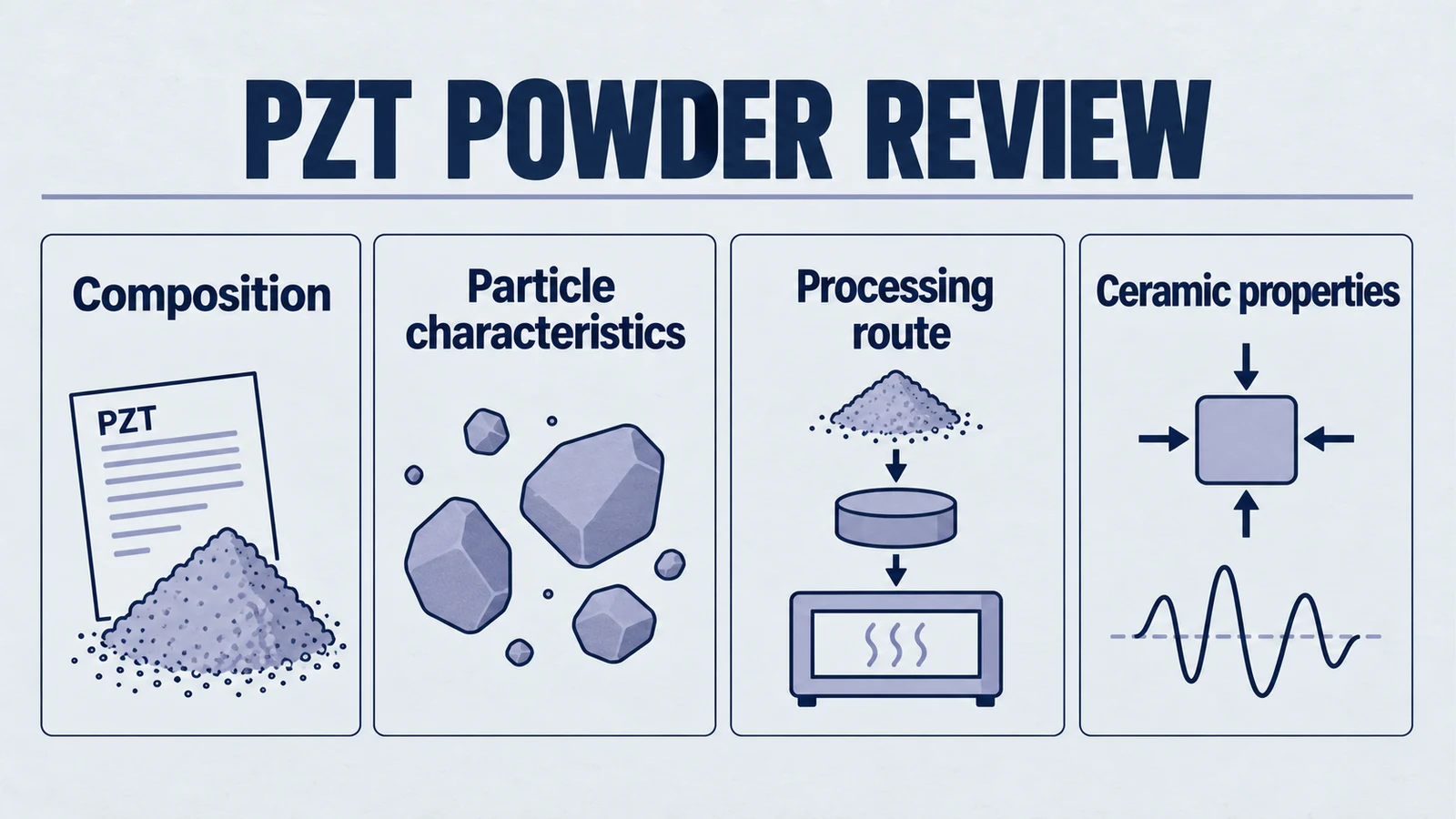
Properties must be reported for defined processed specimens after forming, densification, electroding and poling. Loose-powder particle size, purity and surface area do not establish finished-device properties:
- Elevated Piezoelectric Coefficient (d₃₃): Describes strain/charge response under stated test conditions; d33 alone does not establish optimal conversion efficiency.
- Superior Dielectric Constants: Enables high-performance capacitive applications with substantial energy storage capabilities.
- Thermal Stability: Robust performance retention across a broad temperature spectrum.
- Mechanical Durability: Exceptional resilience suited for challenging operational environments.
Advanced Manufacturing and Processing Techniques
The production of PZT powder employs various sophisticated synthesis methods, notably:
- Solid-State Reaction Method: Predominantly utilized for its cost-effectiveness and scalability, this involves precise stoichiometric mixing of precursor powders (PbO, ZrO₂, TiO₂) followed by controlled calcination processes.
- Chemical Synthesis Methods: Techniques such as sol-gel processing, hydrothermal synthesis, and co-precipitation afford greater control over particle morphology, enhanced purity, and superior homogeneity at the nanoscale.
Critical post-synthesis treatments including meticulous milling, particle size distribution control, and surface modification processes significantly impact powder performance and device reliability.
Industrial Applications and Technological Integration
Ultrasonic Transduction Technologies
PZT powders are fundamental to manufacturing ultrasonic transducers, facilitating medical imaging, industrial cleaning processes, and advanced non-destructive evaluation (NDE) techniques, leveraging the material's superior piezoelectric activity for precision diagnostics and operational efficiency.
Precision Actuation and Sensor Technologies
The swift response and precise mechanical displacement capacities of PZT powders underpin advanced actuator and sensor applications prevalent within aerospace, automotive, robotic, and precision engineering domains, enabling sub-micron accuracy and responsiveness.
Energy Harvesting Systems
PZT-based energy harvesting mechanisms convert ambient mechanical vibrations into electrical energy, supporting sustainable power solutions for wireless sensors, IoT networks, and self-sufficient monitoring systems across remote and inaccessible locations.
Advanced Capacitor and Electronic Component Manufacturing
The exceptional dielectric characteristics of PZT powders are integral to manufacturing high-performance capacitors, which are crucial in telecommunications infrastructure, electronic circuitry, and power management systems.
Emerging Innovations and Future Research Directions
Significant advancements in PZT powder technology include:
- Lead-Free and Environmentally Sustainable Materials: Intensified research and regulatory imperatives are driving the development of advanced, environmentally benign piezoelectric alternatives such as potassium sodium niobate (KNN) and other novel perovskite-based materials.
- Nanostructured PZT Materials: Particle/grain-size engineering can alter processing and selected properties. The result depends on composition, density, domains, interfaces and measured quantity; smaller grains do not inherently give larger piezoelectric response or faster devices.
- Multifunctional Composite Systems: The development of sophisticated composite materials integrating PZT powder with polymeric matrices or alternative ceramic materials enhances multifunctionality, structural integration, and targeted performance optimization.
Challenges and Strategic Solutions
Key challenges in advancing PZT powder technology encompass:
- Mitigating Environmental Concerns Regarding Lead Content: Ongoing innovation focuses on sustainable manufacturing practices, enhanced recycling processes, and exploring viable lead-free alternatives without compromising performance.
- Ensuring Material Consistency and Reproducibility: Advanced processing methodologies and stringent quality control protocols are essential for maintaining consistent performance standards and reliability.
- Integration into Advanced Device Architectures: Continued research into precision fabrication techniques, device miniaturization, and integration methodologies is crucial for expanding the applicability of PZT powder in complex technological systems.
Conclusion
PZT powder remains integral to contemporary technological advancements due to its distinguished properties and expansive application scope. Ongoing research endeavors and continuous innovations are set to further enhance the material's functionality, environmental compatibility, and industrial integration potential. Learn more about our ultrasonic cleaning products and welding transducers that utilize this advanced material.
For an actual powder requirement, start with the PZT powder supply review, then send the available parameters and possible quantity through the inquiry path.
Engineering decision notes
PZT material and ceramic selection
Use this article when the choice is not just a shape, but a material tradeoff between sensitivity, loss, coupling, stability, and operating field. For "Comprehensive Analysis of PZT Powder: Advanced Properties, Synthesis Methodologies, and...", the practical value is in turning the topic into a measurable selection or sourcing decision.
YJ Piezo coordinates PZT ceramic projects with manufacturing support, so material formulation, sintering, polarization, electrode process, and outgoing inspection can be reviewed against the final application.
Selection checks
- Separate sensing needs from high-power actuation needs before comparing d33 or coupling values.
- Check dielectric loss, Qm, Curie temperature, aging behavior, and operating field against the real duty cycle.
- Confirm whether the application needs standard PZT grades or a custom formulation and geometry.
Failure risks
- Choosing only the highest d33 can create heat, drift, or depolarization risk in power ultrasonics.
- A ceramic that performs well in free measurement can fail once bonded, clamped, or loaded.
- Material substitutions without batch testing can change capacitance, resonance, and system tuning.
RFQ details
- Is the part used for sensing, actuation, atomization, cleaning, welding, or measurement?
- What field strength, temperature, duty cycle, and mechanical load will the ceramic see?
- Which values must be controlled: d33, capacitance, resonance, impedance, Qm, or dimensional tolerance?
Relevant YJ Piezo pages
- PZT Material Hub
Material grades and application tradeoffs
- Piezoelectric Ceramics
Shapes and ceramic manufacturing options
- PZT Material Supplier Hub
Material control, grade selection, and sourcing support
Application FAQ
- Is the highest d33 always the best PZT choice?
- No. High d33 can be useful for sensitivity, but high-power ultrasonic systems often need lower loss, higher Qm, better thermal stability, and safer operation under field and stress.
- What makes PZT material selection different from catalog buying?
- The right PZT choice depends on geometry, load, drive field, duty cycle, temperature, and inspection targets. A catalog value is only useful when it is tied to the final assembly conditions.