
Custom PZT Components: A Strategic Guide to Unlocking Peak Performance
Introduction: Why Standard Components Can't Keep Pace with Innovation
In advanced product development, design engineers, R&D scientists, and product managers often need devices that are smaller, faster, more precise, or more durable than a standard component can support. Off-the-shelf parts are useful starting points, but they may force compromises in resonance, size, electrode layout, mounting, or environmental margin.
This is where custom PZT components become useful. Lead zirconate titanate, commonly represented as Pb(Zr,Ti)O3, or PZT, is a widely used piezoelectric ceramic, and its performance depends strongly on material grade, geometry, electrode design, and processing. Customization turns a generic ceramic into a component matched to a specific acoustic, sensing, or actuation requirement.
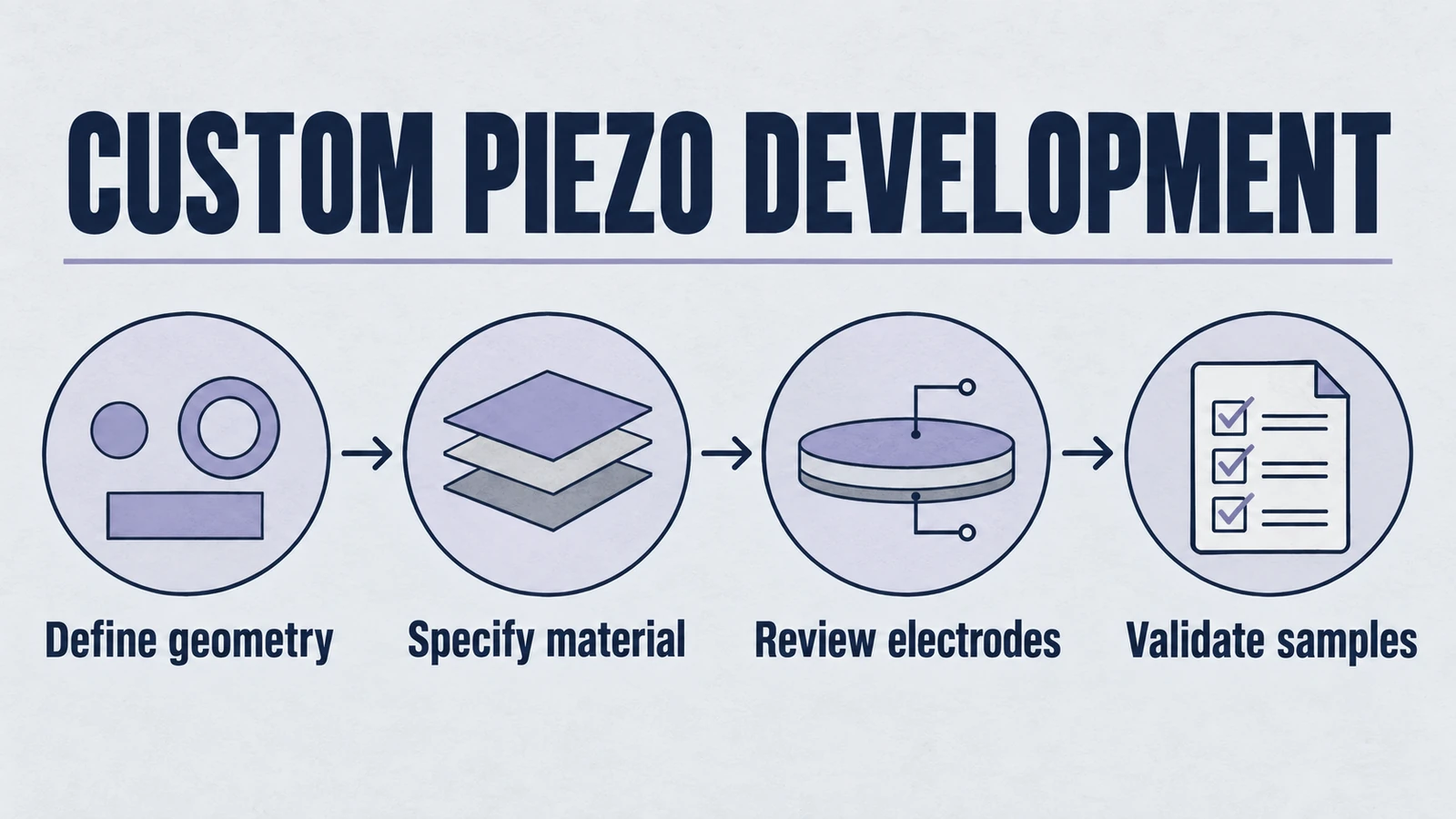
This guide explains the main design levers behind custom PZT components, the trade-offs they create, and the information an OEM team should prepare before requesting a custom ceramic.
Product path for this search intent
Match the article topic to the right YJ Piezo product page
Use this article when the choice is not just a shape, but a material tradeoff between sensitivity, loss, coupling, stability, and operating field. For "Custom PZT Components: A Strategic Guide to Unlocking Peak Performance", the practical value is in turning the topic into a measurable selection or sourcing decision.
- PZT Material Hub
Material grades and application tradeoffs
- Piezoelectric Ceramics
Shapes and ceramic manufacturing options
- PZT Material Supplier Hub
Material control, grade selection, and sourcing support
Section 1: The Anatomy of a Custom PZT Component: Engineering at the Material Level
To fully appreciate the value of custom PZT, one must understand that "custom" signifies far more than non-standard dimensions. It represents a holistic engineering discipline that begins at the material level and extends through every aspect of the component's design and fabrication. It is a process of deconstructing a standard ceramic and rebuilding it to solve a specific, complex challenge.
The Piezoelectric Principle: A Quick Primer on PZT
The functionality of PZT is rooted in the piezoelectric effect, a remarkable property of certain materials to convert energy between mechanical and electrical domains. This bidirectional capability manifests in two ways:
- The Direct Piezoelectric Effect: When a PZT ceramic is subjected to mechanical stress (such as pressure or vibration), it generates an electrical charge across its faces. This makes it an ideal material for sensors.
- The Converse (or Inverse) Piezoelectric Effect: When an electric field is applied to a PZT ceramic, it undergoes a precise mechanical deformation, changing its shape. This makes it perfect for actuators, motors, and transducers.
This behavior originates in PZT's perovskite crystal structure. In its raw, fired state, the ceramic consists of randomly oriented crystal domains, resulting in no net piezoelectric effect. A critical manufacturing step called "poling" involves subjecting the material to a strong DC electric field, which aligns the electric dipoles within the domains. This process imparts the macroscopic piezoelectric properties to the ceramic, making it functionally active. PZT has become the dominant material in the field due to its superior combination of high sensitivity, a high operating temperature (Curie temperature), and excellent chemical inertness, making it more versatile and robust than other piezoceramics for the most demanding applications.
Beyond the Basics: The Four Pillars of PZT Customization
The abstract concept of "customization" can be broken down into four tangible and interconnected pillars of engineering. The true power of a custom solution lies in the ability to manipulate all four pillars in concert to achieve a specific performance outcome.
Pillar 1: Material Formulation & Doping
The properties of a PZT ceramic are not fixed; they can be precisely tailored by modifying the chemical composition. This leads to a critical distinction between two primary families of PZT materials: "soft" and "hard".
- Soft PZT: These materials are characterized by higher piezoelectric charge coefficients (d₃₃), greater sensitivity, and higher dielectric permittivity. This makes them ideal for applications where large strain or high sensitivity is required, such as sensors, low-power actuators, and nanopositioning systems used in microscopy and optics.
- Hard PZT: These materials exhibit a higher mechanical quality factor (Qₘ), lower dielectric losses, and a higher coercive field, meaning they can withstand strong electric fields without depolarization. These properties make them the material of choice for high-power applications that generate significant heat and mechanical stress, such as ultrasonic transducers for industrial cleaning and welding, sonar projectors, and specialized medical devices.
A specialized manufacturer can go even further, using specific dopants to fine-tune these properties and create proprietary formulations tailored for extreme operational environments, such as the high temperatures found in down-hole oil and gas sensors or automotive engine components.
Pillar 2: Geometric Complexity & Form Factor
While standard PZT components are typically available as simple discs, rings, and plates, innovation often requires more complex shapes. Advanced machining capabilities allow for the fabrication of intricate geometries that are functionally optimized for their application. This includes:
- Hemispheres and Spherical Sections: Critical for creating wide-beam sonar transducers that can send and receive signals over a large area.
- Tubes and Cylinders: Used for applications requiring radial displacement or 360-degree sensing and actuation, such as in flow meters or scanning microscopy.
- Custom Milled Shapes: Components can be machined with complex features like through-holes, tapered edges, radiused surfaces, and other non-standard contours.
This geometric freedom is not merely aesthetic. It allows the PZT element to be integrated seamlessly into a larger, often space-constrained assembly. This eliminates the need for bulky mounting hardware, reduces the overall part count, simplifies the assembly process, and ultimately improves the reliability of the final device.
Pillar 3: Precision Tolerances & Machining
PZT is a hard, brittle ceramic, which means it cannot be machined using conventional cutting tools. Material removal is achieved through abrasive processes utilizing diamond or silicon carbide tooling. A high-capability manufacturer employs a suite of specialized techniques to achieve exacting tolerances:
- Lapping: This process uses a fine abrasive slurry to produce surfaces with extreme flatness and parallelism, critical for stack actuators where uniform force distribution is paramount.
- Center-less Grinding: Used to machine the outer diameter of discs and rods to precise dimensions, which is essential for tuning the component's radial resonant frequency.
- Multi-Axis CNC Milling and Drilling: These computer-controlled processes enable the creation of the complex geometries mentioned in the previous pillar, from large blocks of fired PZT.
Through these advanced techniques, it is possible to achieve dimensional tolerances as tight as 0.002 inches (approximately 50 micrometers). This level of precision is crucial for ensuring consistent performance, especially in high-frequency applications or systems requiring repeatable, nanometer-scale positioning.
Pillar 4: Electrode Pattern & Electrical Interface
The method of applying an electric field to the PZT element is a critical design consideration that is often overlooked with standard parts. Customization of the electrode—the conductive layer applied to the ceramic's surface—is essential for robust and reliable device integration. Key aspects include:
- Electrode Materials: The choice of material, such as fired-on silver or nickel plating, depends on the application's environment and the required connection method (e.g., soldering or conductive epoxy bonding).
- Custom Patterns: Instead of simple, fully-faced electrodes, custom patterns can be designed to facilitate easier electrical connection and assembly. Examples include wrap-around electrodes that bring both positive and negative terminals to one side of the component, or isolated electrode "pads" for complex wiring schemes.
Properly designed electrodes simplify the manufacturing of the final device, reduce the risk of connection failures, and enhance the overall robustness of the system, especially in applications subject to vibration or thermal cycling.
Section 2: The Strategic Imperative: Why Custom PZT is a Competitive Advantage
Choosing a custom PZT component is not a simple component-level decision; it is a system-level strategic choice that yields cascading benefits throughout the product lifecycle. It directly impacts performance, reliability, form factor, and ultimately, the ability to innovate beyond the competition.
Benefit 1: Performance Optimization for Peak Efficiency
Standard components are designed for a wide range of potential applications, so they may not match one system's target resonance, force, displacement, or sensor sensitivity. Custom components can be tuned more closely to the intended task, helping the device team reduce wasted energy and integration compromises. It is the difference between a general-purpose part and a part designed around a specific operating window.
Benefit 2: Seamless System Integration and Miniaturization
The trend across nearly every high-tech industry—from medical devices to consumer electronics—is toward smaller, lighter, and more integrated products. Custom geometries are a key enabler of this trend. By designing a PZT element to fit perfectly within a complex, space-constrained assembly, such as a medical catheter, a wearable sensor, or a compact optical system, engineers can eliminate the need for bulky adapters, brackets, and other mounting hardware. This not only reduces the overall size and weight of the system but also decreases the number of potential points of failure, leading to a more elegant and robust final product.
Benefit 3: strong Reliability in Demanding Environments
Many PZT applications operate in harsh environments, including high temperatures, high pressure, vibration, shock, or strict material-contact evaluation requirements. Standard components may not provide enough margin. Through custom material formulations, robust geometric design, and specialized electrode configurations, components can be engineered to support the finished system's reliability targets, with final performance confirmed by device-level testing.
Benefit 4: Enabling Innovation and Unlocking New Capabilities
Perhaps the most profound advantage of custom PZT is its role as an enabler of innovation. Many of today's most advanced technologies would be impossible to realize with standard components. For example:
- High-definition haptic feedback in smartphones and gaming controllers relies on custom PZT actuators that can produce crisp, nuanced vibrations far beyond the capabilities of traditional motors.
- Precise fluidic systems can use custom multilayer PZT stacks to power micropumps that dispense very small fluid volumes within the finished device's validated accuracy range.
- The Internet of Things (IoT) can use custom PZT energy harvesters that convert ambient vibrations from machinery or infrastructure into electrical energy, reducing battery dependence in suitable low-power designs.
In this way, custom PZT serves as a foundational, enabling technology. It provides R&D teams with the tools they need to transform theoretical concepts into functional prototypes and, ultimately, into market-disrupting products. The initial investment in a custom-engineered component radiates positive effects throughout the entire development cycle, resulting in a final product that is superior in performance, reliability, and market competitiveness.
Section 3: A Universe of Applications: Custom PZT in Action Across Industries
The versatility of custom PZT components is demonstrated by their widespread adoption across a diverse range of high-stakes industries. In each sector, the ability to tailor material properties, geometry, and electrical interfaces allows engineers to solve unique challenges and achieve new levels of performance.
Medical Technology: Precision, Imaging, and Therapy
The medical field relies on precision and reliability, making it a prime area for custom PZT applications.
- Diagnostic Imaging: Custom high-frequency transducers are the heart of modern ultrasound systems, enabling higher-resolution images for better diagnostics. A key example is Intravascular Ultrasound (IVUS), where miniaturized, custom-shaped PZT elements are mounted on catheters to image the inside of blood vessels.
- specialized medical devices: Validated focused ultrasound systems systems can use custom-shaped, spherically focused PZT transducers to concentrate acoustic energy at a designed focal zone. Ultrasonic surgical instruments leverage custom PZT to create high-frequency vibrations for controlled cutting and coagulation, with finished-device performance depending on the complete device design and validation pathway.
- Fluidics and Actuation: Custom multilayer stack actuators are essential in micro-dosing pumps for automated drug delivery and in nebulizers that atomize liquid medication into a fine mist for inhalation.
Aerospace & Defense: Sensing, Actuation, and Surveillance
In aerospace and defense, components must perform flawlessly under extreme conditions of vibration, temperature, and pressure.
- Sensing & Monitoring: Custom-shaped PZT sensors are integrated into airframes for Structural Health Monitoring (SHM), where they "listen" for the acoustic signatures of stress, fatigue, or impact damage. PZT accelerometers are used for vibration monitoring in jet engines and in inertial guidance systems for munitions.
- Defense Systems: The history of PZT is deeply linked with defense. High-power PZT stacks, rings, and hemispheres form the core of active sonar transducers for submarines and surface ships, a technology that has evolved dramatically since its origins in World War I.
- Space Applications: In the vacuum of space, PZT actuators provide the ultra-high precision required for nanopositioning of satellite optics, mirrors, and scientific instruments.
Automotive: Efficiency, Safety, and Experience
The automotive industry leverages custom PZT to improve engine efficiency, enhance vehicle safety, and create a better driving experience.
- Engine Management: Simple PZT disc sensors are used for engine knock detection, allowing for real-time adjustments to ignition timing for optimal performance. More advanced custom multilayer actuators enable ultra-fast, precise piezoelectric fuel injectors that improve fuel atomization, increasing efficiency and reducing emissions.
- Advanced Driver-Assistance Systems (ADAS): Custom ultrasonic transducers are the workhorses of ADAS, used for parking assistance, blind-spot monitoring, and proximity detection.
- Safety & Monitoring: Identify actual sensor architectures for TPMS and occupant-safety functions. Conventional TPMS commonly uses capacitive/piezoresistive MEMS; piezoelectric strain/harvesting research does not prove static pressure or occupancy sensing in every system.
Industrial & Manufacturing: Power, Precision, and Control
In the industrial sector, custom PZT components are critical for applications requiring high power, extreme precision, and reliable process control.
- High-Power Ultrasonics: Custom-designed "hard" PZT rings and stacks are the engines for powerful ultrasonic systems used in welding plastics, cleaning sensitive components, and creating fine mists in atomization nozzles.
- Non-Destructive Testing (NDT): Custom PZT transducers are designed to generate and receive specific ultrasonic wave patterns for detecting internal flaws, cracks, or voids in materials without causing damage.
- Automation & Robotics: Piezo actuators provide the microsecond response times and nanometer precision needed for high-speed sorting systems, robotic grippers, and precision positioning stages in semiconductor manufacturing.
Consumer Electronics & Communications: Haptics, Audio, and Miniaturization
The drive for smaller, more feature-rich consumer devices has made custom PZT an important technology.
- Haptic Feedback: Custom PZT benders and multilayer actuators provide the crisp, high-definition tactile feedback that distinguishes premium smartphones, laptop trackpads, and virtual reality controllers from their conventional counterparts.
- Audio: Miniaturized PZT speakers and MEMS (Micro-Electro-Mechanical Systems) microphones enable high-fidelity audio in slim devices where traditional components cannot fit. Piezoelectric bone-conduction architectures are possible, but other products use moving-coil/magnetic transducers; identify the actual implementation.
- RF & Communications: Acoustic RF filters use several piezoelectric materials: common SAW substrates include lithium tantalate/niobate and many BAW devices use AlN-family thin films. Describe a PZT implementation only with its specific source; do not assign PZT to the full 5G filter category.
| Industry Vertical | Common Component Type | Specific Application | Key Customization Benefit |
|---|---|---|---|
| Medical Technology | Custom-Shaped Transducer | focused ultrasound systems | Geometric focusing of ultrasonic energy toward a controlled device-level focal zone. |
| Miniaturized Tube/Ring | Intravascular Ultrasound (IVUS) Catheters | Form factor allows for integration into small catheters for imaging inside arteries. | |
| Multilayer Stack Actuator | Micro-Dosing & Nebulizers | Precision displacement enables accurate, repeatable dispensing of nanoliter fluid volumes. | |
| Aerospace & Defense | PZT Hemisphere/Stack | Naval Sonar Arrays | Material formulation (hard PZT) and shape are optimized for high-power output and wide-beam patterns. |
| PZT Patch Sensor | Structural Health Monitoring (SHM) | Custom shape and sensitivity are tailored to detect specific vibration modes indicating fatigue. | |
| Ring Actuator | Satellite Mirror Positioning | High-resolution displacement and vacuum compatibility for precise optical alignment. | |
| Automotive | Multilayer Stack Actuator | Piezoelectric Fuel Injectors | Ultra-fast response time and high force enable finer fuel atomization for improved efficiency. |
| PZT Disc Transducer | Parking Assist Sensors | Beam pattern and frequency are customized to optimize range and spatial resolution. | |
| Industrial & Manufacturing | High-Power PZT Ring | Ultrasonic Welding/Cleaning | Hard PZT material with high Qm minimizes heat loss and maximizes power delivery. |
| Custom Transducer | Non-Destructive Testing (NDT) | Geometry and material are matched to generate specific wave types for flaw detection. | |
| Consumer Electronics | Bender/Bimorph Actuator | High-Definition Haptics | Mechanical properties are tuned to produce a specific tactile frequency response and feel. |
| PZT-based MEMS | Miniaturized Microphones | Integration of PZT thin films enables high performance in an extremely small package. |
Section 4: Your Partner in Precision: The Collaborative Custom PZT Development Process
Engaging a manufacturer for a custom PZT component is not a transactional purchase; it is the beginning of a collaborative engineering partnership. The process is designed to de-risk development, optimize performance, and ensure the final component perfectly aligns with the system's goals. This journey transforms a customer's challenge into a high-performance, production-ready solution.
It Starts with Your Challenge, Not Our Catalog
The custom development process begins with a deep dive into the customer's application requirements and performance objectives. Unlike ordering a standard part, the conversation is not limited to a list of catalog numbers. It is a collaborative problem-solving session focused on the engineering challenge at hand. To facilitate a completely open discussion of proprietary designs and goals, this process typically begins under a Non-Disclosure Agreement (NDA).
The Four Phases of Custom Component Realization
The journey from concept to scaled production can be structured into four distinct, value-added phases.
Phase 1: Collaborative Discovery & Specification
This initial consultation brings together engineers from both the customer and the manufacturer to define the project's core parameters. This involves a detailed discussion of the application's operational environment (temperature, pressure, humidity), the desired electromechanical performance (displacement, force, frequency, sensitivity), physical constraints (size, weight, mounting), and the electrical drive conditions (voltage, power, waveform). This phase is critical for establishing a clear set of design targets that will guide the rest of the development process.
Phase 2: Material Science, Modeling & Design
With the specifications defined, the manufacturer's material scientists select an existing PZT formulation or, for highly demanding applications, develop a new powder composition optimized for the task. Simultaneously, design engineers use advanced tools like Finite Element Analysis (FEA) to model the component's behavior. FEA allows the team to simulate performance, predict stress concentrations, and optimize the geometry for electromechanical efficiency and long-term reliability before any physical parts are made. This modeling phase significantly reduces development time and cost by preventing cycles of physical redesign.
Phase 3: Prototyping & Performance Validation
Once the design is finalized through modeling, initial prototypes are manufactured for customer testing and validation. These prototypes are subjected to rigorous in-house testing to verify key electrical and physical properties, such as capacitance, dielectric loss, resonant frequency, and displacement under load. This ensures that the components meet the agreed-upon specifications. The customer then integrates these prototypes into their system to validate performance in the real-world application, providing critical feedback for any final design adjustments.
Phase 4: Scaled Manufacturing & Quality Assurance
Following successful prototype validation, the project transitions to full-scale production. A vertically integrated manufacturing process—from the formulation of raw PZT powders to the final testing of finished components—is essential for ensuring consistency and quality control. Adherence to rigorous quality management systems, such as ISO 9001, helps verify that production components continue to meet the agreed standards established during prototyping, providing the reliability needed for demanding applications.
This structured process demonstrates that the "product" being delivered is not just the final PZT component itself, but the entire collaborative engineering journey. The value lies in the shared expertise, the advanced modeling and simulation, and the methodical de-risking of the customer's project, ensuring a successful outcome.
Conclusion: Engineer Your Vision with Custom PZT Solutions
For today's most advanced and demanding technological applications, customization is no longer a luxury—it is a fundamental necessity. Standard, off-the-shelf PZT components force compromises that can limit performance, complicate integration, and jeopardize reliability. A custom-engineered PZT solution, by contrast, is purpose-built to excel. By tailoring every aspect of the component—from its core material formulation to its final geometric shape and electrical interface—engineers can achieve optimized performance, seamless system integration, and unwavering reliability in the harshest environments.
This level of specialization is achieved through a deep, collaborative partnership. A true manufacturing partner acts as an extension of the customer's engineering team, bringing decades of expertise in materials science, mechanical design, and high-volume production to bear on the toughest challenges. This partnership transforms the development process from a simple transaction into a shared journey of innovation.
Ready to move beyond the limitations of standard components? Contact our engineering team today to discuss your application and discover how a custom PZT solution can bring your vision to life.
Engineering decision notes
PZT material and ceramic selection
Use this article when the choice is not just a shape, but a material tradeoff between sensitivity, loss, coupling, stability, and operating field. For "Custom PZT Components: A Strategic Guide to Unlocking Peak Performance", the practical value is in turning the topic into a measurable selection or sourcing decision.
YJ Piezo coordinates PZT ceramic projects with manufacturing support, so material formulation, sintering, polarization, electrode process, and outgoing inspection can be reviewed against the final application.
Selection checks
- Separate sensing needs from high-power actuation needs before comparing d33 or coupling values.
- Check dielectric loss, Qm, Curie temperature, aging behavior, and operating field against the real duty cycle.
- Confirm whether the application needs standard PZT grades or a custom formulation and geometry.
Failure risks
- Choosing only the highest d33 can create heat, drift, or depolarization risk in power ultrasonics.
- A ceramic that performs well in free measurement can fail once bonded, clamped, or loaded.
- Material substitutions without batch testing can change capacitance, resonance, and system tuning.
RFQ details
- Is the part used for sensing, actuation, atomization, cleaning, welding, or measurement?
- What field strength, temperature, duty cycle, and mechanical load will the ceramic see?
- Which values must be controlled: d33, capacitance, resonance, impedance, Qm, or dimensional tolerance?
Relevant YJ Piezo pages
- PZT Material Hub
Material grades and application tradeoffs
- Piezoelectric Ceramics
Shapes and ceramic manufacturing options
- PZT Material Supplier Hub
Material control, grade selection, and sourcing support
Application FAQ
- Is the highest d33 always the best PZT choice?
- No. High d33 can be useful for sensitivity, but high-power ultrasonic systems often need lower loss, higher Qm, better thermal stability, and safer operation under field and stress.
- What makes PZT material selection different from catalog buying?
- The right PZT choice depends on geometry, load, drive field, duty cycle, temperature, and inspection targets. A catalog value is only useful when it is tied to the final assembly conditions.