
The Engineer's Guide to PZT-8: Choosing a High-Performance Hard Ceramic Manufacturer for Power Applications
Introduction: The Unseen Engine of High-Power Ultrasonics
In the world of high-power industrial and medical technology, performance is measured at the extremes. Inside devices like ultrasonic welders generating intense localized heat to bond thermoplastics, or naval sonar projectors emitting powerful acoustic pulses to map the ocean floor, components are subjected to immense electrical and mechanical stresses. These applications demand a unique class of material—one that can not only withstand but thrive under continuous high-power operation without faltering. This is the domain of PZT-8, a specialized piezoelectric ceramic engineered for the most demanding tasks.
PZT-8, also known by its military designation Navy Type III, is the material of choice for high-power resonant devices. Its fundamental purpose is to efficiently and reliably convert high-voltage electrical energy into powerful, high-frequency mechanical vibrations, all while minimizing the energy lost as heat. However, the exceptional properties listed on a datasheet are only a starting point. The true performance of a PZT-8 component is inextricably linked to the expertise of its manufacturer.
This guide provides a definitive overview for engineers, transducer designers, and technical procurement managers. It delves into the core properties of PZT-8, offers a detailed comparison with its common alternative, PZT-4, and explores its critical applications. Most importantly, it illuminates why the selection of a PZT-8 hard ceramic manufacturer is a critical design decision that directly impacts system reliability, efficiency, and longevity.
Product path for this search intent
Match the article topic to the right YJ Piezo product page
Use this article when the choice is not just a shape, but a material tradeoff between sensitivity, loss, coupling, stability, and operating field. For "The Engineer's Guide to PZT-8: Choosing a High-Performance Hard Ceramic Manufacturer fo...", the practical value is in turning the topic into a measurable selection or sourcing decision.
- PZT Material Hub
Material grades and application tradeoffs
- Piezoelectric Ceramics
Shapes and ceramic manufacturing options
- PZT Material Supplier Hub
Material control, grade selection, and sourcing support
The central challenge in high-power applications extends beyond simple power handling; it is a battle against thermal instability. Every cycle of electrical drive and mechanical vibration generates waste heat due to inherent material losses. If this self-heating is not managed at the material and assembly level, it can lead to performance degradation, frequency drift, and thermal depolarization. PZT-8 is not merely a powerful material; it is an engineered response to this fundamental thermal problem, a distinction that a strong manufacturer understands and builds into every component.
What is PZT-8? Deconstructing the "Hard" Piezoelectric Ceramic
To appreciate the unique capabilities of PZT-8, one must first understand the material science that defines it. At its core, PZT is an acronym for lead zirconate titanate, a synthetic polycrystalline ceramic commonly represented as Pb(Zr,Ti)O3. This material possesses a perovskite crystal structure, which, after a critical manufacturing step called "poling," exhibits the piezoelectric effect.
During poling, a strong DC electric field is applied to the ceramic at an elevated temperature, aligning the randomly oriented electric dipoles within its crystal domains. This process imparts a permanent net polarization, enabling the material to convert mechanical energy into electrical energy (the direct piezoelectric effect) and vice versa (the converse piezoelectric effect).
However, not all PZT ceramics are created equal. They are broadly classified into two categories—"soft" and "hard"—a distinction that has profound implications for their application.
The "Hard" vs. "Soft" Distinction
The terms "hard" and "soft" do not refer to the material's physical hardness but to its ferroelectric properties, specifically the mobility of its domain walls. This behavior is not an inherent property of the base PZT compound but is meticulously engineered through the addition of specific chemical dopants.
- Hard PZT (e.g., PZT-8, PZT-4): These materials are formulated with "acceptor" dopants. At the atomic level, these dopants create defects, such as oxygen vacancies, within the crystal lattice. These defects act as pinning sites that restrict the movement of the domain walls. This microscopic pinning results in the defining macroscopic characteristics of hard ceramics: a high coercive field (making them difficult to depolarize), lower hysteresis, excellent linearity, and strong resistance to degradation from high electric fields or large mechanical stresses.
- Soft PZT (e.g., PZT-5A, PZT-5H): These materials are formulated with "donor" dopants, which facilitate easier domain wall movement. This results in higher piezoelectric constants (greater sensitivity), larger electromechanical coupling factors, and higher permittivity. However, this increased mobility comes at a cost: soft PZT ceramics have higher internal losses, lower mechanical quality factors, and are more susceptible to depolarization under high-drive conditions.
This intentional chemical engineering is where a manufacturer's expertise becomes paramount. The process is not simply a matter of mixing and firing powders; it is the precise control of atomic-level structures to achieve a target performance profile. A superior manufacturer is, in essence, a materials engineering expert, capable of consistently producing a ceramic with the optimal balance of properties for its intended application.
PZT-8 is positioned at the extreme end of the "hard" PZT spectrum. It is specifically designed for maximum stability, endurance, and efficiency in high-power, resonant-mode applications where other materials would quickly fail.
The Core Properties of PZT-8: A Technical Deep Dive
The superior performance of PZT-8 in high-stress environments is not due to a single attribute but a unique combination of key properties. For a design engineer, understanding these characteristics and their interplay is crucial for optimizing transducer performance and ensuring system reliability.
Extremely High Mechanical Quality Factor (Qₘ)
The Mechanical Quality Factor, or Qₘ, is arguably the most important parameter for high-power resonant applications. It is a dimensionless value that represents the inverse of the material's internal mechanical losses. In simpler terms, it measures how little energy is dissipated as heat during mechanical vibration. Yujie’s public material summary lists nominal P-81 Qm 800; this is not an established minimum acceptance bound, while industry PZT-8 examples may be higher.
The engineering importance of this is threefold:
- Minimized Self-Heating: A high Qₘ means less mechanical energy is converted into waste heat. This is critical for devices operating continuously at high power, but high Qm alone does not prevent thermal runaway or guarantee stable assembled-device performance.
- Sharp Resonance: High-Qₘ materials exhibit a very sharp and efficient resonance peak. This allows transducers to be driven precisely at their most efficient operating frequency, maximizing the conversion of electrical input into useful acoustic output.
- High Efficiency: By minimizing internal friction, high Qm reduces a specified modal mechanical-loss contribution; delivered useful power also depends on dielectric/interface/driver losses and load, whether it is for welding plastic, cleaning parts, or generating a sonar pulse.
Very Low Dielectric Loss (tan δ)
While Qₘ relates to mechanical losses, the dielectric loss tangent, tan δ, quantifies the energy dissipated as heat when the material is subjected to an alternating electric field. Yujie’s public material summary lists nominal P-81 tanδ 0.004 (0.4%); confirm test conditions and contractual acceptance limits. This property is essential for handling the high drive voltages characteristic of power applications.
Low tanδ can reduce dielectric heat at stated field/frequency/capacitance, but total heating and cooling still require validation, which complements the low mechanical losses indicated by its high Qₘ. Together, these two properties make PZT-8 exceptionally stable under high electrical and mechanical drive.
High Stability Under Load
High-power transducers often operate under significant static mechanical pre-stress (preload) and in thermally challenging industrial environments. PZT-8 is engineered to maintain its properties under these conditions.
- Curie transition: Yujie’s public summary lists nominal P-81 Tc 300°C. Tc is a material transition, not a guaranteed minimum or permitted assembly working temperature. Validate field, stress, duty, cooling and the actual operating limit; qualified repoling does not guarantee recovery of a finished device.
- High Coercive Field: As a "hard" ceramic, PZT-8 possesses a high coercive field. This means a very strong opposing electric field is required to reverse its polarization. This property makes it highly resistant to depolarization, even when subjected to the intense electric fields and high mechanical stresses found in power transducers.
Aging, Endurance and Measurement Conditions
Hard-PZT aging depends on grade, property, time after poling and operating history; conventional hard grades often age faster than soft grades. Aging is distinct from fatigue and need not make every property change in the same direction. Establish loaded endurance and drift measurements before claiming thousands of hours of unchanged performance.
| Property | Symbol | Typical Value | Unit |
|---|---|---|---|
| Mechanical Quality Factor | Qₘ | 800 (published nominal) | - |
| Dielectric Loss Factor | tan δ | 0.004 (published nominal) | - |
| Piezoelectric Charge Constant | d₃₃ | 225 | pC/N |
| Electromechanical Coupling Factor (Planar) | kₚ | 0.53 | - |
| Electromechanical Coupling Factor (Thickness) | kₜ | 0.47 | - |
| Relative Dielectric Constant (@ 1 kHz) | εᵣ = ε / ε₀ | 1025 ±12.5% | - |
| Curie Temperature | Tᶜ | 300 (published nominal) | °C |
| Density | ρ | 7.6 | g/cm³ |
Table 1: Typical Performance Characteristics of PZT-8 (Navy Type III) Ceramic. The named P-81 nominal entries are from Yujie’s public summary; additional fields and cross-grade comparisons require identified exact-grade data and test conditions. This table does not establish contractual acceptance limits.
PZT-8 vs. PZT-4: A Head-to-Head Comparison for Engineers
In the realm of hard piezoelectric ceramics, the most common alternative to PZT-8 is PZT-4 (Navy Type I). The choice between these two materials is a frequent and critical decision for transducer designers, representing a classic engineering trade-off between maximum power handling and higher electromechanical conversion efficiency.
Where PZT-8 Excels: Maximum Power and Stability
PZT-8 is the undisputed champion in applications where the primary requirements are maximum power handling, minimal heat generation, and unwavering stability under extreme conditions. Its key advantages over PZT-4 are:
- Higher Mechanical Quality Factor (Qₘ): PZT-8's Qₘ is roughly double that of PZT-4, meaning it has significantly lower internal mechanical losses.
- Lower Dielectric Loss: It generally exhibits lower dielectric losses under high electric drive, further reducing self-heating.
- Superior Stability: PZT-8 is considered "harder" than PZT-4, demonstrating better stability at higher mechanical preloads and drive levels.
For these reasons, PZT-8 is the default choice for dedicated high-power resonant drivers, such as those used in ultrasonic welding, focused ultrasound, and powerful sonar projectors, where efficiency and durability are paramount.
Where PZT-4 Offers an Advantage: Higher Output and Sensitivity
PZT-4's primary advantage lies in its higher piezoelectric charge coefficient (d₃₃). This means that for a given applied electric field, PZT-4 will produce a larger mechanical displacement. Conversely, for a given applied mechanical stress, it will generate a larger electrical charge. This higher sensitivity makes PZT-4 an excellent candidate for applications that require both transmitting and receiving capabilities, such as certain types of sonar transceivers or NDT transducers.
The Nuanced Reality of System-Level Performance
While material datasheets provide a clear distinction, the performance in a real-world assembled transducer can be more complex. Research has shown that in bolted Langevin-type transducers, the mechanical losses at the joints between the ceramic, electrodes, and metal end masses can be the dominant source of energy loss in the system. In such cases, the inherent Qₘ advantage of the PZT-8 material itself can be partially or even fully masked by these system-level losses.
| Feature | PZT-8 (Navy Type III) | PZT-4 (Navy Type I) |
|---|---|---|
| Primary Designation | High-Power Resonant Driver | High-Power Transmit/Receive |
| Mechanical Quality Factor (Qₘ) | High (≥800) | High (~500-600) |
| Dielectric Loss (tan δ) | Very Low | Low |
| Piezoelectric Constant (d₃₃) | Medium-Low (225 pC/N) | Medium-High (~300 pC/N) |
| Power Handling Capability | Very High | High |
| Stability Under Stress | Excellent | Very Good |
| Ideal Use Case | Ultrasonic welding, focused ultrasound, high-power sonar projectors, continuous-wave applications where minimal heat is critical. | Transducers requiring both high-power transmission and sensitive reception; pulsed power applications. |
| Key Trade-Off | Sacrifices some sensitivity (d₃₃) for maximum power handling, efficiency, and stability. | Sacrifices some ultimate power handling and efficiency (Qₘ) for higher sensitivity and output. |
Table 2: Comparative Analysis: PZT-8 vs. PZT-4 for High-Power Applications.
Unlocking Performance: Key Applications of PZT-8 Ceramics
The unique properties of PZT-8 make it the enabling material behind some of the most powerful and precise ultrasonic technologies across a wide range of industries. The common thread connecting these diverse applications is the need for a device to operate reliably and efficiently at a specific, fixed resonant frequency. PZT-8 is not a broadband material; it is a resonant specialist, and its high Qₘ and exceptional stability are what allow these technologies to function.
Industrial Ultrasonic Processing
- Ultrasonic Welding, Cutting, and Staking: These processes require the delivery of intense, localized acoustic energy to melt or join materials. PZT-8 elements form the core of the transducers that generate this power. Their high Qₘ and low losses allow them to operate continuously, delivering consistent power without overheating, which is essential for high-throughput manufacturing environments.
- Ultrasonic Cleaning and Atomization: High-power ultrasonic cleaners use PZT-8 transducers to create intense cavitation in a liquid bath, scrubbing contaminants from delicate parts. Similarly, ultrasonic atomizers use high-frequency vibration to nebulize liquids for applications like medical inhalers or industrial coating processes.
Sonar and Underwater Acoustics
- High-Power Sonar Projectors: In military, commercial, and research applications, sonar systems rely on powerful acoustic "pings" to detect, map, and communicate underwater. PZT-8 is used in the projector transducers that generate these sound waves. It can withstand the immense drive voltages and mechanical forces required to produce high-intensity acoustic signals capable of traveling kilometers through water.
Medical Technology
- focused ultrasound systems: focused ultrasound systems use focused ultrasonic waves in validated device workflows. Transducers in these systems may use PZT-8 or similar high-power materials because focused acoustic output places demanding requirements on power handling, heat control, and repeatability. Device safety and treatment accuracy depend on the complete system design, regulatory validation, and validated use case, not the ceramic material alone.
Nondestructive Testing (NDT)
- High-Power NDT Transducers: While many NDT applications use PZT-4 for its transmit/receive capabilities, certain specialized tests require higher power to penetrate thick or highly attenuating materials. In these cases, PZT-8's reliability and power handling ensure that a strong, consistent ultrasonic wave is sent through the test piece, enabling the accurate detection of internal flaws like cracks or voids.
The Manufacturing Advantage: Why Your PZT-8 Manufacturer Matters
A datasheet represents an ideal. It describes the potential of a material under controlled laboratory conditions. However, achieving that potential consistently in thousands of components, batch after batch, is the true test of a manufacturer. The reality is that a customer is not buying a commodity material; they are buying a critical component whose performance and reliability dictate the success of their entire system. This is why the choice of a PZT-8 hard ceramic manufacturer is one of the most important decisions in the design process.
Beyond the Datasheet—The Challenge of Consistency
The designation "PZT-8" refers to a type of material, but the exact formulation, doping, and manufacturing processes are often proprietary and can vary significantly between suppliers. This can lead to performance variations. The challenge of "sample to sample variation" is a well-known issue in materials science, and for a product designer, it can be a source of major production headaches.
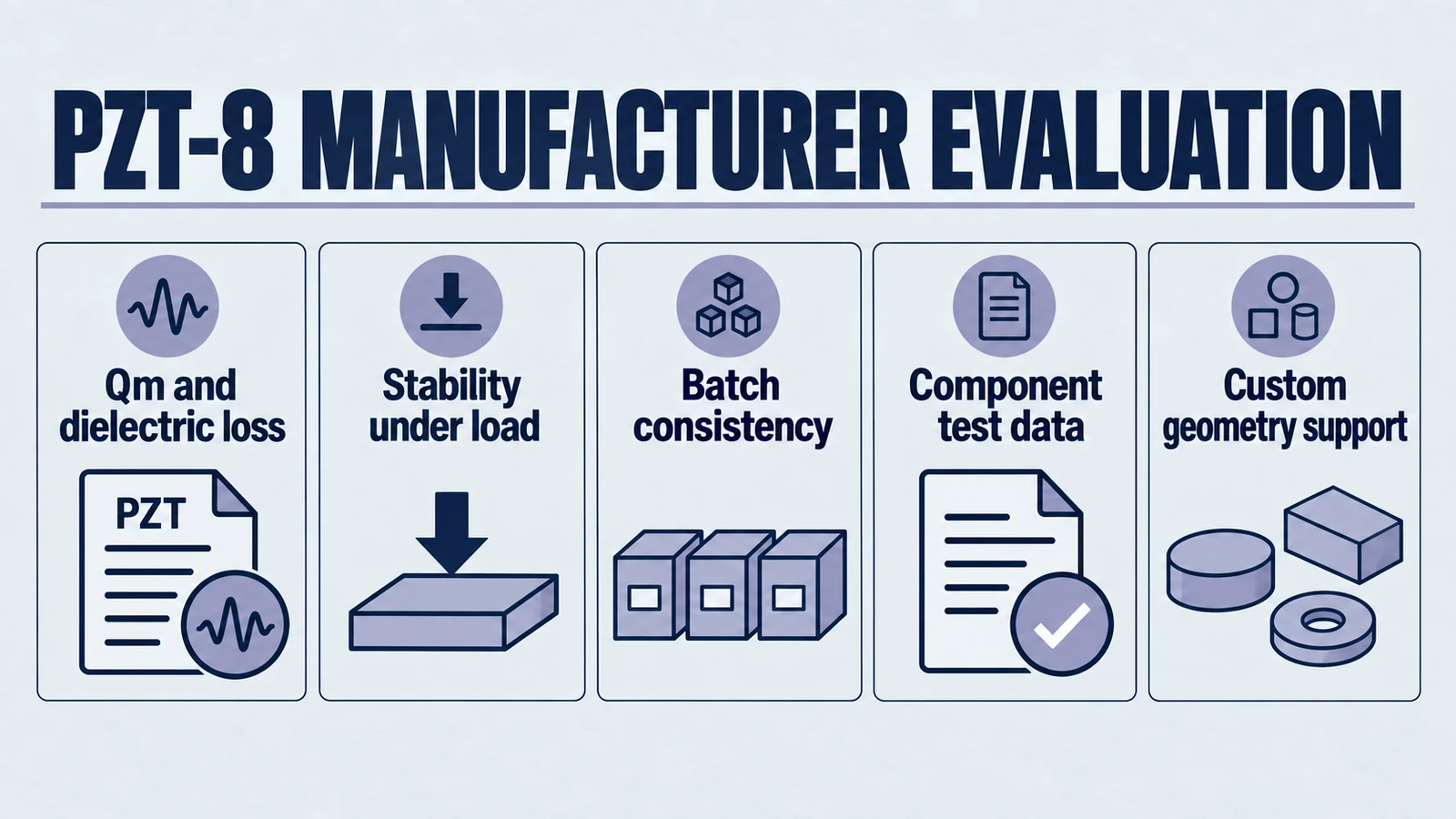
Batch-to-batch consistency in key parameters like resonant frequency, capacitance, and Qₘ is a hallmark of a top-tier manufacturer and is essential for building reliable, interchangeable transducers.
What to Look for in a PZT-8 Manufacturer
Selecting a manufacturing partner should go beyond a simple price comparison. It requires an evaluation of their technical capabilities and quality systems.
- Material Science Expertise: A leading manufacturer possesses deep expertise in ceramic formulation. They can control the chemical composition, doping levels, and sintering processes to produce a highly dense, low-porosity ceramic with uniform grain structure—the microscopic foundation of superior macroscopic performance.
- Precision Manufacturing: PZT-8 components often come in complex shapes like rings, discs, and tubes, requiring tight dimensional tolerances for proper assembly and performance. The ability to execute this precision machining, along with applying high-quality, durable electrodes, is a critical capability.
- Rigorous Quality Control & Testing: A commitment to quality is demonstrated by rigorous testing protocols. Critical parameters should be verified against the agreed specification. The ability to provide comprehensive and self-consistent characterization data for each batch gives designers known, reliable parameters.
- Engineering and Application Support: The best suppliers act as technical partners. They have the engineering expertise to provide guidance on system-level challenges, such as optimizing preload, designing drive electronics, and troubleshooting performance issues—adding value far beyond the component itself.
The value of a superior manufacturer lies in risk reduction. It is the reduction of the risk of inconsistent performance, the risk of premature field failures, and the risk of production delays caused by out-of-spec components. When the PZT element is the heart of an expensive and critical piece of equipment like a focused ultrasound system or an industrial welder, investing in a component from a highly reputable manufacturer is an exercise in managing that risk.
Introducing Advanced P-81 Material and Custom Solutions
For high-power projects, we combine material review with ceramic processing and component-level manufacturing. Our P-81 material is a PZT-8-type option intended for applications that prioritize low loss and power handling; final suitability should be confirmed in the customer's operating conditions.
We can review custom PZT-8-type components in a range of shapes and sizes. Sample quantity, tooling, inspection, and production planning are confirmed against the drawing and forecast.
Conclusion: Partnering for High-Power Success
PZT-8 is a cornerstone material for many high-power ultrasonic designs. Its combination of high mechanical quality, low energy loss, and strong stability makes it a common choice for high-stress, resonant applications where performance and reliability are central requirements. From industrial manufacturing systems to validated focused ultrasound platforms, PZT-8 is one of the key material classes behind modern power ultrasonics.
However, the theoretical properties of this remarkable material can only be realized through expert manufacturing. The consistency of the ceramic powder, the precision of the machining, and the rigor of the quality control are what transform a chemical formula into a reliable, high-performance component. Choosing a manufacturer is not just a supply chain decision; it is a technical partnership that underpins the success of the final product.
For engineers exploring the potential of PZT-8 ceramics or those requiring custom actuator solutions, understanding the material's properties and applications is crucial for making informed design decisions.
Your high-power application demands a component that performs without compromise. Do not leave your system's reliability to chance. Contact our engineering team today to discuss your project requirements and discover how our P-81 ceramic and custom manufacturing solutions can provide a decisive competitive edge.
Related High-Power Material Guides
Engineering decision notes
PZT material and ceramic selection
Use this article when the choice is not just a shape, but a material tradeoff between sensitivity, loss, coupling, stability, and operating field. For "The Engineer's Guide to PZT-8: Choosing a High-Performance Hard Ceramic Manufacturer fo...", the practical value is in turning the topic into a measurable selection or sourcing decision.
YJ Piezo coordinates PZT ceramic projects with manufacturing support, so material formulation, sintering, polarization, electrode process, and outgoing inspection can be reviewed against the final application.
Selection checks
- Separate sensing needs from high-power actuation needs before comparing d33 or coupling values.
- Check dielectric loss, Qm, Curie temperature, aging behavior, and operating field against the real duty cycle.
- Confirm whether the application needs standard PZT grades or a custom formulation and geometry.
Failure risks
- Choosing only the highest d33 can create heat, drift, or depolarization risk in power ultrasonics.
- A ceramic that performs well in free measurement can fail once bonded, clamped, or loaded.
- Material substitutions without batch testing can change capacitance, resonance, and system tuning.
RFQ details
- Is the part used for sensing, actuation, atomization, cleaning, welding, or measurement?
- What field strength, temperature, duty cycle, and mechanical load will the ceramic see?
- Which values must be controlled: d33, capacitance, resonance, impedance, Qm, or dimensional tolerance?
Relevant YJ Piezo pages
- PZT Material Hub
Material grades and application tradeoffs
- Piezoelectric Ceramics
Shapes and ceramic manufacturing options
- PZT Material Supplier Hub
Material control, grade selection, and sourcing support
Application FAQ
- Is the highest d33 always the best PZT choice?
- No. High d33 can be useful for sensitivity, but high-power ultrasonic systems often need lower loss, higher Qm, better thermal stability, and safer operation under field and stress.
- What makes PZT material selection different from catalog buying?
- The right PZT choice depends on geometry, load, drive field, duty cycle, temperature, and inspection targets. A catalog value is only useful when it is tied to the final assembly conditions.