
The Engineer's Definitive Guide to Piezoelectric Discs: PZT Fundamentals, Applications, and Selection
For a purchasing enquiry, use the PZT ceramic RFQ template to send disc dimensions, quantity and the material or electrode requirements you already know.
Introduction: The Unseen Engine of Modern Technology
In the heart of countless advanced technologies, from medical ultrasound systems to the ultra-precise fuel injectors in modern engines, lies a component that is both powerful and often invisible: the piezoelectric disc. These unassuming ceramic elements are the workhorses of electromechanical conversion, silently enabling innovations that define our world. They generate the sparks for gas grill igniters, create the ultrasonic waves for industrial cleaning, and provide the delicate haptic feedback in our smart devices.
For the design engineer, however, this versatility presents a significant challenge. Selecting the right piezoelectric disc from a vast catalog of materials, geometries, and performance specifications is a critical design decision. An incorrect choice can lead to suboptimal performance, component failure, or unnecessary costs, directly impacting the success of a project. The path from concept to a reliable, high-performance product hinges on a deep understanding of these remarkable components.
Product path for this search intent
Match the article topic to the right YJ Piezo product page
Use this article when the choice is not just a shape, but a material tradeoff between sensitivity, loss, coupling, stability, and operating field. For "The Engineer's Definitive Guide to Piezoelectric Discs: PZT Fundamentals, Applications,...", the practical value is in turning the topic into a measurable selection or sourcing decision.
- PZT Material Hub
Material grades and application tradeoffs
- Piezoelectric Ceramics
Shapes and ceramic manufacturing options
- PZT Material Supplier Hub
Material control, grade selection, and sourcing support
A piezoelectric disc is a precisely formulated ceramic component that operates on the principles of the piezoelectric effect. In its most basic sense, it is a solid-state converter. It can transform mechanical energy, such as pressure or vibration, into a measurable electrical signal, functioning as a highly sensitive sensor. Conversely, when an electrical signal is applied, it converts that energy into precise mechanical displacement, functioning as a fast and accurate actuator.
This guide serves as a practical resource for engineers navigating the complexities of piezoelectric technology. It will demystify the fundamental science, explore the vast landscape of applications, and, most importantly, provide a clear, systematic blueprint for selecting a suitable piezoelectric disc for an engineering project. By moving from core principles to practical selection criteria, this article will equip you with the knowledge to harness the full potential of these powerful components.
The Science Inside: Understanding Piezoelectric Disc Fundamentals
To effectively select and implement a piezoelectric disc, an engineer must first grasp the core principles that govern its behavior. This foundational knowledge, spanning from fundamental physics to material science, is the key to unlocking its performance potential and avoiding common design pitfalls.
The Piezoelectric Effect: A Duality of Function
The term "piezo" is derived from the Greek word piezein, meaning to squeeze or press. Discovered in 1880 by brothers Jacques and Pierre Curie, the piezoelectric effect is a fundamental property of certain crystalline materials that exhibit a reversible, dual-mode relationship between their mechanical and electrical states.
The Direct Effect (Sensor Mode)
The direct piezoelectric effect is the generation of an electric charge in response to applied mechanical stress. When a piezoelectric disc is compressed, stretched, or vibrated, the mechanical force displaces the positive and negative charge centers within its crystal lattice structure. This separation of charge creates a potential difference, or voltage, across the disc's electrodes. The magnitude of this voltage is directly proportional to the applied stress. This principle is the foundation for all piezoelectric sensors, from simple contact microphones that convert sound vibrations into an electrical signal to sophisticated pressure sensors that monitor industrial processes with high fidelity.
The Inverse Effect (Actuator Mode)
The inverse piezoelectric effect is the reciprocal phenomenon: the material undergoes a physical deformation when an external electric field is applied. By applying a voltage across the disc's electrodes, the internal charge centers are forced to move, causing the entire crystal lattice to expand or contract. This displacement is incredibly precise, often on the order of nanometers, and occurs almost instantaneously. This behavior is the basis for all piezoelectric actuators, enabling applications that require fine motion control, such as micro-positioning stages in semiconductor manufacturing, fast-acting valves in fuel injection systems, and the generation of sound waves in buzzers and ultrasonic transducers.
Material Matters: Why PZT Dominates the Industry
While natural crystals like quartz exhibit the piezoelectric effect, their response is relatively weak. The modern era of piezoelectric applications was ushered in by the development of polycrystalline ferroelectric ceramics, with lead zirconate titanate, commonly represented as Pb(Zr,Ti)O3, or PZT, emerging as the industry standard. PZT offers a significantly stronger piezoelectric effect, can be manufactured into various shapes like discs, and its properties can be precisely tailored for specific applications, making it exceptionally versatile.
A key characteristic of PZT is that it is a ferroelectric material. In its raw, sintered ceramic state, the material is composed of numerous crystalline grains, each containing regions of aligned electric dipoles known as "domains." However, these domains are randomly oriented throughout the material, resulting in no net piezoelectric effect. To unlock its potential, the disc must undergo a critical manufacturing process called poling. During poling, the disc is heated to an elevated temperature while a strong, direct current (DC) electric field is applied across it. This process forces the randomly oriented domains to align as closely as possible with the electric field. After the material is cooled with the field still applied, this alignment is largely locked in, creating a permanent net polarization and imparting the material with its powerful piezoelectric properties.
Ferroelectric PZT has a Curie transition associated with loss of long-range ferroelectric order. Not every piezoelectric material is ferroelectric: quartz is a counterexample. Tc is not a safe assembly working temperature. Qualified repoling can recover some intact ceramics, but neither irreversible loss nor finished-device recovery is universal.
The Critical Divide: "Hard" PZT vs. "Soft" PZT
Perhaps the most fundamental decision an engineer will make at the material level is the choice between "hard" and "soft" PZT formulations. These categories do not refer to the material's physical hardness but to its behavior under electrical and mechanical loads. This choice is dictated entirely by the intended application and represents a fundamental trade-off between power handling and sensitivity.
Hard PZT (High-Power Applications)
Hard PZT materials are engineered for stability and endurance in high-power, continuous-duty, or resonant applications. They are characterized by a high mechanical quality factor (Qm), low dielectric loss (tanδ), a higher coercive field (making them resistant to depolarization), and excellent stability under high mechanical loads and strong electric drive fields. Their properties often make them the preferred choice for applications where large amounts of energy must be converted efficiently without significant heat generation.
Best For: High-power ultrasonic transducers (for cleaning, welding, and sonar), high-force actuators, and any device that operates continuously at or near its resonant frequency.
Industry Example: Our proprietary materials like P-81 (similar to standard PZT-8) and P-44 (similar to PZT-4) are prime examples of hard PZT. They are specifically engineered for minimal energy loss and maximum power handling capability, ensuring reliability in the most demanding industrial environments.
Soft PZT (High-Sensitivity Applications)
Soft PZT formulations commonly have higher d₃₃ and permittivity and lower mechanical Q than hard power formulations. Higher d₃₃ does not independently imply higher open-circuit voltage sensitivity, because g depends on d and permittivity. High-power suitability depends on exact-grade losses, drive, stress, cooling and complete-assembly validation; soft PZT does not inevitably overheat in every resonant application.
Best For: High-fidelity sensors (accelerometers, pressure sensors), receivers, low-power actuators for precision positioning, and medical imaging probes where the primary goal is to detect minute signals or achieve large displacements at relatively low drive voltages.
Industry Example: Our P-52 material (similar to PZT-5H) exemplifies a high-performance soft PZT, offering the exceptional sensitivity required for advanced medical diagnostic equipment and precision measurement instruments.
The choice between hard and soft PZT is not a matter of preference but a direct consequence of the application's physics. Attempting to use a soft PZT in a high-power ultrasonic cleaner requires validation of dielectric/mechanical losses, drive and cooling; class alone does not establish inevitable rapid failure. Conversely, a hydrophone’s receive response depends on the relevant g/d coefficients, stress combination, geometry and readout; hard PZT does not universally have lower g or inadequate sensitivity. This first choice sets the entire foundation for a successful design.
Demystifying Key Performance Parameters for Engineers
A piezoelectric disc's datasheet is filled with coefficients and parameters that can be daunting. However, a few key metrics tell the majority of the story and directly translate into practical performance characteristics.
Piezoelectric Charge Coefficient (d₃₃): In the linear converse effect, d₃₃ relates longitudinal strain to electric field. Strain is dimensionless; displacement has units of length. For an ideal uniform, unloaded single layer along the applied field, thickness change is approximately d₃₃ times voltage. Mechanical restraint, geometry, loading and nonlinearity must be included outside this idealization.
Piezoelectric Voltage Coefficient (g₃₃): g₃₃ characterizes the open-circuit longitudinal electric-field response to specified stress. Receive output also depends on geometry, dielectric properties, stress combination and readout. A charge amplifier and a voltage readout need different response models; hydrostatic response may involve g₃₃ plus twice g₃₁ for a transversely isotropic ceramic. g₃₃ is not universally the governing coefficient for every sensor or hydrophone.
Electromechanical Coupling Factor (k): This parameter is a measure of the material's effectiveness in converting energy between mechanical and electrical forms. It is not an efficiency rating but rather the square root of the ratio of stored mechanical energy to absorbed electrical energy (or vice versa). A higher k value indicates a more effective conversion process. Common mode-specific coefficients include kp for planar/radial vibration of a thin disc, kt for thickness vibration of a thin plate or disc, and k₃₃ for longitudinal vibration of a slender rod. These coefficients are not interchangeable.
Mechanical Quality Factor (Qm): This dimensionless number represents the degree of mechanical damping in the material when it vibrates. A high Qm signifies very low mechanical loss, meaning the disc can vibrate at its resonant frequency with minimal energy dissipation as heat. This is absolutely essential for high-power resonant devices like ultrasonic transducers, where a low Qm would lead to overheating and failure. Hard PZT materials have Qm values that can be more than ten times higher than those of soft PZT.
Dielectric Loss (tanδ): This parameter measures the inherent electrical inefficiency of the material, representing the energy that is converted into heat when an alternating current (AC) electric field is applied. A low dielectric loss is crucial for any application involving high-frequency or high-voltage AC drive signals to prevent thermal runaway. Hard PZT materials are specifically formulated to have very low dielectric loss.
A World of Applications: Where Piezoelectric Discs Excel
The unique dual functionality of piezoelectric discs has enabled their integration into an astonishingly broad range of applications across nearly every major industry. By organizing these uses by their primary function—sensing, actuating, or transducing—we can clearly see how the material principles discussed previously translate into real-world performance.
As High-Fidelity Sensors: Detecting the Imperceptible
In sensor mode, piezoelectric discs leverage the direct effect to convert physical phenomena into clean electrical signals. This function almost exclusively utilizes soft PZT materials, which are optimized for high sensitivity (g₃₃) to detect even the most minute changes.
Pressure and Force Sensors: The linear relationship between applied stress and output voltage makes piezo discs ideal for dynamic pressure measurement. They are used in industrial process control, high-precision load cells, and even as triggers in modern electronic drum kits.
Accelerometers and Vibration Sensors: By bonding a small seismic mass to a piezoelectric disc, a device is created that generates a charge proportional to acceleration. This principle is used in automotive engine knock sensors to detect harmful detonation, in industrial machinery for predictive maintenance, and in civil engineering for structural health monitoring of bridges and buildings.
Acoustic Sensors and Hydrophones: Piezo discs serve as robust and sensitive contact microphones. In industrial non-destructive testing (NDT), they "listen" for the acoustic emissions of cracks propagating within a material. In marine applications, they are the core components of hydrophones used in sonar systems for underwater navigation and object detection.
Ultrasonic Flow and Level Sensing: A key industrial application involves using a pair of discs for non-invasive fluid measurement. One disc emits a short ultrasonic pulse through a pipe or tank wall, and a second disc (or the same one) detects the echo. Pulse-echo timing can support level measurement; transit-time flow uses upstream/downstream travel-time differences, and Doppler flow uses frequency shift. Geometry, medium, sound speed and calibration determine the result; one generic echo time does not establish every flow measurement.
As High-Precision Actuators: Motion at the Nanoscale
As actuators, piezoelectric discs use the inverse effect to create motion with very high precision and speed. The choice between soft and hard PZT depends on the specific requirements for displacement, force, and frequency.
Micro-positioning Systems: The ability to control displacement with nanometer-level resolution makes piezo actuators important in high-tech fields. They are used for the fine alignment of mirrors and lenses in optical systems, for sample positioning in scanning probe microscopes, and for wafer handling in semiconductor fabrication. For applications prioritizing maximum travel for a given voltage, high-d₃₃ soft PZT is often preferred.
Fast-Response Valves: In applications like common-rail diesel fuel injectors, piezo stack actuators can open and close valves in microseconds. This speed allows for multiple, precisely timed injections per combustion cycle, dramatically improving efficiency and reducing emissions—a capability also achieved by specific solenoid injectors; Bosch documents multiple injections per cycle. Compare actual timing, pressure, packaging and energy rather than claiming exclusivity. These high-load, high-frequency applications typically require the durability of hard PZT.
Piezoelectric Motors: These innovative motors generate motion through high-frequency vibrations. Ultrasonic motors use these vibrations to drive a rotor or linear slider, offering silent, high-torque operation. They are particularly valuable in environments with strong magnetic fields, such as inside MRI machines, subject to complete-system MR safety/image compatibility assessment; actuation principle alone does not establish suitability.
Haptic Feedback: In premium consumer electronics, thin piezoelectric discs are used to generate crisp, localized tactile feedback. When a user touches a specific area of a screen or trackpad, a precise voltage pulse is applied to the disc, creating a distinct "click" sensation that enhances the user interface.
As High-Power Transducers: Shaping the Physical World
When driven at resonance, piezoelectric discs become powerful transducers, capable of converting electrical energy into intense mechanical vibrations. This domain is the exclusive territory of hard PZT materials, which are designed with the high Qm and low tanδ necessary to handle high power levels efficiently and without self-destruction.
Ultrasonic Cleaning: High-power transducers made from hard PZT discs are bonded to the bottom of a stainless-steel tank. When driven at frequencies typically between 20 kHz and 200 kHz, they cause the tank to vibrate intensely, creating millions of microscopic cavitation bubbles in the cleaning solvent. The implosion of these bubbles generates powerful micro-jets that scrub contaminants from the surfaces of submerged parts.
Ultrasonic Welding: In this industrial process, high-intensity ultrasonic vibrations are focused at the interface between two plastic parts. The vibrations generate intense friction and localized heating, melting the plastic and fusing the parts together in a fraction of a second without the need for adhesives or solvents.
Medical and Aesthetic Devices: Piezoelectric transducers are used in medical ultrasound technology. In diagnostics, they generate the sound waves used for imaging. In validated device-level systems, they can support ultrasound equipment workflows, with final safety and performance determined by the complete device design and regulatory pathway. They are also widely used in aesthetic devices where controlled vibration and acoustic output are required.
Atomization and Nebulization: When a piezoelectric disc vibrates at a high frequency (often over 1 MHz), it can atomize a liquid placed on its surface into a fine, cool mist. This principle is used in nebulizer device designs, consumer humidifiers, and advanced industrial spray-coating systems, with medical delivery performance validated at finished-device level.
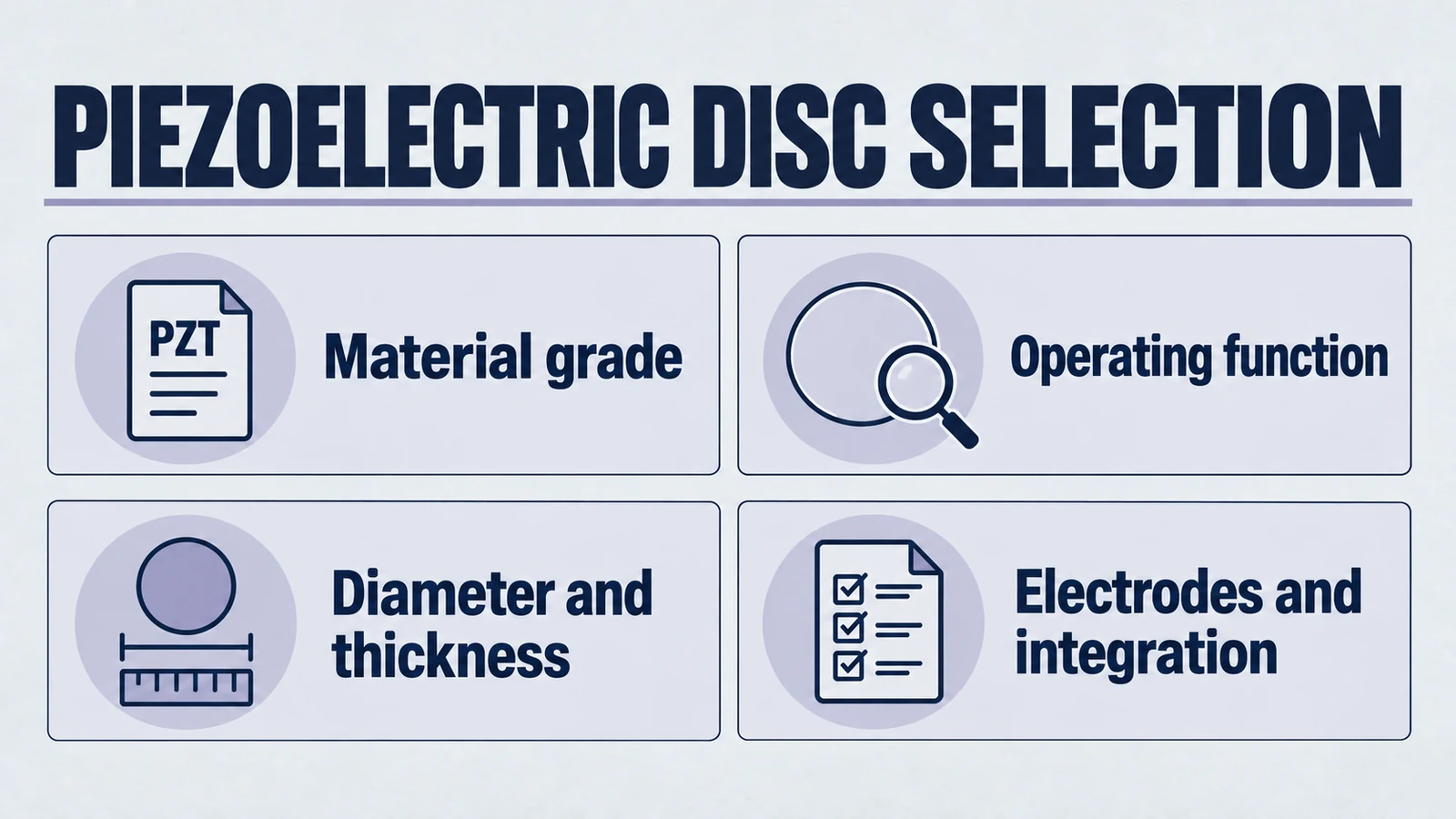
The Engineer's Selection Blueprint: A Systematic Approach to Choosing the Optimal Piezoelectric Disc
With a firm grasp of the fundamentals and applications, the engineer can now approach the selection process systematically. This four-step blueprint provides a structured framework for translating high-level project requirements into a specific component choice, ensuring that the selected disc is perfectly matched to the design's demands.
Step 1: Define the Primary Function and Operating Mode
The first and most critical step is to classify the application's primary function. This single decision will guide all subsequent material and parameter choices.
Is the primary goal Sensing? If the disc's main purpose is to detect a physical change (pressure, vibration, sound) and convert it into a voltage, the application is sensing. This immediately points the selection toward Soft PZT materials (like our P-52), which are optimized for high sensitivity and voltage generation.
Is the primary goal Actuation? If the disc needs to produce controlled motion, the application is actuation. A further distinction is needed: Is it a low-frequency, high-displacement task (e.g., a precision positioner) that favors the high d₃₃ of Soft PZT? Or is it a high-frequency, high-load, or continuous-duty task (e.g., a fast valve) that requires the durability and thermal stability of Hard PZT?
Is the primary goal Resonant Power Transmission? If the disc will be driven continuously at its resonant frequency to deliver high acoustic power (e.g., an ultrasonic cleaner, welder, or sonar projector), the choice is unequivocal. The application demands high efficiency and low heat generation, which mandates the use of Hard PZT materials (like our P-81).
Step 2: Decode the Datasheet - Matching Key Parameters to Your Design
Once the material category (Hard or Soft PZT) is determined, the next step is to drill down into the specific performance parameters on the datasheet. Understanding these parameters is crucial for making an informed selection of your piezoelectric disc.
Step 3: Align Physical and Electrical Specifications
With the material and key performance parameters defined, the focus shifts to the physical geometry of the disc and its interaction with the drive electronics. These are not independent variables; they are deeply interconnected.
Dimensions (Diameter and Thickness): The physical dimensions of the disc are the primary determinants of its resonant frequencies. For a disc operating in thickness mode (vibrating along its polarization axis), the resonant frequency is inversely proportional to its thickness. For radial mode resonance, the frequency is inversely proportional to its diameter. Engineers can therefore "tune" a component to a specific frequency by precisely controlling its dimensions.
Beam Width and Divergence: The choice of diameter has a profound, second-order effect on the entire system design, particularly in ultrasonic applications. For a given frequency, a smaller diameter disc produces a wider acoustic beam, while a larger diameter disc produces a narrower, more focused beam. This creates a critical system-level trade-off that affects resolution, coverage, component efficiency, and the cost of supporting electronics.
Drive Voltage and Impedance: A piezoelectric disc behaves electrically as a capacitor. Away from significant resonances, a capacitive approximation gives sinusoidal current proportional to frequency, capacitance and voltage. Near resonance include the full loaded motional/electrical impedance. Soft PZT materials have a much higher dielectric constant, and thus higher capacitance for a given geometry, meaning they will demand more current from the drive amplifier than a hard PZT disc of the same size.
Step 4: Evaluate Customization and Integration Needs
Finally, the engineer must consider whether a standard, off-the-shelf component is sufficient or if the application demands a custom solution.
Standard vs. Custom: For many prototyping and general-purpose applications, a standard disc with a common material formulation and size is a cost-effective choice. However, for high-volume OEM products or applications with unique performance constraints, a custom solution is often necessary to achieve optimal results.
Customization Vectors: Collaboration with an experienced manufacturer can unlock a wide range of customizations. These include:
- Specific Dimensions: Machining to non-standard diameters and thicknesses to achieve a precise resonant frequency.
- Electrode Patterns: Custom metallization, such as wrap-around electrodes, can simplify electrical connections in tight assemblies.
- Material Formulations: Developing a custom PZT composition to meet specific requirements for temperature stability, sensitivity, or power handling.
- Assemblies: Providing discs with pre-attached lead wires or integrated into protective housings to simplify manufacturing and improve reliability.
This is the stage where the value of a true OEM partnership becomes clear. Working with a specialized manufacturer provides access not just to components, but to a team of engineers who can assist in designing, prototyping, and scaling a custom solution. This collaborative approach can significantly de-risk a project and accelerate the time to market, transforming a component supplier into a critical engineering partner.
Conclusion: Partnering for Success in Your Piezoelectric Application
The selection of a piezoelectric disc is a multi-faceted engineering decision that extends far beyond a simple component choice. It requires a foundational understanding of the piezoelectric effect, a clear-eyed assessment of the critical trade-offs between hard and soft PZT materials, and a systematic process for aligning component parameters with the application's ultimate goal. The journey from a datasheet to a successful, reliable product is paved with these critical considerations.
The key takeaways are clear: the dual nature of the piezoelectric effect enables both sensing and actuation; the distinction between high-power "hard" PZT and high-sensitivity "soft" PZT is the most important initial decision; and a successful design requires a holistic approach that matches material properties, physical geometry, and electrical drive characteristics to the specific demands of the application.
For longer ranges and tank monitoring, review the SR55 ultrasonic sensor and the UltraNova1 / UltraNova2 series.
Partnering with a supplier that can connect material selection, manufacturing, and application review offers distinct advantages:
- Material Expertise: Review PZT options such as P-52 and P-81 against the application's sensitivity, loss, temperature, and power requirements.
- Manufacturing Coordination: Match geometry, tolerance, tooling, inspection, and quantity to the actual drawing and forecast instead of relying on one general capacity figure.
- OEM Engineering Support: Coordinate component selection, samples, production planning, and integration feedback as the project develops.
PZT Discs: Quotes & Volume Pricing
Catalog models are examples. We also make common ceramic shapes in the dimensions you need. For simple shapes, send dimensions and quantity; no drawing is needed to start an enquiry.
Ask for volume pricing on larger orders or annual requirements. Samples, custom designs and development enquiries are welcome too.
Engineering decision notes
PZT material and ceramic selection
Use this article when the choice is not just a shape, but a material tradeoff between sensitivity, loss, coupling, stability, and operating field. For "The Engineer's Definitive Guide to Piezoelectric Discs: PZT Fundamentals, Applications,...", the practical value is in turning the topic into a measurable selection or sourcing decision.
YJ Piezo coordinates PZT ceramic projects with manufacturing support, so material formulation, sintering, polarization, electrode process, and outgoing inspection can be reviewed against the final application.
Selection checks
- Separate sensing needs from high-power actuation needs before comparing d33 or coupling values.
- Check dielectric loss, Qm, Curie temperature, aging behavior, and operating field against the real duty cycle.
- Confirm whether the application needs standard PZT grades or a custom formulation and geometry.
Failure risks
- Choosing only the highest d33 can create heat, drift, or depolarization risk in power ultrasonics.
- A ceramic that performs well in free measurement can fail once bonded, clamped, or loaded.
- Material substitutions without batch testing can change capacitance, resonance, and system tuning.
RFQ details
- Is the part used for sensing, actuation, atomization, cleaning, welding, or measurement?
- What field strength, temperature, duty cycle, and mechanical load will the ceramic see?
- Which values must be controlled: d33, capacitance, resonance, impedance, Qm, or dimensional tolerance?
Relevant YJ Piezo pages
- PZT Material Hub
Material grades and application tradeoffs
- Piezoelectric Ceramics
Shapes and ceramic manufacturing options
- PZT Material Supplier Hub
Material control, grade selection, and sourcing support
Application FAQ
- Is the highest d33 always the best PZT choice?
- No. High d33 can be useful for sensitivity, but high-power ultrasonic systems often need lower loss, higher Qm, better thermal stability, and safer operation under field and stress.
- What makes PZT material selection different from catalog buying?
- The right PZT choice depends on geometry, load, drive field, duty cycle, temperature, and inspection targets. A catalog value is only useful when it is tied to the final assembly conditions.