
High-Power Ultrasonics: Why High Qₘ and Low Loss Matter in PZT-8 Design
Executive Summary
The engineering landscape of high-power ultrasonics and precision actuation relies on converting electrical energy into mechanical vibration with high efficiency and controlled heat buildup. In this demanding environment, Lead Zirconate Titanate (PZT) ceramics—specifically the acceptor-doped formulation known as PZT-8 or Navy Type III—are commonly selected for resonant applications. This technical guide helps engineers, researchers, and procurement specialists understand the material mechanisms, performance metrics, and application-specific advantages of PZT-8 ceramics manufactured by Yujie Technology.
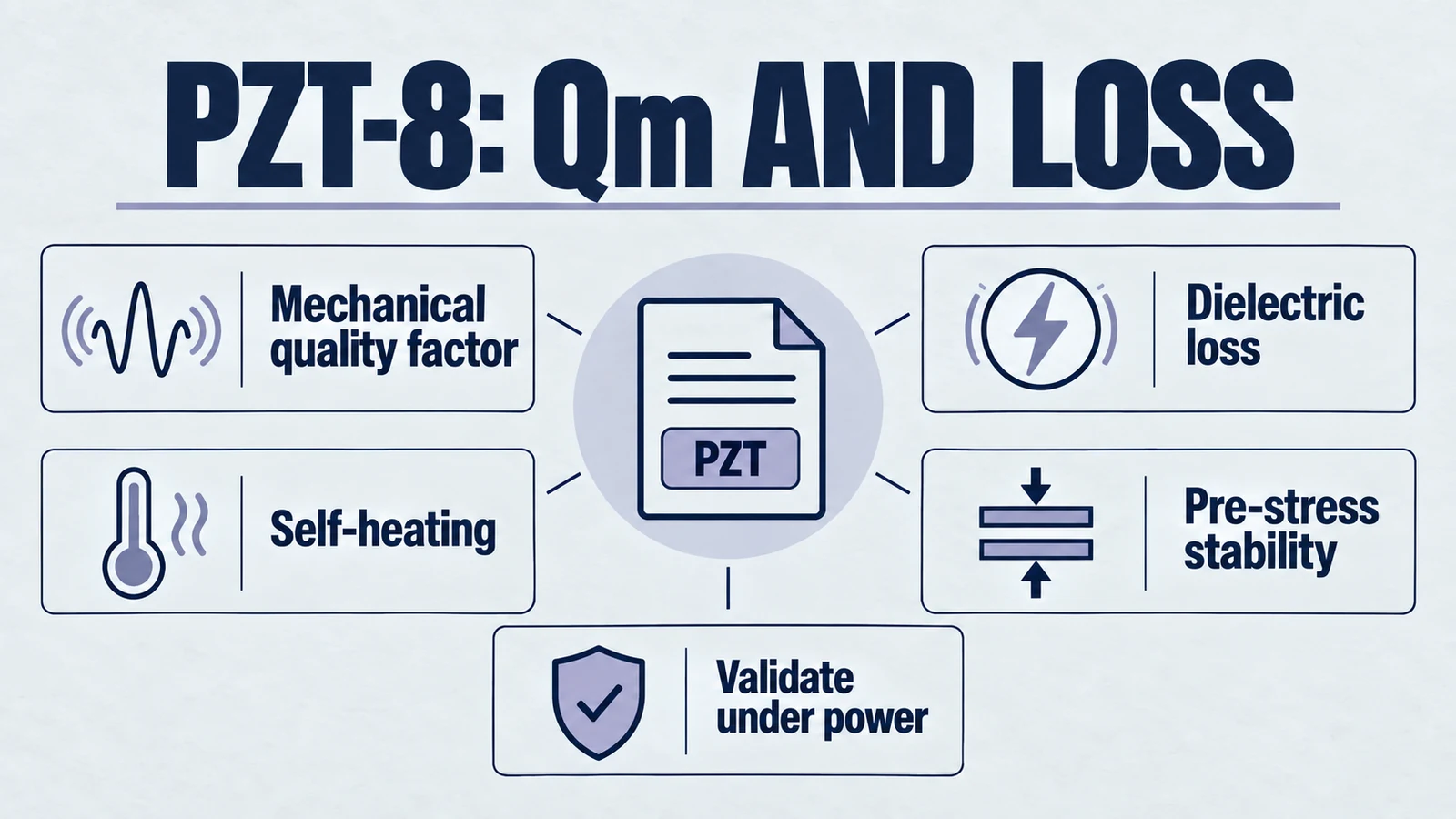
PZT-8 is distinguished by its "hard" ferroelectric characteristics, specifically its high mechanical quality factor (Qₘ), stability under high mechanical preload, and low dielectric loss (tan δ). These properties make it suitable for applications where continuous high-power operation is required, such as ultrasonic welding, industrial cleaning, and validated surgical-device transducer programs. Unlike "soft" piezoceramics (e.g., PZT-5A/H), which excel in sensing due to high sensitivity but can be more sensitive to thermal drift, PZT-8 is engineered to handle the thermal and mechanical stresses of active power generation.
This analysis explores the crystallographic origins of PZT-8's "hardness," provides a granular comparison against industry alternatives like PZT-4, and details the operational considerations for designing transducers that leverage Yujie Technology’s advanced PZT formulations.
Product path for this search intent
Match the article topic to the right YJ Piezo product page
Use this article when the choice is not just a shape, but a material tradeoff between sensitivity, loss, coupling, stability, and operating field. For "High-Power Ultrasonics: Why High Qₘ and Low Loss Matter in PZT-8 Design", the practical value is in turning the topic into a measurable selection or sourcing decision.
- PZT Material Hub
Material grades and application tradeoffs
- Piezoelectric Ceramics
Shapes and ceramic manufacturing options
- PZT Material Supplier Hub
Material control, grade selection, and sourcing support
1. Fundamentals of Piezoelectric Ceramics
To fully appreciate the performance characteristics of PZT-8, it is essential to establish a deep understanding of the underlying materials science of ferroelectric ceramics. Lead Zirconate Titanate is a solid solution that crystallizes in the perovskite structure (ABO₃). The remarkable piezoelectric properties of PZT arise from the morphotropic phase boundary (MPB), where the polarizability of the lattice is maximized, allowing for enhanced electromechanical coupling.
1.1 "Hard" vs. "Soft" Piezoceramics: The Doping Mechanism
The classification of PZT into "Hard" (e.g., PZT-4, PZT-8) and "Soft" (e.g., PZT-5A, PZT-5H) categories is a description of ferroelectric domain mobility, chemically engineered through doping.
Soft PZT (Donor Doping)
Soft piezoceramics (Navy Type II, VI) are created by doping with "donor" ions. These materials are characterized by high permittivity and high piezoelectric charge constants (d₃₃), making them ideal for sensors and hydrophones. However, their high internal friction leads to significant dielectric loss (tan δ) and heat generation under high drive, making them unsuitable for power applications.
Hard PZT (Acceptor Doping)
PZT-8 is the archetypal "hard" piezoceramic (Navy Type III). It is created by doping with "acceptor" ions (such as Fe³⁺). These dopants create oxygen vacancies that form defect dipoles, which effectively "pin" the domain walls.
- Pinning Effect: This pinning restricts domain wall motion, which minimizes the internal friction associated with polarization switching.
- Result: This leads to the defining characteristics of PZT-8: reduced hysteresis, extremely low dielectric loss, and a high mechanical quality factor (Qₘ).
2. Technical Specifications of PZT-8 (Navy Type III)
Yujie Technology’s PZT-8 materials are chemically and structurally engineered to meet or exceed the rigorous standards defined for Navy Type III piezoceramics.
2.1 Mechanical Quality Factor (Qₘ): The Efficiency Metric
The Mechanical Quality Factor (Qₘ) is the most critical figure of merit for high-power ultrasonics. It represents the inverse of mechanical loss; a higher Qₘ indicates lower energy dissipation per cycle of vibration.
- Operational Impact: A high Qₘ allows the system to achieve high-amplitude displacements with significantly less input power and heat generation.
- Yujie PZT-8 Performance: Yujie’s PZT-8 typically exhibits a Qₘ between 800 and 1200. In contrast, soft PZT-5 materials often have Qₘ values below 100, and standard PZT-4 materials range from 500–600.
2.2 Dielectric Loss Factor (tan δ): The Thermal Gatekeeper
Dielectric loss represents electrical energy dissipated as heat. For continuous-wave applications (like ultrasonic cleaning), minimizing this loss is paramount to preventing thermal runaway.
- High Field Performance: A unique property of PZT-8 is its stability under high drive. While the loss tangent of PZT-4 rises as the electric field increases, PZT-8 maintains a low loss factor even at high drive fields.
- Specifications: Yujie’s PZT-8 demonstrates a dissipation factor (tan δ) of ≤ 0.003 at low fields.
2.3 Elastic Constants and Stiffness
PZT-8 is physically stiffer than soft PZT formulations.
- Wave Speed and Frequency Constant: Use cL for longitudinal wave speed with the propagation mode and electrical boundary condition specified. A frequency constant is measured resonance frequency times the governing length. For an ideal fundamental half-wave rod fL≈cL/2; equal units do not make the two values interchangeable. Request exact-grade measured values.
- Stiffness: The high elastic modulus (Y₃₃ᴱ) ensures efficient energy transfer into high-impedance loads like metals or liquids.
Table 1: Typical Properties of Yujie PZT-8 vs. Industry Standards
| Property | Symbol | Unit | Yujie PZT-8 (Typical) | PZT-4 (Navy I) | PZT-5A (Navy II) |
|---|---|---|---|---|---|
| Material Class | - | - | Hard (High Power) | Hard (Mid Power) | Soft (Sensor) |
| Mech. Quality Factor | Qₘ | - | 1000 - 1200 | 500 - 600 | ~75 |
| Curie Temperature | Tᶜ | °C | 300 - 330 | 328 | 365 |
| Rel. Dielectric Constant | ε₃₃ᵀ/ε₀ | - | 1000 - 1300 | 1300 | 1700 |
| Piezo Charge Constant | d₃₃ | pC/N | 220 - 290 | 290 - 300 | 375 - 400 |
| Dielectric Loss | tan δ | % | ≤ 0.5 | 0.4 | 2.0 |
| Sound Velocity | cL (specified mode) | m/s | Confirm grade/mode | Confirm grade/mode | Confirm grade/mode |
Data aggregated from Yujie technical specifications.
Companion Guides for High-Power Material Selection
- Why High d33 Is Not Always Better in Power Ultrasonics
- PZT-8 Manufacturer Guide for Power Applications
- PZT Material Hub
3. Comparative Analysis: PZT-8 vs. PZT-4
Both PZT-4 (Navy Type I) and PZT-8 (Navy Type III) are "hard" ceramics, but they serve different operational niches.
3.1 The "High Power" Distinction
- PZT-4 (High Output): Offers a higher piezoelectric charge constant (d₃₃), producing more strain per volt. It is ideal for high-amplitude bursts or deep-water sonar where high power radiation is needed but continuous duty cycles are less common.
- PZT-8 (High Stability): Offers significantly higher Qₘ and lower dielectric loss. It is superior for continuous-wave (CW) applications because it runs cooler and offers better frequency stability.
3.2 Thermal Stability Case Study
The cited PZT-4/PZT-8 wire-bonding study concerns specified transducer designs and preload conditions. Assembly and interface losses materially affected performance; it does not establish that every PZT-8 device runs cooler or every PZT-4 device heats rapidly. Compare loaded output, losses and temperature at the intended drive and preload.
3.3 Pre-Stress Stability
High-power transducers (Langevin stacks) require high compressive pre-stress (30–50 MPa) to prevent tensile failure.
- PZT-8 Advantage: PZT-8 is "harder" structurally and maintains its piezoelectric properties (like d₃₃ and coupling factors) more effectively under high preload compared to PZT-4. At high preloads (e.g., 40-90 MPa), PZT-8 often outperforms PZT-4 in stability.
4. Engineering Design Guidelines for PZT-8 Transducers
4.1 The Langevin Bolted-Stack
The standard configuration involves sandwiching PZT-8 rings between a steel back mass and a titanium/aluminum front mass, held together by a high-tensile bolt.
- Pre-Stress: For Yujie PZT-8, a preload of 35-45 MPa is recommended. The "pinned" domain structure allows PZT-8 to withstand this force without depoling, enabling higher power densities.
4.2 Thermal Management
While PZT-8 has low loss, the nodal point of a stack can still generate heat.
- Curie Temperature: Yujie PZT-8 has a Tᶜ of ~300°C. The allowable operating temperature is typically limited to ~150°C (half of Tᶜ) to prevent accelerated aging.
- Heat Sinking: In continuous applications (like industrial cleaning), the front mass must effectively dissipate heat into the liquid load.
5. Key Applications of Yujie PZT-8 Ceramics
5.1 Ultrasonic Welding
Ultrasonic welding requires the transducer to maintain oscillation amplitude under heavy, variable loads. PZT-8's high stiffness and Qₘ ensure the system does not "damp out" when the horn contacts the plastic or metal part, ensuring consistent weld quality. For more on our capabilities, visit our welding transducer section.
5.2 Precision Ultrasonic Cleaning
Industrial cleaning tanks run for hours at a time. PZT-8 is the standard for these systems (from 28 kHz to megasonic frequencies) because its low dielectric loss prevents the transducers from overheating during long shifts.
5.3 Medical Ultrasonics: Phacoemulsification
One of the most critical applications is Phacoemulsification (cataract surgery).
- Safety: The handpiece must emulsify the eye's lens without generating excess heat that could burn the cornea.
- Material: PZT-8 is exclusively used here due to its high efficiency and low heat generation, ensuring finished-device risk control during the delicate procedure.
5.4 Emerging Application: Energy Storage
Recent research has utilized PZT-8 as an additive in Silicon-Carbon anodes for Lithium-Ion batteries. The piezoelectric effect of the PZT-8 particles buffers the mechanical stress of silicon expansion during charging, significantly improving the battery's cycle life and capacity retention.
6. Manufacturing Excellence at Yujie Technology
Yujie Technology employs advanced manufacturing techniques to ensure batch-to-batch consistency.
- Quality Control: Every batch of PZT-8 is tested not just at low voltage, but under high-power conditions to verify Qₘ and loss stability.
- Customization: Yujie provides PZT-8 in discs, rings, rectangular plates, tubes, and hollow spheres, with precise control over dimensions and electrode materials (Silver/Nickel). For guidance on selecting the right geometry for your application, see our geometry selection guide.
7. Conclusion
PZT-8 (Navy Type III) is a widely used "hard" piezoelectric ceramic for high-power ultrasonics. Its usefulness comes from crystallographic engineering that helps reduce loss and increase mechanical quality.
For Yujie Technology customers, PZT-8 offers:
- Efficiency: Reduced energy costs and amplifier requirements.
- Reliability: Extended lifespan even under continuous industrial use.
- Stability: Consistent performance in precision medical and industrial processes.
For detailed datasheets, application support, or to request samples of Yujie PZT-8, please visit our Materials Page or contact our engineering team directly.
8. Appendix: Yujie PZT-8 Typical Specifications
| Parameter | Symbol | Value |
|---|---|---|
| Rel. Dielectric Constant | Kᵀ | 1000 - 1300 |
| Dielectric Loss | tan δ | < 0.5% |
| Coupling Coefficient (Thickness) | kₜ | ~0.45 - 0.50 |
| Coupling Coefficient (Longitudinal) | k₃₃ | ~0.60 - 0.68 |
| Piezo Constant (Charge) | d₃₃ | 220 - 290 pC/N |
| Mechanical Q Factor | Qₘ | 1000 - 1200 |
| Density | ρ | 7.6 g/cm³ |
| Curie Temperature | Tᶜ | 300 - 335 °C |
Engineering decision notes
PZT material and ceramic selection
Use this article when the choice is not just a shape, but a material tradeoff between sensitivity, loss, coupling, stability, and operating field. For "High-Power Ultrasonics: Why High Qₘ and Low Loss Matter in PZT-8 Design", the practical value is in turning the topic into a measurable selection or sourcing decision.
YJ Piezo coordinates PZT ceramic projects with manufacturing support, so material formulation, sintering, polarization, electrode process, and outgoing inspection can be reviewed against the final application.
Selection checks
- Separate sensing needs from high-power actuation needs before comparing d33 or coupling values.
- Check dielectric loss, Qm, Curie temperature, aging behavior, and operating field against the real duty cycle.
- Confirm whether the application needs standard PZT grades or a custom formulation and geometry.
Failure risks
- Choosing only the highest d33 can create heat, drift, or depolarization risk in power ultrasonics.
- A ceramic that performs well in free measurement can fail once bonded, clamped, or loaded.
- Material substitutions without batch testing can change capacitance, resonance, and system tuning.
RFQ details
- Is the part used for sensing, actuation, atomization, cleaning, welding, or measurement?
- What field strength, temperature, duty cycle, and mechanical load will the ceramic see?
- Which values must be controlled: d33, capacitance, resonance, impedance, Qm, or dimensional tolerance?
Relevant YJ Piezo pages
- PZT Material Hub
Material grades and application tradeoffs
- Piezoelectric Ceramics
Shapes and ceramic manufacturing options
- PZT Material Supplier Hub
Material control, grade selection, and sourcing support
Application FAQ
- Is the highest d33 always the best PZT choice?
- No. High d33 can be useful for sensitivity, but high-power ultrasonic systems often need lower loss, higher Qm, better thermal stability, and safer operation under field and stress.
- What makes PZT material selection different from catalog buying?
- The right PZT choice depends on geometry, load, drive field, duty cycle, temperature, and inspection targets. A catalog value is only useful when it is tied to the final assembly conditions.