
Complete Guide: How to Choose the Best Piezoelectric Ceramic Materials for Your Application
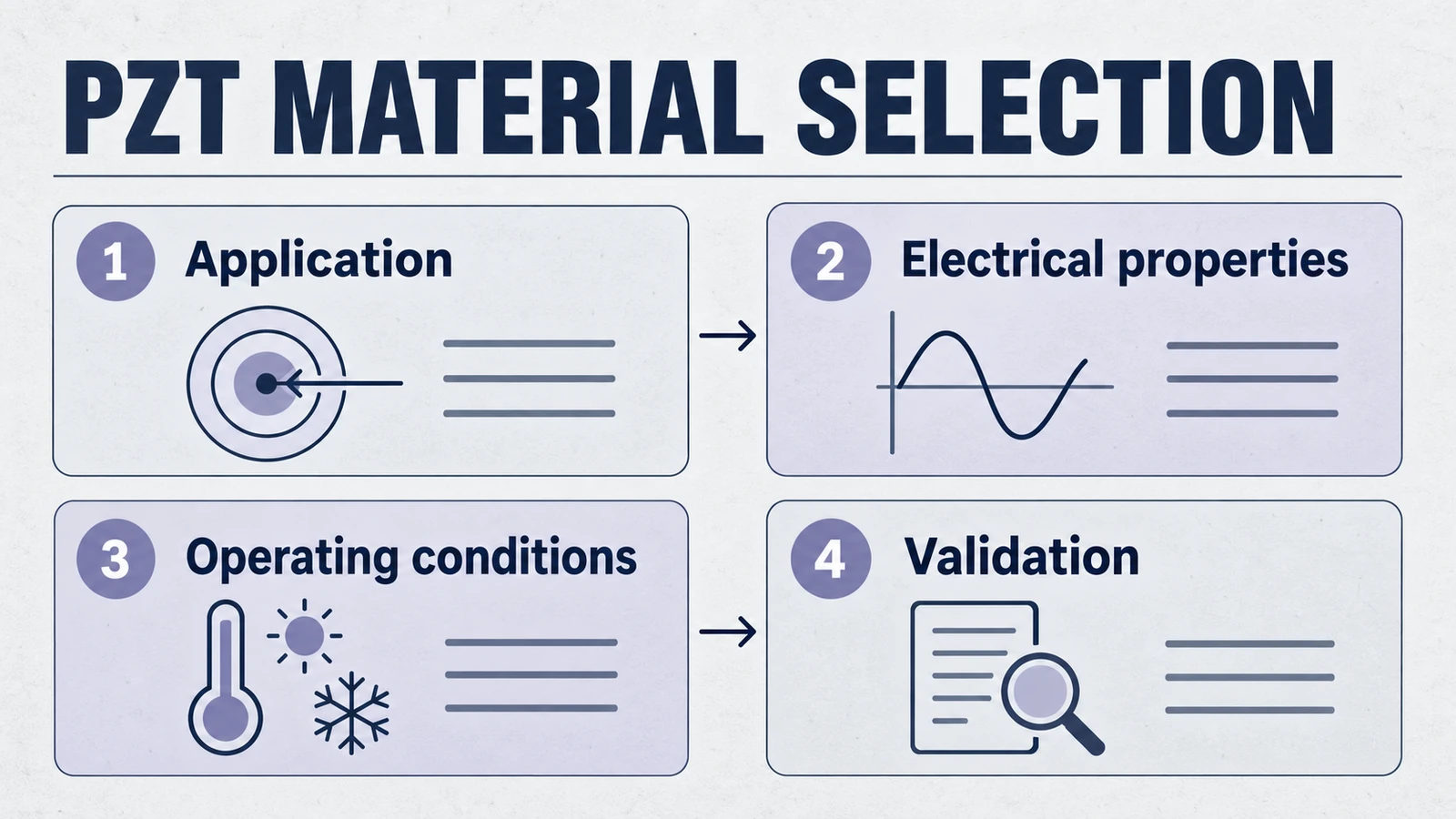
Choosing the right piezoelectric ceramic is essential to achieving optimal performance, reliability, and efficiency in your application. Piezoelectric ceramics convert mechanical stress into electrical energy and vice versa, making them critical components in ultrasonic transducers, actuators, sensors, and energy harvesting devices. Selecting the appropriate ceramic impacts system accuracy, lifespan, and overall functionality.
Understanding Piezoelectric Ceramics
Piezoelectric ceramics are specialized materials that generate electrical charges when mechanical pressure or stress is applied—known as the piezoelectric effect. The piezoelectric effect was discovered in crystals by the Curie brothers in 1880; engineered piezoelectric ceramics have since transformed numerous industrial applications by enabling precise energy conversion and control. Learn more about our material specifications and properties.
Key Factors to Consider When Choosing Piezoelectric Ceramics
Product path for this search intent
Match the article topic to the right YJ Piezo product page
Use this article when the choice is not just a shape, but a material tradeoff between sensitivity, loss, coupling, stability, and operating field. For "Complete Guide: How to Choose the Best Piezoelectric Ceramic Materials for Your Applica...", the practical value is in turning the topic into a measurable selection or sourcing decision.
- PZT Material Hub
Material grades and application tradeoffs
- Piezoelectric Ceramics
Shapes and ceramic manufacturing options
- PZT Material Supplier Hub
Material control, grade selection, and sourcing support
Material Composition
- PZT (Lead Zirconate Titanate): Widely used due to its excellent piezoelectric performance, versatility, and cost-effectiveness.
- Barium Titanate (BaTiO₃): Offers moderate performance, commonly used in capacitors and certain transducers.
- Lead-Free Piezoelectrics: Environmentally friendly alternatives, such as potassium sodium niobate (KNN), gaining attention due to regulatory demands.
Piezoelectric Coefficients (d33), (g31)
- The coefficient d33 relates longitudinal electric displacement to stress at constant electric field, or strain to field at constant stress. It is not assembled-device efficiency.
- g31 represents voltage sensitivity. Higher values indicate superior sensitivity for sensing applications.
Dielectric Properties (εr)
- Relative permittivity affects capacitance under specified electrical and mechanical conditions. It does not by itself determine conversion efficiency; a higher value can also increase required drive current and dielectric heating.
Mechanical Strength & Durability
- High mechanical strength ensures resistance to fractures and prolongs the operational life of ceramics under rigorous mechanical stress.
- Consider the mechanical stress environment when selecting materials for robust industrial use.
Resonant Frequency & Operating Range
- Match ceramics to your required resonant frequency and operational range to ensure maximum performance, especially crucial in ultrasonic applications.
Comparing Different Types of Piezoelectric Ceramics
High-Sensitivity vs. High-Power Ceramics
- Soft PZT: Ideal for high sensitivity and fine control, suitable for sensors and low-power actuators.
- Hard PZT: Commonly considered for low-loss high-drive applications; frequency alone does not require hard PZT, such as ultrasonic transducers and industrial actuators.
Applications in Different Industries
- Medical Devices: Ultrasonic imaging, precise actuators for surgical instruments.
- Industrial Sensing: Vibration monitoring sensors, pressure sensors in harsh environments.
- Energy Harvesting: Power generation from ambient vibrations, self-powered IoT devices.
- Aerospace & Defense: Precision navigation systems, robust sonar devices.
Comparison Table: Piezoelectric Ceramic Types
| Ceramic Type | Piezo Coefficient (d33) | Dielectric Constant (εr) | Mechanical Strength | Frequency Range |
|---|---|---|---|---|
| Soft PZT | High | High | Moderate | Geometry/mode-dependent |
| Hard PZT | Moderate | Moderate | High | Geometry/mode-dependent |
| BaTiO₃ | Moderate | High | Moderate | Low to Moderate |
| KNN (Lead-Free) | Moderate | Moderate | Moderate | Moderate |
Common Pitfalls and Mistakes in Piezoelectric Ceramic Selection
- Material Selection at High Frequency: Frequency alone does not require hard PZT. Select the grade from drive level, bandwidth, losses, geometry and load; soft grades are also used in high-frequency imaging.
- Ignoring Temperature Stability: Overlooking temperature-induced performance variations can lead to failures.
- Circuit Compatibility and Mechanical Constraints: Failing to ensure compatibility with existing electronic circuits and mechanical setups.
Future Trends in Piezoelectric Materials
- Lead-Free Alternatives: Driven by environmental regulations, lead-free materials are becoming more prevalent and advanced.
- Nanostructured Piezoelectrics: Enhanced performance and precision through nanotechnology.
- AI-Driven Material Optimization: Leveraging artificial intelligence for custom-designed, high-performance piezoelectric solutions.
Conclusion and Next Steps
Selecting the right piezoelectric ceramic significantly affects your application's performance, efficiency, and reliability. With a comprehensive understanding of key properties and application requirements, engineers and manufacturers can make informed choices. Explore our range of disc, ring, tube, and rectangular series to find the perfect match for your needs.
Need help selecting the right piezoelectric ceramic for your application? Contact us for expert recommendations and custom solutions.
Engineering decision notes
PZT material and ceramic selection
Use this article when the choice is not just a shape, but a material tradeoff between sensitivity, loss, coupling, stability, and operating field. For "Complete Guide: How to Choose the Best Piezoelectric Ceramic Materials for Your Applica...", the practical value is in turning the topic into a measurable selection or sourcing decision.
YJ Piezo coordinates PZT ceramic projects with manufacturing support, so material formulation, sintering, polarization, electrode process, and outgoing inspection can be reviewed against the final application.
Selection checks
- Separate sensing needs from high-power actuation needs before comparing d33 or coupling values.
- Check dielectric loss, Qm, Curie temperature, aging behavior, and operating field against the real duty cycle.
- Confirm whether the application needs standard PZT grades or a custom formulation and geometry.
Failure risks
- Choosing only the highest d33 can create heat, drift, or depolarization risk in power ultrasonics.
- A ceramic that performs well in free measurement can fail once bonded, clamped, or loaded.
- Material substitutions without batch testing can change capacitance, resonance, and system tuning.
RFQ details
- Is the part used for sensing, actuation, atomization, cleaning, welding, or measurement?
- What field strength, temperature, duty cycle, and mechanical load will the ceramic see?
- Which values must be controlled: d33, capacitance, resonance, impedance, Qm, or dimensional tolerance?
Relevant YJ Piezo pages
- PZT Material Hub
Material grades and application tradeoffs
- Piezoelectric Ceramics
Shapes and ceramic manufacturing options
- PZT Material Supplier Hub
Material control, grade selection, and sourcing support
Application FAQ
- Is the highest d33 always the best PZT choice?
- No. High d33 can be useful for sensitivity, but high-power ultrasonic systems often need lower loss, higher Qm, better thermal stability, and safer operation under field and stress.
- What makes PZT material selection different from catalog buying?
- The right PZT choice depends on geometry, load, drive field, duty cycle, temperature, and inspection targets. A catalog value is only useful when it is tied to the final assembly conditions.