
MU18 vs MU30 vs SR55 vs SR80: How Procurement Teams Should Compare Quotes
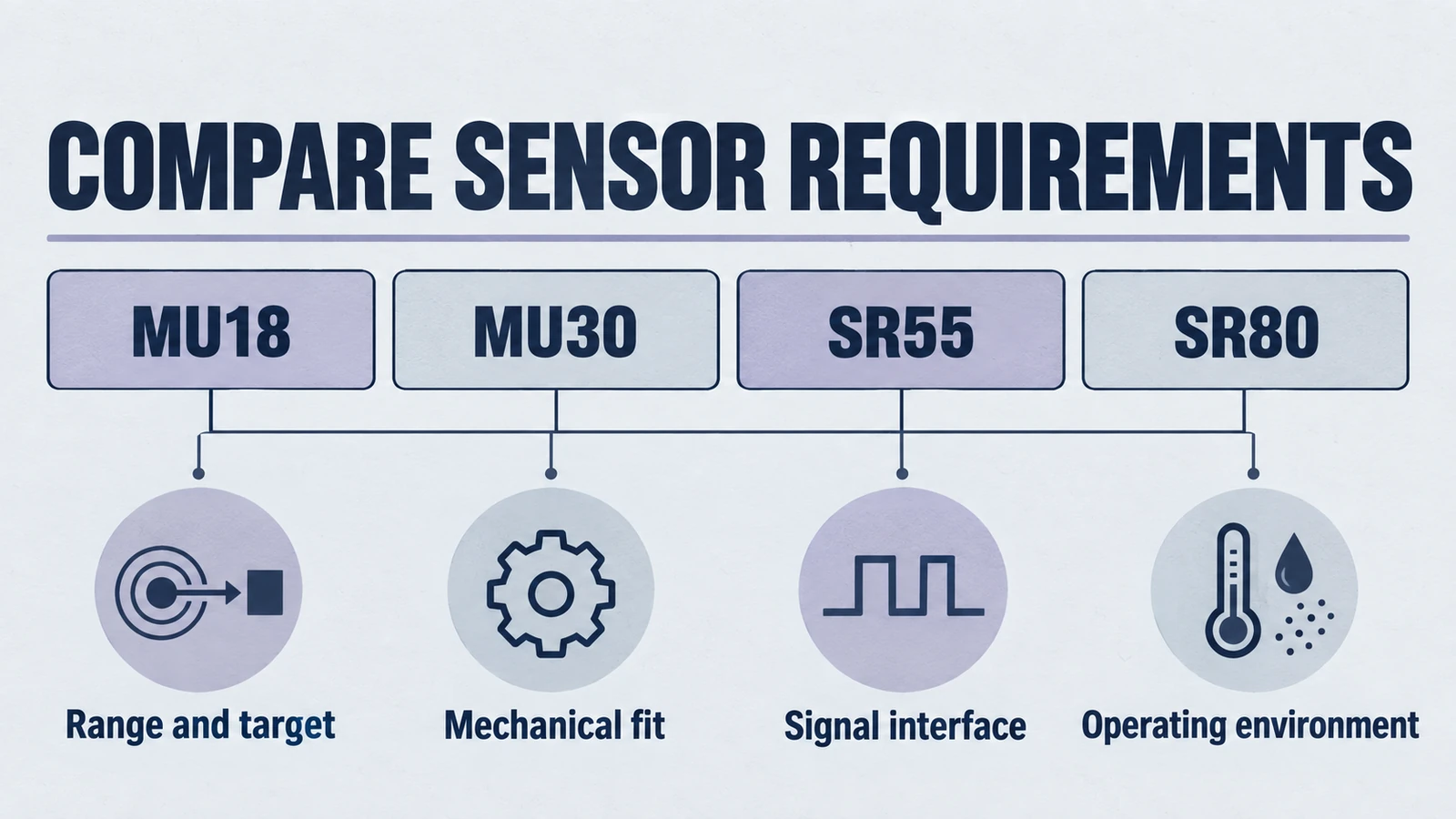
Many industrial buyers still compare ultrasonic sensor quotes the same way they compare commodity hardware: they collect a few model numbers, line up unit prices, and treat the lowest visible number as the commercial benchmark. That method looks efficient, but it usually fails when the quote set includes different sensor classes. A compact short-range MU18 short-range option, a general-purpose MU30 general-purpose model, an SR55 waterproof level class, and an SR80 long-range sensor are not interchangeable commercial lines with different sticker prices. They belong to different application envelopes, which means the quotes cannot be compared responsibly until procurement normalizes the requirement.
That is the hidden problem when teams ask for "price" too early. Buyers are often not asking for a public list price. They are asking which quote should be treated as the correct baseline, which assumptions are missing from the cheaper offer, and why two suppliers can both sound reasonable while recommending different models. If those questions stay unresolved, the lowest quote often wins for the wrong reason: it simply assumed less.
This article is written as a procurement-first comparison guide for teams sourcing through the sensor product hub and validating supplier capability through the ultrasonic transducer supplier page. It does not publish list prices. Exact commercial pricing still requires a project RFQ through contact. The purpose here is to help buyers compare quotes across MU18, MU30, SR55, and SR80 on equal terms before sample approval and sourcing decisions.
Problem Context
Product path for this search intent
Match the article topic to the right YJ Piezo product page
Use this article when sensor performance depends on target distance, beam angle, housing material, liquid behavior, or false echo control. For "MU18 vs MU30 vs SR55 vs SR80: How Procurement Teams Should Compare Quotes", the practical value is in turning the topic into a measurable selection or sourcing decision.
- Ultrasonic Sensors
Distance, level, and detection sensor portfolio
- Flow Measurement Transducers
Bubble and flow-related ultrasonic sensing paths
- Air Acoustic Transducers
Air-coupled transducers for range and presence detection
Raw unit price is misleading across MU18, MU30, SR55, and SR80 because the four models are built for different application classes. MU18 is naturally suited to compact short-range sensing. MU30 is a flexible mid-range baseline for general industrial use. SR55 sits closer to medium-range level and outdoor IP68 service. SR80 belongs to long-range silo and large-equipment measurement. When procurement places all four into the same spreadsheet without first defining the job class, the comparison becomes structurally wrong before any commercial review begins.
The mistake usually starts with a vague RFQ: "Please quote a sensor for tank level" or "Need a sensor for automation detection." Supplier A interprets that as a short-range machine application and quotes MU18. Supplier B assumes a wider range requirement and quotes MU30. Supplier C reads the environment as outdoor wet service and quotes SR55. Supplier D assumes the customer wants maximum range safety margin and quotes SR80. None of those suppliers are necessarily wrong. The problem is that procurement is comparing four different assumptions while calling the result a single quote comparison.
Why Quote Comparisons Fail So Often
- Range class is not normalized: one quote may be based on a 1 m short-range job, another on a 4 m tank, and another on a 10 m silo reserve margin.
- Blind-zone risk is ignored: two sensors may both "reach" the target, but one may not support the required minimum usable distance.
- Interface scope is hidden: switching output, analog output, RS485, connectors, and cable policies can materially shift quote value.
- Environmental scope is inconsistent: IP67, IP68, housing material, and outdoor or washdown assumptions are not commercial footnotes; they are part of the quote class.
- Validation scope is invisible: the lowest quote may exclude sample evidence, acceptance support, or backup-model logic that another supplier already included.
This is why procurement should compare normalized quotes, not raw unit prices. A cheap quote often means the supplier was asked a smaller question. A more expensive quote often means the supplier included more application responsibility, more robust interface assumptions, or more realistic deployment risk. Until those differences are made explicit, price comparison creates false confidence rather than commercial clarity.
What Buyers Actually Need From a Quote
A useful ultrasonic sensor quote must answer three buyer questions at once. First, is the recommended model technically aligned with the application class? Second, are the interface, environment, and quantity assumptions visible enough to compare against other offers? Third, does the quote include enough validation logic to move from purchasing to approval without restarting model selection later?
If any of these three questions is missing, procurement does not yet have a comparable quote set. For a generalized RFQ structure, use the existing ultrasonic sensor RFQ template. This article goes one step further: it explains how procurement should compare the responses after they arrive.
Engineering Constraints
Procurement does not need to become a design team, but it does need to normalize the fields that materially change quote quality. Otherwise suppliers will fill in the missing engineering details with their own assumptions, and every quote will represent a different job definition.
1) Range Window and Minimum Usable Distance
A valid quote starts with the real range window: minimum, normal, and maximum working distance. Buyers should never request quotation with only a single nominal number. The minimum required distance matters because blind zone and near-field behavior are often what separate MU18 from MU30 in compact automation and what separate MU30 from SR55 or SR80 in larger level work. Two models can both cover the nominal range while only one survives the near-end operating point.
This is also where public price comparisons go wrong. A quote that assumes a wide safety margin or a different minimum measurable point is not directly comparable to one that assumes tighter geometry. If procurement wants an engineering reference on geometry-driven failure, use the beam-angle and mounting geometry field playbook. For quote comparison, the rule is simpler: always normalize range and blind-zone expectations before comparing numbers.
2) Application Class and Mounting Geometry
A short-range machine position check, a conveyor object-detection point, a medium-range utility tank, and a long-range silo are not variants of one application. They are four different commercial categories. The quote must therefore be tied to the actual application class, not just the label "ultrasonic sensor."
Mounting geometry should be normalized in procurement language: top-down or side-looking, recess or standpipe, conveyor width, bracket space, nozzle size, obstacle map, and minimum level or target size. If those details are absent, suppliers will silently decide them for you. For conveyor-specific engineering comparison between MU18 and MU30, use the M18 versus M30 conveyor guide. In this article, the procurement takeaway is that geometry changes the quote class because it changes which model is actually acceptable.
3) Output Interface and Power Scope
Output type is one of the most common hidden quote differentiators. A switching output quote, a 4-20 mA quote, and an RS485-capable quote may all refer to the "same model family" while representing different commercial scopes. Power supply assumptions create the same problem. If one supplier assumes a standard industrial DC environment and another includes additional integration flexibility, the numbers are not directly comparable.
Procurement should therefore normalize output interface, supply range, connector expectation, cable policy, and any control-system constraints before asking for price. Otherwise the cheaper quote may simply be the one that removed interface responsibility from the supplier side.
4) IP, Housing, and Operating Environment
MU18 and MU30 generally belong in IP67 short-to-mid-range industrial applications, while SR55 and SR80 naturally enter the conversation when the environment, distance, or outdoor reliability class changes. That does not mean one is a premium version of the other. It means the environment and application scope changed the procurement baseline.
Buyers should normalize IP expectation, housing material, moisture exposure, chemical risk, and outdoor duty before comparing quotations. If the application includes tank turbulence, foam, vapor, or unstable surface return, review the false-echo troubleshooting guide. For procurement, the simpler lesson is that environment assumptions must be visible in the quote package, not buried behind a model number.
5) Validation Evidence, Quantity, and Lifecycle Scope
A meaningful quote is not just a unit price. It also reflects what level of validation support, sample logic, quantity planning, and supply continuity the supplier expects to provide. Sample quantity, pilot quantity, annual volume, requested lead time, test-report expectation, and backup-model logic all affect quote value even if the first spreadsheet row shows only one number.
This is why procurement should treat quote mismatch as a requirement mismatch until proven otherwise. If one supplier includes sample support, backup-model recommendation, and acceptance guidance while another gives only a part number and a price, procurement is not comparing equivalent offers.
Selection Matrix
The first procurement job is to put the application into the correct comparison class. Only then does commercial ranking become meaningful.
| Application Class | Wrong Comparison Risk | Preferred Baseline Model | What Must Be Normalized Before Quote | Buyer Note |
|---|---|---|---|---|
| Compact short-range automation or close-distance detection | Treating MU18 and MU30 as simple size variants | MU18 | Minimum usable distance, target size, mounting space, response expectation | If near-field demand is tight, cheaper mid-range quotes may actually be wrong-fit quotes |
| General industrial distance control or mid-range material handling | Comparing MU30 to SR55 as if both serve the same baseline job | MU30 | Range window, output type, power, conveyor or machine geometry, sample quantity | MU30 is the cleanest general-purpose baseline when the job is neither very short-range nor truly outdoor long-range |
| Medium-range tank, outdoor utility, or IP68-oriented level work | Treating SR55 as the waterproof version of MU30 without redefining the duty class | SR55 | Outdoor exposure, IP expectation, level behavior, mounting height, interface and acceptance method | SR55 should be compared against quotes built for medium-range level and outdoor reliability, not compact machine sensing |
| Long-range silo, hopper, or large-equipment distance monitoring | Using SR80 as a premium upsell against MU30 or SR55 | SR80 | Maximum range, blind-zone allowance, long-distance installation height, environment, and backup-model logic | SR80 belongs to a different procurement class; if it is quoted, the buyer should confirm that the application truly needs long-range architecture |
Quote Scorecard for Procurement Review
Once the application class is normalized, procurement can score supplier quotes using the same weighted framework instead of reacting to the first price row.
| Comparison Criterion | Weight | What Procurement Should Check |
|---|---|---|
| Technical fit | 30% | Is the recommended model aligned with the actual range, blind-zone, application class, and environment? |
| Commercial scope | 20% | What interface, accessories, connector policy, and quote assumptions are included or excluded? |
| Validation evidence | 20% | Does the supplier define sample logic, acceptance criteria, and why the model was selected? |
| Supply continuity and lifecycle risk | 15% | Is there a backup model, stable sourcing path, and realistic support for pilot to volume transition? |
| Lead time | 15% | Does the delivery promise align with sample timing, pilot timing, and launch timing? |
A scorecard like this turns quote comparison into a controlled sourcing decision. It also helps procurement explain internally why the lowest unit price did not necessarily win, because the review criteria were commercial completeness and deployability, not only raw cost.
Model Mapping
Procurement should treat the four models as four quote classes rather than four interchangeable catalog lines. The fastest way to make the right comparison is to identify which model naturally serves as the baseline quote for the job and which model should only appear as a backup or category shift.
MU18: Compact Short-Range Automation Baseline
MU18 should anchor procurement when the application is genuinely compact and close-range. It is the right baseline for near-field machine positioning, compact bin checks, and installations where minimum usable distance and physical envelope matter more than long-range margin. If the quote discussion starts from MU18, buyers should verify that the supplier is not silently widening the job class into a broader MU30-style application.
MU30: General-Purpose Mid-Range Quote Baseline
MU30 is the cleanest baseline when the buyer needs a general industrial quote for mid-range detection without pushing into dedicated long-range level architecture. That makes it the natural first commercial reference for many automation and material-handling RFQs. It should not automatically be replaced by SR55 or SR80 unless the application class actually changes.
SR55: Medium-Range Level and Outdoor Reliability Class
SR55 becomes the correct baseline when the quote is really for medium-range level work, wet outdoor service, or an IP68-oriented application where the duty class is no longer standard indoor automation. Buyers should move from MU30 to SR55 when the environment and measurement envelope justify that shift, not because SR55 sounds more rugged in the abstract.
SR80: Long-Range Architecture, Not Premium Upsell
SR80 should enter the quote set only when the job itself belongs to long-range silo, hopper, or large-equipment distance monitoring. Procurement must not treat SR80 as the premium version of MU30. If SR80 is quoted, the buyer should confirm that the project truly requires long-range architecture, higher installation height, and the associated environment assumptions. Otherwise the quote comparison is being distorted by category expansion rather than application need.
A practical buyer workflow is to request one primary model and one backup model from the supplier, then compare whether the proposed pair makes sense for the job definition. That is a stronger sourcing pattern than collecting isolated model numbers without explanation.
RFQ Checklist
If procurement wants quotes that can actually be compared, the RFQ must describe the job in a normalized way. The mandatory five are unchanged: range + environment + output interface + power + quantity + lead-time. For four-model comparison, add the fields that define quote class and validation scope.
- Range: minimum, normal, and maximum working distance.
- Environment: moisture, dust, vapor, temperature band, and outdoor or indoor duty.
- Output interface: switching, analog, or digital communication.
- Power: supply window, connector, and cable expectation.
- Quantity + lead-time: sample, pilot, annual volume, and required delivery schedule.
- Application scenario: compact automation, conveyor, tank level, silo, or other defined class.
- Minimum usable distance: especially where blind-zone risk matters.
- Mounting geometry: stand-off distance, nozzle, bracket, lane width, obstacle map, or mounting height.
- Housing / IP expectation: IP67, IP68, outdoor service, washdown, or material preference.
- Validation / acceptance criteria: what must be proven before sample approval.
- Sample quantity: how many samples are needed for real qualification rather than bench-only review.
Copy-Paste RFQ Starter
Request a normalized quote
Application scenario:
Required range (min / normal / max):
Minimum usable distance:
Mounting geometry:
Environment:
Housing / IP expectation:
Output interface:
Power:
Sample quantity:
Pilot / annual quantity:
Required lead-time:
Validation / acceptance criteria:
Buyer-Side Quote Comparison Worksheet
Before selecting a supplier, procurement should summarize each quote in the same internal worksheet: proposed model, stated application class, included interface scope, environmental assumptions, sample plan, backup-model logic, lead time, and missing assumptions. This one-page normalization step prevents teams from comparing a technically narrow quote against a commercially broader one without realizing it.
When the worksheet is complete, the next step is simple: send the clarified package through the contact page and ask for a normalized quote with the same input set across suppliers. That is how procurement turns quote collection into a controlled decision process.
FAQ
Why are MU18 and MU30 quotes different even when both can detect the target?
Because detection is not the only criterion. Minimum usable distance, mounting space, response expectation, and application class all change the commercial baseline. If two models can both reach the target but only one fits the actual near-field or geometry constraints, the cheaper one is not necessarily the right quote.
When should procurement move from MU30 to SR55?
Move from MU30 to SR55 when the quote clearly belongs to medium-range level work, outdoor reliability, or an IP68-oriented duty class rather than general indoor automation. The shift should be triggered by application scope, not by the assumption that SR55 is simply a premium upgrade.
Why must SR80 be compared in a different baseline set?
SR80 belongs to long-range architecture. It should be compared against quotes intended for silo, hopper, and large-equipment distance monitoring, not against short- or mid-range automation models. If procurement compares SR80 to MU30 without redefining the application class, the commercial comparison is already distorted.
Should buyers request price before confirming interface and environment?
No. Buyers can request a budgetary indication, but a usable commercial comparison requires interface, environment, power, range, and quantity assumptions to be visible first. Otherwise the returned number reflects supplier guesswork more than decision-grade scope.
What evidence should be required before sample approval?
At minimum, procurement should require the recommended model, the backup model, the assumptions behind the recommendation, and the agreed sample acceptance method. If those four items are missing, sample approval is vulnerable to interpretation drift during testing.
How should procurement compare quotes from multiple suppliers fairly?
Use the same normalized RFQ input for each supplier, then score the responses using a common framework covering technical fit, commercial scope, validation evidence, supply continuity, and lead time. Fair comparison comes from aligned assumptions, not from looking at unit price first.
Engineering decision notes
Ultrasonic sensing and detection
Use this article when sensor performance depends on target distance, beam angle, housing material, liquid behavior, or false echo control. For "MU18 vs MU30 vs SR55 vs SR80: How Procurement Teams Should Compare Quotes", the practical value is in turning the topic into a measurable selection or sourcing decision.
YJ Piezo treats ultrasonic sensing as an acoustic interface problem: transducer frequency, beam shape, housing, drive electronics, and target environment are reviewed together.
Selection checks
- Define target range, dead zone, beam angle, and mounting geometry before choosing the sensor family.
- Check the medium, target surface, temperature swing, foam, vapor, and side-wall risk.
- Separate detection repeatability from ideal lab accuracy when the sensor will operate in a tank, tube, or moving line.
Failure risks
- A sensor can pass bench distance tests and still fail in tanks with foam, agitation, vapor, or narrow geometry.
- Changing only frequency without reviewing beam angle and mounting can increase false echoes.
- Ignoring housing material or sealing requirements can shorten lifetime in washdown or chemical environments.
RFQ details
- What is the minimum and maximum detection distance?
- Is the target liquid, solid, sheet material, air flow, or a moving object?
- What temperature, humidity, IP rating, and output signal does the system require?
Relevant YJ Piezo pages
- Ultrasonic Sensors
Distance, level, and detection sensor portfolio
- Flow Measurement Transducers
Bubble and flow-related ultrasonic sensing paths
- Air Acoustic Transducers
Air-coupled transducers for range and presence detection
Application FAQ
- What makes an ultrasonic sensor page useful for procurement?
- It should connect range, beam angle, output signal, housing, mounting, and environmental limits to a concrete use case. A model name alone is not enough for reliable supplier comparison.
- Which information speeds up an ultrasonic sensor RFQ?
- Send the target material, distance range, installation geometry, output interface, temperature range, IP rating, and whether the application involves foam, vapor, liquid, or moving objects.