
Piezo Actuators for Micro-Motion: Precision Control in Advanced Applications
In an era where micro-scale precision is crucial to innovation, piezoelectric actuators have emerged as a cornerstone technology for applications requiring ultra-fine motion control. From semiconductor manufacturing to biomedical engineering, these devices provide nanometer-level accuracy, rapid response times, and high reliability—capabilities that are reshaping what's possible in advanced engineering.
Understanding Piezoelectric Actuators
Piezo actuators operate on the piezoelectric effect, a property of certain ceramics that allows them to convert electrical energy into precise mechanical displacement. Unlike electromagnetic motors, which rely on magnetic fields and mechanical components, piezo actuators produce motion directly from crystalline lattice deformation, enabling:
- High resolution — down to the sub-nanometer scale.
- Fast response times — in the microsecond range.
- No mechanical backlash — due to the absence of gears.
- High stiffness — capable of maintaining position under load.
Product path for this search intent
Match the article topic to the right YJ Piezo product page
Use this article when the choice is not just a shape, but a material tradeoff between sensitivity, loss, coupling, stability, and operating field. For "Piezo Actuators for Micro-Motion: Precision Control in Advanced Applications", the practical value is in turning the topic into a measurable selection or sourcing decision.
- PZT Material Hub
Material grades and application tradeoffs
- Piezoelectric Ceramics
Shapes and ceramic manufacturing options
- PZT Material Supplier Hub
Material control, grade selection, and sourcing support
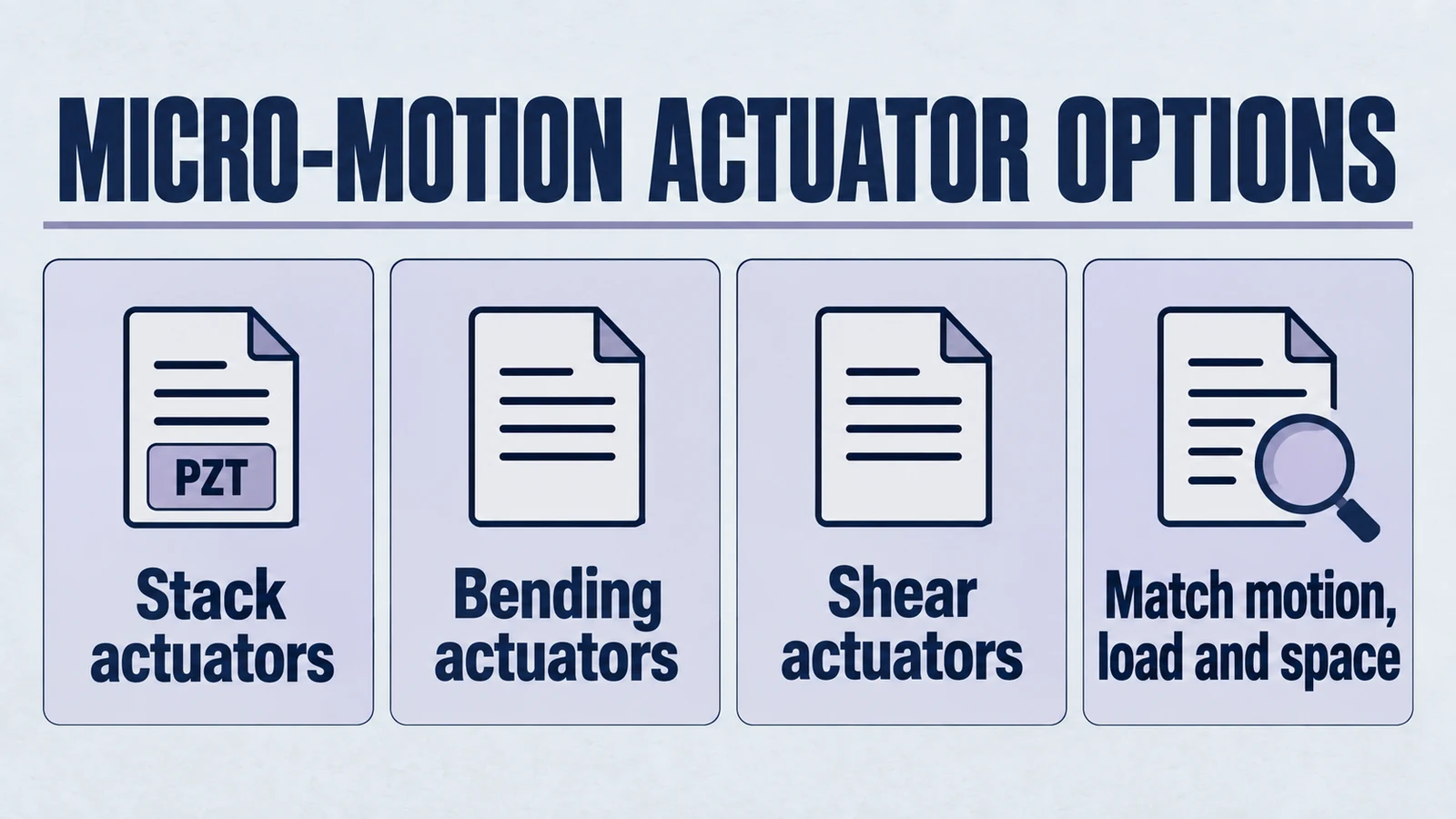
Types of Piezo Actuators for Micro-Motion
- Stack Actuators
Built from layers of piezoelectric ceramics stacked together, these actuators deliver high force and precise displacement. They are widely used in precision positioning stages. - Bimorph Actuators
Made of two piezo layers bonded together, they provide bending motion and are common in scanning microscopy and optical alignment. - Shear Actuators
Designed to produce lateral movement, these actuators excel in applications like fast beam steering. - Tube Actuators
Often used in scanning probe microscopes, they enable precise X-Y-Z motion within compact designs.
Key Advantages in Micro-Motion Applications
1. strong Positioning Accuracy
Piezo actuators offer motion control at the atomic scale, enabling precision positioning in demanding fields like semiconductor lithography, fiber optic alignment, and nanometrology.
2. High Dynamic Performance
Their rapid response makes them ideal for high-speed operations, such as adaptive optics and micro-robotics.
3. Compact and Durable Design
Direct piezo actuation can avoid sliding drive interfaces, but the ceramic deforms mechanically. Fatigue, bonds, electrodes, insulation and environmental exposure still limit life. Validate the loaded assembly and required lifetime rather than assuming wear-free stability.
4. Energy Efficiency
Static ceramic holding power can be low, but leakage, driver, feedback and control electronics still consume energy. Dynamic demand depends on capacitance, waveform, frequency, load and losses. Evaluate the complete system power budget.
Advanced Applications of Piezo Actuators
1. Semiconductor Manufacturing
In wafer inspection, lithography, and mask alignment, even a few nanometers of deviation can cause costly defects. Piezo stages ensure accurate positioning of wafers and optical elements.
2. Optical Systems
Piezo-driven mirror mounts and lenses enable real-time focusing, beam steering, and vibration compensation in laser machining, telescopes, and microscopy.
3. Life Sciences & Medical Devices
From precision dosing in drug delivery systems to cellular manipulation under a microscope, piezo actuators allow scientists to work at the cellular and molecular level.
4. Aerospace & Defense
In satellite optics, piezo actuators enable ultra-fine adjustments for imaging and communications systems operating in extreme environments.
5. Industrial Automation
In high-speed inspection lines, piezo-based motion systems help achieve higher throughput without sacrificing accuracy.
Conclusion
Piezo actuators have become an important tool for micro-motion applications in cutting-edge industries. Their combination of nanometer accuracy, high dynamic performance, and durability makes them a superior choice over conventional actuation methods.
Learn about actuator selection criteria and custom solutions for specialized requirements.
Explore micro-motion control possibilities? Contact our technical team to discuss your precision positioning needs.
Related Technical Resources
Use these internal references to compare geometry, material selection, reliability testing, and sourcing decisions.
- How to Choose Radius of Curvature for Focused Piezo Ceramics
- Key Design Parameters for Curved Piezo Elements
- Focused Piezo Ceramics in Medical Ultrasound: Engineering Constraints
- Mode Coupling Risk in Piezo Ceramic Geometry
- Selecting Piezo Ceramics for Continuous Duty Applications
- Common Mistakes Integrating Ultrasonic Transducers into OEM Systems
- Piezoelectric Ceramics Geometry and Shape Guide
- Understanding Ultrasonic Transducers: Types and Uses
Engineering decision notes
PZT material and ceramic selection
Use this article when the choice is not just a shape, but a material tradeoff between sensitivity, loss, coupling, stability, and operating field. For "Piezo Actuators for Micro-Motion: Precision Control in Advanced Applications", the practical value is in turning the topic into a measurable selection or sourcing decision.
YJ Piezo coordinates PZT ceramic projects with manufacturing support, so material formulation, sintering, polarization, electrode process, and outgoing inspection can be reviewed against the final application.
Selection checks
- Separate sensing needs from high-power actuation needs before comparing d33 or coupling values.
- Check dielectric loss, Qm, Curie temperature, aging behavior, and operating field against the real duty cycle.
- Confirm whether the application needs standard PZT grades or a custom formulation and geometry.
Failure risks
- Choosing only the highest d33 can create heat, drift, or depolarization risk in power ultrasonics.
- A ceramic that performs well in free measurement can fail once bonded, clamped, or loaded.
- Material substitutions without batch testing can change capacitance, resonance, and system tuning.
RFQ details
- Is the part used for sensing, actuation, atomization, cleaning, welding, or measurement?
- What field strength, temperature, duty cycle, and mechanical load will the ceramic see?
- Which values must be controlled: d33, capacitance, resonance, impedance, Qm, or dimensional tolerance?
Relevant YJ Piezo pages
- PZT Material Hub
Material grades and application tradeoffs
- Piezoelectric Ceramics
Shapes and ceramic manufacturing options
- PZT Material Supplier Hub
Material control, grade selection, and sourcing support
Application FAQ
- Is the highest d33 always the best PZT choice?
- No. High d33 can be useful for sensitivity, but high-power ultrasonic systems often need lower loss, higher Qm, better thermal stability, and safer operation under field and stress.
- What makes PZT material selection different from catalog buying?
- The right PZT choice depends on geometry, load, drive field, duty cycle, temperature, and inspection targets. A catalog value is only useful when it is tied to the final assembly conditions.