
Piezo Sensors Working Principle: Understanding the Fundamentals of Piezoelectric Sensing
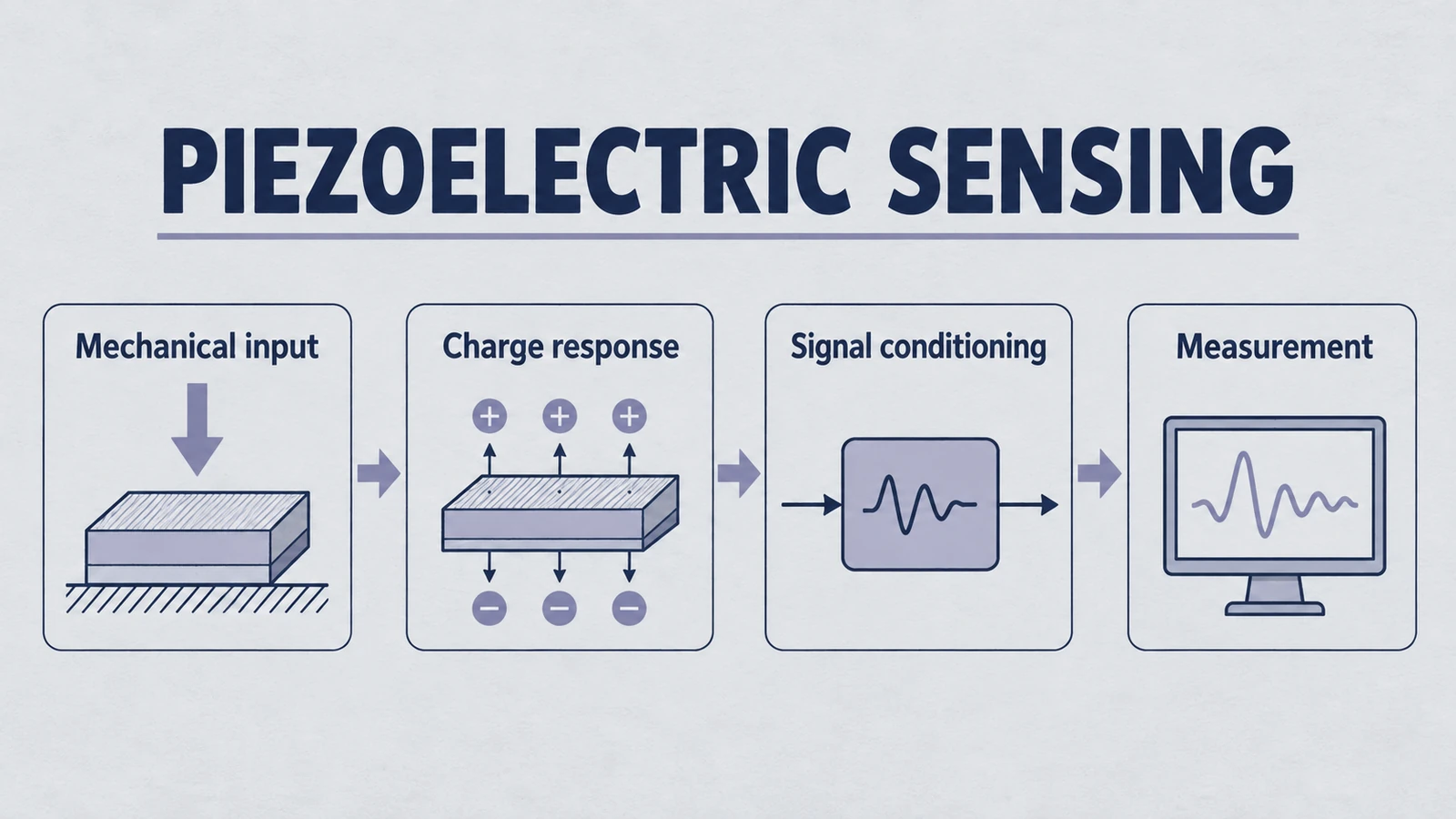
Piezoelectric sensors are a cornerstone of modern sensing technology, valued for their precision, versatility, and reliability. From industrial machinery monitoring to medical diagnostics, they enable accurate detection of force, pressure, vibration, and acceleration. In this article, we will explore how piezoelectric sensors work, their core components, applications, and advantages. By understanding these fundamentals, engineers and decision-makers can make informed choices when selecting the right sensor solution.
1. What is a Piezoelectric Sensor?
A piezoelectric sensor is a device that uses the piezoelectric effect—the ability of certain crystalline materials to generate an electric charge in response to applied mechanical stress. In reverse, these materials can also deform when an electric field is applied (inverse piezoelectric effect), but sensing applications primarily use the direct effect.
Common piezoelectric materials include:
Product path for this search intent
Match the article topic to the right YJ Piezo product page
Use this article when the choice is not just a shape, but a material tradeoff between sensitivity, loss, coupling, stability, and operating field. For "Piezo Sensors Working Principle: Understanding the Fundamentals of Piezoelectric Sensing", the practical value is in turning the topic into a measurable selection or sourcing decision.
- PZT Material Hub
Material grades and application tradeoffs
- Piezoelectric Ceramics
Shapes and ceramic manufacturing options
- PZT Material Supplier Hub
Material control, grade selection, and sourcing support
- Quartz (natural crystal)
- Lead zirconate titanate (PZT)
- Barium titanate
- Polyvinylidene fluoride (PVDF)
2. Working Principle of Piezoelectric Sensors
The working principle is straightforward yet powerful:
- Mechanical Input – Force, pressure, acceleration, or vibration is applied to the sensor.
- Piezoelectric Effect – The piezoelectric material inside the sensor deforms, causing an internal rearrangement of electrical charges.
- Charge Generation – This deformation creates a proportional electrical charge on the material's surface.
- Signal Conditioning – The raw charge signal is often weak and needs to be amplified and converted into a measurable voltage or current.
- Output Signal – The conditioned signal is sent to a measurement system, data logger, or control unit.
Mathematically, the generated charge (Q) is proportional to the applied force (F):
Where d is the piezoelectric charge constant (material-dependent).
3. Core Components of a Piezoelectric Sensor
A typical piezoelectric sensor contains:
- Sensing Element – The piezoelectric crystal or ceramic.
- Electrodes – To collect the generated electrical charge.
- Housing/Enclosure – Protects against environmental conditions.
- Preload Mechanism – Ensures consistent contact with the sensing element.
- Signal Conditioning Circuit – May include amplifiers, filters, and analog-to-digital converters.
4. Advantages of Piezoelectric Sensors
- High Sensitivity – Detect minute changes in force or vibration.
- Wide Frequency Range – Ideal for dynamic measurements.
- Compact Size – Easy to integrate into small or complex systems.
- No External Power Needed for Sensing – Generates its own signal from mechanical input.
- Durability – Resistant to extreme temperatures, radiation, and harsh environments (especially with PZT ceramics).
5. Limitations to Consider
- Not Suitable for Static Measurements – The generated charge dissipates over time.
- Signal Requires Conditioning – High-impedance output needs amplification.
- Material Fragility – Some crystals are brittle and require protective housing.
6. Common Applications of Piezoelectric Sensors
Industrial Applications:
- Machinery vibration monitoring
- Tool condition monitoring in CNC machines
- Structural health monitoring
Medical Applications:
- Ultrasound imaging transducers
- Blood pressure measurement devices
Automotive Applications:
- Knock sensors in engines
- Airbag deployment systems
Consumer Electronics:
- Microphones
- Touch-sensitive interfaces
For specialized sensing applications, see our Ultrasonic Bubble Detection Sensor which demonstrates advanced piezoelectric technology in action.
7. How to Select the Right Piezoelectric Sensor
When choosing a sensor, consider:
- Measurement Type – Force, acceleration, or vibration?
- Operating Environment – Temperature range, humidity, vibration levels.
- Frequency Response – Required bandwidth.
- Sensitivity – Match with your signal processing capability.
- Size & Mounting Options – For integration into existing designs.
8. Future Trends in Piezoelectric Sensing
With advancements in materials science, piezoelectric sensors are becoming:
- More Miniaturized – For integration in MEMS devices.
- More Energy-Efficient – Dual-function as both sensors and energy harvesters.
- Smarter – With built-in IoT connectivity for real-time monitoring.
Conclusion
The working principle of piezoelectric sensors is both simple and elegant: converting mechanical energy into electrical energy with remarkable precision. By understanding the fundamentals—material choice, sensing mechanism, and signal conditioning—you can leverage their full potential in diverse applications. As technology continues to evolve, piezoelectric sensing will remain a key player in industries ranging from aerospace to healthcare.
Related Technical Resources
Use these internal references to compare geometry, material selection, reliability testing, and sourcing decisions.
- Mode Coupling Risk in Piezo Ceramic Geometry
- Selecting Piezo Ceramics for Continuous Duty Applications
- Common Mistakes Integrating Ultrasonic Transducers into OEM Systems
- Piezoelectric Ceramics Geometry and Shape Guide
- Understanding Ultrasonic Transducers: Types and Uses
- How to Test and Measure Piezoelectric Materials
- Understanding Piezoelectric Constants d33, k, and Qm
- Ensuring Quality of Piezoelectric Components
Engineering decision notes
PZT material and ceramic selection
Use this article when the choice is not just a shape, but a material tradeoff between sensitivity, loss, coupling, stability, and operating field. For "Piezo Sensors Working Principle: Understanding the Fundamentals of Piezoelectric Sensing", the practical value is in turning the topic into a measurable selection or sourcing decision.
YJ Piezo coordinates PZT ceramic projects with manufacturing support, so material formulation, sintering, polarization, electrode process, and outgoing inspection can be reviewed against the final application.
Selection checks
- Separate sensing needs from high-power actuation needs before comparing d33 or coupling values.
- Check dielectric loss, Qm, Curie temperature, aging behavior, and operating field against the real duty cycle.
- Confirm whether the application needs standard PZT grades or a custom formulation and geometry.
Failure risks
- Choosing only the highest d33 can create heat, drift, or depolarization risk in power ultrasonics.
- A ceramic that performs well in free measurement can fail once bonded, clamped, or loaded.
- Material substitutions without batch testing can change capacitance, resonance, and system tuning.
RFQ details
- Is the part used for sensing, actuation, atomization, cleaning, welding, or measurement?
- What field strength, temperature, duty cycle, and mechanical load will the ceramic see?
- Which values must be controlled: d33, capacitance, resonance, impedance, Qm, or dimensional tolerance?
Relevant YJ Piezo pages
- PZT Material Hub
Material grades and application tradeoffs
- Piezoelectric Ceramics
Shapes and ceramic manufacturing options
- PZT Material Supplier Hub
Material control, grade selection, and sourcing support
Application FAQ
- Is the highest d33 always the best PZT choice?
- No. High d33 can be useful for sensitivity, but high-power ultrasonic systems often need lower loss, higher Qm, better thermal stability, and safer operation under field and stress.
- What makes PZT material selection different from catalog buying?
- The right PZT choice depends on geometry, load, drive field, duty cycle, temperature, and inspection targets. A catalog value is only useful when it is tied to the final assembly conditions.