
Piezo Technology in Healthcare: Ultrasound Imaging and Beyond
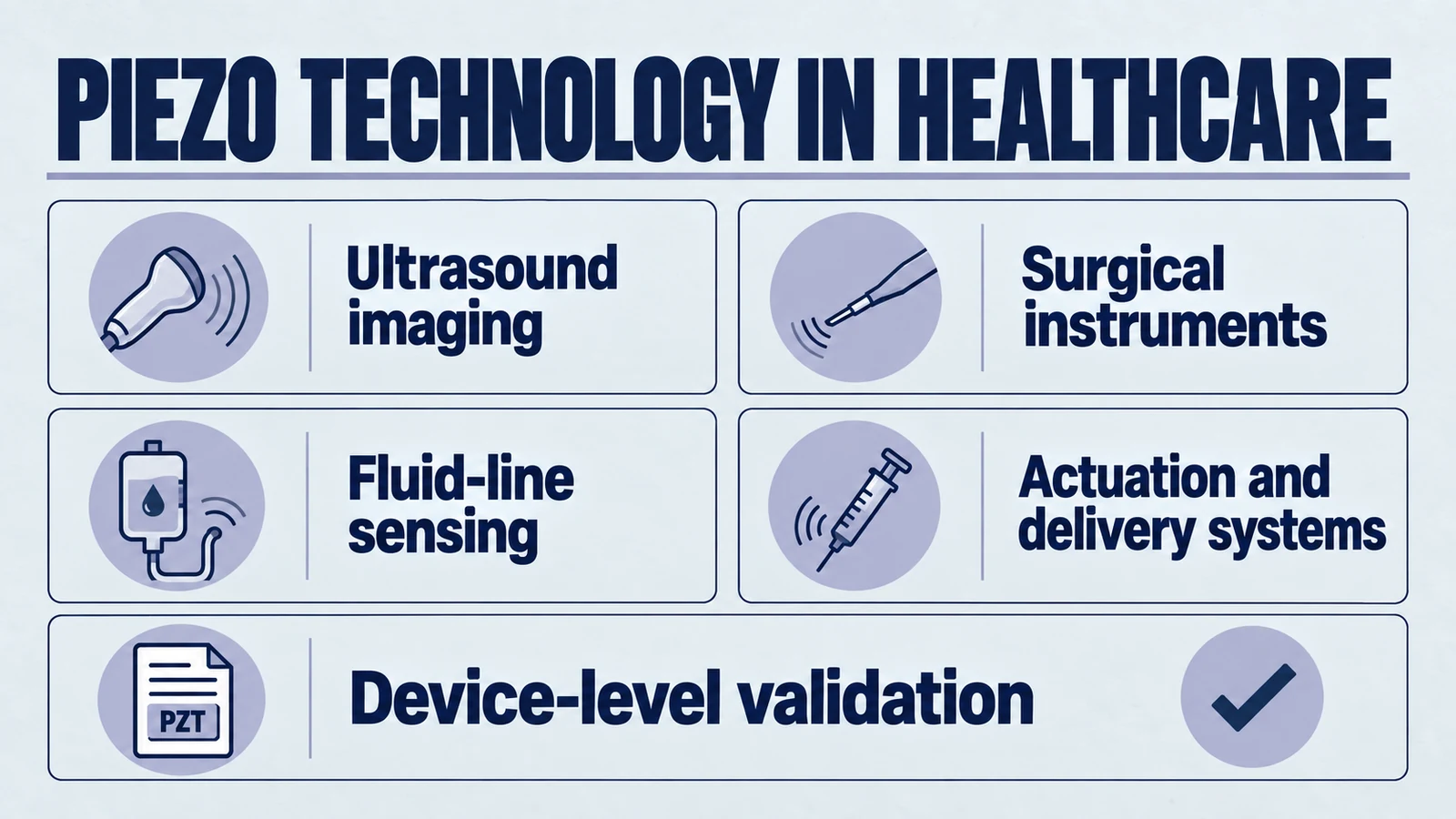
Piezoelectric materials are widely used in healthcare device engineering because they convert electrical energy into mechanical vibration and convert mechanical stress back into electrical signals. They can support imaging probes, sensing modules, fluid-handling systems, and other biomedical equipment when they are integrated and validated by the finished-device manufacturer. This article explores how piezoelectric medical sensors and ultrasound transducer medical designs use ceramic elements at the component level.
The Role of Piezoelectric Technology in Medical Sensors
Piezoelectric sensors operate based on the piezoelectric effect, a phenomenon where certain materials generate an electric charge under mechanical stress. This makes them useful for sensing and actuation in healthcare equipment. In finished devices, these elements may be used to detect pressure changes, generate high-frequency sound waves, or convert mechanical signals into electrical outputs, subject to the device maker's design controls and validation.
Key Benefits of Piezoelectric Medical Sensors:
Product path for this search intent
Match the article topic to the right YJ Piezo product page
Use this article when the choice is not just a shape, but a material tradeoff between sensitivity, loss, coupling, stability, and operating field. For "Piezo Technology in Healthcare: Ultrasound Imaging and Beyond", the practical value is in turning the topic into a measurable selection or sourcing decision.
- PZT Material Hub
Material grades and application tradeoffs
- Piezoelectric Ceramics
Shapes and ceramic manufacturing options
- PZT Material Supplier Hub
Material control, grade selection, and sourcing support
- Miniaturization: Ideal for catheters, implants, and wearable diagnostics.
- High Sensitivity: Enables detection of subtle physiological changes.
- Low Power Consumption: Suitable for portable and battery-powered devices.
- Material integration: Contact path, encapsulation, sealing, and device-level material evaluation must be handled in the finished product design.
Ultrasound Imaging: The Classic Application
Ultrasound imaging remains the most widespread use of piezoelectric transducers in medicine. These devices emit high-frequency sound waves that penetrate the body and reflect off tissues. The echoes are then converted back into electrical signals to create real-time images.
Types of Ultrasound Transducers in Medical Use:
- Linear Transducers
- Used for vascular imaging and musculoskeletal scans.
- Provide high-resolution, shallow-depth images.
- Curvilinear (Convex) Transducers
- Common in abdominal and OB/GYN imaging.
- Offer a wider field of view.
- Phased Array Transducers
- Used in cardiac and transcranial imaging.
- Suitable for deep penetration and rapid image acquisition.
- Endocavitary Transducers
- Designed for rectal and vaginal examinations.
- Offer closer proximity to internal organs.
How Piezoelectric Elements Power Ultrasound Transducers:
Piezoelectric ultrasound transducers contain one or more piezoelectric elements, often PZT. Other imaging architectures exist, including capacitive micromachined ultrasonic transducers (CMUTs); not every ultrasound probe is piezoelectric. When excited by an electric signal, the elements vibrate and emit ultrasound waves. The same elements also receive the echoes, completing the cycle of image generation. For high-precision medical ultrasonic applications, our medical ultrasonic transducers guide provides detailed selection criteria for optimal performance.
Beyond Imaging: Sensing and Actuation Applications
While imaging dominates the discussion, piezoelectric sensors and actuators can also support healthcare equipment where motion, pressure, flow, or acoustic energy must be controlled:
1. Focused Ultrasound Equipment
Focused ultrasound systems rely on arrays or shaped transducers to concentrate acoustic energy. The finished-device manufacturer is responsible for acoustic output limits, use-case validation, software control, and regulatory submission; Yujie can support the ceramic element side through material and geometry discussion.
2. Ultrasonic Surgical Tools
Some surgical instruments use piezoelectric actuation for controlled vibration. Their ceramic stacks, preload, drive electronics, and mechanical coupling must be validated within the complete instrument architecture.
3. Wearable Health Monitors
Flexible piezoelectric films and ceramic elements may be used to track motion, pressure, or vibration signals. The principles of precision ultrasonic sensing are adapted by device designers for monitoring hardware.
4. Drug Delivery Systems
Micro-pumps and fluid-control modules may use piezo ceramics to create small, repeatable displacements. Flow path design, alarms, dosing logic, and end-use validation remain device-level responsibilities.
Advanced Medical Sensing Applications
Modern healthcare equipment leverages various ultrasonic sensor technologies for measurement, monitoring, and device-control functions:
Flow Measurement in Medical Devices
Healthcare flow-monitoring systems may use ultrasonic flow measurement principles similar to industrial flow measurement transducers, with additional device-level requirements for contact materials, calibration, cleaning, software, and documentation.
Bubble Detection in Fluid Lines
Bubble detection sensors monitor acoustic changes in fluid-filled tubing so the finished device can respond according to its risk-control logic. These piezoelectric medical sensors must be matched to tubing material, wall thickness, fluid type, detection threshold, and validation protocol.
Material Considerations for Medical Applications
Healthcare device programs should separate ceramic component performance from finished-device material-contact validation. Our piezoelectric ceramic materials can be discussed in terms of PZT grade, geometry, electrode, frequency, and documentation support for the device maker's evaluation plan, including:
- Material traceability for ceramic lots and processing history
- Encapsulation and contact-path planning when the ceramic is near fluids, skin, or disposable assemblies
- Stable performance under the intended electrical, thermal, and mechanical conditions
- Hermetic sealing compatibility for implantable devices
Future Outlook: Next-Gen Piezo in Healthcare
Researchers are now exploring piezoelectric nanomaterials, bioresorbable ceramics, and hybrid composites to create the next generation of medical sensors and actuators. Applications on the horizon include smart stents, bio-integrated ultrasound patches, and autonomous diagnostic tools.
AI can support device-specific analysis and decision support. Diagnostic autonomy and performance require validation for the software, device and intended indication. Direct piezoelectric strain/pressure sensing is distinct from ultrasonic transmission and reception.
Conclusion
Piezoelectric medical sensors, especially ultrasound transducer components, continue to support diagnostic and device-development programs. As material science advances, these technologies can support healthcare equipment from hospital systems to home-based monitoring devices when integrated and validated at the finished-device level.
The precision engineering required for healthcare applications demands consistent materials, manufacturing processes, and documentation. From ultrasonic cavitation transducers to sophisticated imaging systems, piezoelectric technology continues to support medical device innovation when integrated within validated equipment.
Need custom PZT ceramic elements for healthcare equipment?
Contact Yujie Technology to discuss material grade, geometry, electrode design, and supporting documentation for your device evaluation.
Discuss Ceramic ElementsEngineering decision notes
PZT material and ceramic selection
Use this article when the choice is not just a shape, but a material tradeoff between sensitivity, loss, coupling, stability, and operating field. For "Piezo Technology in Healthcare: Ultrasound Imaging and Beyond", the practical value is in turning the topic into a measurable selection or sourcing decision.
YJ Piezo coordinates PZT ceramic projects with manufacturing support, so material formulation, sintering, polarization, electrode process, and outgoing inspection can be reviewed against the final application.
Selection checks
- Separate sensing needs from high-power actuation needs before comparing d33 or coupling values.
- Check dielectric loss, Qm, Curie temperature, aging behavior, and operating field against the real duty cycle.
- Confirm whether the application needs standard PZT grades or a custom formulation and geometry.
Failure risks
- Choosing only the highest d33 can create heat, drift, or depolarization risk in power ultrasonics.
- A ceramic that performs well in free measurement can fail once bonded, clamped, or loaded.
- Material substitutions without batch testing can change capacitance, resonance, and system tuning.
RFQ details
- Is the part used for sensing, actuation, atomization, cleaning, welding, or measurement?
- What field strength, temperature, duty cycle, and mechanical load will the ceramic see?
- Which values must be controlled: d33, capacitance, resonance, impedance, Qm, or dimensional tolerance?
Relevant YJ Piezo pages
- PZT Material Hub
Material grades and application tradeoffs
- Piezoelectric Ceramics
Shapes and ceramic manufacturing options
- PZT Material Supplier Hub
Material control, grade selection, and sourcing support
Application FAQ
- Is the highest d33 always the best PZT choice?
- No. High d33 can be useful for sensitivity, but high-power ultrasonic systems often need lower loss, higher Qm, better thermal stability, and safer operation under field and stress.
- What makes PZT material selection different from catalog buying?
- The right PZT choice depends on geometry, load, drive field, duty cycle, temperature, and inspection targets. A catalog value is only useful when it is tied to the final assembly conditions.