
Piezoelectric Disc Benders and Buzzers: Small Devices, Big Impact
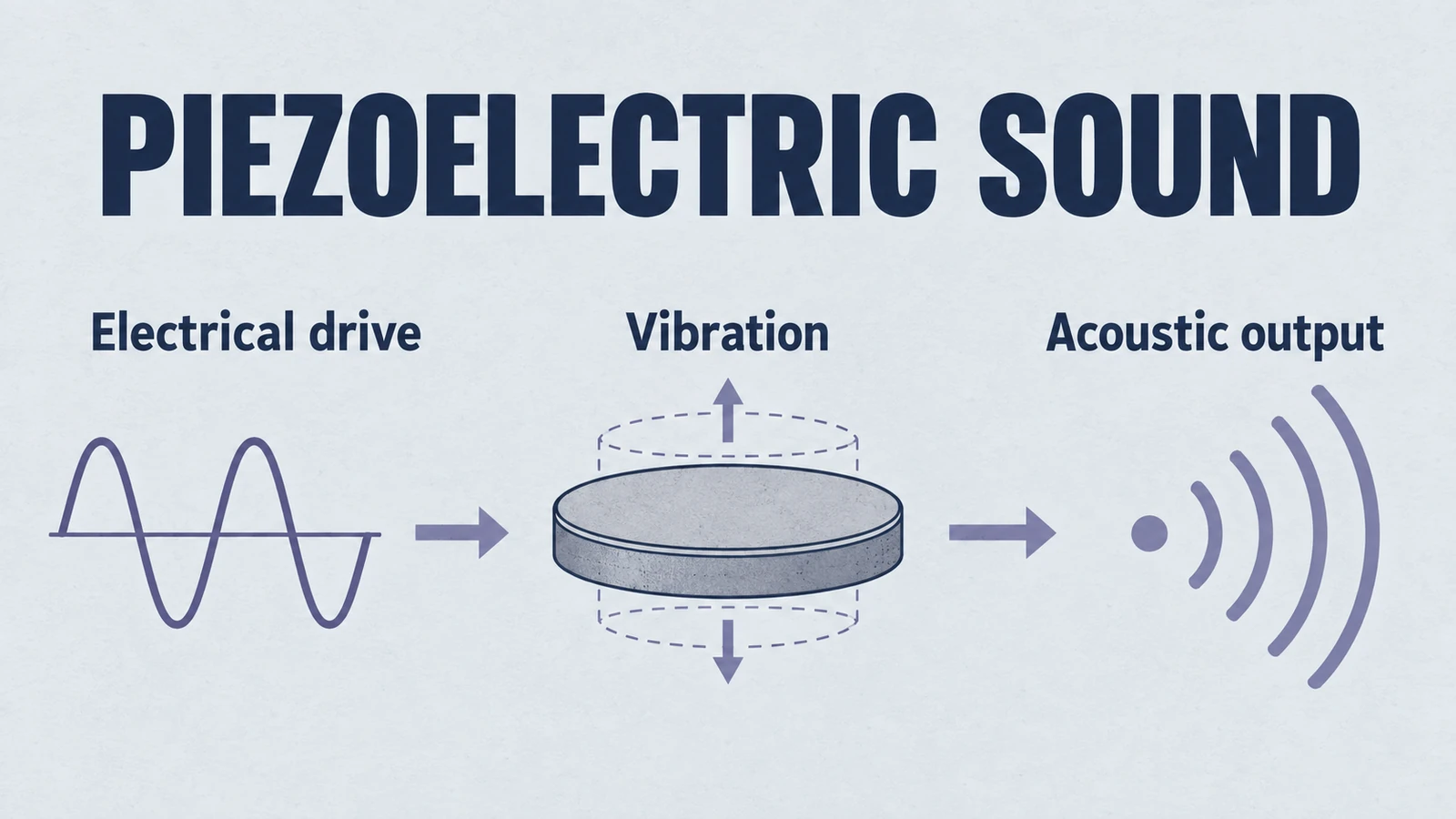
Piezoelectric disc benders and buzzers may be small in size, but their applications span a wide range of industries, from consumer electronics to medical devices. Known for their compact form, reliability, and low power consumption, these components are important in modern design where sound, vibration, or actuation is required. This article will explore the working principles, types, applications, and selection considerations for piezo disc buzzers and piezoelectric benders.
What is a Piezoelectric Disc Bender?
A piezoelectric bender uses differential strain to bend a laminate. One active ceramic layer bonded to a passive metal substrate is a unimorph; two active piezoelectric layers form a bimorph. Disc benders may use either suitable arrangement. Their mechanical bending can generate vibration or displacement for:
- Sound generation (e.g., piezo disc buzzers)
- Precision movement in micro-actuators
- Sensing mechanical changes (as in pressure or acceleration sensors)
Product path for this search intent
Match the article topic to the right YJ Piezo product page
Use this article when the choice is not just a shape, but a material tradeoff between sensitivity, loss, coupling, stability, and operating field. For "Piezoelectric Disc Benders and Buzzers: Small Devices, Big Impact", the practical value is in turning the topic into a measurable selection or sourcing decision.
- PZT Material Hub
Material grades and application tradeoffs
- Piezoelectric Ceramics
Shapes and ceramic manufacturing options
- PZT Material Supplier Hub
Material control, grade selection, and sourcing support
The design's simplicity allows for high reliability and minimal mechanical wear, making it ideal for long-term use. For more information about piezoelectric materials, check our comprehensive guide on what is PZT.
How a Piezo Disc Buzzer Works
A piezo disc buzzer is a type of piezoelectric bender designed to produce audible tones. It operates on the inverse piezoelectric effect: when an AC voltage is applied, the disc vibrates at a set frequency, producing sound waves. The resonance frequency depends on factors like disc size, material properties, and mounting method.
Piezo disc buzzers are widely used because they:
- Operate on low power
- Have no moving mechanical parts (high durability)
- Produce a wide range of tones
- Are lightweight and compact
Types of Piezo Disc Benders and Buzzers
- External Drive Buzzers – Require an external oscillating circuit to produce sound. They offer flexibility in tone control.
- Self-Drive Buzzers – Include an internal oscillation circuit, allowing direct connection to a DC power source.
- Single-Layer Benders – Simple construction for basic applications.
- Multi-Layer Benders – Enhanced displacement and sensitivity, suitable for precision actuation.
For custom solutions, explore our acoustic transducers which can be designed specifically for your application requirements.
Key Applications
1. Consumer Electronics
Piezo disc buzzers are the "beep" in your microwave or alarm clock. They are also found in watches, timers, and toys.
2. Automotive Systems
Used for seatbelt reminders, reverse parking alerts, and warning signals in dashboards. Learn more about automotive applications in our article on piezoelectric sensors in automotive.
3. Medical Devices
Employed in diagnostic equipment alarms, end user monitoring systems, and portable medical devices due to their low power draw. Discover more about piezo technology in healthcare.
4. Industrial Equipment
Act as status indicators, fault alarms, and feedback devices in machinery. For industrial applications, consider our industrial cleaning transducers.
5. Security and Safety
Utilized in smoke detectors, burglar alarms, and emergency alert systems.
Selection Considerations
When choosing a piezoelectric bender or buzzer, engineers should consider:
- Frequency Range – Match the resonant frequency to the intended sound or vibration application.
- Sound Pressure Level (SPL) – Determines loudness.
- Size and Mounting Method – Impacts resonance, durability, and integration.
- Power Consumption – Critical for battery-operated devices.
- Environmental Resistance – Choose materials resistant to moisture, dust, and temperature extremes.
For guidance on material selection, read our article about piezoelectric ceramic materials and PZT types.
Advantages Over Other Technologies
Compared to electromagnetic buzzers, piezo disc buzzers and benders:
- Have lower power requirements
- Are more compact and lightweight
- Provide longer operational lifespans due to no moving coils or magnets
- Offer wider frequency adaptability
For a detailed comparison, see our analysis of piezoelectric vs electromagnetic actuators.
Future Trends
With advancements in material science and miniaturization, piezoelectric benders and buzzers are expected to become even more efficient and versatile. Integration into IoT devices, wearable electronics, and medical implants will likely expand their applications further. Learn about upcoming developments in our article on emerging trends in piezoelectric technology.
Conclusion
The piezo disc buzzer and piezoelectric bender may be small, but their impact across industries is undeniable. Their combination of efficiency, durability, and versatility makes them a go-to choice for engineers worldwide. Whether it's a gentle beep in a consumer device or a precise actuation in a sensor system, these components prove that big innovations often come in small packages.
For high-quality piezoelectric benders and custom solutions, explore our complete range of piezoelectric materials and contact our engineering team for application-specific guidance.
Engineering decision notes
PZT material and ceramic selection
Use this article when the choice is not just a shape, but a material tradeoff between sensitivity, loss, coupling, stability, and operating field. For "Piezoelectric Disc Benders and Buzzers: Small Devices, Big Impact", the practical value is in turning the topic into a measurable selection or sourcing decision.
YJ Piezo coordinates PZT ceramic projects with manufacturing support, so material formulation, sintering, polarization, electrode process, and outgoing inspection can be reviewed against the final application.
Selection checks
- Separate sensing needs from high-power actuation needs before comparing d33 or coupling values.
- Check dielectric loss, Qm, Curie temperature, aging behavior, and operating field against the real duty cycle.
- Confirm whether the application needs standard PZT grades or a custom formulation and geometry.
Failure risks
- Choosing only the highest d33 can create heat, drift, or depolarization risk in power ultrasonics.
- A ceramic that performs well in free measurement can fail once bonded, clamped, or loaded.
- Material substitutions without batch testing can change capacitance, resonance, and system tuning.
RFQ details
- Is the part used for sensing, actuation, atomization, cleaning, welding, or measurement?
- What field strength, temperature, duty cycle, and mechanical load will the ceramic see?
- Which values must be controlled: d33, capacitance, resonance, impedance, Qm, or dimensional tolerance?
Relevant YJ Piezo pages
- PZT Material Hub
Material grades and application tradeoffs
- Piezoelectric Ceramics
Shapes and ceramic manufacturing options
- PZT Material Supplier Hub
Material control, grade selection, and sourcing support
Application FAQ
- Is the highest d33 always the best PZT choice?
- No. High d33 can be useful for sensitivity, but high-power ultrasonic systems often need lower loss, higher Qm, better thermal stability, and safer operation under field and stress.
- What makes PZT material selection different from catalog buying?
- The right PZT choice depends on geometry, load, drive field, duty cycle, temperature, and inspection targets. A catalog value is only useful when it is tied to the final assembly conditions.