
Piezoelectric Nebulizer Transducers: Ensuring Reliable Medical Aerosol Delivery
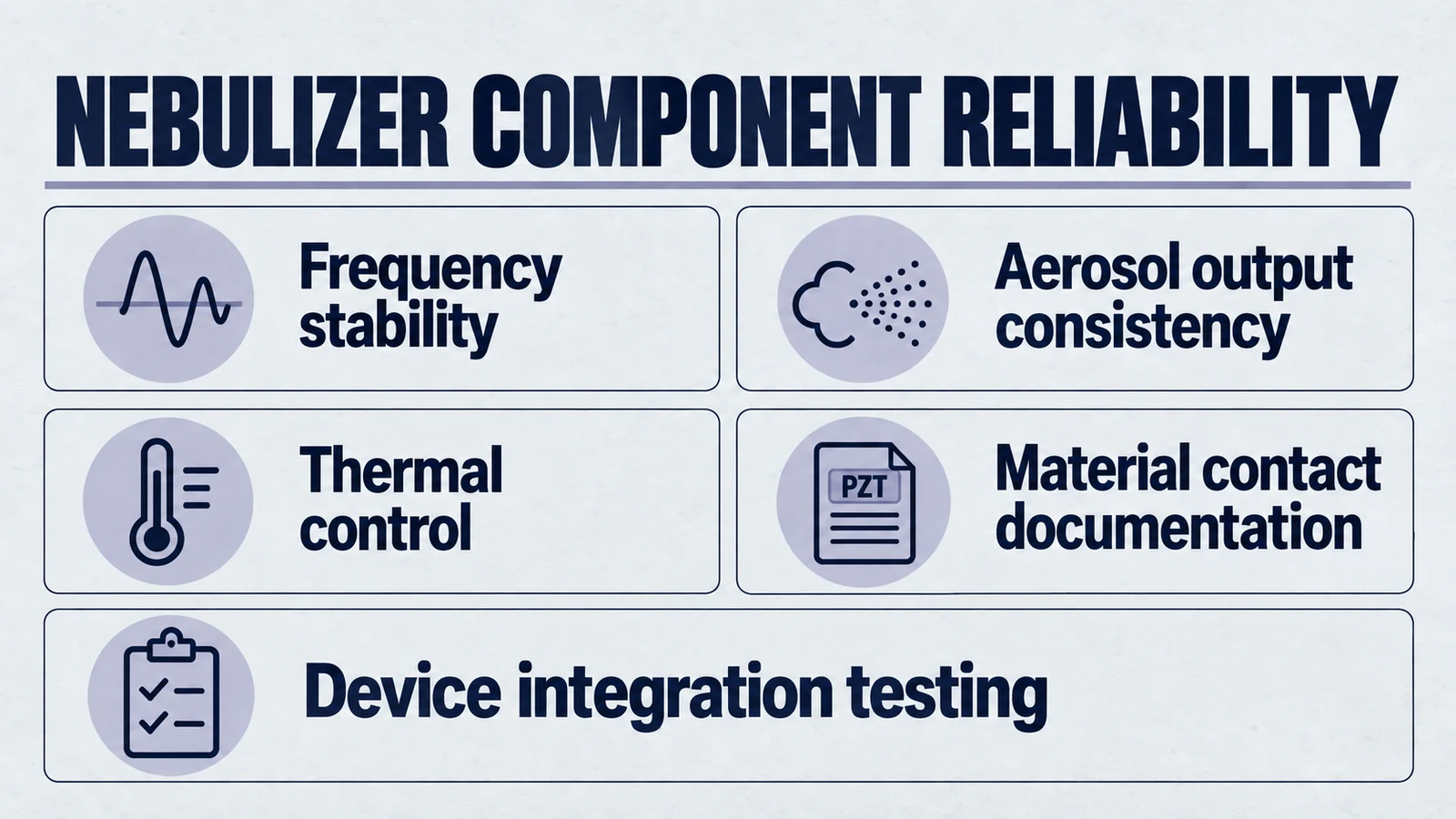
Medical aerosol delivery is a finished-device function, but many nebulizer designs depend on a small vibration source: the piezoelectric nebulizer transducer. At the component level, the key part is often a PZT ceramic ring, disc, or custom element that converts electrical energy into ultrasonic motion.
What is a Piezoelectric Nebulizer Transducer?
A piezoelectric nebulizer transducer is a specialized ultrasonic nebulizer component that uses the inverse piezoelectric effect. When an alternating electrical field is applied, the piezoelectric ceramic material expands and contracts, generating high-frequency vibration. The finished nebulizer assembly then uses that vibration to drive a membrane, mesh, or liquid interface.
1. Key Features
Product path for this search intent
Match the article topic to the right YJ Piezo product page
Use this article when the choice is not just a shape, but a material tradeoff between sensitivity, loss, coupling, stability, and operating field. For "Piezoelectric Nebulizer Transducers: Ensuring Reliable Medical Aerosol Delivery", the practical value is in turning the topic into a measurable selection or sourcing decision.
- PZT Material Hub
Material grades and application tradeoffs
- Piezoelectric Ceramics
Shapes and ceramic manufacturing options
- PZT Material Supplier Hub
Material control, grade selection, and sourcing support
- High-frequency vibration: The ceramic element is selected for the frequency range and vibration mode required by the assembly.
- Efficient energy conversion: PZT material choice affects coupling, capacitance, dielectric loss, and heat generation.
- Compact geometry: Piezo rings, discs, and custom shapes can support compact product layouts.
Advantages of Piezoelectric Nebulizer Transducers
1. Precision Aerosol Generation
For inhalation, validate aerodynamic size distribution, emitted drug mass and residual output with the finished device and formulation; generic droplet diameter or stable piezo vibration alone does not establish delivered dose.
2. Silent Operation
Unlike pneumatic systems, ultrasonic designs can be mechanically quiet when the piezo element, housing, and drive circuit are properly matched.
3. Lower Power Consumption
Portable and battery-operated systems benefit from ceramic materials and drive circuits selected for low loss and stable operation.
4. Efficient Vibration Transfer
Efficient vibration transfer can reduce wasted energy and help the finished assembly reach its target output with less thermal load.
5. Integration Flexibility
Custom disc, ring, and rectangular ceramic shapes can be developed around the device's mechanical constraints.
Applications in Medical Devices
Piezoelectric nebulizer transducers may appear in several aerosol-device design contexts:
- Home-use ultrasonic nebulizer designs where compact size and lower noise are priorities
- Professional aerosol devices that require detailed validation by the finished-device manufacturer
- Portable inhalation device platforms where ceramic efficiency and battery load matter
- Smart nebulizer platforms where sensor feedback and drive electronics must match the piezo element
Factors Influencing Performance and Reliability
To design a stable aerosol device, manufacturers should consider several component-level factors:
1. Material Selection
High-performance piezoelectric ceramics should be selected for coupling, dielectric loss, mechanical quality, and operating temperature.
2. Frequency Stability
Consistency in oscillation frequency helps the finished device maintain predictable behavior across operating conditions.
3. Thermal Management
Excessive heat can shift ceramic behavior and stress the assembly. Lower-loss PZT material, proper mounting, and drive matching all matter.
4. Durability and Lifespan
Design teams should review fatigue, bonding, electrode durability, and aging under the expected duty cycle.
5. Integration with Circuitry
Proper matching with driving electronics improves energy transfer and reduces stress on the ceramic element.
Quality Control and Validation Support
Component suppliers should support the finished-device team with practical data. For ultrasonic nebulizer components, useful checks include:
- Material traceability: Ceramic material, lot, electrode, and coating information where applicable
- Performance support: Resonant frequency, capacitance, impedance, and other agreed component tests
- Durability assessment: Long-term reliability testing under continuous operation
- Finished-device validation: Aerosol output, contact-path review, cleaning, and regulatory submissions remain the device manufacturer's responsibility
Future Trends in Piezoelectric Nebulizer Components
1. Miniaturization
Development of even smaller, more energy-efficient transducers for wearable nebulizer and compact sensing devices, building on advances in ultrasonic sensor component platforms.
2. Smart Control Systems
Closed-loop drive electronics and sensor feedback may improve control when they are matched to the piezo element's measured behavior.
3. Biocompatible Coatings
Coatings, isolation methods, and assembly design can be considered when the ceramic is near a liquid path.
4. Enhanced Durability
Advancements in material science improving durability under continuous use, reducing maintenance requirements for medical facilities.
Yujie's Ceramic Element Support
Yujie focuses on the PZT ceramic element rather than claiming responsibility for the complete nebulizer device. Our support includes:
- PZT material selection: Soft or hard PZT families matched to sensitivity, power, and loss requirements
- Custom geometry: Disc, ring, rectangular, and custom ceramic shapes
- Batch testing: Agreed electrical and dimensional checks for production lots
- Traceability systems: Material and batch records for customer engineering files
Conclusion
The piezoelectric nebulizer transducer is an important ultrasonic nebulizer component, but its performance is inseparable from the finished assembly. A stable, traceable PZT ceramic element gives the device team a stronger foundation for design and validation.
As compact aerosol devices continue to evolve, engineers who understand the ceramic material, geometry, and drive requirements behind the transducer will be better prepared to build repeatable products.
For more information about custom piezo ceramic elements, explore our piezoelectric ceramics, PZT materials, ultrasonic sensor components, and engineering consultation.
Related Nebulizer Guides
Engineering decision notes
PZT material and ceramic selection
Use this article when the choice is not just a shape, but a material tradeoff between sensitivity, loss, coupling, stability, and operating field. For "Piezoelectric Nebulizer Transducers: Ensuring Reliable Medical Aerosol Delivery", the practical value is in turning the topic into a measurable selection or sourcing decision.
YJ Piezo coordinates PZT ceramic projects with manufacturing support, so material formulation, sintering, polarization, electrode process, and outgoing inspection can be reviewed against the final application.
Selection checks
- Separate sensing needs from high-power actuation needs before comparing d33 or coupling values.
- Check dielectric loss, Qm, Curie temperature, aging behavior, and operating field against the real duty cycle.
- Confirm whether the application needs standard PZT grades or a custom formulation and geometry.
Failure risks
- Choosing only the highest d33 can create heat, drift, or depolarization risk in power ultrasonics.
- A ceramic that performs well in free measurement can fail once bonded, clamped, or loaded.
- Material substitutions without batch testing can change capacitance, resonance, and system tuning.
RFQ details
- Is the part used for sensing, actuation, atomization, cleaning, welding, or measurement?
- What field strength, temperature, duty cycle, and mechanical load will the ceramic see?
- Which values must be controlled: d33, capacitance, resonance, impedance, Qm, or dimensional tolerance?
Relevant YJ Piezo pages
- PZT Material Hub
Material grades and application tradeoffs
- Piezoelectric Ceramics
Shapes and ceramic manufacturing options
- PZT Material Supplier Hub
Material control, grade selection, and sourcing support
Application FAQ
- Is the highest d33 always the best PZT choice?
- No. High d33 can be useful for sensitivity, but high-power ultrasonic systems often need lower loss, higher Qm, better thermal stability, and safer operation under field and stress.
- What makes PZT material selection different from catalog buying?
- The right PZT choice depends on geometry, load, drive field, duty cycle, temperature, and inspection targets. A catalog value is only useful when it is tied to the final assembly conditions.