
Not All Piezoelectric Nebulizers Are Created Equal: The Yujie 'Material DNA' Standard
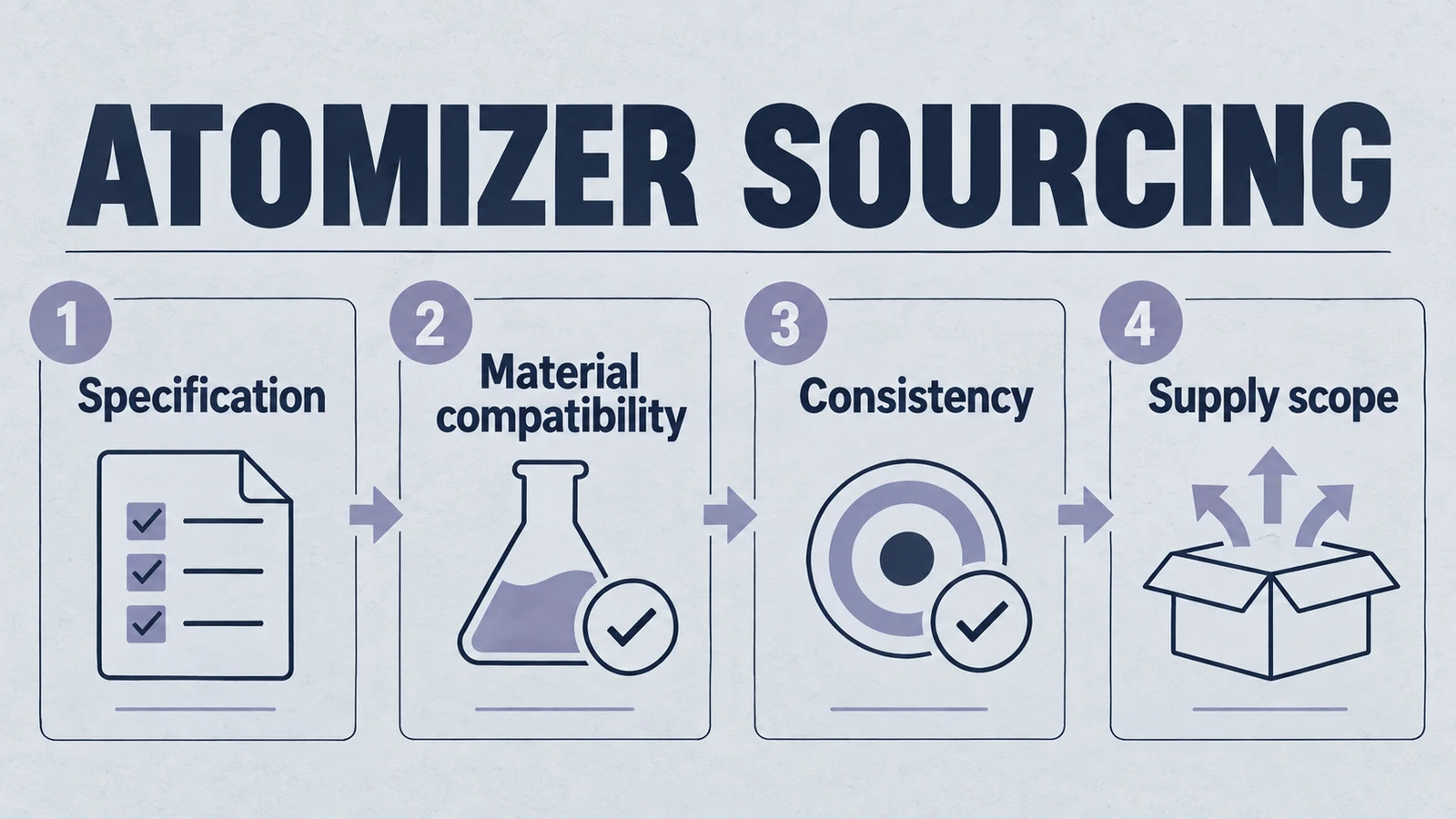
For the R&D engineer or product manager working on a nebulizer device, the piezoelectric nebulizer transducer deserves more than a quick datasheet comparison. The ceramic element inside it can affect frequency stability, drive efficiency, heat generation, and repeatability from prototype to production.
This component is the vibration engine of the atomization section. Its purpose is to convert an electrical signal into high-frequency mechanical motion that the finished assembly uses to create aerosol or mist.
This leads technical and procurement teams to a central, frustrating challenge we call the "procurement paradox." An engineer will gather technical datasheets from a half-dozen suppliers for a PZT-4 or PZT-8 piezoelectric transducer. On paper, these documents appear nearly identical, listing comparable frequencies, coupling factors, and dimensions.
This is the trap. The very document intended to mitigate risk often conceals it.
Product path for this search intent
Match the article topic to the right YJ Piezo product page
Use this article when the choice is not just a shape, but a material tradeoff between sensitivity, loss, coupling, stability, and operating field. For "Not All Piezoelectric Nebulizers Are Created Equal: The Yujie 'Material DNA' Standard", the practical value is in turning the topic into a measurable selection or sourcing decision.
- PZT Material Hub
Material grades and application tradeoffs
- Piezoelectric Ceramics
Shapes and ceramic manufacturing options
- PZT Material Supplier Hub
Material control, grade selection, and sourcing support
This paradox is reinforced by the deceptive simplicity of the consumer market. A household humidifier and a regulated nebulizer device may share a broad piezoelectric principle, but their design controls, validation expectations, and production risks are very different.
The reliability of the final device is not determined by datasheet numbers alone. It is strongly influenced by the transducer's "Material DNA": the ceramic formulation, sintering control, electrode quality, poling process, machining tolerance, and traceability behind the PZT element.
Setting the Record Straight: The Piezoelectric Engine of Modern Nebulizers
To understand the risk, we must first clarify the technology. The market terms "ultrasonic nebulizer," "mesh nebulizer," and "piezoelectric nebulizer" are often used interchangeably, creating confusion. In practice, the complete device architecture determines how the ceramic element is used.
Conventional Free-Surface Ultrasonic Nebulization
Traditional ultrasonic nebulizers used a piezoelectric crystal to vibrate a body of water or saline at a high frequency. These vibrations were then transferred to the liquid medication, breaking it apart into an aerosol.
This method has two practical limitations in many compact precision designs:
- It was inefficient and bulky, sometimes requiring a coupling bath and associated packaging. Portability and power are device-specific, not universally impossible.
- Formulation compatibility: Evaluate temperature, emitted dose/size distribution and drug activity with the actual device and liquid. Both conventional and mesh designs can impose thermal/interfacial stress; sensitive medication does not establish a category-wide prohibition.
The "Modern" Vibrating Mesh Nebulizer (Piezo-Driven)
Many modern compact devices use vibrating mesh technology. This technology is powered by a piezoelectric component, which is why the terms are so often linked. The piezoelectric nebulizer component is the vibration engine that drives the mesh system.
The mechanism is precise, gentle, and highly efficient:
- A piezoceramic ring or related ceramic element is stimulated with an electrical signal, causing it to vibrate at an ultrasonic frequency.
- This vibration is transferred directly to a razor-thin metal membrane perforated with thousands of microscopically small, laser-drilled holes.
- The liquid is pushed through those precision holes, and the finished assembly controls the final aerosol output.
This piezoelectric-driven architecture makes the ceramic element a key engineering variable. The material, shape, electrode, and mounting method should be chosen together.
Compared with some immersed designs, vibrating mesh architectures can reduce thermal load and support compact, battery-powered products. The final device team must still validate aerosol performance, material contact, cleaning, and regulatory requirements at the system level.
Mesh hole size, drive waveform, liquid properties, and ceramic vibration all contribute to droplet-size distribution. The ceramic element does not define the output alone, but unstable ceramic behavior can make system validation harder.
This is why the ceramic ring or disc should be treated as an engineered part, not as a generic accessory.
The Anatomy of an 'In-Spec Failure': What Your Supplier's Datasheet Hides
An "in-spec failure" is a frustrating scenario for an OEM: a component passes incoming checks based on its datasheet but behaves differently in the actual assembly or during long-term validation. In a piezoelectric nebulizer design, these issues often trace back to the "Material DNA" that spec sheets ignore.
Failure Mode 1: Material Inconsistency & Frequency Drift
A piezoelectric component's resonant frequency is its most critical parameter. Purchased powder and catalog parts can be qualified through specifications, process controls and batch evidence. Sourcing route alone does not establish uncontrollable variation. This leads to components that exhibit significant frequency drift as they heat up during normal operation.
This drift matters because it can change vibration amplitude and make aerosol output less predictable. The finished-device team should verify the assembly across temperature, duty cycle, liquid conditions, and aging.
Failure Mode 2: Contact-Path Documentation Gaps
Depending on the architecture, a nebulizer component may be near or outside the liquid path. The finished-device team must define whether the ceramic is isolated, coated, encapsulated, or otherwise separated from liquid exposure.
Many standard industrial-grade PZT components are not documented for regulated-device contact-path review. A low-cost supplier may not provide ceramic lot records, coating details, or construction information. Yujie supports the component side with material traceability and practical engineering discussion, while finished-device compliance remains the customer's responsibility.
Failure Mode 3: The 'R&D vs. Production' Catastrophe
This is the most common failure mode and the very definition of the "procurement paradox." An engineer in the R&D lab validates a single "golden sample" from a supplier. It works perfectly. The device passes validation, and the procurement team places a production order for 50,000 units.
Illustrative procurement risk: inadequate process control or an insufficient inspection plan can allow out-of-spec variation. The 50,000-unit/30%-failure scenario is not a documented customer dataset. Define acceptance limits and production capability instead of promising literal identity of every part or asserting a universal failure rate.
This failure was hidden in plain sight, concealed by a simple datasheet that couldn't differentiate a "golden sample" from a high-volume, uncontrolled production process.
To arm engineers and procurement managers against this, we have developed a simple procurement risk checklist. This matrix helps you ask the questions that datasheets will not answer.
Table 1: The 'In-Spec Failure' Matrix: A Procurement Risk Checklist
| Parameter | "Commodity-Grade" Spec (The Datasheet Trap) | Better Component-Level Requirement |
|---|---|---|
| Frequency | 2.4 MHz (Typical) | Frequency Stability: Define the test method, tolerance, and assembly-level verification conditions. |
| Material | PZT-8 Ceramic | Material Documentation: Traceable ceramic lots, agreed isolation or coating strategy, and support data for the customer's device review. |
| Diaphragm | Metal Diaphragm | Surface Strategy: Define electrode, coating, seal, or membrane construction according to the liquid path. |
| Lifetime | "10,000-hour lifetime" (Stated) | Production Consistency: Compare prototype, pilot, and production lots with agreed electrical and dimensional tests. |
| QC Process | Batch Sampling (Typical) | Process Control: An agreed risk-based inspection plan for measurable critical characteristics, with sampling/destructive testing and acceptance risks defined. Rigid, documented SOPs for manufacturing. |
The Yujie Solution: Engineering Reliability from the Powder Up
Yujie Piezo helps OEMs solve the procurement paradox by starting with the ceramic material. We support PZT ceramic elements, custom shapes, and production controls for demanding applications.
Our solution is built on three foundational pillars that form a single, logical chain of reliability.
Pillar 1: We Control the 'Material DNA'
You cannot build a consistent product from inconsistent materials. Yujie's philosophy begins at the most fundamental level: the material science of the ceramic itself.
We are a piezoelectric ceramic manufacturing partner that controls PZT formulations from the raw powder up. This allows our engineers to select and customize materials for sensitivity, loss, coupling, thermal behavior, and mechanical quality.
Pillar 2: Batch-to-Batch Consistency Control
Because we control our "Material DNA" (Pillar 1), we can support tighter batch-to-batch consistency than a supplier that only resells generic ceramic parts.
Our manufacturing is governed by documented Standard Operating Procedures for key steps such as mixing, pressing, sintering, machining, electrode application, and poling. Critical parameters can be tested according to the customer's control plan.
This process gives R&D, pilot, and production teams a clearer basis for comparing lots and investigating changes.
Pillar 3: A 'Concept to Component' Engineering Partnership
You should not be left alone to guess which catalog part will work. Yujie operates as a strategic partner designed to de-risk your entire product development lifecycle.
Our process begins with a technical discussion around the ceramic element. We provide custom piezo ceramic components, including rings, discs, rectangular plates, and custom PZT shapes.
When useful, engineering review can include geometry discussion, frequency targets, electrode layout, sample testing, and assembly feedback before tooling decisions are finalized.
Conclusion: De-Risk Your Supply Chain, Stabilize Your Device Program
The procurement paradox teaches a practical lesson: datasheets are useful, but they are not enough. The search for a reliable piezoelectric nebulizer component is not just a search for a better spec sheet. It is a search for a better engineering partner.
The risks of frequency drift, material documentation gaps, and production-run inconsistency are real enough to address early. Partner with a manufacturer that understands the entire ceramic process, from PZT powder to finished piezo element.
Stop risking your project on an unknown variable. Stop comparing datasheets. Start a technical consultation.
Contact the Yujie engineering team today to discuss PZT ceramic material, piezo ring or disc geometry, electrode pattern, frequency target, and validation sample needs.
Engineering decision notes
PZT material and ceramic selection
Use this article when the choice is not just a shape, but a material tradeoff between sensitivity, loss, coupling, stability, and operating field. For "Not All Piezoelectric Nebulizers Are Created Equal: The Yujie 'Material DNA' Standard", the practical value is in turning the topic into a measurable selection or sourcing decision.
YJ Piezo coordinates PZT ceramic projects with manufacturing support, so material formulation, sintering, polarization, electrode process, and outgoing inspection can be reviewed against the final application.
Selection checks
- Separate sensing needs from high-power actuation needs before comparing d33 or coupling values.
- Check dielectric loss, Qm, Curie temperature, aging behavior, and operating field against the real duty cycle.
- Confirm whether the application needs standard PZT grades or a custom formulation and geometry.
Failure risks
- Choosing only the highest d33 can create heat, drift, or depolarization risk in power ultrasonics.
- A ceramic that performs well in free measurement can fail once bonded, clamped, or loaded.
- Material substitutions without batch testing can change capacitance, resonance, and system tuning.
RFQ details
- Is the part used for sensing, actuation, atomization, cleaning, welding, or measurement?
- What field strength, temperature, duty cycle, and mechanical load will the ceramic see?
- Which values must be controlled: d33, capacitance, resonance, impedance, Qm, or dimensional tolerance?
Relevant YJ Piezo pages
- PZT Material Hub
Material grades and application tradeoffs
- Piezoelectric Ceramics
Shapes and ceramic manufacturing options
- PZT Material Supplier Hub
Material control, grade selection, and sourcing support
Application FAQ
- Is the highest d33 always the best PZT choice?
- No. High d33 can be useful for sensitivity, but high-power ultrasonic systems often need lower loss, higher Qm, better thermal stability, and safer operation under field and stress.
- What makes PZT material selection different from catalog buying?
- The right PZT choice depends on geometry, load, drive field, duty cycle, temperature, and inspection targets. A catalog value is only useful when it is tied to the final assembly conditions.