
Piezoelectric vs Ultrasonic Transducers: Engineering Differences
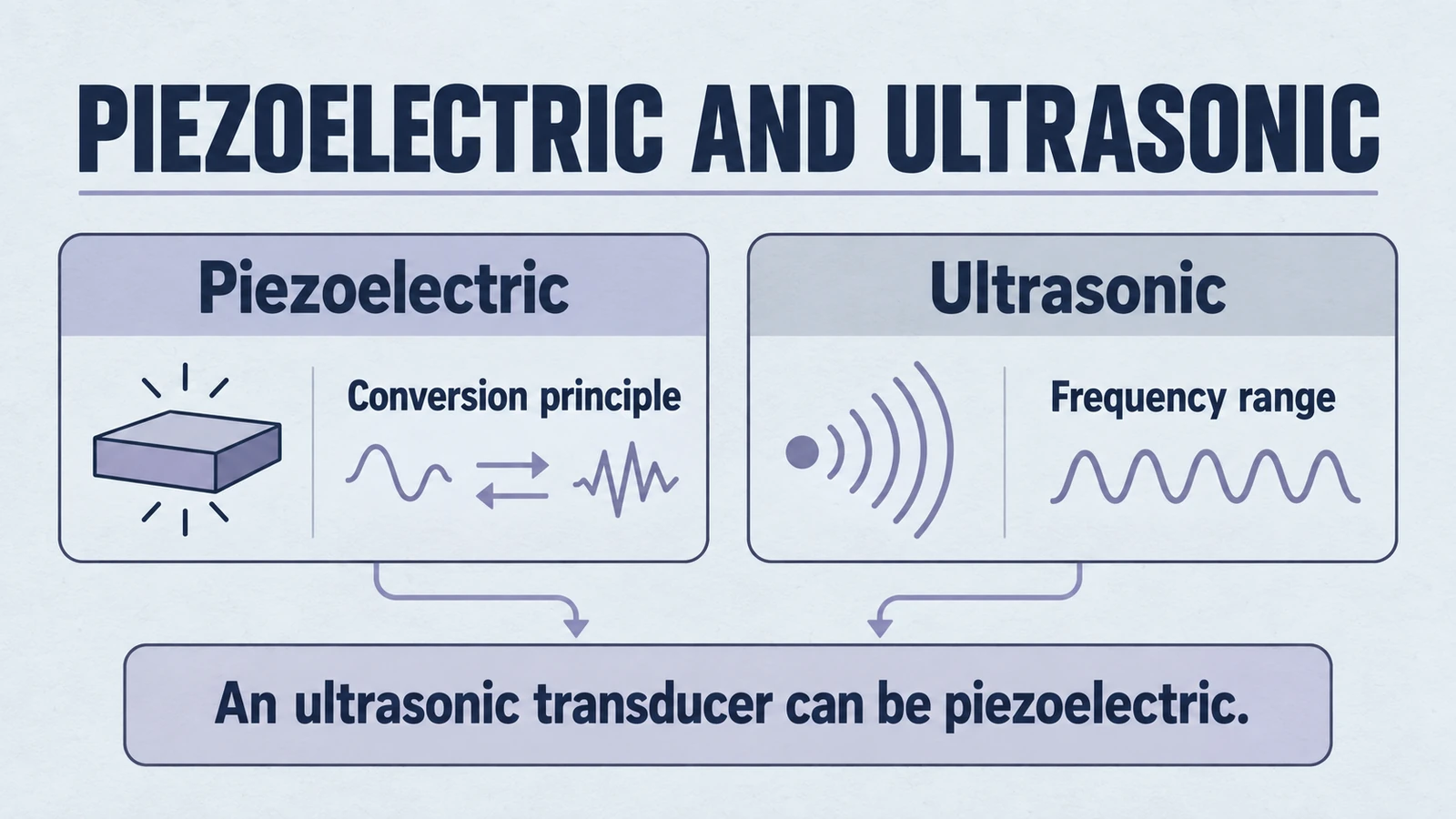
Quick answer: Piezoelectric identifies a conversion mechanism: it converts mechanical and electrical energy using a piezoelectric material such as PZT. An ultrasonic transducer is a specialized transducer designed to transmit or receive sound above 20 kHz. Most ultrasonic transducers are piezoelectric, but not every piezoelectric transducer is ultrasonic.
For the material side, start with what PZT is. For ultrasonic-grade selection, see PZT ultrasonic transducer selection.
Piezoelectric describes the conversion mechanism; ultrasonic describes the acoustic frequency range, generally above 20 kHz. The categories overlap. Piezoelectric devices need not be ultrasonic, and ultrasonic devices can use other mechanisms, including capacitive micromachined ultrasonic transducers (CMUTs).
Engineering decision focus: Determine whether your system needs general electromechanical conversion or ultrasonic wave transmission before final component selection.
Understanding this distinction is essential for engineers, designers, and product developers aiming to select the right component for their applications—whether it's sensing, actuation, or high-frequency signal transmission. This article aims to clarify the definitions, mechanisms, use cases, and critical differences between these two categories, providing a practical guide for component selection.
Product path for this search intent
Match the article topic to the right YJ Piezo product page
Use this article when sensor performance depends on target distance, beam angle, housing material, liquid behavior, or false echo control. For "Piezoelectric vs Ultrasonic Transducers: Engineering Differences", the practical value is in turning the topic into a measurable selection or sourcing decision.
- Ultrasonic Sensors
Distance, level, and detection sensor portfolio
- Flow Measurement Transducers
Bubble and flow-related ultrasonic sensing paths
- Air Acoustic Transducers
Air-coupled transducers for range and presence detection
What Are Piezoelectric Transducers?
Piezoelectric transducers are devices that use the piezoelectric effect to convert mechanical energy into electrical energy, and vice versa. This effect is observed in certain materials—most commonly piezoelectric ceramics like PZT (lead zirconate titanate)—which generate an electric charge under mechanical stress, and deform when subjected to an electric field. This dual function allows piezoelectric transducers to act as both sensors and actuators.
Key Characteristics:
- Material: PZT ceramics, quartz, PVDF polymers
- Frequency Range: Broad, from static signals to several MHz
- Applications: Pressure sensors, accelerometers, actuators, energy harvesters, vibration sensors, sonar systems
- Form Factors: Discs, rings, multilayer stacks, tubes, cantilevers
Piezoelectric transducers are widely used in applications requiring high precision, fast response, and reliability under harsh conditions. Their ability to provide accurate measurements and rapid actuation in compact, passive devices makes them suitable for industries ranging from aerospace to consumer electronics.
In addition, their high durability and lack of moving parts reduce wear and maintenance, making them a cost-effective solution for long-term applications. Some advanced systems even use piezo transducers for micro-positioning tasks in nanotechnology and optics.
What Are Ultrasonic Transducers?
Ultrasonic transducers transmit or receive acoustic waves above the audible range, conventionally above 20 kHz. Piezoelectric conversion is common, but CMUTs and other mechanisms also exist. Waves propagate through the relevant gas, liquid or solid medium.
Key Characteristics:
- Function: Emission and/or reception of ultrasonic waves
- Frequency Range: Typically 20 kHz to several MHz
- Applications:
- Medical imaging (ultrasound)
- Non-destructive testing (NDT)
- Ultrasonic cleaning
- Level sensing and flow measurement
- Robotics and obstacle detection
- Biometric sensors and fingerprint scanners
- Form Factors: Probes, sensor arrays, immersion transducers, air-coupled designs, focused elements
These transducers are engineered with additional design features—such as acoustic matching layers, backing layers for damping, and housing materials optimized for sound propagation—to maximize the efficiency and directionality of the emitted or received ultrasound signal. Some systems also use phased arrays for beam steering and improved resolution.
Relationship Between the Two
Are all ultrasonic transducers piezoelectric?
- Most are. Piezoelectric materials are the industry standard for generating ultrasonic waves due to their high energy efficiency, compact size, frequency controllability, and proven reliability.
- However, some ultrasonic transducers are based on alternative technologies, such as:
- CMUTs (Capacitive Micromachined Ultrasonic Transducers)
- Magnetostrictive transducers
- Optical and MEMS-based systems
Are all piezoelectric transducers ultrasonic?
- Definitely not. Many piezoelectric transducers operate at low or non-ultrasonic frequencies and are used for sensing physical changes like force, acceleration, displacement, or for precise micro-actuation tasks.
So, the correct relationship is:
Ultrasonic and piezoelectric transducers are overlapping categories (frequency versus conversion mechanism)
These categories overlap: piezoelectric describes conversion mechanism, whereas ultrasonic describes frequency. Some ultrasonic devices are piezoelectric and others use different mechanisms; piezoelectric devices can also operate below ultrasound.
Comparison Table
| Feature | Piezoelectric Transducers | Ultrasonic Transducers |
|---|---|---|
| Scope | General-purpose electromechanical converters | Specialized for ultrasonic wave generation and detection |
| Frequency Range | DC actuation to MHz; conventional direct piezo sensing has a finite low-frequency/charge-decay limit | >20 kHz (ultrasound) |
| Typical Use | Sensing, actuation, energy harvesting | Imaging, detection, measurement |
| Design Complexity | Often simpler, general-use designs | Acoustic-specific designs with matching layers, focused beams |
| Application Examples | Pressure sensors, energy harvesters, piezo buzzers | Ultrasound probes, ultrasonic welders, level meters |
| Directionality | Broad; not always directional | Often highly directional and beam-focused |
| Signal Processing | May require charge amplifiers | Usually integrated with echo processing and filtering systems |
How to Choose Between Them
The key is not choosing "either-or" but defining your application's need first, then selecting the most appropriate transducer. Here's a more detailed guide:
Choose a Piezoelectric Transducer if:
- You need to detect force, pressure, or vibration
- You are building a low-frequency actuator or sensor
- Your design needs durability, compact size, and low power consumption
- You require general electromechanical conversion without specific acoustic requirements
Our Ring Series and Disc Series offer excellent solutions for these applications.
Choose an Ultrasonic Transducer if:
- Your application involves wave propagation, imaging, or detection through air, liquid, or solid
- You need precise, non-contact measurement such as in fluid levels, distance sensing, or medical imaging
- Your system operates in the ultrasonic frequency range and requires beam directionality or echo analysis
- You're designing for cleanroom, underwater, or biomedical environments where acoustic performance is critical
Also consider:
- Environmental conditions (temperature, humidity, pressure)
- Mechanical integration and mounting options
- Required sensitivity, resolution, and frequency response
Product Examples from Our Portfolio
At Yujie Technology, we offer both piezoelectric and ultrasonic transducers for various applications:
Piezoelectric Transducers:
- Disc Series - Ideal for general sensing and actuation
- Ring Series - Perfect for force and pressure applications
- Rectangular Series - Optimized for specific mounting requirements
Ultrasonic Transducers:
- Cleaning Applications - High-power ultrasonic cleaning transducers
- Beauty Devices - Precision transducers for cosmetic applications
- Flow Measurement - Accurate flow sensing solutions
- Underwater Applications - Robust sonar and detection systems
Final Thoughts
Specify both the operating frequency and conversion mechanism. A piezoelectric ultrasonic device uses the piezoelectric effect, while another ultrasonic architecture may use a different mechanism. Device goals, loading and readout determine the appropriate design.
For metering OEMs, the gas flow transducer HJ-GF200KH and the liquid flow transducer HJ-2825/1M product pages include application and mounting guidance.
As technology continues to evolve, hybrid solutions are also emerging, where piezo and ultrasonic functions are combined, or enhanced with MEMS, optical, or AI-based signal processing.
If you're developing a system requiring precision sensing, high-frequency actuation, or reliable signal transmission, the right transducer choice can dramatically affect performance, longevity, and cost-effectiveness.
At Yujie, we offer both piezoelectric and ultrasonic transducers tailored to your specific application requirements. Whether you're prototyping a new device, upgrading existing systems, or seeking OEM production solutions, our engineering team is ready to help.
👉 Contact us today to explore our custom and standard transducer solutions—and unlock the power of precision.
Related Engineering Reading
Engineering decision notes
Ultrasonic sensing and detection
Use this article when sensor performance depends on target distance, beam angle, housing material, liquid behavior, or false echo control. For "Piezoelectric vs Ultrasonic Transducers: Engineering Differences", the practical value is in turning the topic into a measurable selection or sourcing decision.
YJ Piezo treats ultrasonic sensing as an acoustic interface problem: transducer frequency, beam shape, housing, drive electronics, and target environment are reviewed together.
Selection checks
- Define target range, dead zone, beam angle, and mounting geometry before choosing the sensor family.
- Check the medium, target surface, temperature swing, foam, vapor, and side-wall risk.
- Separate detection repeatability from ideal lab accuracy when the sensor will operate in a tank, tube, or moving line.
Failure risks
- A sensor can pass bench distance tests and still fail in tanks with foam, agitation, vapor, or narrow geometry.
- Changing only frequency without reviewing beam angle and mounting can increase false echoes.
- Ignoring housing material or sealing requirements can shorten lifetime in washdown or chemical environments.
RFQ details
- What is the minimum and maximum detection distance?
- Is the target liquid, solid, sheet material, air flow, or a moving object?
- What temperature, humidity, IP rating, and output signal does the system require?
Relevant YJ Piezo pages
- Ultrasonic Sensors
Distance, level, and detection sensor portfolio
- Flow Measurement Transducers
Bubble and flow-related ultrasonic sensing paths
- Air Acoustic Transducers
Air-coupled transducers for range and presence detection
Application FAQ
- What makes an ultrasonic sensor page useful for procurement?
- It should connect range, beam angle, output signal, housing, mounting, and environmental limits to a concrete use case. A model name alone is not enough for reliable supplier comparison.
- Which information speeds up an ultrasonic sensor RFQ?
- Send the target material, distance range, installation geometry, output interface, temperature range, IP rating, and whether the application involves foam, vapor, liquid, or moving objects.