
From Powder to Precision Mist: Why Your Ultrasonic Atomizing Transducer's Manufacturing Partner Matters
For Original Equipment Manufacturers (OEMs) designing critical-application devices, the ultrasonic atomizing transducer is not just a small part. It is the vibration engine inside the system. Whether that system is a nebulizer device, a semiconductor coating line, or a precision agricultural misting platform, the reliability of the misting engine depends heavily on the piezoelectric ceramic element at its core.
Yet, when systems fail, the blame is often misplaced. Product engineers and end-users are told to troubleshoot "common problems": clean the nozzle for "clogging", check for "power issues", or perform more frequent "maintenance".
But what if these problems are not common user errors? What if they are symptoms of a deeper, component-level failure—a failure rooted in a supplier who prioritizes unit price over manufacturing consistency?
This article explains why the important sourcing decision is not only whether you use an ultrasonic atomizer piezo element, but how that ceramic element is specified, manufactured, tested, and documented. The difference between a commodity part and an engineering partnership often becomes visible only after prototypes move toward production.
Product path for this search intent
Match the article topic to the right YJ Piezo product page
Use this article when the choice is not just a shape, but a material tradeoff between sensitivity, loss, coupling, stability, and operating field. For "From Powder to Precision Mist: Why Your Ultrasonic Atomizing Transducer's Manufacturing...", the practical value is in turning the topic into a measurable selection or sourcing decision.
- PZT Material Hub
Material grades and application tradeoffs
- Piezoelectric Ceramics
Shapes and ceramic manufacturing options
- PZT Material Supplier Hub
Material control, grade selection, and sourcing support
The High Cost of Inconsistency: When "Common" Problems Are Supplier Problems
For an OEM engineer, field failures are the ultimate nightmare, leading to costly warranty claims, reputational damage, and frantic troubleshooting. Many of the most-cited "common problems" in atomization systems can be traced directly back to a substandard transducer.
The "Inconsistent Mist" Failure
The most frequent complaint for atomization systems is low, uneven, or inconsistent mist. The user guide may blame a clogged mesh, but the engineering cause can also be unstable vibration. A poorly matched piezoelectric ceramic may not transfer energy uniformly across the working surface, especially when the housing, adhesive, liquid load, and drive circuit are not considered together.
The Droplet Size Dilemma: Precision vs. Reality
The core promise of ultrasonic atomization is controlled droplet formation. For a nebulizer device program, droplet-size distribution is validated at the finished-device level. For an industrial coater, it affects film thickness and yield. In both cases, the piezo ceramic contributes through stable frequency, amplitude, and coupling to the working surface.
However, the reality of a cheap, off-the-shelf component can be non-uniform particle sizes and unstable output. In semiconductor manufacturing, that may mean wasted coating material or scrap. In regulated aerosol devices, it may mean additional design iteration and validation work before the device team can move forward.
The Downtime Multiplier: Cavitation, Contamination, and Failure
Cavitation erosion depends on the acoustic field, coupling, liquid and exposed surface. Component, integration and operating factors can interact; investigate root cause experimentally instead of assigning universal acceleration or supplier fault.
In nebulizer device programs, uneven vibration can also complicate cleaning validation, liquid-reservoir design, and output repeatability. These are finished-device responsibilities, but component-level consistency makes that work easier to control.
These are not user-level problems. They are supplier-level failures.
Beyond the Reseller: The Yujie "Powder-to-Performance" Philosophy
A strong way to reduce these component-level failures is to work with a partner who controls the component at its most fundamental level: the ceramic material.
Yujie Technology was founded in 1996 and focuses on piezoelectric ceramic components, PZT materials, and custom ceramic shapes. Our work for atomization-related designs is centered on the ceramic element: material formulation, geometry, electrode pattern, frequency target, and production testing.
We Aren't Assemblers; We Are Materials Scientists
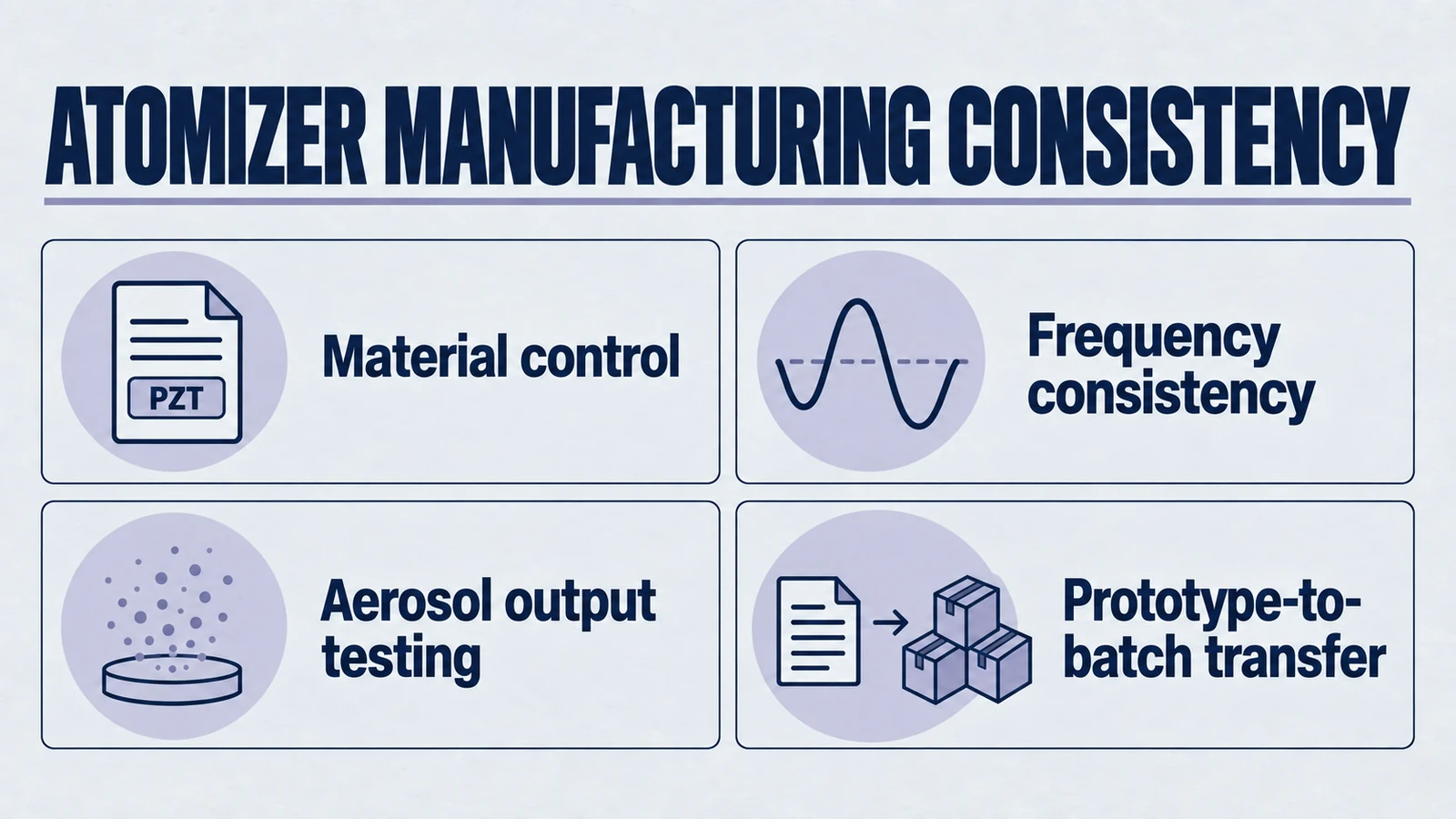
The integrity of any piezoelectric device begins with the chemistry of the ceramic itself. Yujie controls the vertical ceramic manufacturing process, from PZT powder formulation to machining, electrode application, poling, and electrical inspection. This in-house, materials-science-led approach helps reduce the inconsistencies that can appear in commodity components.
The Right Material for the Mist: "Soft" PZT for Atomization
Not all piezoelectric ceramics are created equal. Engineers know that "Hard" PZT (like PZT-4) is for high-power applications like ultrasonic cleaning transducers, while "Soft" PZT (like PZT-5) is for precision and sensitivity.
A precision ultrasonic atomizing transducer may use a high-sensitivity soft PZT formulation, such as PZT-5A or PZT-5H, when the design needs strong displacement at a controlled drive level. Yujie's PZT materials can be selected according to sensitivity, dielectric behavior, mechanical quality, and operating load.
This material choice is one part of the technical solution. The final mist behavior still depends on the complete system, but stable piezo ceramic properties give the device team a more predictable starting point.
Manufacturing Controls from Prototype to Batch Production
For an OEM procurement manager, an innovative component is not enough without supply chain integrity. Our manufacturing workflow supports project-specific inspection, agreed batch records, and production communication. The applicable controls and documentation are confirmed during qualification.
With high-volume production capacity for piezoelectric ceramic chips, we support prototype-to-production programs that require consistent ceramic dimensions and electrical parameters.
Engineering in Action: Critical Applications Powered by Yujie
Yujie's "powder-to-performance" approach is not theoretical. It is the enabling technology behind next-generation devices in the world's most demanding industries.
Nebulizer Device Programs: Protecting Material and Output Requirements
- Application: Medical nebulizers for respiratory diseases like COPD, asthma, and cystic fibrosis.
- The Challenge: Some formulations are sensitive to thermal or interfacial stress. Verify drug/formulation compatibility, temperature and delivered dose with the complete nebulizer; therapeutic effectiveness belongs to the particular drug and indication, not the ceramic grade or aerosol architecture.
- Yujie's Role: Yujie supports the piezo ceramic rings, discs, and custom elements that can be used to drive vibrating mesh assemblies. Finished-device teams remain responsible for aerosol output, material-contact validation, cleaning validation, and regulatory submissions.
Industrial & Semiconductor: Material Utilization and Coating Consistency
- Application: Applying conformal coatings on Printed Circuit Boards (PCBs), thin-film coatings for solar cells, and hydrophobic layers on electronics.
- The Challenge: Traditional pneumatic spray nozzles are notoriously wasteful, non-uniform, and can clog.
- Yujie's Role: Our piezo ceramic elements can be matched to ultrasonic nozzle designs where the customer is optimizing material utilization, film uniformity, and maintenance intervals.
Precision Agriculture: Smart Fogging for a Smarter Farm
- Application: Smart misting systems for the precise delivery of pesticides, herbicides, and nutrients in automated, data-driven farming.
- The Challenge: Component failure in harsh, outdoor agricultural environments where reliability is paramount.
- Yujie's Role: We manufacture robust ceramic elements for misting and fogging systems where stable output, corrosion considerations, and field durability matter.
The Manufacturing Partner Decision Matrix: Are You Buying a Component or a Partnership?
When you are in the "Decision" stage of sourcing, the spec sheet of a commodity supplier and an OEM piezoelectric component supplier may look similar. But the procurement manager and lead engineer know the real evaluation criteria are risk, reliability, and support.
Based on Yujie's own engineering-partner standard, the choice becomes clear.
| Evaluation Criterion | The "Commodity Supplier" Approach | The Yujie Engineering Partner Standard |
|---|---|---|
| Design & Prototyping | Awaits your final drawings to provide a price quote. | Offers collaborative design review, FEA simulation, and pre-tooling optimization. |
| Material Science | Uses generic, off-the-shelf PZT materials, leading to "inconsistent mist". | Develops custom, proprietary "soft" PZT formulations (e.g., PZT-5H) engineered for atomization. |
| Quality & Consistency | High risk of batch-to-batch variation, causing field failures and "cold spots". | Project-specific inspection and process controls, with agreed acceptance limits and records. |
| Scalability & Supply Chain | Promises future capacity can be met. | Reviews tooling, process constraints, inspection throughput, and capacity against the selected component and forecast. |
| Support | Transactional. Support ends at delivery. | An end-to-end engineering partnership, from integration troubleshooting to custom OEM solutions. |
Don't Just Buy a Component, Secure Your Product's Future
The "common problems" that plague atomization systems are often easier to manage when ceramic material, geometry, and testing are addressed at the beginning of the project.
At Yujie, we believe that a well-machined component still needs the right material foundation. We start with the PZT material, then support the shape, electrode, and test requirements that your design actually needs.
Your product's performance depends on the precision of its smallest engine. Don't let a component-level risk derail your entire project.
Contact the Yujie engineering team today to discuss PZT ceramic material, disc, ring, rectangular, or custom element requirements for your atomization, sensor, cleaning, or other OEM ultrasonic system.
Engineering decision notes
PZT material and ceramic selection
Use this article when the choice is not just a shape, but a material tradeoff between sensitivity, loss, coupling, stability, and operating field. For "From Powder to Precision Mist: Why Your Ultrasonic Atomizing Transducer's Manufacturing...", the practical value is in turning the topic into a measurable selection or sourcing decision.
YJ Piezo coordinates PZT ceramic projects with manufacturing support, so material formulation, sintering, polarization, electrode process, and outgoing inspection can be reviewed against the final application.
Selection checks
- Separate sensing needs from high-power actuation needs before comparing d33 or coupling values.
- Check dielectric loss, Qm, Curie temperature, aging behavior, and operating field against the real duty cycle.
- Confirm whether the application needs standard PZT grades or a custom formulation and geometry.
Failure risks
- Choosing only the highest d33 can create heat, drift, or depolarization risk in power ultrasonics.
- A ceramic that performs well in free measurement can fail once bonded, clamped, or loaded.
- Material substitutions without batch testing can change capacitance, resonance, and system tuning.
RFQ details
- Is the part used for sensing, actuation, atomization, cleaning, welding, or measurement?
- What field strength, temperature, duty cycle, and mechanical load will the ceramic see?
- Which values must be controlled: d33, capacitance, resonance, impedance, Qm, or dimensional tolerance?
Relevant YJ Piezo pages
- PZT Material Hub
Material grades and application tradeoffs
- Piezoelectric Ceramics
Shapes and ceramic manufacturing options
- PZT Material Supplier Hub
Material control, grade selection, and sourcing support
Application FAQ
- Is the highest d33 always the best PZT choice?
- No. High d33 can be useful for sensitivity, but high-power ultrasonic systems often need lower loss, higher Qm, better thermal stability, and safer operation under field and stress.
- What makes PZT material selection different from catalog buying?
- The right PZT choice depends on geometry, load, drive field, duty cycle, temperature, and inspection targets. A catalog value is only useful when it is tied to the final assembly conditions.