
The Procurement Paradox: How Yujie Solves the Hidden Risks of Sourcing an Ultrasonic Nebulizer Transducer
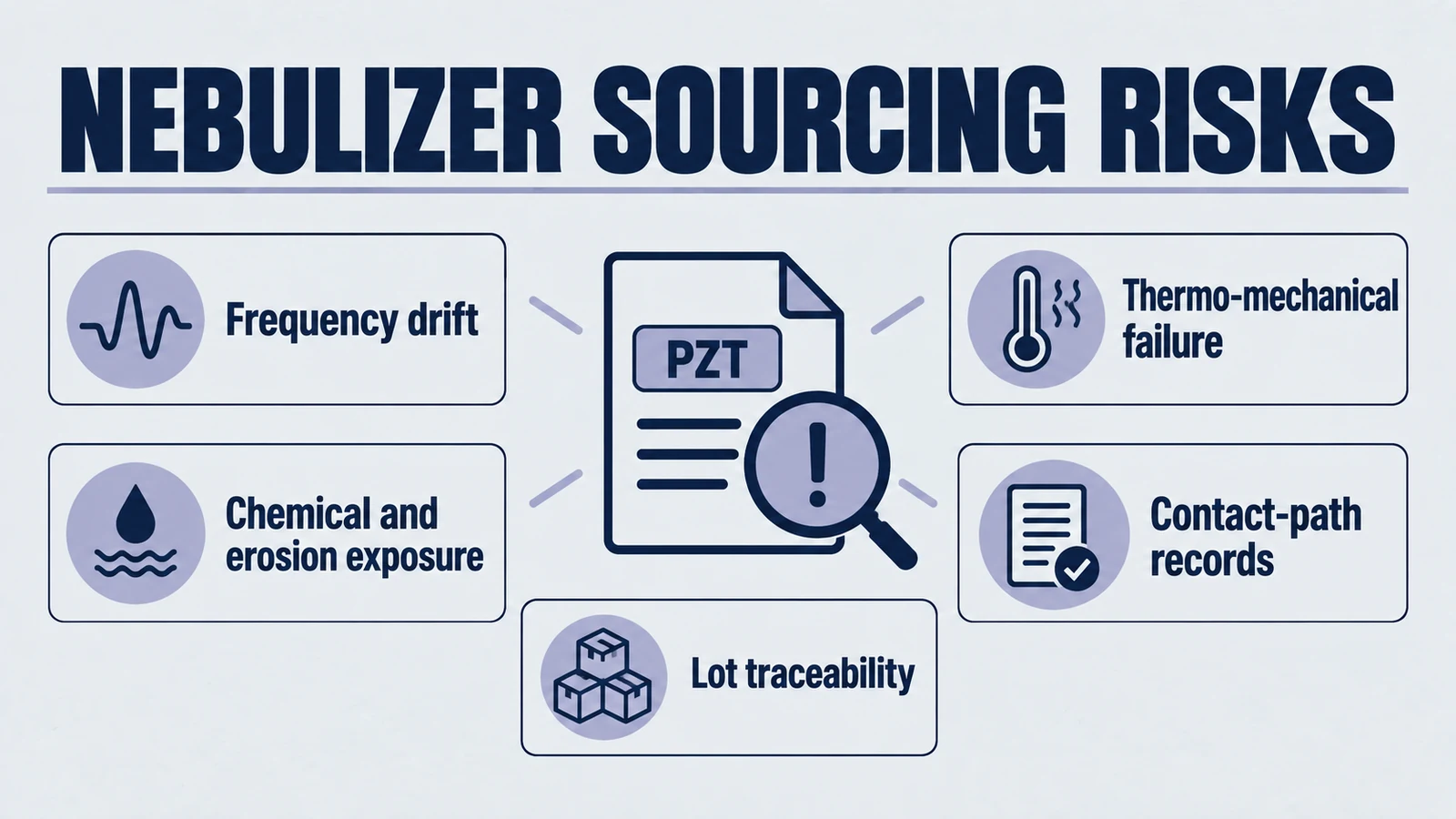
For the R&D engineer or product manager working on a nebulizer device, the ultrasonic nebulizer transducer is often treated as a small purchased part. In reality, the piezoelectric ceramic element inside that transducer can influence frequency behavior, vibration stability, heat generation, and repeatability across production lots.
This creates a sourcing challenge we call the procurement paradox. Several suppliers may offer parts with the same nominal frequency, capacitance, diameter, and tolerance. On paper, the datasheets look interchangeable. In an assembled device, they may behave very differently.
An engineer might gather datasheets for PZT ceramic discs, rings, or bonded elements and see similar values. What the datasheet may not show is powder formulation control, sintering consistency, electrode quality, dielectric loss, aging behavior, bonding recommendations, or lot-to-lot variation.
The consumer market reinforces the confusion. A household humidifier and a regulated nebulizer device may both use piezoelectric vibration, but the engineering requirements are not the same. A designer who treats all atomizing ceramics as commodity accessories can inherit unnecessary redesign, validation, and production risk.
Product path for this search intent
Match the article topic to the right YJ Piezo product page
Use this article when the choice is not just a shape, but a material tradeoff between sensitivity, loss, coupling, stability, and operating field. For "The Procurement Paradox: How Yujie Solves the Hidden Risks of Sourcing an Ultrasonic Ne...", the practical value is in turning the topic into a measurable selection or sourcing decision.
- PZT Material Hub
Material grades and application tradeoffs
- Piezoelectric Ceramics
Shapes and ceramic manufacturing options
- PZT Material Supplier Hub
Material control, grade selection, and sourcing support
The final nebulizer system must be verified by the device manufacturer. Yujie's role is more specific: we support the piezo ceramic elements, PZT material selection, geometry, electrode options, and batch data that help the device team build a more controlled design.
This guide explains the hidden risks that can sit behind an "in-spec" component and gives a practical framework for specifying the ceramic element inside a nebulizer transducer.
The Anatomy of Failure: Why "In-Spec" Transducers Fail in the Real World
A transducer can meet incoming inspection values and still create trouble in the finished assembly. These failures are often rooted in material science and manufacturing process, which a simple datasheet cannot fully predict.
Failure Mode 1: The "Silent" Failure – Frequency Drift and Aerosol-Output Variability
In an aerosol device, mist output and droplet-size distribution are validated at the finished-device level. The piezo element contributes by maintaining stable vibration under the selected drive conditions.
Frequency is not the whole story. Mesh design, liquid properties, drive waveform, mechanical mounting, and temperature all matter. But if the ceramic element drifts under load, the system team may see changing output even when the incoming component record looks acceptable.
A low-cost ultrasonic nebulizer transducer, even if measured at the target frequency at the factory, may respond differently after bonding, heating, or long operation. That is why engineering teams should review resonant behavior, impedance, capacitance, and thermal behavior in the actual assembly.
This issue is easy to miss because the device may still produce visible mist. The more useful question is whether the finished device continues to meet its own output and validation targets after temperature, duty-cycle, liquid, and aging tests.
This is the classic in-application mismatch: mechanically active, but not stable enough for the finished design target.
Failure Mode 2: Thermo-Mechanical Breakdown
Piezoelectric ceramics are not 100% efficient. During operation, dielectric and mechanical losses can generate heat. In a low-demand consumer accessory, this may be manageable. In a compact high-duty-cycle device, thermal load becomes a primary engineering challenge.
When a ceramic element overheats, it can shift electrically, lose output, or crack from thermo-mechanical stress. The root cause may be drive design, mounting, poor heat path, or high dielectric loss in the ceramic itself.
This is why batch control matters. Dielectric loss can vary between ceramic lots, even when primary dimensions and nominal frequency match. A supplier who controls the PZT material process can provide more useful data than a reseller who only passes along a catalog value.
The procurement paradox appears when the R&D team validates a "golden sample" from one lot and later receives production lots made from slightly different ceramic conditions. The more demanding the assembly, the more important batch records and incoming comparison tests become.
Failure Mode 3: The Degradation Failure – Cavitation Erosion and Chemical Attack
An ultrasonic nebulizer transducer does not work in isolation. It is connected to a liquid path, membrane, adhesive system, housing, and drive circuit. Each interface can affect durability.
In some designs, acoustic activity, cleaning chemistry, or corrosive liquids can create erosion or material attack on exposed surfaces. If the ceramic is isolated from the liquid path, the design challenge changes to bonding, vibration transfer, and seal stability.
For this reason, material selection cannot stop at the ceramic type. The finished-device team should consider coatings, electrodes, adhesives, isolation design, cleaning environment, and validation method. A ceramic supplier can support this work with material traceability and clear part construction information.
The Critical Divide: What Regulated-Device Sourcing Requires
A standard datasheet is not enough for regulated-device sourcing. Instead of relying on broad labels, procurement teams should ask what documentation the component supplier can provide and what validation remains with the finished-device manufacturer.
Requirement 1: Material Contact Review and the Hidden Lead Question
PZT stands for lead zirconate titanate, and lead is part of the ceramic chemistry. In many devices, the ceramic is not intended to be a wetted material; it may be isolated, coated, encapsulated, or separated from the fluid path. The finished-device manufacturer must define and validate that contact-path strategy.
Yujie supports this review by providing traceable PZT material information, ceramic lot control, and part construction details where applicable. If the customer's design requires a different material strategy or isolation approach, that should be discussed before prototype tooling.
This is also why component-level wording must be precise. A ceramic element alone does not make a finished device compliant. Compliance and material-contact validation are system-level responsibilities.
Requirement 2: Traceability and Lot Control
Regulated and high-reliability OEM programs need a clear chain of information. Which ceramic material was used? Which lot produced the samples? Which test values were recorded? Were electrode, thickness, diameter, and capacitance controlled consistently?
If a future test result changes, the OEM should be able to compare lots, not start over from guesswork. Traceability is not glamorous, but it is one of the strongest protections against confusion during scale-up.
This is where a commodity supplier creates hidden business risk. If the supplier provides no lot numbers, no batch control, and no material information, the OEM has less ability to isolate a root cause.
The unseen value of a higher-control supplier is not just the component; it is the data behind the component.
| Parameter | Commodity Spec | The Hidden Risk | Better Component-Level Requirement |
|---|---|---|---|
| Frequency | 2.4 MHz | Frequency drift after bonding, heating, or aging | Define frequency target, tolerance, test method, and assembly-level verification |
| Material | PZT-8 Ceramic | Variable dielectric loss or unclear material lot | Traceable PZT material, agreed electrical properties, and contact-path documentation |
| Surface | Metal Diaphragm | Coating, electrode, or bonding not matched to the environment | Define liquid exposure, isolation method, coating needs, and cleaning conditions |
| Lifetime | 10,000-hour lifetime | Golden sample problem. Fails due to batch-to-batch inconsistency | Lot comparison data and finished-assembly lifetime testing by the OEM |
| Quality | QC Passed Stamp | No traceability. No batch numbers. Impossible to isolate issues for recall | Material and batch lot control with agreed records for customer files |
The Yujie Solution: Engineering for Consistency, Safety, and Reliability
Yujie Piezo addresses the procurement paradox by focusing on the ceramic element itself. We manufacture piezoelectric ceramics, support PZT material selection, and work with customers on disc, ring, rectangular, and custom geometries.
Solving Failure Mode 1 & 2: Batch-to-Batch Consistency Control
We recognize that transducer manufacturing is complex. Batch variation is one of the main threats to OEM production, so our process focuses on control and verification:
- Controlling the "Material DNA": Our process begins with PZT material formulation and raw-material qualification.
- Standardized Production (SOPs): Our manufacturing lines are governed by rigid, documented Standard Operating Procedures for every step—mixing, pressing, poling, assembly, and curing.
- Final Testing: Critical parameters such as resonant behavior, impedance, capacitance, and dimensions can be tested according to the customer's agreed control plan.
This process supports consistency. It gives OEM teams a clearer basis for comparing R&D samples, pilot builds, and production lots.
Solving Failure Mode 3 & The Lead Risk: Designing the Contact Path
For nebulizer-related programs, the finished-device team should define whether the ceramic is outside the liquid path, coated, encapsulated, or otherwise isolated. Yujie can support that discussion at the ceramic element level:
- Material Selection: We help compare PZT material options based on sensitivity, loss, coupling, stability, and operating load.
- Geometry Selection: We support disc, ring, rectangular, and custom ceramic shapes depending on the assembly.
- Documentation Support: We provide ceramic material and batch information to support the customer's own validation records.
Solving the Documentation Burden: A Clearer Component Partner
An OEM's regulatory and quality teams should not be scrambling to find component data late in development. Yujie is not a black-box supplier. Depending on the project agreement, ceramic component shipments can be supported with:
- Batch and Lot Control Numbers for full traceability
- Certificates of Conformance (CoC)
- Material Certifications (available upon request)
This does not replace finished-device compliance work. It gives the device manufacturer better component evidence to include in its own files and investigations.
Conclusion: Specify a Partner, Not Just an Ultrasonic Nebulizer Transducer
We return to the procurement paradox. Identical spec sheets can hide meaningful differences in PZT ceramic material, process control, batch traceability, and assembly behavior.
Yujie Piezo solves this problem by shifting the discussion from the spec sheet to the process. Our "Material DNA" approach focuses on ceramic formulation, production control, and practical engineering support.
The true cost of a component is not only its initial purchase price. It also includes the cost of redesign, validation delay, inconsistent lots, and unclear documentation.
Contact Yujie's engineering team to discuss PZT ceramic material, frequency target, disc/ring geometry, electrode pattern, and sample requirements for your nebulizer or atomization system.
Companion Guides for Nebulizer Sourcing Teams
Engineering decision notes
PZT material and ceramic selection
Use this article when the choice is not just a shape, but a material tradeoff between sensitivity, loss, coupling, stability, and operating field. For "The Procurement Paradox: How Yujie Solves the Hidden Risks of Sourcing an Ultrasonic Ne...", the practical value is in turning the topic into a measurable selection or sourcing decision.
YJ Piezo coordinates PZT ceramic projects with manufacturing support, so material formulation, sintering, polarization, electrode process, and outgoing inspection can be reviewed against the final application.
Selection checks
- Separate sensing needs from high-power actuation needs before comparing d33 or coupling values.
- Check dielectric loss, Qm, Curie temperature, aging behavior, and operating field against the real duty cycle.
- Confirm whether the application needs standard PZT grades or a custom formulation and geometry.
Failure risks
- Choosing only the highest d33 can create heat, drift, or depolarization risk in power ultrasonics.
- A ceramic that performs well in free measurement can fail once bonded, clamped, or loaded.
- Material substitutions without batch testing can change capacitance, resonance, and system tuning.
RFQ details
- Is the part used for sensing, actuation, atomization, cleaning, welding, or measurement?
- What field strength, temperature, duty cycle, and mechanical load will the ceramic see?
- Which values must be controlled: d33, capacitance, resonance, impedance, Qm, or dimensional tolerance?
Relevant YJ Piezo pages
- PZT Material Hub
Material grades and application tradeoffs
- Piezoelectric Ceramics
Shapes and ceramic manufacturing options
- PZT Material Supplier Hub
Material control, grade selection, and sourcing support
Application FAQ
- Is the highest d33 always the best PZT choice?
- No. High d33 can be useful for sensitivity, but high-power ultrasonic systems often need lower loss, higher Qm, better thermal stability, and safer operation under field and stress.
- What makes PZT material selection different from catalog buying?
- The right PZT choice depends on geometry, load, drive field, duty cycle, temperature, and inspection targets. A catalog value is only useful when it is tied to the final assembly conditions.