
Why PZT Dominates Piezo Ceramics: Practical Engineering View
Introduction
In the world of piezoelectric materials, lead zirconate titanate (PZT) holds a commanding position as the most widely used and versatile ceramic. Since its discovery in the mid-20th century, PZT has become the cornerstone material for applications ranging from ultrasonic transducers and sensors to actuators and energy harvesters. This dominance is rooted in a combination of exceptional PZT ceramic properties, broad tunability, and adaptability to both high-performance and cost-effective designs.
Engineering decision focus: Evaluate d33, Qm, dielectric loss, and drive stress together so performance gains do not create reliability drift in long-duty operation.
This article dives into the science behind PZT, explaining why it remains the industry’s top choice and what makes its properties so unique. For a foundation on raw materials, see our guide on PZT powder.
Product path for this search intent
Match the article topic to the right YJ Piezo product page
Use this article when the choice is not just a shape, but a material tradeoff between sensitivity, loss, coupling, stability, and operating field. For "Why PZT Dominates Piezo Ceramics: Practical Engineering View", the practical value is in turning the topic into a measurable selection or sourcing decision.
- PZT Material Hub
Material grades and application tradeoffs
- Piezoelectric Ceramics
Shapes and ceramic manufacturing options
- PZT Material Supplier Hub
Material control, grade selection, and sourcing support
What is Lead Zirconate Titanate (PZT)?
Lead zirconate titanate (chemical formula Pb[ZrxTi1−x]O3) is a solid solution of lead zirconate (PbZrO3) and lead titanate (PbTiO3). By adjusting the zirconium-to-titanium ratio, engineers can fine-tune its crystal structure and thus its piezoelectric, dielectric, and mechanical properties.
PZT ceramics exhibit ferroelectric behavior, meaning their internal electric dipoles can be reoriented by an external electric field. This property is key to their piezoelectric effect—the ability to convert mechanical stress into electrical signals and vice versa.
PZT Ceramic Properties That Set It Apart
1. High Piezoelectric Coefficients
PZT’s piezoelectric constants (such as d33) can exceed 500 pC/N in soft PZT formulations, enabling sensitive detection of small mechanical changes and efficient energy conversion.
2. Tailorable Properties
By modifying the Zr/Ti ratio and introducing dopants (softening with donor dopants or hardening with acceptor dopants), manufacturers can create variants optimized for:
- High sensitivity (soft PZT)
- High power and stability under stress (hard PZT)
3. Wide Operating Temperature Range
With Curie temperatures ranging from 200°C to over 350°C, PZT can perform reliably in challenging thermal environments.
4. High Dielectric Constant
PZT’s dielectric constants can be several thousand, allowing strong charge storage capability and efficient actuation.
5. Mechanical Strength and Stability
PZT ceramics have robust mechanical properties, making them suitable for high-vibration and high-load environments.
Why PZT Dominates Piezo Ceramics
- Performance-to-Cost Ratio – PZT delivers exceptional properties at a manufacturing cost lower than many advanced single crystals.
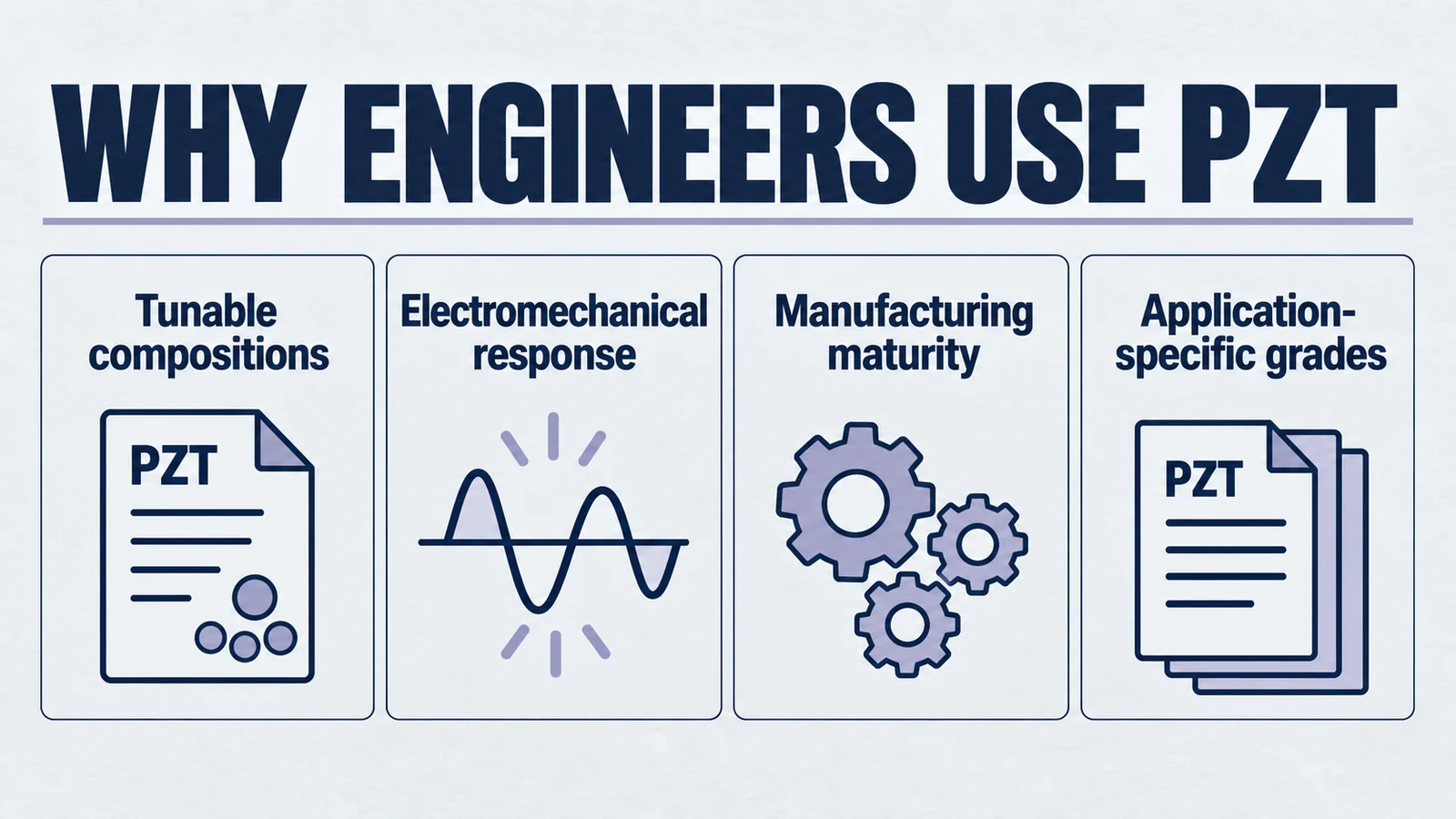
- Mature Manufacturing Processes – Decades of refinement in powder synthesis, pressing, sintering, and electrode application ensure consistent quality.
- Design Flexibility – PZT can be formed into discs, rings, tubes, plates, and complex geometries.
- Broad Industry Adoption – From medical imaging probes to industrial ultrasonic cleaners, PZT is a trusted and proven material.
- Customizability – Specific formulations can be engineered to meet unique application demands.
Applications Leveraging PZT Ceramic Properties
Thanks to its versatile performance profile, PZT finds use in:
- Medical Ultrasound Transducers – High sensitivity and resolution for diagnostic imaging. See our HJ-4036-1M beauty transducer as an example of ergonomic coupling and frequency control.
- Industrial Ultrasonic Transducers – Robustness under continuous high-power operation. Explore HJ-3528B cleaner transducer and HJ-3825 precision cleaner.
- Sensors – Vibration, pressure, and acoustic sensing. For bubble detection in tubes, check our ultrasonic bubble detection sensor.
- Welding – High-power energy transfer for plastics and metals. See the HJ-6015 ultrasonic welder transducer.
- Flow Measurement – Stable frequency and coupling for transit-time systems. View the HJ-2112-1M flowmeter transducer.
Future Outlook for PZT
While research into lead-free piezoelectric alternatives is accelerating due to environmental regulations, PZT remains strong in terms of performance, availability, and cost-effectiveness. Ongoing innovations in doping strategies, composite structures, and thin-film fabrication promise to further expand PZT’s application range.
Conclusion
The science behind lead zirconate titanate (PZT) explains its strong status in the piezoelectric ceramics industry. Its unique combination of high piezoelectric response, tunable properties, durability, and cost-effectiveness ensures that PZT will remain the go-to material for high-performance applications for years to come.
Related Engineering Reading
- Review PZT fundamentals before final material selection
- Compare soft vs hard PZT trade-offs for your duty cycle
- Review piezoelectric ceramics options for sourcing
- Contact engineering for application fit validation
For technical selection support or custom specification, contact our technical team.
Engineering decision notes
PZT material and ceramic selection
Use this article when the choice is not just a shape, but a material tradeoff between sensitivity, loss, coupling, stability, and operating field. For "Why PZT Dominates Piezo Ceramics: Practical Engineering View", the practical value is in turning the topic into a measurable selection or sourcing decision.
YJ Piezo coordinates PZT ceramic projects with manufacturing support, so material formulation, sintering, polarization, electrode process, and outgoing inspection can be reviewed against the final application.
Selection checks
- Separate sensing needs from high-power actuation needs before comparing d33 or coupling values.
- Check dielectric loss, Qm, Curie temperature, aging behavior, and operating field against the real duty cycle.
- Confirm whether the application needs standard PZT grades or a custom formulation and geometry.
Failure risks
- Choosing only the highest d33 can create heat, drift, or depolarization risk in power ultrasonics.
- A ceramic that performs well in free measurement can fail once bonded, clamped, or loaded.
- Material substitutions without batch testing can change capacitance, resonance, and system tuning.
RFQ details
- Is the part used for sensing, actuation, atomization, cleaning, welding, or measurement?
- What field strength, temperature, duty cycle, and mechanical load will the ceramic see?
- Which values must be controlled: d33, capacitance, resonance, impedance, Qm, or dimensional tolerance?
Relevant YJ Piezo pages
- PZT Material Hub
Material grades and application tradeoffs
- Piezoelectric Ceramics
Shapes and ceramic manufacturing options
- PZT Material Supplier Hub
Material control, grade selection, and sourcing support
Application FAQ
- Is the highest d33 always the best PZT choice?
- No. High d33 can be useful for sensitivity, but high-power ultrasonic systems often need lower loss, higher Qm, better thermal stability, and safer operation under field and stress.
- What makes PZT material selection different from catalog buying?
- The right PZT choice depends on geometry, load, drive field, duty cycle, temperature, and inspection targets. A catalog value is only useful when it is tied to the final assembly conditions.