
The Secret Language of Piezoelectricity: Decoding d33, k, and Qm
The Silent Engine of Modernity
In the intricate tapestry of modern electromechanical engineering, few materials bridge the chasm between the digital and physical worlds as effectively as piezoelectric ceramics. These polycrystalline materials, capable of converting mechanical stress into electrical energy and vice versa, serve as the beating heart of an immense array of technologies. From the precise autofocus mechanisms in smartphone cameras to the massive ultrasonic welders used in automotive assembly lines, and from the delicate hydrophones monitoring ocean acoustics to the robust sensors optimizing industrial fluid flow, piezoelectricity is ubiquitous.
Yet, for the product designer, the R&D engineer, or the procurement specialist, the datasheets that describe these materials often resemble a cryptic cipher. Columns of Greek letters, varying units, and complex coefficients—, , , —can obscure the true performance characteristics of the material.
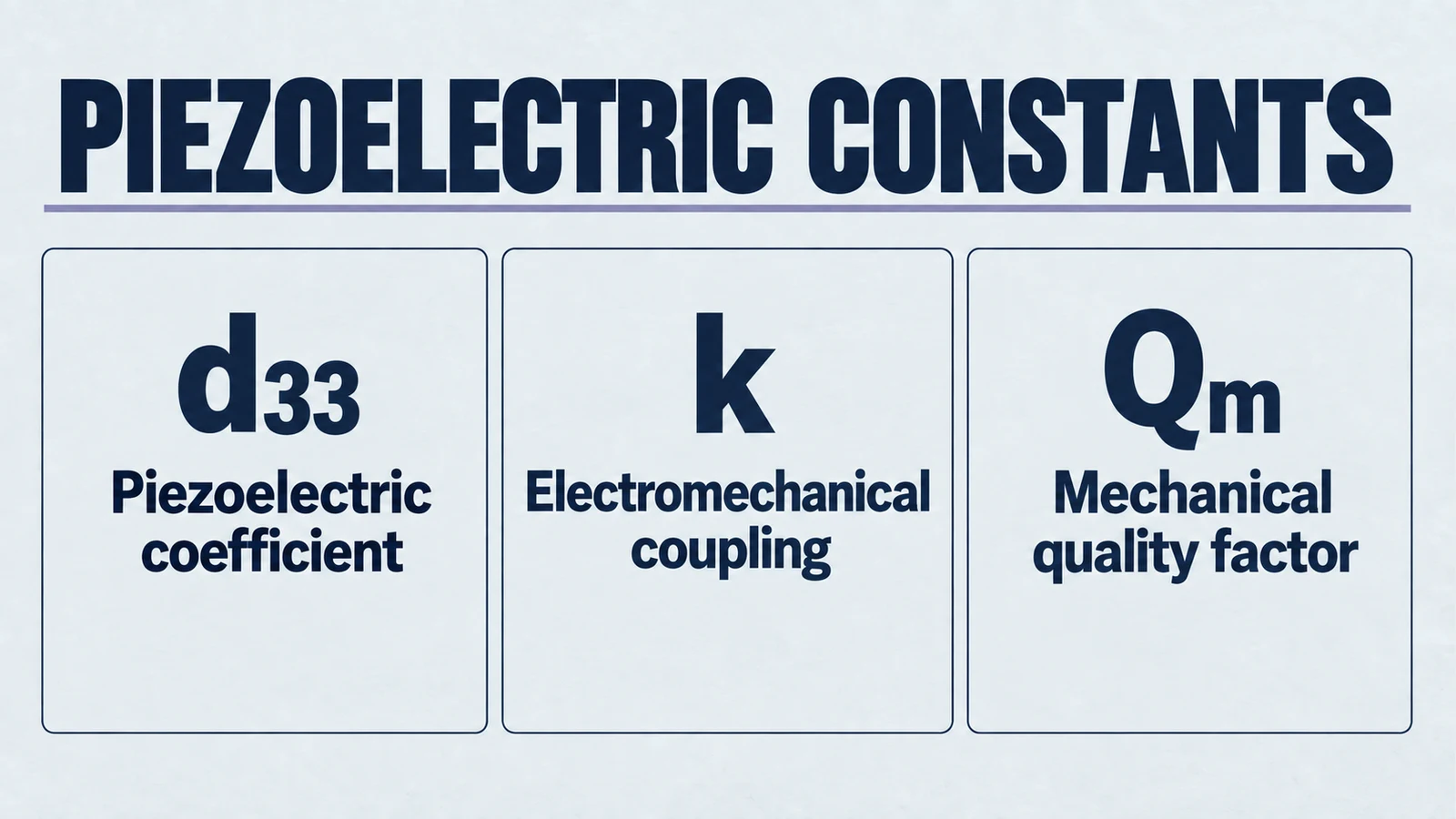
Selecting the correct piezoelectric ceramic is not merely a matter of matching dimensions or satisfying a voltage requirement; it is a sophisticated exercise in balancing conflicting physical properties to achieve a specific, often demanding, engineering outcome. The difference between a medical imaging probe that provides crystal-clear diagnostics and a cleaning transducer that overheats and fails within minutes often lies in the nuanced understanding of three critical parameters: the Piezoelectric Charge Constant (), the Electromechanical Coupling Factor (), and the Mechanical Quality Factor ().
Product path for this search intent
Match the article topic to the right YJ Piezo product page
Use this article when the choice is not just a shape, but a material tradeoff between sensitivity, loss, coupling, stability, and operating field. For "The Secret Language of Piezoelectricity: Decoding d33, k, and Qm", the practical value is in turning the topic into a measurable selection or sourcing decision.
- PZT Material Hub
Material grades and application tradeoffs
- Piezoelectric Ceramics
Shapes and ceramic manufacturing options
- PZT Material Supplier Hub
Material control, grade selection, and sourcing support
As a global leader in the manufacturing of high-performance piezoelectric components, Yujie Piezo recognizes that our partners require more than just raw ceramic elements; they require the deep technical insight necessary to integrate these advanced materials into reliable systems. We see the consequences of material mismatch daily: a "soft" ceramic applied to a high-power welding application leading to thermal runaway, or a "hard" ceramic used in a passive sensor resulting in poor signal-to-noise ratios. This comprehensive guide aims to demystify these constants, moving beyond textbook definitions to explore the practical implications of ferroelectric domain mechanics, doping strategies, and application-specific engineering.
By understanding the interplay of these constants, engineers can predict device behavior before a prototype is ever built, ensuring that the chosen material—whether it be the workhorse PZT-4, the sensitive PZT-5H, or the high-power PZT-8—is perfectly attuned to its operational environment.
Chapter 1: The Crystal Heart – PZT Structure and Physics
To truly comprehend the constants , , and , one must first appreciate the architecture of the material itself. The numbers on the datasheet are macroscopic manifestations of microscopic phenomena occurring within the crystal lattice.
The Perovskite Architecture
Lead Zirconate Titanate (PZT) is a solid solution of lead zirconate () and lead titanate (), crystallizing in the perovskite structure generally denoted as . In this lattice, the 'A' sites are occupied by large lead ions (), the 'B' sites by smaller zirconium () or titanium () ions, and the 'O' sites by oxygen ().
The magic of PZT lies in its lack of centro-symmetry. Above a certain critical temperature known as the Curie temperature (), the crystal exists in a cubic, paraelectric phase where the charges are balanced symmetrically. However, as the material cools below , the lattice distorts. The central B-site cation () shifts off-center relative to the oxygen octahedron, creating a permanent electric dipole moment within the unit cell. This spontaneous polarization is the fundamental origin of piezoelectricity in these ceramics.
The Morphotropic Phase Boundary (MPB)
Engineers often ask why PZT is the dominant material in the industry, overshadowing alternatives like Barium Titanate or Quartz. The answer lies in the Morphotropic Phase Boundary (MPB). The properties of PZT are not linear across the Zirconium-Titanium ratio. At a specific composition (approximately 52% Zirconium and 48% Titanium), the crystal structure straddles the boundary between a tetragonal phase (elongated in one direction) and a rhombohedral phase (elongated along the diagonal).
At this boundary, the number of allowable polarization states increases, making the domain walls—the interfaces between regions of different polarization alignment—exceptionally mobile. This enhanced mobility results in a maximization of the dielectric and piezoelectric constants. Yujie Piezo leverages this phenomenon by strictly controlling the Zr/Ti ratio in our standard series to ensure optimal electromechanical coupling and sensitivity.
The Poling Process: Creating Order from Chaos
In a "virgin" sintered ceramic, the microscopic dipoles are randomly oriented, statistically canceling each other out. The net piezoelectric effect is zero. To activate the material, it must undergo "poling."
- Application of Field: Apply a grade-specific DC poling field for a controlled time, often at an elevated temperature below the Curie point. The temperature may be well below that transition; field, temperature, duration, insulation and any field-cooling step require a qualified process. CeramTec describes 2–3 kV/mm at 80–140°C as one production example, not a universal recipe.
- Domain Alignment: The electric field forces the dipoles to align with the field direction. Domains oriented favorably expand, while those oriented unfavorably shrink or reorient.
- Freezing the State: The material is cooled while the field is maintained, "locking" the dipoles in their aligned state.
The resulting material is anisotropic; its properties are different along the axis of polarization (denoted as the "3" direction) compared to the perpendicular axes (the "1" and "2" directions). This anisotropy is why our constants have subscripts (e.g., vs ). The efficiency and stability of this poling process directly influence the magnitude of and the stability of over time.
Chapter 2: The Piezoelectric Charge Coefficient ()
The piezoelectric charge coefficient, , is perhaps the most recognized specification on a datasheet. It is frequently the first number engineers assess, often under the mistaken assumption that "higher is always better." While a high constant implies great sensitivity or displacement, maximizing it indiscriminately can compromise other critical system parameters.
Defining the Coefficient
The constant relates the mechanical strain () produced by an applied electric field (), or conversely, the electrical charge density () collected due to an applied mechanical stress ().
The first index is the electrical direction (1–3); the second index is the mechanical component (1–6 in contracted Voigt notation). The axes and components are:
- 3: Parallel to the poling direction.
- 1, 2: Perpendicular to the poling direction.
- 4, 5, 6: Shear directions.
Therefore, describes the strain generated along the poling axis when the electric field is applied along that same axis (Longitudinal Effect). Its unit is metres per volt (m/V) for strain per electric field, or coulombs per newton (C/N) for electric displacement per stress. Total displacement also depends on geometry. Remarkably, these two units are dimensionally equivalent.
The Mechanism: Intrinsic vs. Extrinsic Contributions
The value of is derived from two sources:
- Intrinsic Contribution: The actual stretching of the unit cell lattice. This is a purely elastic-electric response and is extremely fast and linear.
- Extrinsic Contribution: The motion of domain walls. When an electric field is applied, the boundaries between domains can shift. This "wall motion" contributes significantly to the total displacement.
Critical Insight: "Soft" PZT materials (like PZT-5H) are engineered to have highly mobile domain walls, leading to massive extrinsic contributions and high values (often >600 pC/N). "Hard" PZT materials (like PZT-4 and PZT-8) have "pinned" domain walls, limiting the extrinsic contribution. This results in lower (~225–300 pC/N) but significantly higher linearity and stability.
Applications of High
For sensing and actuation, is the figure of merit for sensitivity and stroke.
1. Medical Imaging and Sensors
In a medical ultrasound probe, the transducer acts as both a speaker and a microphone. During the "receive" phase, the returning acoustic echoes from body tissues are infinitesimally weak. A material with a high acts like a sensitive microphone, generating a readable charge from tiny pressure variations. Yujie's PZT-5H equivalents are optimized for this, ensuring high signal-to-noise ratios in diagnostic imaging.
2. Precision Actuation
In semiconductor lithography or optical alignment, piezoelectric stacks are used to move lenses or wafers by nanometers. Here, translates directly to "Stroke."
Where is the expansion, is the number of layers, and is the voltage. A high allows for larger ranges of motion with lower driving voltages, which is why soft piezo stacks are preferred for micro-positioning stages.
The Trap of Linearity and Hysteresis
A high comes at a cost: Hysteresis. Because a large portion of the displacement comes from domain wall motion (friction), the displacement curve is not perfectly linear. When the voltage is removed, the material may not return exactly to zero (remnant strain). For open-loop control systems, this nonlinearity can be a significant source of error. Furthermore, the friction associated with domain wall motion generates heat—a topic we will explore in depth regarding .
Chapter 3: The Electromechanical Coupling Factor ()
If measures "how much" action occurs, the electromechanical coupling factor () measures "how effectively" the energy is converted between domains. It is often cited as a proxy for efficiency, but this is a dangerous oversimplification.
The Physics of Coupling
The coupling factor is defined as the square root of the ratio of stored mechanical energy to the total input electrical energy (or vice versa).
Important Distinction: is not efficiency (). A device can have a low coupling factor (e.g., ) but still be highly efficient (>90%) if it is operated at resonance where the energy is recycled over many cycles. is better understood as a measure of bandwidth and energy transfer capability per cycle.
Think of as the "stiffness" of the connection between the electrical and mechanical systems.
- High : The electrical and mechanical systems are tightly locked. A change in voltage immediately and forcefully impacts the mechanics. This allows for broadband operation because the transducer can be "forced" to vibrate away from its natural resonance.
- Low : The connection is loose. It takes many cycles of electrical input to build up significant mechanical energy. This typically restricts the device to operating strictly at its resonance frequency.
Vector Dependence of
Like , varies based on the geometry and vibration mode.
- (Longitudinal Coupling): The coupling factor for a rod or bar polarized along its length and vibrating in the same direction. This is typically the highest value (0.70–0.75 for commercial PZT) because the stress and field are parallel.
- (Planar Coupling): The most common specification for Piezo Discs. It describes the coupling when a thin disc expands radially. This involves the Poisson effect, as expansion in the thickness direction causes contraction in the radius. values are typically around 0.50–0.65.
- (Thickness Coupling): For a thin plate vibrating in thickness mode. Interestingly, is usually smaller than (around 0.45–0.50) because the thin plate is mechanically clamped in the lateral directions by its own inertia, restricting the Poisson effect.
- (Effective Coupling): This is the coupling of the assembled device, not just the ceramic. It is always lower than the material .
Measurement via Resonance
In practice, is determined by measuring the impedance curve of the ceramic. The material exhibits a minimum impedance at the Resonance Frequency () and a maximum impedance at the Anti-Resonance Frequency ().
The separation between these two peaks determines :
A wide gap between resonance and anti-resonance implies a high coupling factor. This is why medical imaging transducers, which require short pulses (broad frequency content), demand high- materials like PZT-5H or single crystals.
Yujie Engineering Insight: in Underwater Sonar
For our Piezo Ceramic Tube Cylinders used in underwater acoustics, high coupling ( and ) is paramount. Sonar systems often use "chirp" signals—sweeping across a range of frequencies—to improve target resolution. A material with low coupling would act as a narrow bandpass filter, attenuating the edges of the chirp and degrading the image. By optimizing the specific processing of our tube elements, Yujie achieves coupling factors that enable broadband sonar performance.
Chapter 4: The Mechanical Quality Factor ()
For high-power applications, is one of the most important differentiators. It strongly influences heat generation, usable bandwidth, drive stability, and expected service behavior.
Defining
The Mechanical Quality Factor () describes modal mechanical energy loss. In a specified low-loss elastic model it can approximate the inverse relevant mechanical loss tangent, but a measured resonator Q also includes boundary, interface, loading and coupled loss contributions. State the mode, drive and measurement conditions rather than identifying every measured Q with intrinsic elastic loss.
The Wine Glass Analogy:
- High (e.g., Crystal Glass): If you flick a high-quality crystal glass, it rings for a long time with a pure tone. The material has very low internal damping.
- Low (e.g., Plastic Cup): If you flick a plastic cup, it produces a dull thud and stops instantly. The material absorbs the mechanical energy and dissipates it as heat.
The Physics of Loss and Heat
In piezoelectric ceramics, energy loss () stems primarily from domain wall damping.
- In Soft PZT, domain walls slide back and forth easily. This sliding creates internal friction, similar to rubbing your hands together. This friction generates heat. Therefore, Soft PZT has low (typically 50–80).
- In Hard PZT, domain walls are chemically pinned. They behave elastically with very little hysteresis or friction. Therefore, Hard PZT has high (typically 500–1200).
in High-Power Applications
For applications like Ultrasonic Cleaning and Ultrasonic Welding, the transducer is driven continuously at resonance to generate massive amplitudes.
For a specified geometry and mode under small-signal drive near an isolated resonance, response may scale with the appropriate piezoelectric coefficient and effective loaded Q. The expression below is schematic: d33 applies only to its longitudinal coupling example, and the Q used must represent the assembled mode rather than an unloaded catalog value.
Catalog d33 and Qm products do not establish loaded amplitude or high-drive heat ratios. Compare mode-specific coupling, assembled loss, allowable vibration/stress/temperature and the actual electrical/acoustic measurements.
The Thermal Runaway Cycle:
One possible thermal-feedback scenario is outlined below. It is not an inevitable consequence of low small-signal Qm: loss, impedance, drive control, loading and cooling must be measured for the actual stack.
- High friction generates internal heat.
- As temperature rises, the domain walls become even more mobile (loss increases).
- Impedance drops, drawing more current from the generator.
- More current = more heat.
- The material reaches a temperature where it depolarizes or fractures.
PZT-8-family material can be a useful low-loss high-drive candidate, but Qm alone does not establish a completed HJ-5020B power rating or stable thermal operation. Confirm the controlled model specification, power basis, duty, load, cooling and qualification evidence; no 1250 W stability guarantee follows directly from the material coefficient.
The Trade-Off Triangle
A fundamental rule of piezoceramics is the inverse relationship between and :
- High requires mobile domains → High Friction → Low .
- High requires pinned domains → Restricted Motion → Low .
This trade-off dictates the entire material selection process. You cannot maximize both simultaneously with standard PZT formulations.
Chapter 5: The Great Divide – Hard vs. Soft PZT Chemistry
The terms "Hard" and "Soft" do not refer to mechanical hardness (both are brittle ceramics) but to the ferroelectric "stiffness" of the domains. This distinction is engineered at the atomic level through doping.
Soft PZT: The Sensitive Listener (Donor Doping)
Soft PZT (Navy Types II, V, VI) is created by replacing atoms in the lattice with "Donor" dopants—ions with a higher positive charge than the host.
- Chemistry: Replacing with Niobium ().
- Mechanism: To maintain charge neutrality, the crystal creates Lead Vacancies (). These vacancies relax the internal stress of the lattice, allowing domain walls to move with minimal energy.
- Properties: High , High Permittivity, Low , Low Linearity.
- Yujie Equivalents: PZT-5A (Type II) and PZT-5H (Type VI).
- Best For: Flow meters, medical imaging, hydrophones, passive sensing, fine actuation.
Hard PZT: The Powerhouse (Acceptor Doping)
Hard PZT (Navy Types I, III) is created by doping with "Acceptor" ions—ions with a lower charge.
- Chemistry: Replacing with Iron ().
- Mechanism: To balance charge, Oxygen Vacancies () are created. These vacancies form "defect dipoles" that align with the spontaneous polarization. These dipoles act as "pins" or "clamps" that lock the domain walls in place.
- Properties: Low , Low Permittivity, High , High Linearity, High Coercive Field.
- Yujie Equivalents: PZT-4 (Type I) and PZT-8 (Type III).
- Best For: Ultrasonic cleaning, welding, atomization, high-power sonar.
Comparison Table: Yujie Material Grades
The table reproduces selected nominal entries from our published material summary for explicit Yujie grades. These are screening values, not guaranteed minima, maximum operating limits or finished-transducer measurements. Request the current grade specification, measurement conditions and acceptance limits for procurement.
| Property | Unit | P-81 (PZT-8 class, hard high-power) | P-43 (PZT-4 class, power) | P-51 (PZT-5A class, sensing) | P-52 (PZT-5H class, high sensitivity) |
|---|---|---|---|---|---|
| d₃₃ | pC/N | 225 | 290 | 450 | 575 |
| Planar coupling kp | dimensionless | 0.53 | 0.58 | 0.65 | 0.64 |
| Mechanical Qm | dimensionless | 800 | 500 | 70 | 65 |
| Dielectric loss tan δ | dimensionless | 0.004 | 0.006 | 0.020 | 0.020 |
| Curie temperature | °C | 300 | 300 | 260 | 180 |
Chapter 6: Application Engineering – Matching Constants to Reality
The theoretical values on a datasheet are merely the starting point. Successful engineering requires mapping these constants to the specific constraints of the application environment.
Case Study 1: Ultrasonic Cleaning
- The Physics: Ultrasonic cleaning relies on acoustic cavitation—the formation and violent collapse of microscopic bubbles. This requires a transducer to drive high-amplitude acoustic standing waves into a liquid tank.
- The Conflict: The transducer must run continuously (high duty cycle) but needs enough amplitude to initiate cavitation.
- The Solution (PZT-4): Yujie recommends PZT-4 for cleaning.
- Why not PZT-8? While PZT-8 runs cooler, its lower means it is harder to drive to the necessary amplitude to "break" the water's tensile strength and create bubbles.
- Why not PZT-5? It would overheat instantly.
- The Balance: PZT-4 offers the "Goldilocks" zone—enough (500) to run continuously without burning up, but enough (~300) to provide a strong "kick" to the water.
- Yujie Product: Our HJ-3828 (28kHz) and HJ-3840 (40kHz) transducers utilize large PZT-4 rings to ensure uniform cavitation distribution across the tank.
Case Study 2: Ultrasonic Plastic Welding
- The Physics: Welding involves hammering two plastic interfaces together at 20 kHz with amplitudes of 20–50 microns until friction melts the boundary. The load is highly variable; as the plastic melts, the mechanical impedance changes drastically.
- The Requirement: Extreme stability and low loss under high electric field drive.
- The Solution (PZT-8): Yujie recommends PZT-8.
- Reasoning: Welding transducers are often driven at the limit of the material's mechanical strength. The high (~1000) reduces self-heating, which is critical because heating causes the resonance frequency to drift. If the frequency drifts too fast, the generator loses lock, and the weld fails. PZT-8's "hard" clamping helps ensure that the amplitude remains linear even when the horn contacts the part and the load spikes.
- Yujie Product: The HJ-5020B utilizes a quad-stack of PZT-8 rings. Its low impedance () and high power handling (1250W) are direct results of the material's high and low dielectric loss.
Case Study 3: Ultrasonic Flow Metering
- The Physics: A pair of transducers transmit and receive pulses through a fluid flowing in a pipe. The time-of-flight difference indicates flow velocity.
- The Requirement: Phase stability and sensitivity. The received signal is weak, so high is needed. Crucially, the sensor must not drift over years of service in outdoor temperatures.
- The Solution (PZT-5A):
- Why PZT-5A? A selected PZT-5A-class formulation may offer a useful sensitivity and thermal-stability tradeoff. Its charge response, dielectric properties and resonance still vary with temperature. Compare the exact grade using our material table, then validate the complete flowmeter over its specified range, including acoustic-path and electronic compensation.
- Yujie Product: Our HJ-2112 flow transducers utilize PZT-5A discs to maintain metering accuracy () over long service lives.
Case Study 4: Beauty and Medical Aesthetics
- The Physics: Devices like skin scrubbers and atomizers use high-frequency vibrations (25kHz – 1MHz) to atomize water or exfoliate skin.
- The Requirement: High electromechanical coupling () and compactness.
- The Solution (Specialized PZT): These devices often use thin discs operating in radial or thickness modes.
- Yujie Product: The HJ-2806 skin scrubber transducer. Here, we optimize the ceramic for Planar Coupling (). High helps ensure that the electrical drive efficiently converts into the complex bending mode vibration of the stainless steel blade. We use a modified PZT-4 formulation that allows for high vibration velocity without fracturing the thin ceramic wafer.
Chapter 7: Failure Analysis – When Constants Collide
Understanding these constants is often a lesson learned through failure. Analyzing why piezoelectric devices fail reveals the critical importance of respecting the material limits.
1. Thermal Runaway (The Low Trap)
The most common failure in power ultrasonics is using a material with insufficient .
- Scenario: A user replaces a PZT-8 welding ring with a generic PZT-5 ring to save cost.
- Mechanism: The PZT-5 ring has higher dielectric loss (). Under the 1000V drive of the welder, it dissipates 10x more power as heat. The ceramic heats up, increases uncontrollably, the resonance frequency shifts down by hundreds of Hertz, and the generator overloads.
- Insight: Always verify the of replacement parts. Yujie's PZT-8 rings are batch-tested to ensure to prevent this specific failure mode.
2. Depolarization Under Stress
- Scenario: A bolt-clamped transducer loses power after assembly.
- Mechanism: To keep the ceramic in compression, it is torqued to a high preload (often 30–50 MPa). If a Soft PZT is used, this mechanical stress can be sufficient to reorient the domains (mechanical depolarization), drastically reducing .
- Insight: Hard PZT (PZT-8) is chemically "pinned" and can withstand much higher preloads without depolarizing. In fact, applying preload to Hard PZT often increases its by mechanically stabilizing the domain walls.
3. Aging Drift
- Scenario: A flow meter works perfectly at the factory but reads 5% low after 3 months.
- Mechanism: Poled ferroelectric ceramics can exhibit time-dependent property changes. Conventional hard PZT often ages more strongly than donor-softened PZT, despite generally better high-drive tolerance. The rate depends on formulation, measured property, time since poling, temperature, field and stress.
- Insight: Conditioning can change subsequent drift. For precision metering, request the exact grade’s conditioning history, time-stability measurements and acceptance criterion; conditioning alone does not establish negligible aging.
Chapter 8: Manufacturing and Quality Control at Yujie
The values of , , and are determined not just by chemistry, but by the ceramic processing itself. Yujie Piezo employs advanced manufacturing techniques to optimize these parameters.
- Nanopowder Preparation: The uniformity of the constants starts with the grain size. We utilize high-energy ball milling to achieve sub-micron particle sizes. This supports a dense microstructure after sintering. Impact: A denser ceramic has higher breakdown voltage and better mechanical strength, allowing for higher values in our industrial series.
- Low-Temperature Sintering Technology: Suitable sintering aids can lower densification temperature and may reduce PbO volatilization. They can also alter defect chemistry, grain boundaries, phase balance and electromechanical properties. Verify composition, phase structure and the qualified firing process for each formulation; an external Li₂CO₃-assisted PZT study does not establish Yujie’s recipe or guarantee exact MPB placement.
- Precision Poling: Poling is where the "potential" of the ceramic becomes "kinetic." Yujie uses computer-controlled oil baths to pole ceramics. Optimization: We tailor the poling field and temperature profile for each material type. PZT-5H is poled gently to avoid breakdown, while PZT-8 is poled aggressively at higher temperatures to fully overcome the "hard" pinning forces and maximize stability.
- 100% Parameter Testing: Before any component leaves our facility—whether it's a 1MHz beauty disc or a 20kHz welding ring—it passes through an automated impedance analyzer. We measure (Capacitance), and (Resonance/Antiresonance), and (Impedance at Resonance). From these, our systems calculate and in real-time, rejecting any unit that drifts outside the strict tolerance window.
Chapter 9: Future Outlook – Beyond Standard PZT
While PZT remains the industry standard, the demand for higher performance and environmental compliance is driving the evolution of piezoelectric constants.
Single Crystal Piezoelectrics (PMN-PT)
Materials like Lead Magnesium Niobate-Lead Titanate (PMN-PT) have changed some high-end medical imaging transducer designs. Being single crystals, they do not have randomly oriented grains.
- The Constants: They offer staggering values (>2000 pC/N) and coupling factors .
- The Trade-off: They are extremely expensive, brittle, and have low and low . While not suitable for industrial cleaning, Yujie monitors this technology for high-end medical arrays.
Lead-Free Ceramics
With regulations like RoHS impacting electronics, the search for lead-free alternatives (like KNN or BNT-BT) is intense.
Current Status: Historically, lead-free materials suffered from low and poor temperature stability. However, recent advancements in "Texture Engineering" (aligning the grains during sintering) are bringing their values closer to PZT. Yujie is actively researching these formulations to provide eco-friendly options for consumer electronics.
Conclusion: The Symphony of Constants
Piezoelectric design is a symphony where physics, chemistry, and engineering meet. There is no single "best" material, only the optimal balance of constants for the task at hand.
- is your Volume Knob—turn it up for sensitivity in sensors and stroke in actuators, but respect the thermal limits.
- is your Transmission—it determines the bandwidth and the mode-specific electromechanical coupling; assembled efficiency also depends on losses and loading.
- is your Resonance Guardian—it describes mechanical loss for a specified mode; high Q does not guarantee protection from thermal or mechanical failure.
At Yujie Piezo, we bridge the gap between material science and application success. By mastering the manipulation of , , and through precise doping and manufacturing control, we empower our clients to build devices that are not just functional, but exceptional. Whether you are blasting dirt from engine parts with PZT-4, welding medical masks with PZT-8, or imaging the human body with PZT-5H, understanding these constants is the key to unlocking the full potential of piezoelectric technology.
Related Technical Resources
Use these internal references to compare geometry, material selection, reliability testing, and sourcing decisions.
- Piezoelectric Ring Products
- Piezoelectric Tube Products
- Ultrasonic Transducer Supplier Overview
- Piezoelectric Material Selection Guide
- Contact the Engineering Team
- Spherically Curved Piezoelectric Ceramics: Practical Introduction
- How Bowl-Shaped Piezo Ceramics Focus Ultrasound
- Spherical Cap vs Hemispherical Piezo Ceramics
- When Not to Use Focused Piezoelectric Ceramics
Engineering decision notes
PZT material and ceramic selection
Use this article when the choice is not just a shape, but a material tradeoff between sensitivity, loss, coupling, stability, and operating field. For "The Secret Language of Piezoelectricity: Decoding d33, k, and Qm", the practical value is in turning the topic into a measurable selection or sourcing decision.
YJ Piezo coordinates PZT ceramic projects with manufacturing support, so material formulation, sintering, polarization, electrode process, and outgoing inspection can be reviewed against the final application.
Selection checks
- Separate sensing needs from high-power actuation needs before comparing d33 or coupling values.
- Check dielectric loss, Qm, Curie temperature, aging behavior, and operating field against the real duty cycle.
- Confirm whether the application needs standard PZT grades or a custom formulation and geometry.
Failure risks
- Choosing only the highest d33 can create heat, drift, or depolarization risk in power ultrasonics.
- A ceramic that performs well in free measurement can fail once bonded, clamped, or loaded.
- Material substitutions without batch testing can change capacitance, resonance, and system tuning.
RFQ details
- Is the part used for sensing, actuation, atomization, cleaning, welding, or measurement?
- What field strength, temperature, duty cycle, and mechanical load will the ceramic see?
- Which values must be controlled: d33, capacitance, resonance, impedance, Qm, or dimensional tolerance?
Relevant YJ Piezo pages
- PZT Material Hub
Material grades and application tradeoffs
- Piezoelectric Ceramics
Shapes and ceramic manufacturing options
- PZT Material Supplier Hub
Material control, grade selection, and sourcing support
Application FAQ
- Is the highest d33 always the best PZT choice?
- No. High d33 can be useful for sensitivity, but high-power ultrasonic systems often need lower loss, higher Qm, better thermal stability, and safer operation under field and stress.
- What makes PZT material selection different from catalog buying?
- The right PZT choice depends on geometry, load, drive field, duty cycle, temperature, and inspection targets. A catalog value is only useful when it is tied to the final assembly conditions.