
How to Select the Right Piezoelectric Ceramic Material for Your Application in 2025
Piezoelectric ceramics have become essential components in a wide range of applications, from medical ultrasound devices and industrial sensors to consumer electronics and precision actuators. With their ability to convert mechanical stress into electrical signals (and vice versa), piezoelectric ceramics are a cornerstone of modern engineering innovation. But with a variety of formulations and performance characteristics available, how do you choose the right piezoelectric ceramic material for your specific application?
In this guide, we'll explore the key factors to consider when selecting piezoelectric ceramics, helping engineers and procurement professionals make informed decisions for optimal performance and cost-effectiveness.
Understanding the Basics of Piezoelectric Ceramics
Piezoelectric ceramics are materials—usually based on lead zirconate titanate (PZT)—that exhibit the piezoelectric effect. When subjected to mechanical pressure, they generate an electric charge; conversely, when exposed to an electric field, they deform mechanically.
Product path for this search intent
Match the article topic to the right YJ Piezo product page
Use this article when the choice is not just a shape, but a material tradeoff between sensitivity, loss, coupling, stability, and operating field. For "How to Select the Right Piezoelectric Ceramic Material for Your Application in 2025", the practical value is in turning the topic into a measurable selection or sourcing decision.
- PZT Material Hub
Material grades and application tradeoffs
- Piezoelectric Ceramics
Shapes and ceramic manufacturing options
- PZT Material Supplier Hub
Material control, grade selection, and sourcing support
Common types of piezoelectric ceramics include:
- PZT (Lead Zirconate Titanate): The most widely used, offering strong piezoelectric coefficients and stability. Learn more about our comprehensive PZT materials guide.
- BaTiO3 (Barium Titanate): Lead-free alternative with lower performance but suitable for some consumer applications.
- KNLN (Potassium Sodium Lithium Niobate): A promising lead-free material with good piezoelectricity and environmental compatibility.
Each material has unique dielectric, piezoelectric, and mechanical properties that influence its suitability for specific uses. For detailed specifications, visit our material specifications page.
Key Selection Criteria
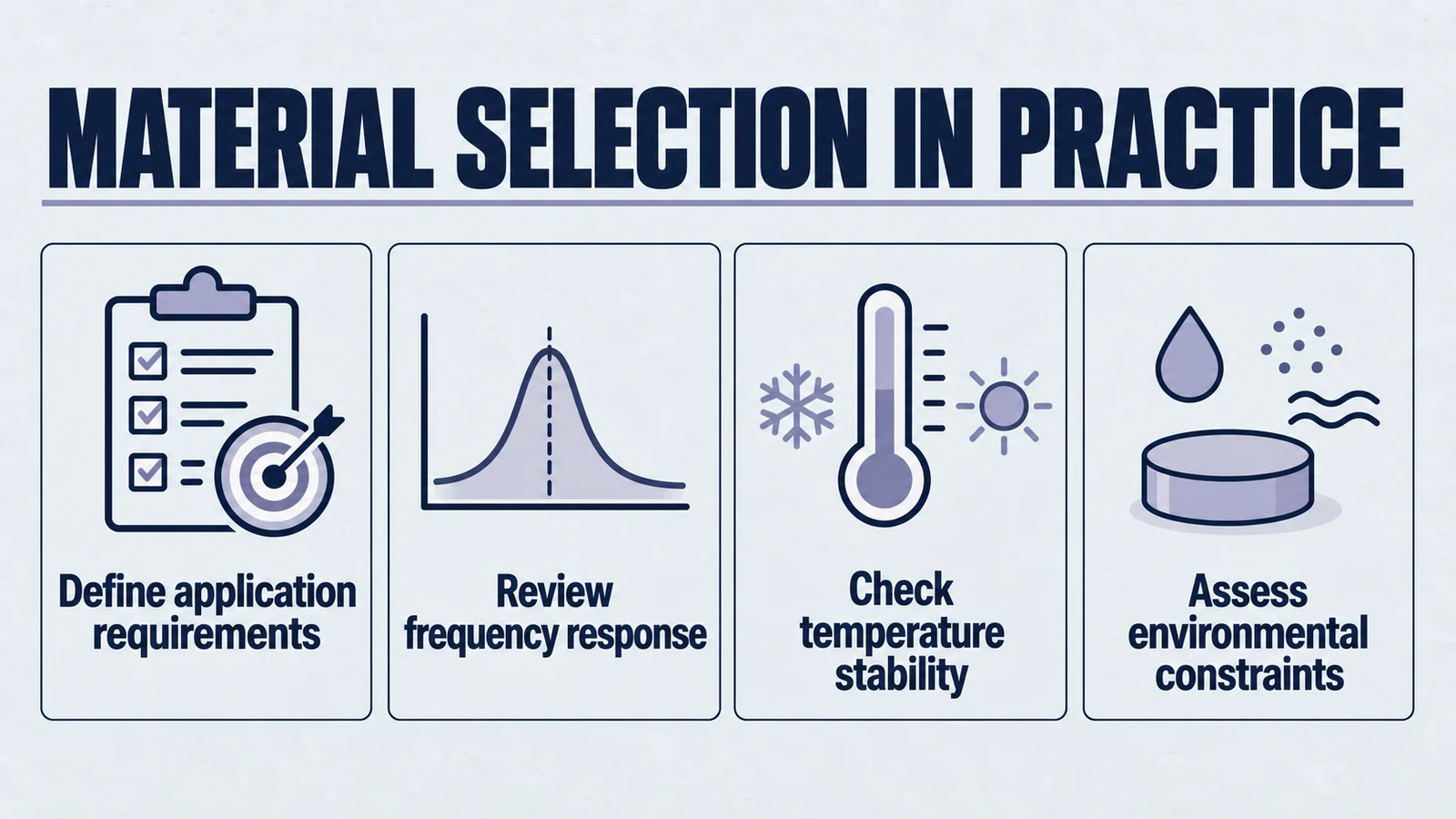
1. Application Requirements
Define what you expect the ceramic to do:
- Is it generating a signal (sensor)?
- Is it actuating a movement (actuator)?
- Is it involved in both transmitting and receiving (e.g., ultrasonic transducers)?
2. Piezoelectric Properties
Important material parameters include:
- d33 (Charge coefficient): Measures how much charge is generated per unit force.
- k (Coupling coefficient): Describes mode-specific reversible electromechanical coupling under defined boundary conditions; it is not device power efficiency.
- Qm (Mechanical quality factor): Related to how well the material vibrates with minimal energy loss.
For high-sensitivity sensors, a high d33 and k are preferred. For high-power applications like ultrasonic cleaning, a high Qm is crucial.
3. Frequency Response
Different applications require different resonant frequencies. For example:
- Medical imaging requires MHz-level frequencies.
- Structural health monitoring may need lower kHz ranges.
Make sure the material's thickness and mode of vibration align with your system's operational frequency. Our high-frequency transducers demonstrate optimal frequency matching.
4. Temperature Stability
Piezoelectric ceramics lose their properties above a certain temperature, called the Curie temperature (Tc). Applications in high-temperature environments (e.g., automotive or aerospace) require ceramics with high Tc values.
5. Environmental and Regulatory Factors
For applications in consumer electronics or medical devices, RoHS compliance or the need for lead-free materials may restrict your choice. Materials like BaTiO3 or KNLN are alternatives, though with trade-offs in performance.
6. Mechanical Strength and Durability
In mechanically demanding environments, ensure the ceramic can withstand repeated stress without degradation. Some formulations are optimized for toughness and fatigue resistance, as seen in our ultrasonic welding applications.
Matching Ceramics to Applications
| Application Type | Recommended Material | Key Properties |
|---|---|---|
| Medical Ultrasound | PZT-5H | High sensitivity (d33, k), stable frequency |
| Ultrasonic Cleaning | PZT-8 | High Qm, mechanical strength |
| Vibration Sensors | PZT-5A | Balanced performance, good stability |
| Fuel Injectors | Hard PZT | High power density, durability |
| Consumer Electronics | BaTiO3 | Lead-free, moderate piezoelectricity |
| Precision Actuators | Soft PZT | High displacement; open-loop large-signal hysteresis and creep require control or calibration |
Yujie's Advanced Material Solutions for 2025
Since 1996, Yujie Technology has been at the forefront of piezoelectric ceramic innovation. Our 2025 product lineup includes:
- Disc Series: Optimized for high-frequency applications and medical devices
- Ring Series: Perfect for flow measurement and precision sensing
- Tube Series: Ideal for underwater applications
- Rectangular Series: Designed for ultrasonic welding and industrial automation
Why Partner with Yujie for Your 2025 Projects
As we move into 2025, the demand for more efficient, environmentally friendly, and high-performance piezoelectric solutions continues to grow. Learn about the strategic advantages of partnering with an OEM manufacturer like Yujie.
Our expertise in OEM partnerships ensures you get:
- Custom material formulations tailored to your specific needs
- Rapid prototyping and testing capabilities
- Scalable production from samples to millions of units
- Comprehensive technical support throughout your project lifecycle
Conclusion
Selecting the right piezoelectric ceramic material requires a deep understanding of both the material properties and the functional demands of your application. By carefully evaluating factors such as piezoelectric coefficients, frequency response, temperature range, and environmental considerations, engineers can ensure optimal performance and compliance.
For additional guidance, explore our comprehensive resources:
- Complete guide to choosing piezoelectric ceramics
- Understanding piezoelectric ceramics and their applications
- Detailed material specifications and datasheets
If you're exploring piezoelectric ceramics for your next project, our team at Yujie is ready to help you find the best fit—contact us for tailored recommendations and technical support.
Engineering decision notes
PZT material and ceramic selection
Use this article when the choice is not just a shape, but a material tradeoff between sensitivity, loss, coupling, stability, and operating field. For "How to Select the Right Piezoelectric Ceramic Material for Your Application in 2025", the practical value is in turning the topic into a measurable selection or sourcing decision.
YJ Piezo coordinates PZT ceramic projects with manufacturing support, so material formulation, sintering, polarization, electrode process, and outgoing inspection can be reviewed against the final application.
Selection checks
- Separate sensing needs from high-power actuation needs before comparing d33 or coupling values.
- Check dielectric loss, Qm, Curie temperature, aging behavior, and operating field against the real duty cycle.
- Confirm whether the application needs standard PZT grades or a custom formulation and geometry.
Failure risks
- Choosing only the highest d33 can create heat, drift, or depolarization risk in power ultrasonics.
- A ceramic that performs well in free measurement can fail once bonded, clamped, or loaded.
- Material substitutions without batch testing can change capacitance, resonance, and system tuning.
RFQ details
- Is the part used for sensing, actuation, atomization, cleaning, welding, or measurement?
- What field strength, temperature, duty cycle, and mechanical load will the ceramic see?
- Which values must be controlled: d33, capacitance, resonance, impedance, Qm, or dimensional tolerance?
Relevant YJ Piezo pages
- PZT Material Hub
Material grades and application tradeoffs
- Piezoelectric Ceramics
Shapes and ceramic manufacturing options
- PZT Material Supplier Hub
Material control, grade selection, and sourcing support
Application FAQ
- Is the highest d33 always the best PZT choice?
- No. High d33 can be useful for sensitivity, but high-power ultrasonic systems often need lower loss, higher Qm, better thermal stability, and safer operation under field and stress.
- What makes PZT material selection different from catalog buying?
- The right PZT choice depends on geometry, load, drive field, duty cycle, temperature, and inspection targets. A catalog value is only useful when it is tied to the final assembly conditions.