
Selecting the Right Piezoelectric Actuator: A Complete Engineering Guide
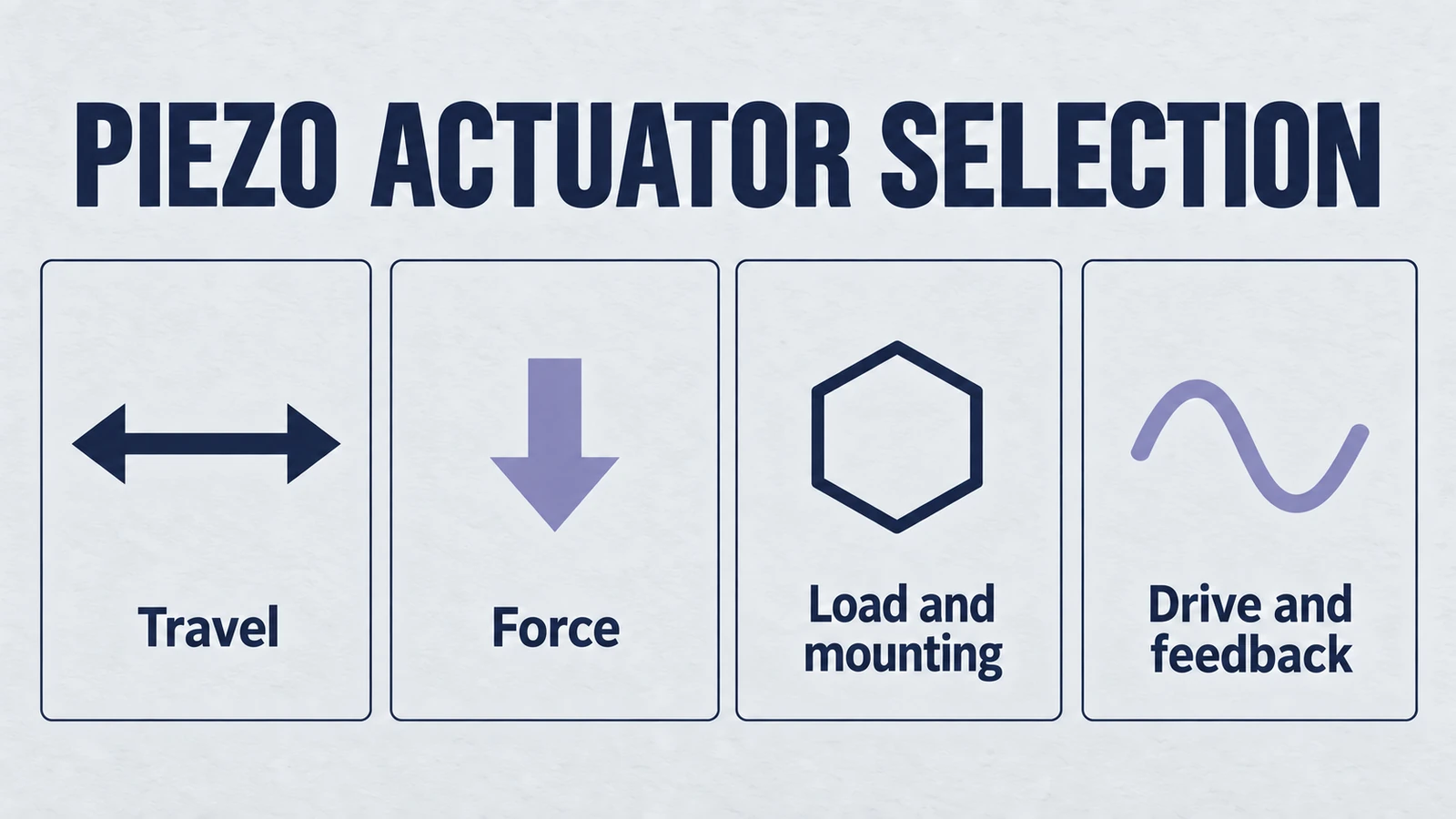
Piezoelectric actuators are at the forefront of precision motion technology, enabling engineers to achieve sub-micron accuracy, rapid response times, and exceptional reliability in demanding applications. However, with a wide variety of actuator types, materials, and configurations available, selecting the right piezoelectric actuator can be challenging. This guide provides an in-depth overview to help engineers and procurement specialists make informed decisions, ensuring optimal performance and return on investment.
1. Understanding Piezoelectric Actuation
Piezoelectric actuators work on the principle that certain ceramic materials, such as lead zirconate titanate (PZT), deform when subjected to an electric field. This deformation, though small, can be precisely controlled, amplified mechanically, and sustained without continuous power consumption.
Key advantages of piezoelectric actuators:
Product path for this search intent
Match the article topic to the right YJ Piezo product page
Use this article when the choice is not just a shape, but a material tradeoff between sensitivity, loss, coupling, stability, and operating field. For "Selecting the Right Piezoelectric Actuator: A Complete Engineering Guide", the practical value is in turning the topic into a measurable selection or sourcing decision.
- PZT Material Hub
Material grades and application tradeoffs
- Piezoelectric Ceramics
Shapes and ceramic manufacturing options
- PZT Material Supplier Hub
Material control, grade selection, and sourcing support
- High precision: Sub-nanometer resolution in positioning applications.
- Fast response: Reaction times in the microsecond range.
- No magnetic interference: Ideal for sensitive instrumentation.
- Low power consumption: Especially when holding a position.
2. Types of Piezoelectric Actuators
2.1 Stack Actuators
- Construction: Multiple thin ceramic layers stacked and electrically connected in parallel.
- Advantages: High blocking force, compact design.
- Applications: Industrial automation, precision machining, active vibration control.
2.2 Bimorph Actuators
- Construction: Two bonded piezo layers that bend when voltage is applied.
- Advantages: Large displacement at low driving voltage.
- Applications: Micro-pumps, scanning devices, optical alignment.
2.3 Shear Actuators
- Construction: Oriented to exploit shear deformation rather than elongation.
- Advantages: High-speed operation with minimal displacement.
- Applications: Active damping, ultrasonics, fine positioning.
2.4 Tube and Ring Actuators
- Construction: Hollow cylindrical or ring-shaped piezo ceramics.
- Advantages: Can expand, contract, or bend depending on electrode configuration.
- Applications: Fiber alignment, micro-optics, scanning probe microscopy.
3. Critical Selection Criteria
3.1 Displacement and Stroke Length
- Determine whether your application requires microns or millimeters of travel.
- Stack actuators provide short travel with high force; bimorphs and amplified designs offer longer travel.
3.2 Blocking Force and Load Capacity
- Match actuator force output to the load requirement.
- Consider safety margins for dynamic loads.
3.3 Resonance Frequency
- For high-speed applications, select an actuator with a high natural frequency.
- Avoid operating close to resonance unless specifically designed for that mode.
3.4 Operating Environment
- Temperature: PZT ceramics have a Curie temperature; avoid prolonged exposure above 50% of this limit.
- Humidity: Use protective coatings or hermetic sealing.
- Vacuum compatibility: Ensure materials meet outgassing standards for vacuum applications.
3.5 Drive Voltage Requirements
- Stack actuators typically need 100–1000V; low-voltage multilayer designs are available.
- Choose compatible driver electronics.
3.6 Lifetime and Reliability
- Look for actuators with proven fatigue resistance.
- Consider preload mechanisms to extend life.
4. Material Considerations
4.1 PZT (Lead Zirconate Titanate)
- Industry standard for most actuators.
- High electromechanical coupling.
4.2 Lead-Free Piezo Ceramics
- Eco-friendly alternatives such as potassium sodium niobate (KNN).
- Compare application-specific measured properties. Lead-free composition alone does not establish RoHS conformity; verify the supplied part’s applicable substances and documentation.
4.3 Single-Crystal Piezo Materials
- Exceptional performance in specialized applications.
- Higher cost, limited availability.
5. Common Applications
- Precision Optics: Adaptive lenses, beam steering.
- Semiconductor Manufacturing: Wafer positioning, lithography stages.
- Medical Devices: Ultrasound probes, micro-dosing systems.
- Aerospace: Active vibration control, shape morphing structures.
- Industrial Automation: Fast tool servos, quality inspection systems.
6. Best Practices for Integration
- Preload Mechanisms: Ensure consistent compression to prevent tensile stress on ceramics.
- Control Electronics: Use matched drivers for optimal performance and longevity.
- Feedback Systems: Integrate strain gauges or capacitive sensors for closed-loop control.
- Thermal Management: Avoid overheating through proper duty cycles and cooling.
7. Future Trends in Piezoelectric Actuation
- Miniaturization: Smaller actuators for micro-robotics.
- Smart Materials Integration: Embedding sensors for real-time health monitoring.
- Energy Harvesting: Combining actuation with power generation.
- Advanced Composites: Hybrid materials for higher performance.
Conclusion
Selecting the right piezoelectric actuator requires a thorough understanding of your application's motion requirements, load conditions, environmental factors, and integration constraints. By carefully balancing displacement, force, and operational parameters, engineers can ensure optimal performance and reliability. With advancements in materials and manufacturing, the future of piezoelectric actuation promises even greater precision, efficiency, and versatility.
Pro Tip: When sourcing actuators, work closely with a trusted manufacturer who can provide customization options and technical support. This partnership often results in better performance, faster integration, and a longer system lifespan.
For personalized recommendations, contact our technical team for application-based selection support and drive solution guidance.
Related Technical Resources
Use these internal references to compare geometry, material selection, reliability testing, and sourcing decisions.
- Spherically Curved Piezoelectric Ceramics: Practical Introduction
- How Bowl-Shaped Piezo Ceramics Focus Ultrasound
- Spherical Cap vs Hemispherical Piezo Ceramics
- When Not to Use Focused Piezoelectric Ceramics
- How to Choose Radius of Curvature for Focused Piezo Ceramics
- Key Design Parameters for Curved Piezo Elements
- Focused Piezo Ceramics in Medical Ultrasound: Engineering Constraints
- Mode Coupling Risk in Piezo Ceramic Geometry
Engineering decision notes
PZT material and ceramic selection
Use this article when the choice is not just a shape, but a material tradeoff between sensitivity, loss, coupling, stability, and operating field. For "Selecting the Right Piezoelectric Actuator: A Complete Engineering Guide", the practical value is in turning the topic into a measurable selection or sourcing decision.
YJ Piezo coordinates PZT ceramic projects with manufacturing support, so material formulation, sintering, polarization, electrode process, and outgoing inspection can be reviewed against the final application.
Selection checks
- Separate sensing needs from high-power actuation needs before comparing d33 or coupling values.
- Check dielectric loss, Qm, Curie temperature, aging behavior, and operating field against the real duty cycle.
- Confirm whether the application needs standard PZT grades or a custom formulation and geometry.
Failure risks
- Choosing only the highest d33 can create heat, drift, or depolarization risk in power ultrasonics.
- A ceramic that performs well in free measurement can fail once bonded, clamped, or loaded.
- Material substitutions without batch testing can change capacitance, resonance, and system tuning.
RFQ details
- Is the part used for sensing, actuation, atomization, cleaning, welding, or measurement?
- What field strength, temperature, duty cycle, and mechanical load will the ceramic see?
- Which values must be controlled: d33, capacitance, resonance, impedance, Qm, or dimensional tolerance?
Relevant YJ Piezo pages
- PZT Material Hub
Material grades and application tradeoffs
- Piezoelectric Ceramics
Shapes and ceramic manufacturing options
- PZT Material Supplier Hub
Material control, grade selection, and sourcing support
Application FAQ
- Is the highest d33 always the best PZT choice?
- No. High d33 can be useful for sensitivity, but high-power ultrasonic systems often need lower loss, higher Qm, better thermal stability, and safer operation under field and stress.
- What makes PZT material selection different from catalog buying?
- The right PZT choice depends on geometry, load, drive field, duty cycle, temperature, and inspection targets. A catalog value is only useful when it is tied to the final assembly conditions.