
Troubleshooting Ultrasonic Systems: Common Transducer Issues & Fixes
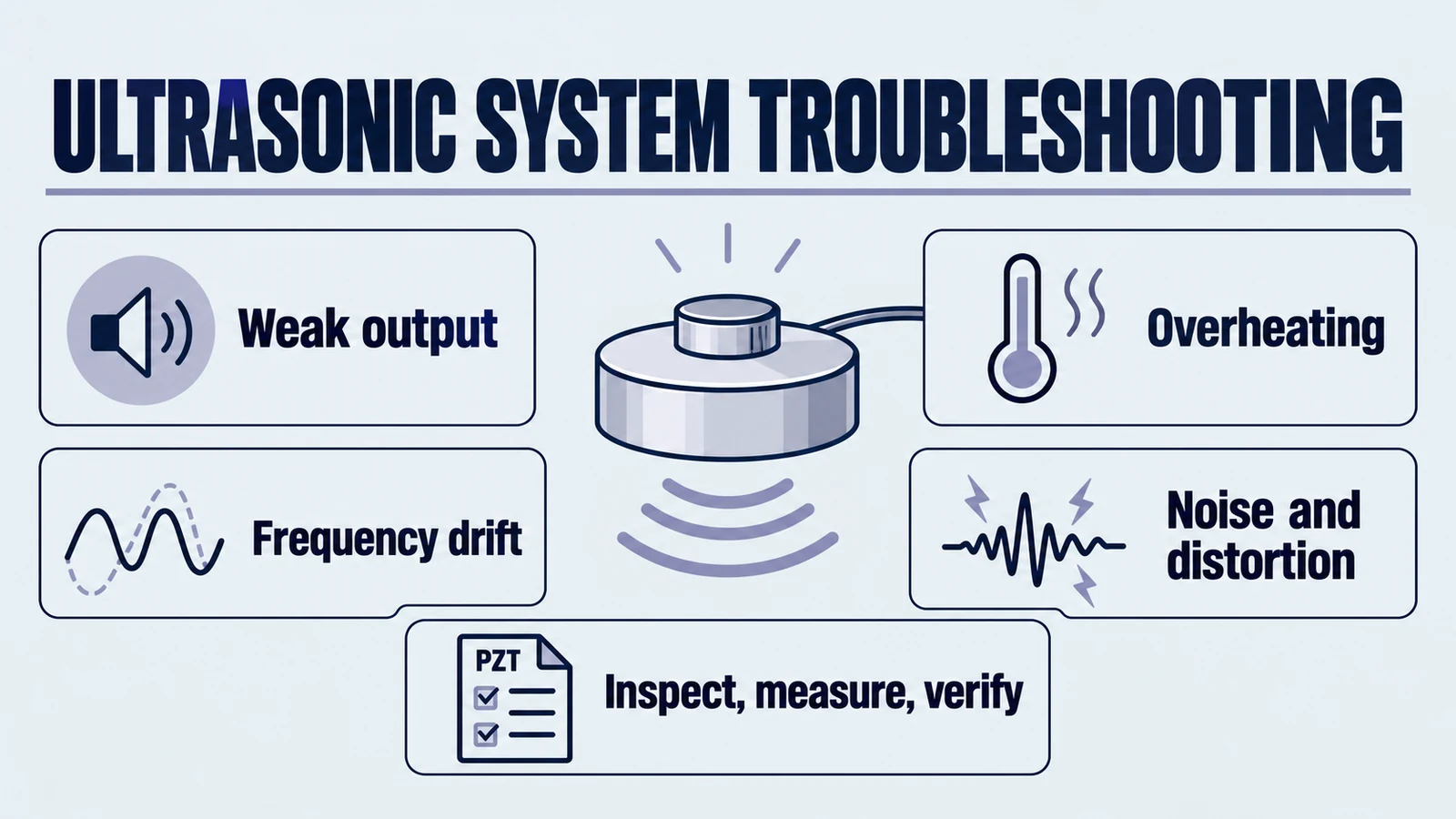
Ultrasonic systems are important in diverse applications such as industrial cleaning, medical imaging, non-destructive testing (NDT), liquid flow measurement, and precision machining. At the core of these systems, ultrasonic transducers serve as the critical interface between electrical energy and high-frequency mechanical vibrations. Over time, these components can experience wear, contamination, and electrical or mechanical failures that degrade performance. A clear understanding of potential problems, early warning signs, and corrective actions is essential for maintaining peak system reliability.
This extended ultrasonic troubleshooting guide provides a detailed breakdown of common ultrasonic transducer issues, their symptoms, causes, diagnostic approaches, and proven fixes.
1. No Output or Weak Signal
Symptoms:
Product path for this search intent
Match the article topic to the right YJ Piezo product page
Use this article when cleaning performance depends on cavitation strength, tank coupling, frequency selection, and long-run thermal behavior. For "Troubleshooting Ultrasonic Systems: Common Transducer Issues & Fixes", the practical value is in turning the topic into a measurable selection or sourcing decision.
- Ultrasonic Cleaning Transducers
Cleaning models for tank and precision cleaning systems
- Piezoelectric Ring Series
Ring ceramics used in high-power transducer stacks
- Piezoelectric Ceramics
PZT material and geometry options for acoustic output
- Complete absence of ultrasonic output
- Weak or fluctuating signal strength
- Diminished cleaning, imaging, or measurement efficiency
Possible Causes:
- Loose or corroded electrical connectors
- Internal fracture or depolarization of piezoelectric elements
- Malfunctioning driver circuitry or unstable power supply
- Mismatch between transducer resonance and generator frequency
Fixes:
- Inspect and secure all wiring and connectors; replace corroded terminals
- Perform impedance analysis to confirm piezo element integrity
- Swap or repair faulty driver boards and stabilize the power source
- Verify generator settings and retune for precise frequency alignment
For applications requiring high-precision output, consider upgrading to our professional ultrasonic cleaning transducers which are designed for consistent, reliable performance.
2. Overheating of the Transducer
Symptoms:
- Outer casing becomes excessively hot within minutes
- Gradual loss of output power over a session
- Burnt smell or visible discoloration near mounting points
Possible Causes:
- Operation at sustained high power beyond specifications
- Inadequate heat dissipation or blocked cooling airflow
- Internal dielectric breakdown causing electrical leakage
- Extended operation at off-resonance conditions
Fixes:
- Reduce input power to rated limits and introduce duty cycling
- Install heat sinks, forced-air cooling, or liquid cooling where applicable
- Test for insulation resistance failures and replace damaged components
- Retune to correct frequency and verify load matching
Our industrial welding transducers are specifically designed with enhanced thermal management for high-power applications.
Video: Why Is Your Ultrasonic Transducer Weak or Overheating?
This YJ Piezo walkthrough uses a bolted power ultrasonic transducer to show a practical diagnostic order: define the symptom, check the drive and impedance matching, inspect the mechanical assembly, and track heat under the actual load. Use the limits and procedures specified for your transducer and generator.

Watch the transducer troubleshooting guide on YouTube.
3. Frequency Drift or Instability
Symptoms:
- Output frequency shifts during warm-up or prolonged operation
- Erratic performance in precision measurements
Possible Causes:
- Piezo material aging altering resonance characteristics
- Thermal expansion or contraction affecting mechanical coupling
- Vibration loosening mounting bolts or couplers
Fixes:
- Replace or refurbish aged transducer assemblies
- Use temperature-controlled enclosures or compensation circuits
- Tighten or re-torque all mechanical fastenings with proper specifications
For critical measurement applications, our ultrasonic flowmeter transducers provide exceptional frequency stability.
4. Excessive Noise or Distorted Output
Symptoms:
- Loud audible hum or rattle beyond normal ultrasonic operation
- Distorted waveforms visible on oscilloscope traces
- Uneven cleaning patterns or imaging artifacts
Possible Causes:
- Loose mechanical fixtures or tank walls causing secondary resonance
- Piezo stack cracking or delamination
- Surface fouling from oil, limescale, or other contaminants
Fixes:
- Secure all fixtures and dampen external vibrations
- Replace compromised piezo stacks or bonding layers
- Thoroughly clean radiating surfaces with approved solvents
5. Cavitation Erosion (Cleaning Applications)
Symptoms:
- Visible pitting, corrosion, or surface wear on the transducer face
- Reduced cleaning intensity in affected areas
Possible Causes:
- Continuous high-power operation in harsh chemical baths
- Poor tank design concentrating cavitation in small zones
Fixes:
- Upgrade to erosion-resistant faceplates or coatings
- Redesign tank geometry to spread cavitation energy evenly
- Implement pulsed or intermittent operation to limit wear
For harsh cleaning environments, consider our heavy-duty cleaning transducers with enhanced erosion resistance.
Advanced Diagnostic Tips
- Impedance Sweeps: Track resonance changes over time to predict aging
- Thermal Imaging: Identify hotspots indicative of electrical leakage or poor coupling
- Output Power Logging: Monitor for gradual declines signaling material fatigue
Our ultrasonic bubble detection sensors can help monitor system performance and detect anomalies early.
Preventive Maintenance for Ultrasonic Transducers
To minimize the likelihood of ultrasonic transducer issues:
- Scheduled inspections: Check connectors, mounting, and housing integrity
- Regular testing: Perform frequency response and impedance measurements
- Cleaning protocols: Keep radiating surfaces and coupling media uncontaminated
- Thermal management: Ensure adequate cooling and avoid continuous overloads
- Documentation: Maintain a log of repairs, replacements, and performance tests for trend analysis
Specialized Applications and Solutions
Medical and Beauty Applications
For medical ultrasonic applications, precision and reliability are paramount. Our facial ultrasonic transducers are designed with strict quality controls to ensure consistent medical-device outcomes.
High-Frequency Applications
For applications requiring high-frequency operation, our high-frequency acoustic transducers provide exceptional performance at frequencies up to 230kHz.
Underwater and Marine Applications
Marine environments present unique challenges. Our submersible transducers are engineered to withstand harsh underwater conditions while maintaining reliable performance.
Welding Applications
Ultrasonic welding requires precise power control and thermal management. Our range includes specialized transducers for plastic welding and metal welding applications.
Conclusion
A proactive approach to ultrasonic troubleshooting not only extends the lifespan of transducers but also reduces operational downtime and costly repairs. By understanding the specific failure modes described in this guide and applying the recommended solutions, operators can keep ultrasonic systems functioning at peak efficiency in industrial, medical, and testing environments. Consistent monitoring, timely maintenance, and precise tuning will safeguard both performance and investment.
For expert consultation on ultrasonic transducer selection, troubleshooting, or custom solutions, contact our technical team. With decades of experience in piezoelectric technology, we can help optimize your ultrasonic systems for maximum reliability and performance.
Engineering decision notes
Ultrasonic cleaning and cavitation
Use this article when cleaning performance depends on cavitation strength, tank coupling, frequency selection, and long-run thermal behavior. For "Troubleshooting Ultrasonic Systems: Common Transducer Issues & Fixes", the practical value is in turning the topic into a measurable selection or sourcing decision.
YJ Piezo evaluates cleaning transducers by acoustic output, impedance stability, ceramic loss, bonding quality, and how the assembly couples into the tank.
Selection checks
- Choose frequency from the cleaning target, part geometry, and contamination type rather than from price alone.
- Review ceramic material, bonding area, impedance, and tank mounting as one acoustic chain.
- Ask whether the transducer is intended for intermittent cleaning, continuous industrial operation, or precision cleaning.
Failure risks
- A transducer can heat water but still produce weak useful cavitation if it is poorly matched to the tank.
- High output without thermal margin can shorten ceramic, adhesive, or cable lifetime.
- Mixing 28 kHz and 40 kHz assumptions can create poor cleaning uniformity or excessive noise.
RFQ details
- What tank size, liquid, duty cycle, and cleaning target are involved?
- Which frequency and power range are currently used or being replaced?
- Do you need impedance records, bonding guidance, or sample validation before production?
Relevant YJ Piezo pages
- Ultrasonic Cleaning Transducers
Cleaning models for tank and precision cleaning systems
- Piezoelectric Ring Series
Ring ceramics used in high-power transducer stacks
- Piezoelectric Ceramics
PZT material and geometry options for acoustic output
Application FAQ
- Why can a cleaning transducer heat liquid but clean poorly?
- Heat only proves energy is entering the system. Useful cleaning needs controlled cavitation, correct frequency, good tank coupling, and stable impedance under load.
- What should I provide for a cleaning transducer quotation?
- Provide tank dimensions, liquid type, target material, duty cycle, desired frequency, current transducer model if replacing one, and whether the system needs continuous industrial operation.