
Precision Acoustics: The Engineering Science of High-Performance Ultrasonic Cleaning Transducers
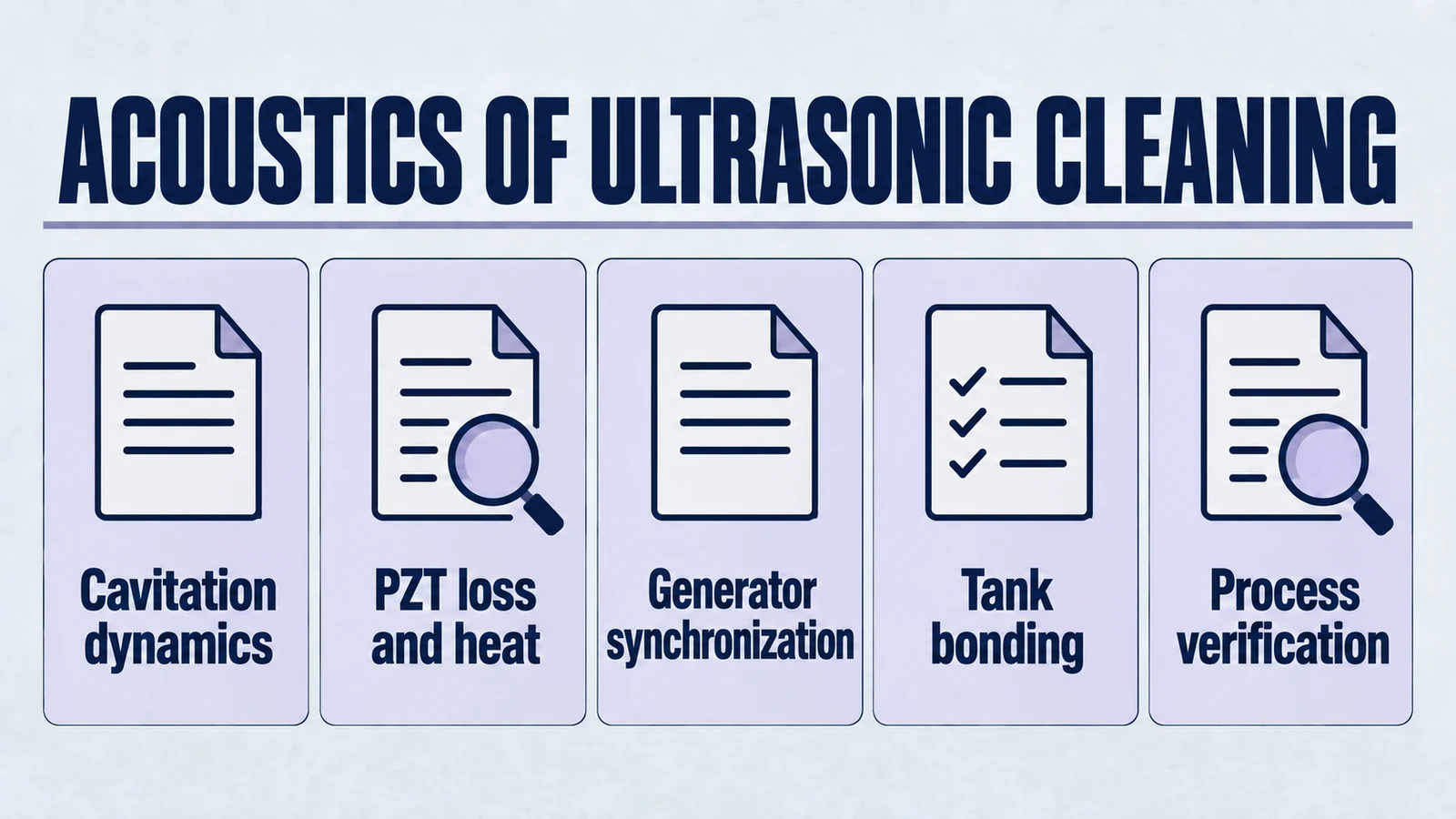
Executive Summary
The modern industrial landscape is defined by an intolerance for contamination. In sectors ranging from semiconductor fabrication and aerospace engineering to medical device manufacturing and precision optics, the standard for "clean" has shifted from visible macroscopic freedom from debris to specified particulate and residue cleanliness. This transition has necessitated a move away from traditional solvent-based washing methods, which are often environmentally hazardous and labor-intensive, toward automated, acoustically driven cleaning solutions. At the epicenter of this technological shift sits the ultrasonic cleaning transducer—a sophisticated electromechanical device that serves as the heartbeat of any precision cleaning system.
This technical guide is for engineers, system integrators, and procurement leaders tasked with selecting, deploying, and maintaining ultrasonic cleaning infrastructure. It moves beyond surface-level specifications to explain the physics, material science, and systems engineering that differentiate a standard component from a high-performance solution. Through the lens of Shenzhen Yujie Electronics Co., Ltd. (Yujie Piezo), a piezoelectric manufacturing company established in 1996, we examine how vertical integration and controlled ceramic formulations can support measurable operational gains.
The analysis that follows focuses on the decisions engineers actually need to make: how PZT-8 ceramics support thermal stability, how mechanical impedance matching affects energy transfer, and how to troubleshoot industrial cleaning tanks. By explaining the interplay between frequency, power density, and cleaning chemistry, this guide helps stakeholders improve ROI and process consistency.
Product path for this search intent
Match the article topic to the right YJ Piezo product page
Use this article when cleaning performance depends on cavitation strength, tank coupling, frequency selection, and long-run thermal behavior. For "Precision Acoustics: The Engineering Science of High-Performance Ultrasonic Cleaning Tr...", the practical value is in turning the topic into a measurable selection or sourcing decision.
- Ultrasonic Cleaning Transducers
Cleaning models for tank and precision cleaning systems
- Piezoelectric Ring Series
Ring ceramics used in high-power transducer stacks
- Piezoelectric Ceramics
PZT material and geometry options for acoustic output
1. The Physics of Acoustic Sanitation: Cavitation Dynamics
To evaluate the engineering merit of a transducer, one must first possess a nuanced understanding of the physical phenomenon it is designed to generate: acoustic cavitation. While often described simply as the formation of bubbles, cavitation is a complex thermodynamic event involving phase transitions, shock waves, and high-energy chemistry.
1.1 The Mechanics of Compression and Rarefaction
Ultrasonic cleaning is fundamentally an energy transfer process. A transducer converts electrical energy into mechanical vibration, which is then coupled into a liquid medium. This vibration propagates as a longitudinal sound wave, creating alternating regions of high pressure (compression) and low pressure (rarefaction) within the fluid.
Acoustic cavitation involves gas/vapor-containing cavities and commonly pre-existing nuclei. Growth and possible inertial collapse depend on the pressure field, liquid, gas content and nuclei; ordinary practical cleaning bubbles are not vacuum cavities.
An inertial collapse can concentrate energy and create local pressure/temperature extremes. Gas/vapor, liquid compressibility and dissipation limit real collapse; a singularity of an idealized model is not a physical cleaning-bath event. Quantitative extremes require an identified model or measurement.
Studies of acoustic cavitation describe extremely localized heat, pressure, and high-velocity micro-jets during bubble collapse. For cleaning-system design, the practical point is that these micro-jets provide mechanical scrubbing force capable of dislodging contaminants that are chemically bonded or mechanically interlocked with the substrate surface.
1.2 Frequency and Bubble Dynamics
The size and energy of these cavitation bubbles are inversely proportional to the frequency of the ultrasonic wave. This relationship is a critical parameter in transducer selection.
- Low Frequency (20 kHz – 28 kHz): At these frequencies, the rarefaction phase is long, allowing bubbles to grow to a relatively large size (micrometers in diameter) before collapsing. When they do collapse, they release a massive amount of energy. This results in "hard" cavitation, suitable for removing heavy contaminants like baked-on carbon, thick grease, and rust from robust parts like engine blocks or injection molds. However, the violence of these implosions can cause pitting or surface erosion on softer metals like aluminum or brass.
- Medium Frequency (40 kHz): Often considered the industry standard, 40 kHz offers a balance between cleaning power and surface safety. The bubbles are smaller and the cleaning action is more distributed, making it ideal for general industrial parts, optics, and laboratory glassware.
- High Frequency (68 kHz – 120+ kHz): As frequency increases, the bubbles become microscopic and the energy per bubble decreases, but the number of cavitation events per second increases drastically. This creates a gentle, scouring action capable of penetrating micron-scale crevices, blind holes, and complex geometries without damaging delicate features. This range is essential for semiconductor wafers, hard drive components, and medical stents.
Yujie Piezo leverages this physics by offering a diverse portfolio of transducers, from heavy-duty 28 kHz units like the HJ-5028 to high-frequency systems, ensuring that the acoustic energy profile matches the specific contamination load and substrate sensitivity of the application.
1.3 The Role of Environmental Variables
The efficiency of the transducer is also heavily influenced by the state of the liquid medium.
- Temperature: Every cleaning chemistry has an optimal temperature for cavitation. As temperature rises, vapor pressure increases, making bubbles easier to form. However, if the temperature is too high, the bubbles become "cushioned" by excessive vapor and collapse with less force. Most aqueous systems optimize between 50°C and 60°C.
- Surface Tension: Lower surface tension facilitates cavitation inception. This is why surfactants (detergents) are added to the water.
- Dissolved Gas: Fresh solution is often saturated with dissolved gases like nitrogen and oxygen. These gases diffuse into the cavitation bubbles, acting as a pneumatic cushion that absorbs the shock of the collapse. A "degas" phase is critical before cleaning can begin effectively.
2. Piezoelectric Material Science: The Core Advantage
The transducer is only as effective as the material that drives it. At the heart of every ultrasonic cleaning transducer is a stack of piezoelectric ceramic rings. While many materials exhibit piezoelectric properties, industrial applications are dominated by Lead Zirconate Titanate (PZT). However, PZT is not a singular material; it is a complex family of ferroelectric ceramics that can be engineered at the atomic level to achieve specific performance characteristics.
2.1 Ferroelectricity and Domain Structure
PZT is a ferroelectric material, meaning it possesses spontaneous electric polarization that can be reversed by the application of an external electric field. This polarization arises from the asymmetry in the crystal lattice structure (perovskite structure) below the Curie temperature. Within the ceramic grains, regions of uniform polarization are called "domains."
In a raw, sintered ceramic, these domains are randomly oriented, resulting in zero net piezoelectric effect. To activate the material, it must undergo a "poling" process, where a strong DC electric field is applied at elevated temperatures to align the domains. The stability of this alignment under mechanical stress and electrical drive is what separates high-quality industrial ceramics from consumer-grade materials.
2.2 The Hard vs. Soft PZT Distinction
In the world of piezoelectric ceramics, materials are broadly classified as "hard" or "soft," a distinction derived from their response to external fields and their mechanical damping properties.
- Soft PZT (e.g., PZT-5H): These materials are doped with donor ions. This doping creates cation vacancies that facilitate domain wall motion. The result is a material with high sensitivity (high piezoelectric charge constant), high permittivity, and large displacement for a given voltage. However, this mobility comes at a cost: high internal friction (high dielectric loss) and poor stability. Under high-power continuous operation, soft PZT generates excessive heat and can easily depolarize.
- Hard PZT (e.g., PZT-4, PZT-8): Hard ceramics are doped with acceptor ions, which create oxygen vacancies in the crystal lattice. These vacancies act as pinning centers, restricting the motion of domain walls. This "clamping" effect results in a material that is harder to polarize but remarkably stable. Hard PZT exhibits lower sensitivity but possesses a high mechanical quality factor and very low dielectric loss.
2.3 PZT-8: The Undisputed Champion for Power Ultrasonics
For ultrasonic cleaning, welding, and high-power sonar, Hard PZT is the mandatory choice. Within the hard PZT category, a critical comparison exists between PZT-4 and PZT-8. While PZT-4 is an excellent material for transmitting and receiving (high output), PZT-8 is universally recognized as the superior material for high-power, continuous-duty applications like industrial cleaning.
Detailed Comparative Analysis: PZT-4 vs. PZT-8
| Property | PZT-4 (Navy Type I) | PZT-8 (Navy Type III) | Implications for Ultrasonic Cleaning |
|---|---|---|---|
| Mechanical Quality Factor (Qm) | ~500 | ~1000+ | Qm describes mechanical energy loss for a specified mode. At equal stored modal energy, doubling Qm halves that mechanical loss per cycle; it does not establish half the total electrical input loss or an assembled-device efficiency. Grade values require their measurement conditions. |
| Dielectric Loss (tan δ) | Moderate | Extremely Low | High dielectric loss translates directly to self-heating. PZT-8 runs significantly cooler, protecting the bonding epoxy and the ceramic itself. |
| Preload Stability | Moderate | High | Transducers are assembled under high compressive stress. PZT-8 maintains its properties better under this heavy preload. |
| d33 (Charge Coefficient) | Higher | Moderate | While PZT-4 has higher displacement per volt, the thermal limitations prevent it from being driven as hard as PZT-8 in continuous modes. |
Yujie Piezo's Material Formulation: Yujie Piezo applies this material science through proprietary PZT-8 formulations designed for low loss and stable power handling. Their materials achieve a dielectric loss (tan δ) as low as 0.004. This low-loss characteristic helps Yujie transducers operate at higher power densities while reducing the risk of thermal runaway—a condition where heat increases impedance, which generates more heat and can lead to failure.
By manufacturing their own ceramic powders and controlling the sintering process in-house since 1996, Yujie helps ensure that the grain structure and chemical stoichiometry are optimized for high-stress environments. This vertical integration eliminates the batch-to-batch variability that often plagues assemblers who source generic ceramics from the spot market.
3. Transducer Architecture: The Langevin Stack
While the piezoelectric ceramic provides the motive force, the mechanical assembly of the transducer dictates how that force is delivered. The standard design for industrial ultrasonic cleaning is the Bolt-Clamped Langevin Transducer (BLT), also known as the sandwich transducer.
3.1 The Necessity of Pre-Stress
Ceramic materials are inherently brittle. They possess high compressive strength (they can bear heavy loads) but very low tensile strength (they crack easily when pulled). In an ultrasonic transducer, the ceramic stack vibrates, expanding and contracting thousands of times per second. During the contraction phase (rarefaction in the liquid), the inertia of the front mass effectively pulls on the ceramic. If this tensile stress exceeds the material's limit, the ceramic will fracture instantly.
The Langevin design solves this by applying a massive static compressive bias. A high-strength central bolt (typically aircraft-grade steel or beryllium copper) clamps the ceramic rings between a metal back mass and a front mass. The tension on this bolt is calibrated such that even at the peak of the vibration cycle, the net stress on the ceramic remains compressive.
Yujie's Precision Assembly: The assembly of a Yujie transducer is a precision-engineered process. The torque applied to the central bolt must be exact. Under-torque leads to poor mechanical coupling, acoustic loss, and the risk of arcing between electrodes due to air gaps. Over-torque dampens the vibration amplitude and risks crushing the ceramic crystal structure. Yujie utilizes automated torque systems and monitors the electrical impedance during assembly to ensure the optimal pre-stress window is achieved.
3.2 Acoustic Impedance Matching Layers
The "sandwich" components are not merely structural; they are acoustic transformers.
- The Back Mass: Usually made of dense steel. Its high mass and inertia force the vibrational energy to travel in the opposite direction—towards the lighter front mass. Ideally, minimal energy should radiate from the back.
- The Front Mass (Radiating Head): This component couples the vibration into the cleaning tank. It is typically made of aluminum or titanium. Aluminum offers excellent acoustic transmission but is soft and prone to cavitation erosion (pitting). Yujie employs specialized aluminum alloys and surface finishes (like hard anodizing) to balance transmission efficiency with durability. Titanium is used for the most demanding applications due to its extreme fatigue strength and chemical resistance.
3.3 Thermal Management and Heat Dissipation
Heat is the enemy of piezoelectric performance. As temperature rises, the resonant frequency of the transducer shifts, and the electromechanical coupling factor degrades. If the temperature approaches the Curie point, the ceramic depolarizes permanently. The BLT design, particularly with PZT-8, inherently minimizes heat generation. However, the heat that is generated must be dissipated. The aluminum front mass acts as a heat sink, transferring waste heat into the cleaning liquid. This is why running a transducer "dry" (without liquid in the tank) is fatal; without the liquid to wick away heat and provide mechanical damping, the energy builds up in the stack until it self-destructs.
4. The Electronic Interface: Generator Synchronization
A high-performance transducer is useless without a generator capable of driving it efficiently. The relationship between the generator and the transducer is governed by the principles of AC circuit theory and reactive power.
4.1 The Challenge of Reactive Loads
To an electrical generator, a piezoelectric transducer is not a simple resistive load (like a lightbulb). It is a complex impedance containing both resistive (real power) and reactive (capacitive/inductive) components. The transducer acts like a large capacitor due to the dielectric nature of the ceramic rings and the electrode structure. Near resonance, the mechanical motion of the stack introduces motional resistance, inductance, and capacitance into the equivalent circuit (Van Dyke model).
Reactive current exchanges stored electrical/mechanical energy rather than itself consuming real power. It can increase current demand and thereby losses in nonideal drivers, wiring and dielectric/material elements. Evaluate complex impedance, power factor, limits and measured real power; do not equate all circulating reactive energy with heat.
4.2 Impedance Matching Networks
To solve this, an Impedance Matching Network is interposed between the generator and the transducer. This circuit typically consists of a series inductor and a parallel transformer or capacitor. The matching network cancels out the reactive capacitance of the transducer, presenting a purely resistive load (usually 50 Ohms) to the generator. This maximizes power transfer and minimizes reflected energy (Standing Wave Ratio).
Yujie's Specification Transparency: Yujie Piezo provides detailed impedance parameters for every model. For instance, the HJ-3828 and similar models specify a resonance impedance and capacitance values. This precise data allows system engineers to design matching networks that are perfectly tuned, rather than relying on generic "one-size-fits-all" drivers that compromise efficiency.
4.3 Frequency Sweep and Tracking
Industrial cleaning tanks are dynamic environments. As parts are loaded and unloaded, the liquid level changes, and the temperature fluctuates, the resonant frequency of the transducer shifts. Fixed Frequency Generators are obsolete for high-end cleaning. If the transducer drifts away from the fixed generator frequency, power output drops precipitously. Modern Auto-Tracking Generators continually monitor the voltage/current phase angle and adjust their output frequency to track the transducer's resonance.
To prevent "standing waves"—stationary zones of high and low pressure that cause uneven cleaning—generators often "sweep" the frequency back and forth. This moves the nodes and antinodes of the sound field, ensuring uniform cavitation throughout the tank. Yujie's transducers are designed with sufficient bandwidth to accommodate these sweep functions without losing efficiency.
5. Bonding and Installation: The Critical Link
The mechanical interface between the transducer and the tank is the single most common point of failure in ultrasonic cleaning systems. A perfect transducer poorly bonded is a failed system.
5.1 Bonding Methodologies: Epoxy vs. Mechanical
There are two primary methods for attaching transducers to a tank:
- Stud Welding (Mechanical): A threaded stud is welded to the tank, and the transducer is screwed onto it. This provides a strong mechanical hold but leaves microscopic air gaps between the transducer face and the tank wall. Since air is an acoustic insulator, these gaps block energy transfer.
- Adhesive Bonding (Epoxy): A high-strength structural epoxy is used to glue the transducer to the tank. This fills the gaps but relies entirely on the chemical bond strength.
The Hybrid Approach: The industry standard for high-reliability systems is a combination of both. The transducer is screwed onto a stud and bonded with epoxy. The screw provides the clamping force to keep the epoxy layer thin and uniform during curing, and also acts as a safety backup.
5.2 Understanding Bonding Failures
Why do bonds fail?
- Thermal Cycling Fatigue: Cleaning tanks heat up and cool down repeatedly. The stainless steel tank and the piezoelectric ceramic have different Coefficients of Thermal Expansion (CTE). This mismatch creates shear stress at the bond line. Over thousands of cycles, this stress can cause the epoxy to crack or delaminate.
- Cohesive vs. Adhesive Failure: Adhesive failure occurs when the glue peels off the metal (poor surface prep). Cohesive failure occurs when the glue itself rips apart (poor epoxy quality). Yujie recommends strict surface preparation (sandblasting to specific Ra roughness) and the use of aerospace-grade epoxies to ensure the bond is stronger than the materials themselves.
- Moisture Ingress: If the epoxy seal is compromised, the cleaning solution—often hot and chemically aggressive—can wick into the interface. This leads to corrosion of the electrodes and eventual electrical shorting.
Advanced Inspection: Leading manufacturers utilize nonlinear ultrasonic inspection techniques to detect micro-scale defects in the adhesive layer before they propagate into serious failures.
6. Manufacturing Excellence: The Yujie Advantage
In a global market flooded with generic components, Yujie Piezo differentiates itself through a philosophy of vertical integration and rigorous quality assurance.
6.1 Vertical Integration: From Powder to Product
Most transducer suppliers are merely assemblers; they buy ceramic rings from one vendor, aluminum masses from another, and bolt them together. Yujie controls the entire value chain.
- Raw Material Control: By mixing their own PZT powders, Yujie controls the doping levels of acceptor ions, directly influencing the hardness and thermal stability of the final ceramic.
- Sintering and Dicing: Advanced kilns and precision dicing saws allow Yujie to manufacture ceramics with exceptional dimensional tolerances. This is critical because the dimensions of the ring determine its resonant frequency. A deviation of a fraction of a millimeter can shift the frequency out of spec.
6.2 Customization Capabilities
The industrial market is not monolithic. A transducer optimized for a 5,000-gallon degreasing tank in an automotive factory is wholly unsuitable for a 2-liter medical-instrument cleaning bath. Yujie's manufacturing flexibility allows for dimensional customization, producing rings from 3mm up to 180mm in diameter, electrode options with silver, nickel, or gold metallization to suit different bonding and environmental requirements, and application-specific tuning by adjusting the PZT formulation to prioritize sensitivity or power handling based on the client's unique needs.
6.3 Global Quality Standards
Yujie defines the inspection plan around the transducer, order scope, and agreed specification. Available checks can include capacitance, impedance, frequency response, dimensional inspection, and project-specific endurance testing. For replacement-part programs, acceptance limits and change-control requirements should be documented during qualification rather than assumed from a general quality claim.
7. Operational Efficiency and ROI: The Business Case
For the end-user—whether a factory manager or a lab director—the technical specifications ultimately translate into business metrics: throughput, yield, and cost.
7.1 Energy Efficiency and TCO
A standard cleaning system can waste meaningful energy as heat if the transducer stack, generator, and tank are poorly matched. A system utilizing Yujie's PZT-8 transducers, with their low dielectric loss and high Qm, can improve electrical-to-acoustic conversion when the complete system is tuned correctly. This can support lower electricity use for the same cleaning target, reduce waste heat, and improve total cost of ownership over the system life.
7.2 Throughput and Yield
In precision manufacturing, the cost of a rejected part often exceeds the cost of cleaning. If a transducer array has "dead zones" due to poor frequency matching or bonding failure, parts placed in those zones will fail cleanliness inspections. This leads to rework, scrap, and production bottlenecks. Yujie's emphasis on batch consistency and impedance stability supports a uniform cavitation field, maximizing First Pass Yield (FPY).
7.3 Troubleshooting and Maintenance
Even the best systems require maintenance. Understanding common failure modes allows for rapid diagnosis:
- The Foil Test: A simple, qualitative test involves suspending aluminum foil in the tank. A healthy tank will uniformly perforate ("pepper") the foil within seconds. Large untouched areas indicate transducer failure or bonding issues.
- Current Monitoring: A sudden drop in current draw from the generator usually indicates a transducer has open-circuited or delaminated. A spike in current often indicates a short circuit due to moisture ingress or electrode failure.
- Audible Noise: A shift from a smooth "hiss" to a harsh "screech" often signals that the system is operating at a sub-harmonic or that mechanical loosening has occurred.
8. Industry Applications: Tailored Solutions
The versatility of ultrasonic cleaning allows it to serve diverse sectors, each with unique requirements that Yujie addresses through its broad product portfolio.
8.1 Automotive and Heavy Industry
Challenge: Removing heavy grease, carbon deposits, and metal shavings from engine blocks, transmission cases, and brake calipers.
Solution: Low-frequency (28 kHz), high-power transducers like the HJ-3828 or HJ-3840. The large cavitation bubbles provide the mechanical impact needed to strip tenacious contaminants. These systems are often integrated into automated parts washing systems and industrial degreasing equipment.
8.2 Medical and Pharmaceutical
Challenge: Removing soil from compatible instruments before the required validated disinfection or sterilization process; ultrasonic exposure alone does not establish sterility.
Solution: Medium to High frequency (40 kHz - 80 kHz). The priority is thoroughness and the ability to clean inside complex lumens (tubes) and hinges without damaging the precision edges of scalpels or scissors. Systems must meet applicable cleanliness and quality standards for cleanliness, necessitating the high reliability and consistency provided by Yujie's manufacturing process.
8.3 Semiconductor and Optics
Challenge: Removing sub-micron particles from silicon wafers or optical lenses. Even a single microscopic dust particle can ruin a microchip.
Solution: Describe 120 kHz as high-frequency ultrasonic cleaning. Megasonic processes commonly operate near the MHz range; state the actual frequency and validate the field, chemistry and substrate-damage limits rather than treating every frequency above 120 kHz as megasonic or gentle.
9. Conclusion: The Strategic Value of Precision
The ultrasonic cleaning transducer is a deceptive component. Externally, it appears to be a simple assembly of metal and ceramic. Internally, it is a marvel of materials science, balancing the violent forces of physics with the delicate requirements of chemical bonding and electrical resonance.
For the industrial buyer, the commoditization of these components is a trap. Opting for generic, low-cost transducers often leads to systems that run hot, clean unevenly, and fail prematurely. Shenzhen Yujie Electronics Co., Ltd. represents the antithesis of this commodity mindset. By rooting their manufacturing in the fundamental science of PZT-8 ceramics and adhering to strict vertical integration, they offer a product that is not just a component, but a documented performance evidence.
Whether supporting medical-device cleaning validation, aircraft-engine maintenance workflows, or semiconductor cleanliness requirements, the transducer is one of the components that shapes process quality. Investing in Yujie's precision engineering helps support the integrity of the customer's own product.
Explore more about our ultrasonic transducer comparison and learn why quality matters in transducer selection. For welding applications, see our guide on ultrasonic welding transducers.
Engineering decision notes
Ultrasonic cleaning and cavitation
Use this article when cleaning performance depends on cavitation strength, tank coupling, frequency selection, and long-run thermal behavior. For "Precision Acoustics: The Engineering Science of High-Performance Ultrasonic Cleaning Tr...", the practical value is in turning the topic into a measurable selection or sourcing decision.
YJ Piezo evaluates cleaning transducers by acoustic output, impedance stability, ceramic loss, bonding quality, and how the assembly couples into the tank.
Selection checks
- Choose frequency from the cleaning target, part geometry, and contamination type rather than from price alone.
- Review ceramic material, bonding area, impedance, and tank mounting as one acoustic chain.
- Ask whether the transducer is intended for intermittent cleaning, continuous industrial operation, or precision cleaning.
Failure risks
- A transducer can heat water but still produce weak useful cavitation if it is poorly matched to the tank.
- High output without thermal margin can shorten ceramic, adhesive, or cable lifetime.
- Mixing 28 kHz and 40 kHz assumptions can create poor cleaning uniformity or excessive noise.
RFQ details
- What tank size, liquid, duty cycle, and cleaning target are involved?
- Which frequency and power range are currently used or being replaced?
- Do you need impedance records, bonding guidance, or sample validation before production?
Relevant YJ Piezo pages
- Ultrasonic Cleaning Transducers
Cleaning models for tank and precision cleaning systems
- Piezoelectric Ring Series
Ring ceramics used in high-power transducer stacks
- Piezoelectric Ceramics
PZT material and geometry options for acoustic output
Application FAQ
- Why can a cleaning transducer heat liquid but clean poorly?
- Heat only proves energy is entering the system. Useful cleaning needs controlled cavitation, correct frequency, good tank coupling, and stable impedance under load.
- What should I provide for a cleaning transducer quotation?
- Provide tank dimensions, liquid type, target material, duty cycle, desired frequency, current transducer model if replacing one, and whether the system needs continuous industrial operation.