
The Ultimate Guide to Choosing a PZT Ceramic Supplier
Introduction: The Power Behind Precision - Why Your PZT Ceramic Supplier is Your Most Critical Partner
In the world of advanced technology, from safety-related medical imaging devices and high-reliability aerospace guidance systems to the intricate fuel injectors that optimize automotive performance, there exists a core enabling technology that is often unseen but fundamentally essential: piezoelectric ceramics. At the heart of this technology is Lead Zirconate Titanate, or PZT, a high-performance ceramic material with the remarkable ability to convert mechanical energy into electrical signals and, conversely, electrical energy into precise mechanical motion.
This dual capability, known as the piezoelectric effect, makes PZT the engine of countless modern innovations. However, the performance, reliability, and lifespan of any sophisticated device relying on this effect are fundamentally limited by the quality of its PZT components. This reality elevates the process of selecting a PZT ceramic supplier from a simple procurement task to a high-reliability strategic decision.
An inferior component can lead to system failure, costly recalls, and brand-quality concerns. Conversely, a high-quality, precisely engineered component from a knowledgeable supplier can support stronger performance and reliability. This guide is designed to provide engineers, R&D scientists, and technical buyers with a practical framework for understanding PZT technology and evaluating PZT ceramic suppliers.
Product path for this search intent
Match the article topic to the right YJ Piezo product page
Use this article when the choice is not just a shape, but a material tradeoff between sensitivity, loss, coupling, stability, and operating field. For "The Ultimate Guide to Choosing a PZT Ceramic Supplier", the practical value is in turning the topic into a measurable selection or sourcing decision.
- PZT Material Hub
Material grades and application tradeoffs
- Piezoelectric Ceramics
Shapes and ceramic manufacturing options
- PZT Material Supplier Hub
Material control, grade selection, and sourcing support
Decoding PZT Ceramics: A Foundation for Application Success
A deep understanding of the material itself is the first step toward making an informed supplier choice. PZT is not a monolithic material; its properties can be finely tuned and tailored for specific applications. Grasping the fundamental science and the critical distinctions between material types is essential for any engineer or designer aiming for application success.
What is PZT? From Chemical Formula to Crystal Structure
Lead Zirconate Titanate is an inorganic compound with the chemical formula PbZrO₃-PbTiO₃. It is a ceramic material that, when fired, forms a perovskite crystal structure. This structure consists of a small tetravalent metal ion (titanium or zirconium) within a lattice of large divalent metal ions (lead). The PZT solid-solution system was first mapped at the Tokyo Institute of Technology around 1952, with its piezoelectric applications pioneered by Bernard Jaffe at the U.S. National Bureau of Standards in 1954. PZT represented a significant leap forward from its predecessor, Barium Titanate (BaTiO₃).
The defining characteristic of PZT is its piezoelectricity, which manifests in two ways:
- The Direct Piezoelectric Effect: When the material is subjected to mechanical stress or deformation, it generates an electric charge or voltage. This makes it an ideal material for sensors.
- The Inverse Piezoelectric Effect: When an external electric field is applied to the material, it physically changes shape, expanding or contracting. This property is the basis for actuators and precision motion control.
The Critical Distinction: "Soft" vs. "Hard" PZT Ceramics
Not all PZT is created equal. The terms "soft" and "hard" do not refer to the mechanical properties of the ceramic but to the mobility of the electric dipoles within its domain structure. This distinction is one of the most important concepts in PZT material selection, as it directly dictates the material's suitability for a given application.
Soft PZT (Sensor Type)
Soft PZT ceramics are characterized by a domain structure where the electric dipoles can be reoriented more easily. This results in materials with a high piezoelectric charge coefficient (d₃₃), high dielectric constant, and high electromechanical coupling factors. In essence, they are extremely sensitive.
Ideal Applications: These properties make soft PZT the material of choice for applications requiring high sensitivity and precise measurement. This includes ultrasonic transducers for non-destructive testing (NDT) and medical diagnostic imaging, hydrophones for underwater acoustics, and sensors for measuring flow, pressure, or subtle vibrations.
Hard PZT (High-Power Type)
Hard PZT ceramics are formulated with dopants that "pin" the domain walls, making it more difficult for the electric dipoles to move. This results in a lower piezoelectric charge coefficient but offers other significant advantages: a much higher mechanical quality factor (Qₘ), lower dielectric and mechanical losses, and excellent stability under high electrical and mechanical stress.
Ideal Applications: Hard PZT is engineered for applications that generate high-power ultrasonic energy or require robust, high-force actuation. This includes transducers for ultrasonic cleaning and welding, high-intensity sonar projectors, and powerful actuators for industrial machinery.
The World of PZT: A Universe of Applications
The remarkable versatility of PZT, stemming from its tunable properties and robust nature, has led to its integration into a vast and growing number of applications across nearly every high-technology sector.
Medical Applications
The medical field relies heavily on the precision and reliability of PZT. Soft PZT is crucial for diagnostic ultrasonic imaging transducers, where its high sensitivity allows for the creation of clear, detailed images of internal organs. In medical-device applications, hard PZT is used in High-Intensity Focused Ultrasound (focused ultrasound) systems to apply focused energy to target tissue non-invasively.
Aerospace & Defense
In defense and aerospace, reliability in harsh environments is paramount. Hard PZT is the workhorse of sonar systems, used in both active transducers (projectors) that send out acoustic signals and passive hydrophones (receivers) that listen for returns. It is also used in guidance systems, depth sounders, and advanced applications.
Automotive Industry
The modern automobile contains numerous PZT components working to improve efficiency and safety. Soft PZT sensors are used as engine knock sensors to detect abnormal combustion, allowing the engine control unit to adjust timing for optimal performance. PZT stack actuators are used in advanced fuel injection systems to provide extremely fast and precise control over fuel delivery.
Industrial Applications
PZT drives a wide range of industrial processes. High-power ultrasonic transducers made from hard PZT are used for robust cleaning of industrial parts and for welding plastics. In the realm of metrology and manufacturing, PZT actuators provide nano-scale positioning capabilities for tools like atomic force microscopes (AFM).
| Industry | Specific Application | Typical PZT Type | Key Performance Benefit |
|---|---|---|---|
| Medical | Ultrasonic Imaging Transducers | Soft PZT | High coupling & sensitivity for clear imaging |
| Medical | High-Intensity Focused Ultrasound (focused ultrasound) | Hard PZT | High power output, low loss for focused energy delivery |
| Aerospace/Defense | Sonar Transducers | Hard PZT | High mechanical quality, durability in harsh environments |
| Automotive | Engine Knock Sensors | Soft PZT | High charge sensitivity to detect subtle vibrations |
| Industrial | Ultrasonic Welding | Hard PZT | High power efficiency, stability under high mechanical load |
| Consumer | Piezo Ignitors | Hard PZT | High voltage generation from mechanical impact |
From Powder to Power: The Manufacturing Journey of a High-Quality PZT Component
The exceptional properties of a finished PZT component are not inherent to the raw materials alone. They are meticulously cultivated through a complex, multi-stage manufacturing process where precision and control are paramount. Understanding this journey reveals why the quality of a PZT element is a direct reflection of the manufacturer's process control and in-house capabilities.
The Foundational Steps - Crafting the Ceramic
- Raw Materials & Mixing: The process begins with high-purity oxide powders, primarily lead oxide, zirconium oxide, and titanium oxide, along with various dopants that are added to engineer the specific "soft" or "hard" properties. The purity of these initial materials is critical; impurities can compromise the final ceramic's electrical properties and structural integrity.
- Calcination (Pre-Sintering): The mixed powder is heated to a high temperature (with a composition-specific temperature and time) in a process called calcination. During this crucial step, the raw oxides undergo a solid-state chemical reaction to form the desired polycrystalline PZT compound. Proper control of temperature and time during calcination is essential for achieving the correct chemical phase and particle size distribution.
- Milling & Granulation: After calcination, the PZT powder is milled a second time to break up agglomerates and increase its reactivity for the final sintering stage. An organic binder is then added, and the mixture is processed into a free-flowing granulate, typically through spray drying.
Forming the Component - Bulk vs. Multilayer Technology
Once the powder is prepared, it is formed into the desired shape using one of two primary methods:
- Bulk Manufacturing: For components like discs, rings, plates, and tubes, the granulated powder is compacted into a "green" (unfired) body using high-force hydraulic presses.
- Multilayer Manufacturing: For advanced actuators that operate at lower voltages, a more complex process is used. A slurry of PZT powder is cast into very thin "green" tapes, sometimes as thin as 20 µm. A conductive electrode paste is screen-printed onto each tape, then hundreds of these layers are precisely stacked, laminated under pressure and heat, and diced into individual components.
Binder Removal and Sintering
After forming, remove organic binders using a qualified schedule and sinter the ceramic to densify it. Atmosphere, temperature, time and shrinkage control depend on composition and construction; multilayer processing must also be compatible with its internal electrodes. The green body is not already a sintered machining blank.
Finishing and Activation - From Blank to Functional Element
- Machining: The sintered ceramic is extremely hard and brittle. It is now precisely machined to its final dimensions using diamond tools for grinding, lapping, and polishing. The final geometry and surface finish must be held to extremely tight tolerances.
- Electroding: To apply an electric field, conductive electrodes (typically silver) are applied to the appropriate surfaces of the ceramic, often through screen printing, and then fired at a moderate temperature (using a qualified schedule compatible with the electrode and ceramic) to ensure strong adhesion.
- Polarization (Poling): This is the final "activation" step that imparts the piezoelectric properties to the ceramic. Use a grade- and geometry-specific DC poling procedure with qualified temperature, field, duration and insulation medium. Heated-oil procedures are one approach; numerical examples are not universal limits or an independently verified Yujie process.
- Final Inspection: Agree the characteristics, test methods, acceptance limits and inspection plan. Some checks can be performed on every part; destructive tests and other characteristics may require justified sampling. Inspection does not guarantee exact identity of every part.
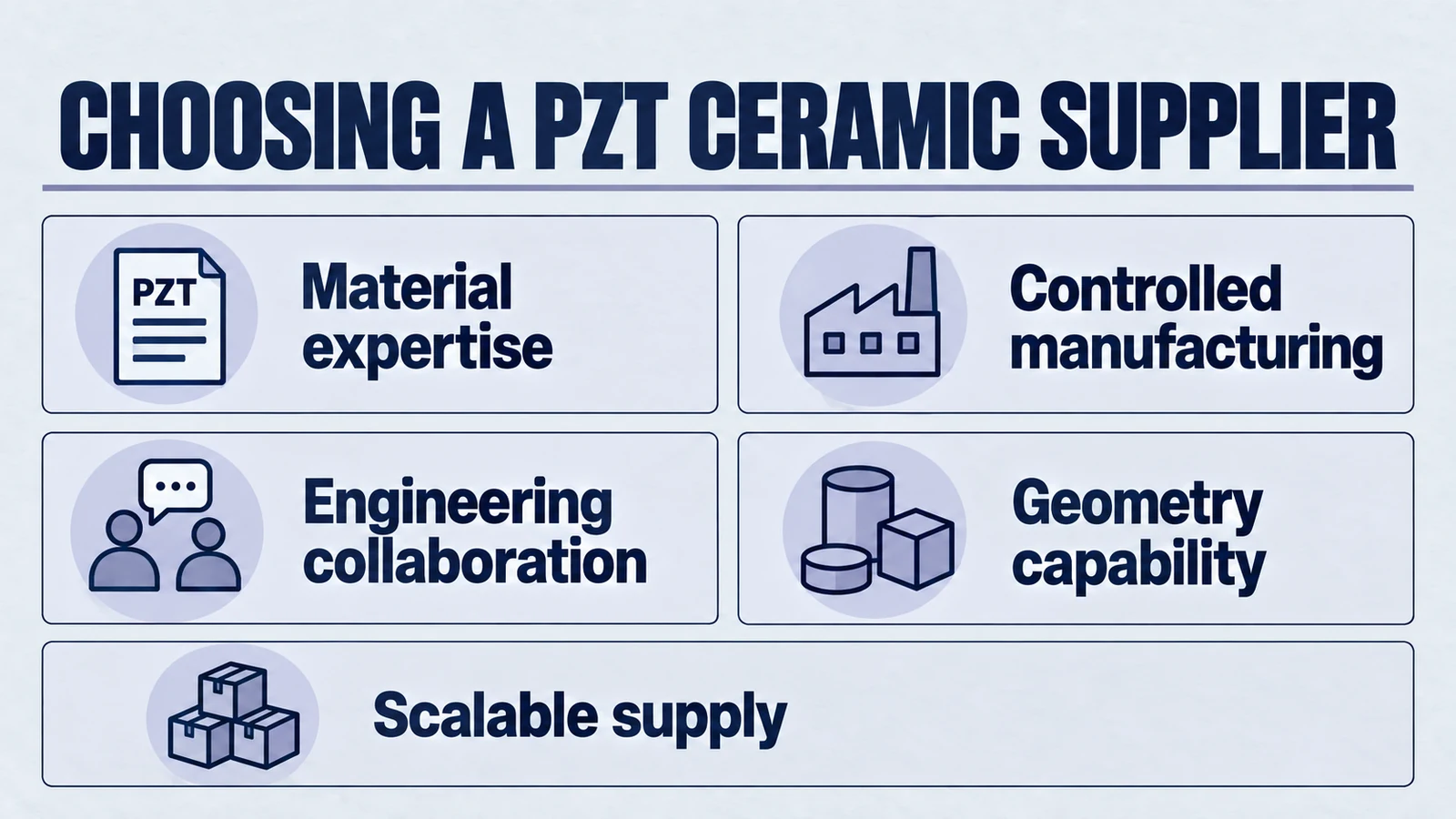
The Supplier Partnership: 5 Critical Factors for Choosing Your PZT Ceramic Supplier
Selecting a PZT ceramic supplier is a decision that extends far beyond a simple price comparison. It is the formation of a technical partnership that can significantly impact a product's performance, reliability, and time-to-market.
Factor 1: Deep Material Expertise & Customization Capabilities
A premier supplier is, first and foremost, a material science expert. Their offerings should go beyond a limited catalog of standard parts. Look for a supplier with a broad portfolio of application-optimized materials, including a variety of hard and soft PZT formulations, materials for specialized applications like focused ultrasound, and even lead-free alternatives for environmentally sensitive applications.
Factor 2: Vertically Integrated Manufacturing & Robust Quality Systems
As detailed in the manufacturing process, quality is the result of end-to-end process control. The ideal supplier has vertically integrated manufacturing, performing all critical steps—from powder formulation and mixing to final poling and testing—in-house. Look for formal certifications like ISO 9001:2015, which serve as objective proof of a commitment to a documented, repeatable, and continuously improving Quality Management System.
Factor 3: Collaborative Engineering & Application Support
The right supplier acts as a technical consultant and partner, not just a vendor. They should have a team of experienced application engineers who are accessible and dedicated to providing technical support from the initial design concept through to final production. This collaborative support is invaluable for selecting the correct material, optimizing transducer or actuator design, and troubleshooting system-level integration challenges.
Factor 4: Breadth of Product Geometries & Machining Precision
A supplier's capabilities are reflected in the variety and complexity of the shapes they can produce. A top-tier manufacturer should be able to produce a wide range of standard geometries—such as discs, rings, plates, tubes, bowls, and hemispheres—as well as highly complex, custom-machined shapes to meet specific application needs.
Factor 5: Proven Track Record, Scalability, and Reliability
Finally, look for a supplier with a long and proven history of success. A track record of decades serving the most demanding industries—such as medical, aerospace, and defense—is a strong indicator of reliability and quality. The supplier must also demonstrate the ability to seamlessly scale production from initial engineering samples and prototypes to high-volume manufacturing without any degradation in quality or consistency.
Conclusion: Powering Your Next Innovation with the Right PZT Partner
Lead Zirconate Titanate is a uniquely powerful and versatile material that forms the technological backbone of countless innovations. However, its full potential can only be realized when the component itself is of the highest quality. The journey from raw powder to a finished, functional PZT element is a testament to the complexities of ceramic manufacturing, where every step is critical and quality is a cumulative achievement.
The selection of a PZT ceramic supplier, therefore, is a strategic decision that should be guided by more than just a datasheet and a price quote. The critical distinction between soft and hard PZT formulations, the immense impact of the manufacturing process on final quality, and the need for deep application knowledge all point to a single conclusion: the ideal supplier is a partner.
They provide not only a component but also the essential material science expertise, manufacturing excellence, and collaborative engineering support that de-risk development and accelerate innovation. By prioritizing these factors, engineering teams can build their next breakthrough on a foundation of quality, reliability, and expertise.
Your project deserves a component built on this foundation. To ensure the success of your application, it is vital to engage with experts who understand the nuances of piezoelectric technology. Contact our engineering team today to discuss your application and discover how a true partnership can power your next innovation.
Engineering decision notes
PZT material and ceramic selection
Use this article when the choice is not just a shape, but a material tradeoff between sensitivity, loss, coupling, stability, and operating field. For "The Ultimate Guide to Choosing a PZT Ceramic Supplier", the practical value is in turning the topic into a measurable selection or sourcing decision.
YJ Piezo coordinates PZT ceramic projects with manufacturing support, so material formulation, sintering, polarization, electrode process, and outgoing inspection can be reviewed against the final application.
Selection checks
- Separate sensing needs from high-power actuation needs before comparing d33 or coupling values.
- Check dielectric loss, Qm, Curie temperature, aging behavior, and operating field against the real duty cycle.
- Confirm whether the application needs standard PZT grades or a custom formulation and geometry.
Failure risks
- Choosing only the highest d33 can create heat, drift, or depolarization risk in power ultrasonics.
- A ceramic that performs well in free measurement can fail once bonded, clamped, or loaded.
- Material substitutions without batch testing can change capacitance, resonance, and system tuning.
RFQ details
- Is the part used for sensing, actuation, atomization, cleaning, welding, or measurement?
- What field strength, temperature, duty cycle, and mechanical load will the ceramic see?
- Which values must be controlled: d33, capacitance, resonance, impedance, Qm, or dimensional tolerance?
Relevant YJ Piezo pages
- PZT Material Hub
Material grades and application tradeoffs
- Piezoelectric Ceramics
Shapes and ceramic manufacturing options
- PZT Material Supplier Hub
Material control, grade selection, and sourcing support
Application FAQ
- Is the highest d33 always the best PZT choice?
- No. High d33 can be useful for sensitivity, but high-power ultrasonic systems often need lower loss, higher Qm, better thermal stability, and safer operation under field and stress.
- What makes PZT material selection different from catalog buying?
- The right PZT choice depends on geometry, load, drive field, duty cycle, temperature, and inspection targets. A catalog value is only useful when it is tied to the final assembly conditions.