
The Ultimate Guide to Piezoelectric Tubes in Ultrasonic Sensing
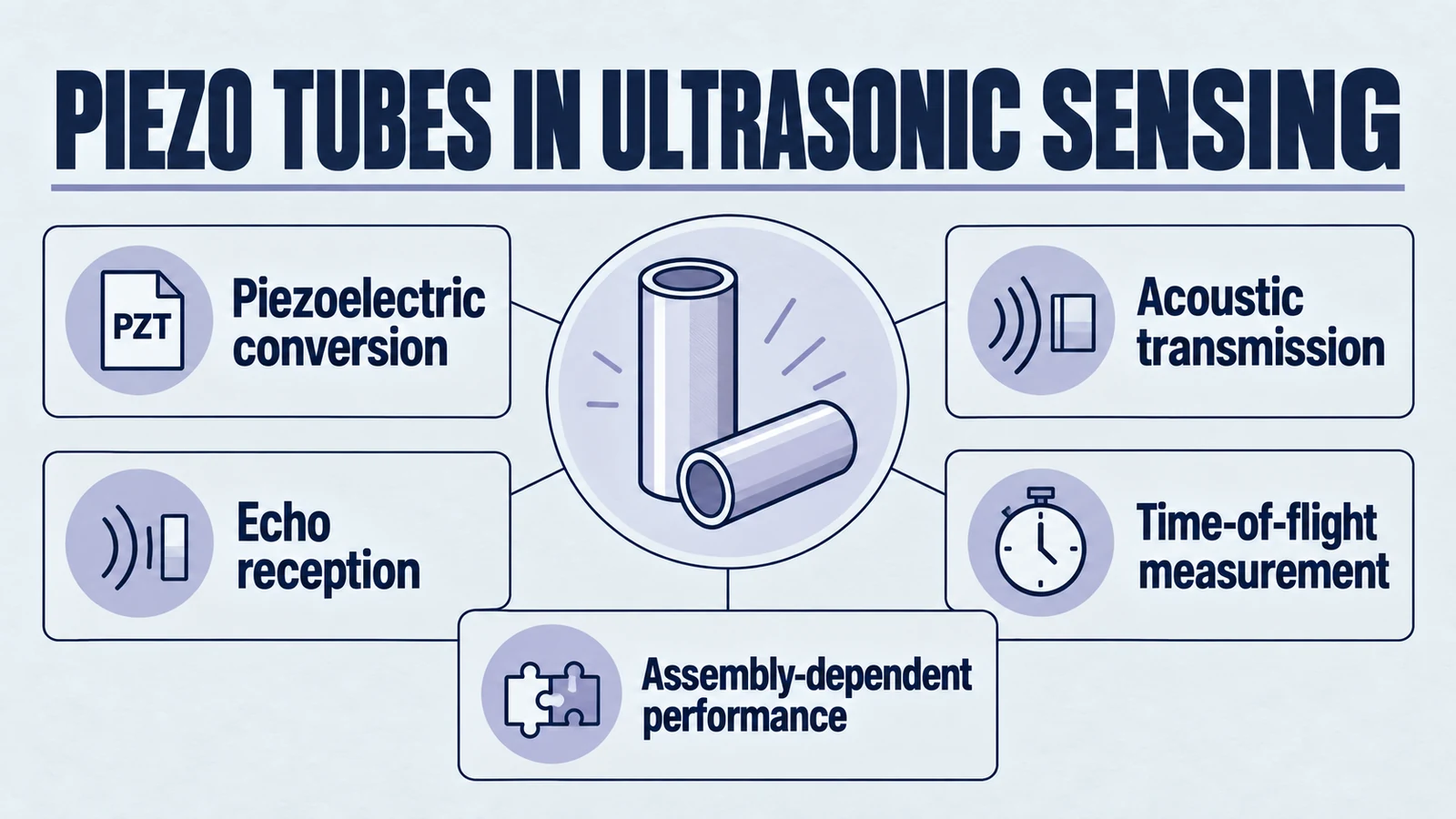
From biological echolocation to medical ultrasound imaging, the ability to use sound for sensing has changed many industries. At the heart of many ultrasonic systems lies a practical component: the piezoelectric tube. These ceramic cylinders help convert electrical energy into high-frequency sound and back again when the geometry, electrodes, and mounting are designed correctly.
This guide provides a comprehensive exploration of piezoelectric tubes and their role in ultrasonic sensing. It will delve into the fundamental physics that make them work, deconstruct the mechanics of an ultrasonic transducer, and showcase the vast landscape of applications they enable—from industrial automation and medical diagnostics to automotive safety and aerospace engineering. For the engineer, the product designer, or the R&D manager, understanding this core technology is the first step toward harnessing its full potential.
Part 1: The Core Principle: Unlocking the Power of Piezoelectricity
To understand how a piezoelectric tube functions within an ultrasonic sensor, one must first grasp the elegant physical principle that governs it: piezoelectricity. This is not merely a property of a material, but a dynamic, two-way process of energy conversion that forms the bedrock of transducer technology.
Product path for this search intent
Match the article topic to the right YJ Piezo product page
Use this article when the choice is not just a shape, but a material tradeoff between sensitivity, loss, coupling, stability, and operating field. For "The Ultimate Guide to Piezoelectric Tubes in Ultrasonic Sensing", the practical value is in turning the topic into a measurable selection or sourcing decision.
- PZT Material Hub
Material grades and application tradeoffs
- Piezoelectric Ceramics
Shapes and ceramic manufacturing options
- PZT Material Supplier Hub
Material control, grade selection, and sourcing support
1.1 The Two-Way Street of Energy Conversion: Direct and Inverse Effects
Piezoelectricity is the ability of certain crystalline materials to generate an electric charge in response to applied mechanical stress. This phenomenon operates through two distinct but complementary effects:
- The Direct Piezoelectric Effect: When a piezoelectric material is subjected to mechanical force—such as pressure, vibration, or strain—its internal crystal lattice deforms. This deformation causes a separation of positive and negative charge centers within the material's structure, resulting in the generation of a measurable voltage across its surfaces. This is the "sensor" or "generator" effect; it converts mechanical energy into electrical energy.
- The Inverse Piezoelectric Effect: Conversely, when an electric field is applied across the same material, it physically deforms, either expanding or contracting based on the field's polarity. This is the "actuator" or "motor" effect; it converts electrical energy into mechanical energy. If the applied voltage is an alternating current (AC), the material will vibrate at the same frequency, generating mechanical waves.
This duality is the cornerstone of modern ultrasonic sensor design. Many of the most efficient sensors use a single piezoelectric element to both transmit a sound pulse and receive its echo. To transmit, the element operates as an actuator, using the inverse effect to turn an electrical signal into a physical vibration. Moments later, to receive the reflected echo, the very same element switches roles to become a sensor, using the direct effect to convert the returning pressure wave back into an electrical signal.
1.2 The Material Science of PZT: Crafting the Active Element
While piezoelectricity exists in natural crystals like quartz, the demands of modern high-performance sensors are met by a class of engineered materials: piezoceramics. The most dominant among these is Lead Zirconate Titanate, commonly known as PZT.
Unlike quartz, PZT is a polycrystalline ceramic, meaning it is composed of many tiny, randomly oriented crystal grains. In its raw, sintered state, the material exhibits no net piezoelectric effect because the random orientations of the grains cancel each other out. The material's remarkable properties are unlocked through a critical manufacturing process called poling.
During the poling process, the PZT ceramic is heated to a high temperature, below a critical point known as its Curie temperature (TC), and subjected to a strong, direct current (DC) electric field. At this elevated temperature, the electric dipoles within each crystal grain have enough mobility to align themselves with the external field. The material is then cooled while the field is maintained, effectively "freezing" this alignment in place.
1.3 A Tale of Two Materials: "Hard" vs. "Soft" PZT
The engineering flexibility of PZT extends even further, into its very chemical composition. By introducing small amounts of other elements (a process called doping), manufacturers can fine-tune the material's electromechanical properties, leading to two broad classifications: "hard" and "soft" PZT.
| Characteristic | "Soft" PZT Materials | "Hard" PZT Materials |
|---|---|---|
| Piezo Constants (d) | High | Low |
| Dielectric Constants (K) | High | Low |
| Primary Use Case | High sensitivity receivers, low-power actuators | High-power transmitters, ultrasonic cleaning, welding |
Part 2: From Vibration to Measurement: How Piezoelectric Tubes Create Ultrasound
With a firm grasp of the underlying material science, it is now possible to explore the complete operational cycle of an ultrasonic sensor. This process transforms the fundamental properties of a piezoelectric tube into a precise and reliable measurement of the physical world.
2.1 Generating the Wave: The Inverse Piezoelectric Effect in Action
The generation of an ultrasonic wave begins with the application of a high-frequency AC voltage to the electrodes on the inner and outer surfaces of the piezoelectric tube. Driven by the inverse piezoelectric effect, the ceramic material responds by physically expanding and contracting at the drive frequency in the steady linear response, with amplitude and phase determined by resonance, damping and loading.
This rapid, microscopic vibration of the tube's surface acts like the cone of a loudspeaker. It pushes and pulls on the particles of the surrounding medium—be it air, water, or biological tissue—creating a series of high-pressure compressions and low-pressure rarefactions. This disturbance propagates outward from the transducer's face as a pressure wave.
2.2 The "Time-of-Flight" (ToF) Principle Explained
Once the ultrasonic wave is generated, the sensor uses a simple yet elegant principle to measure distance: Time-of-Flight (ToF). This method measures the time it takes for a sound pulse to travel to a target and return. The process can be broken down into four distinct steps:
- Transmit: The piezoelectric tube, acting as an actuator, is stimulated with a short electrical pulse, causing it to emit a brief burst of ultrasonic waves—often called a "ping".
- Propagate: The sound wave travels through the medium at a known, constant speed (the speed of sound, 'C') until it encounters an object in its path.
- Reflect: When the wave strikes the object, a portion of its energy is reflected back towards the sensor as an echo.
- Receive: The same piezoelectric tube, now having switched to its sensor mode, detects the returning echo.
The sensor's internal electronics precisely measure the total elapsed time ('T') from the moment the pulse was transmitted to the moment the echo was received. Since the speed of sound ('C') in the medium is a known value, the distance to the object ('L') can be calculated with a straightforward formula:
L = (T × C) / 2
2.3 The Anatomy of an Ultrasonic Transducer: More Than Just a Tube
While the piezoelectric tube is the core of the sensor, a functional ultrasonic transducer is a carefully engineered system where several components work in concert:
- The Active Element: This is the piezoelectric tube itself, the "heart" of the transducer that performs the electromechanical energy conversion.
- Electrodes: These are thin, conductive layers, typically made of silver or nickel, applied to the inner and outer surfaces of the tube.
- Housing and Connectors: The protective casing that shields the delicate ceramic element from the environment.
- Acoustic Matching Layer: This critical component supports efficient energy transfer between the high-impedance ceramic and the low-impedance medium.
Part 3: A World of Applications: Where Piezoelectric Tubes Drive Innovation
The combination of precision, reliability, and solid-state durability has made piezoelectric tube-based ultrasonic sensors widely used across a remarkable spectrum of industries.
3.1 Industrial Automation and Process Control
In the demanding environment of modern manufacturing and logistics, non-contact sensing is essential for maintaining efficiency and safety.
- Level Sensing: Piezoelectric tubes are widely used to continuously monitor the level of materials in tanks, bins, and silos. This non-contact method is ideal for corrosive substances and hygienic applications.
- Flow Measurement: Pairs of ultrasonic transducers are clamped onto the outside of pipes to measure the flow rate of liquids within using time-of-flight or Doppler methods.
- Object Detection and Robotics: Simple proximity sensors are fixtures on automated assembly lines, detecting the presence or absence of parts without physical contact.
3.2 Advancing Medical Technology
Nowhere is the impact of non-contact interaction more profound than in medicine, where piezoelectric transducers are used for both seeing inside the body and treating it non-invasively.
- Diagnostic Imaging: Arrays of piezoelectric transducers generate and receive ultrasonic pulses to create real-time images of internal organs, blood flow, and developing fetuses.
- Focused Ultrasound Power: "Hard" PZT transducers can support focused ultrasound equipment where acoustic output, duty cycle, and use-case limits are validated in the finished device.
- Precision Fluidics: The precise, controllable motion of piezoelectric tubes makes them ideal for microfluidic applications and drug delivery systems.
3.3 Smarter and Safer Automotive Systems
Modern vehicles are packed with sensors, many of which are invisible to the driver but are critical for safety and performance.
- Parking Assist: The familiar beeping sound of a parking sensor is the direct result of a piezoelectric ultrasonic transducer embedded in the vehicle's bumpers.
- Engine Management: Piezoelectric sensors are used as "knock sensors," listening for specific high-frequency vibrations associated with engine knock.
- Safety Systems: Piezoelectric accelerometers serve as impact sensors in airbag systems, triggering deployment within milliseconds of detecting a collision.
3.4 The Final Frontier: Aerospace and Structural Health Monitoring
In applications where failure is not an option, piezoelectric technology provides critical monitoring and control capabilities.
- Structural Health Monitoring (SHM): Networks of piezoelectric transducers can be permanently bonded to critical structures like aircraft wings, bridge supports, or pipelines to detect microscopic cracks and material fatigue.
- Aerospace Instrumentation: The precision and reliability of piezoelectric tubes make them valuable in space applications, from vibration control systems to micro-thrusters for satellite positioning.
Part 4: Choosing the Right Partner for Your Piezoelectric Needs
The journey from a fundamental physical principle to a high-performance ultrasonic sensor is complex. Success depends on a deep understanding of material science, systems engineering, acoustic physics, and application-specific challenges.
4.1 Beyond the Component: The Value of Customization and Expertise
For many cutting-edge applications, a standard, off-the-shelf piezoelectric tube will not deliver the required performance. True innovation is born from collaboration and customization:
- Custom Geometries: Manufacturing tubes, rings, and plates in non-standard dimensions to fit unique mechanical housings or achieve specific acoustic properties.
- Specialized Electrode Configurations: Designing segmented electrodes that enable complex motions like XY bending and scanning for advanced applications.
- Material Formulation: Selecting optimal "hard" or "soft" PZT formulations and developing custom compositions for extreme conditions.
- Value-Added Assemblies: Providing complete solutions beyond bare ceramic elements, including pre-wired assemblies and protective housings.
4.2 Why Yujie Piezo is Your Strategic Advantage
Navigating the complexities of piezoelectric technology requires more than a catalog; it requires expertise. At Yujie Piezo, we specialize in manufacturing high-performance, rigorously tested piezoelectric components tailored to the most demanding applications.
Our technical team understands the nuances of integrating these components into complex systems to achieve optimal performance and reliability. Whether you need high-frequency acoustic transducers, industrial cleaning solutions, or specialized sensing applications, we have the expertise to deliver.
Contact us today to discuss your project requirements. Let us help you select the ideal piezoelectric solution to support your product reliability and efficiency goals.
Conclusion: The Small Tube with a Mighty Impact
A piezoelectric tube can transmit ultrasound through the inverse effect and detect pressure through the direct effect. Select and validate the complete transducer, readout and safety architecture for its intended application.
Its strong reliability stems from a solid-state design with no moving parts to fail. Its exceptional power efficiency is the key enabler for long-life, battery-powered devices that can be deployed anywhere. And its ability to produce precise, controllable ultrasonic waves from a compact and cost-effective component makes widespread innovation achievable.
In the world of sensing and measurement technology, the greatest impact often comes from the most reliable and efficient components. The humble piezoelectric tube is a testament to this principle—a small piece of ceramic that, through the remarkable properties of piezoelectricity, enables breakthrough innovations across industries from healthcare to aerospace, standing as the foundation for the next generation of ultrasonic sensing solutions.
Engineering decision notes
PZT material and ceramic selection
Use this article when the choice is not just a shape, but a material tradeoff between sensitivity, loss, coupling, stability, and operating field. For "The Ultimate Guide to Piezoelectric Tubes in Ultrasonic Sensing", the practical value is in turning the topic into a measurable selection or sourcing decision.
YJ Piezo coordinates PZT ceramic projects with manufacturing support, so material formulation, sintering, polarization, electrode process, and outgoing inspection can be reviewed against the final application.
Selection checks
- Separate sensing needs from high-power actuation needs before comparing d33 or coupling values.
- Check dielectric loss, Qm, Curie temperature, aging behavior, and operating field against the real duty cycle.
- Confirm whether the application needs standard PZT grades or a custom formulation and geometry.
Failure risks
- Choosing only the highest d33 can create heat, drift, or depolarization risk in power ultrasonics.
- A ceramic that performs well in free measurement can fail once bonded, clamped, or loaded.
- Material substitutions without batch testing can change capacitance, resonance, and system tuning.
RFQ details
- Is the part used for sensing, actuation, atomization, cleaning, welding, or measurement?
- What field strength, temperature, duty cycle, and mechanical load will the ceramic see?
- Which values must be controlled: d33, capacitance, resonance, impedance, Qm, or dimensional tolerance?
Relevant YJ Piezo pages
- PZT Material Hub
Material grades and application tradeoffs
- Piezoelectric Ceramics
Shapes and ceramic manufacturing options
- PZT Material Supplier Hub
Material control, grade selection, and sourcing support
Application FAQ
- Is the highest d33 always the best PZT choice?
- No. High d33 can be useful for sensitivity, but high-power ultrasonic systems often need lower loss, higher Qm, better thermal stability, and safer operation under field and stress.
- What makes PZT material selection different from catalog buying?
- The right PZT choice depends on geometry, load, drive field, duty cycle, temperature, and inspection targets. A catalog value is only useful when it is tied to the final assembly conditions.