
The Ultimate Guide to Selecting a PZT Material Supplier
Why Your PZT Material Supplier is a Critical Design Partner, Not Just a Vendor
Selecting a PZT (lead zirconate titanate) material supplier is one of the most consequential decisions in the product development lifecycle. It is a strategic choice that extends far beyond a simple transaction on a purchase order. The properties of the core piezoelectric ceramic element serve as the foundation for a device's performance, reliability, and success in the market. Viewing a supplier as a mere component vendor is a critical oversight; the right supplier is a design partner.
The choice of PZT material creates a ripple effect that touches every aspect of the final product. A suboptimal material can introduce a cascade of performance issues: a poor signal-to-noise ratio in sensitive NDT sensors, insufficient displacement in precision actuators, or premature failure due to thermal depolarization in high-power ultrasonic transducers. These are not minor flaws; they are fundamental failures that can compromise the entire system.
The importance of this decision spans a wide array of demanding applications. From medical ultrasound imaging and industrial non-destructive testing (NDT) to precision automation, consumer electronics, and advanced scientific research, the quality and suitability of the PZT material are paramount. This guide provides engineers, procurement managers, and R&D leaders with a framework for evaluating and selecting a PZT material supplier: a partner who can support innovation through material data, process control, and practical engineering communication.
Product path for this search intent
Match the article topic to the right YJ Piezo product page
Use this article when the choice is not just a shape, but a material tradeoff between sensitivity, loss, coupling, stability, and operating field. For "The Ultimate Guide to Selecting a PZT Material Supplier", the practical value is in turning the topic into a measurable selection or sourcing decision.
- PZT Material Hub
Material grades and application tradeoffs
- Piezoelectric Ceramics
Shapes and ceramic manufacturing options
- PZT Material Supplier Hub
Material control, grade selection, and sourcing support
Decoding the Datasheet: Key PZT Performance Characteristics You Can't Ignore
A PZT material datasheet is dense with technical parameters. While all are important, a few key characteristics govern the fundamental behavior of the material and must be prioritized during the selection process. However, a datasheet should be treated as a map, not the territory itself. The numbers provide guidance, but the true value of a supplier lies in their ability to help navigate the complex interplay and inherent trade-offs between these properties. A material with a world-class value in one parameter may have a critical deficiency in another for a specific use case. An expert supplier moves beyond the numbers to provide application-specific context.
The Core Piezoelectric Coefficients (d and g)
The piezoelectric coefficients are the most direct indicators of a material's primary function. They are typically divided into two key constants:
- Piezoelectric Charge Coefficient (d-constant): Often called the "actuator constant," this value (e.g., d₃₃) quantifies the mechanical strain the material produces for a given applied electric field. A higher d₃₃ value means greater displacement or force, making it a critical parameter for applications like micro-positioning actuators and precision injectors.
- Piezoelectric Voltage Coefficient (g-constant): Known as the "sensor constant," this value (e.g., g₃₃) measures the strength of the electric field the material generates in response to an applied mechanical stress. Materials with a high g₃₃ are exceptionally sensitive and are the preferred choice for sensors such as hydrophones, accelerometers, and acoustic emission detectors.
The relevant voltage coefficient satisfies g = d/ε for the specified component and boundary conditions. A formulation with higher d may also have sufficiently higher permittivity to give lower g; this is not an intrinsic inverse law between d and g. Compare charge and voltage readout, capacitance, loading and noise for the actual sensor or actuator.
Energy Conversion and Efficiency Metrics
These parameters define how effectively the material converts energy between its mechanical and electrical states and how much energy is lost as heat during operation.
- Electromechanical Coupling Factors (kₚ, kt, k₃₃): This is not a measure of efficiency in the traditional sense, but rather an indicator of the material's ability to convert stored energy from one form to another. Higher coupling factors are essential for transducers that must both transmit and receive signals effectively, such as those used in medical imaging and NDT.
- Mechanical Quality Factor (Qₘ): This value represents the inverse of mechanical damping within the material. A high Qₘ signifies low mechanical loss, which is critical for high-power, resonant applications like ultrasonic welding and cleaning. Low loss minimizes heat buildup, allowing the transducer to operate at higher power levels without risk of failure. Conversely, a low Qₘ is desirable for broadband sensors that need to dampen vibrations or "ringing" quickly to accurately detect short pulses.
- Dielectric Dissipation Factor (tan δ or Loss Tangent): This parameter measures the electrical energy lost as heat when the material is subjected to an alternating electric field. A low dissipation factor is non-negotiable for high-power, high-duty-cycle applications. It ensures high energy efficiency and prevents thermal runaway, which can permanently damage the ceramic. For example, materials achieving an ultra-low tan δ as low as 0.004 represent a benchmark for high-performance applications.
Operational and Environmental Limits
These properties define the physical and thermal boundaries within which the material can reliably operate.
- Curie Temperature (Tc): The relevant ferroelectric phase transition can destroy remanent polarization, but does not necessarily make an intact ceramic intrinsically unrecoverable. Re-poling is a qualified process and does not guarantee recovery of finished equipment. Use documented operating and assembly limits separately.
- Dielectric Constant (K or Permittivity): This property is crucial for electrical impedance matching between the piezoelectric element and the driving or receiving electronics. In applications like high-frequency medical ultrasound arrays, where elements are extremely small, a high dielectric constant is necessary to achieve a manageable electrical impedance that can be efficiently driven by the system's electronics.
The initial and most critical filter in the selection process is understanding the distinction between "soft" and "hard" PZT ceramics. This classification is not mere jargon; it represents a fundamental divergence in material properties and intended applications. "Soft" PZTs generally exhibit higher piezoelectric constants and coupling factors, making them ideal for sensitive sensors and actuators. "Hard" PZTs are characterized by lower losses, higher mechanical quality factors, and greater stability under high electrical and mechanical stress, making them the usual starting point for high-power transducers. An engineer's first question to a potential supplier should concern their portfolio and expertise across both categories, as this demonstrates a comprehensive understanding of the piezoelectric landscape.
The Anatomy of Quality: Manufacturing, Consistency, and Certification
Many suppliers claim to offer "high-quality" materials, but this term is meaningless without a clear understanding of what constitutes true quality in PZT manufacturing. Quality is not a promise; it is an observable and auditable process that begins with raw materials and is validated by rigorous testing and certification. For a procurement manager or OEM, this process-driven approach to quality is a direct proxy for risk mitigation.
The Foundation of Performance: Raw Materials and Manufacturing Processes
The performance of a finished PZT component is determined long before it is pressed and fired. The entire process is a chain where the final product is only as strong as the weakest link.
- Raw Material Purity: The process begins with the selection and sourcing of high-purity precursor materials, such as lead, zirconium, and titanium oxides. Even trace impurities can significantly and unpredictably alter the final piezoelectric properties, leading to performance degradation.
- Process Control: A top-tier manufacturer exercises precise control over every subsequent step. This includes the exact weighing of ingredients, wet milling to achieve a uniform particle size distribution, and calcining in high-purity crucibles at temperatures around 1000°C to form the correct PZT crystal phase. During this high-temperature firing, proprietary measures are essential to prevent the evaporation of lead oxide, which would alter the material's stoichiometry and compromise its properties. Following calcination, processes like spray drying are used to create uniform, spherical particles that ensure defect-free, lamination-free ceramic shapes after pressing.
- Traceability: A hallmark of a quality-focused manufacturer is full traceability, allowing any finished component to be tracked back through the production process to the specific batches of raw materials from which it was made. This provides documented quality evidence and an invaluable tool for root-cause analysis should any issues arise.
The OEM's Holy Grail: Batch-to-Batch Consistency
For an Original Equipment Manufacturer (OEM), consistency is often more critical than peak performance. A transducer that works perfectly today is of little use if the next batch of PZT material performs differently. Variability in piezoelectric properties from one batch to the next can wreak havoc on production lines, forcing constant recalibration of equipment, delaying shipments, and resulting in inconsistent end-product performance that can damage a brand's reputation. A reliable supplier must demonstrate a history of low variability and be willing to provide batch-specific data to prove their consistency. This commitment to reliability is a cornerstone of a successful long-term partnership.
The Language of Trust: Certifications and Standards
Certifications from internationally recognized bodies provide objective, third-party validation of a supplier's commitment to quality. They are not just badges; they are evidence of robust systems designed to prevent errors and ensure reliability, directly reducing supply chain risk for the customer.
- Quality Management Systems: ISO 9001 certification demonstrates that a supplier has implemented and maintains a quality management system for its processes. For medical-device programs, confirm the required traceability records, supplier controls, and any device-level quality documentation rather than assuming the ceramic element alone carries medical certification.
- Technical Standards: Agree the test method and edition, specimen geometry, vibration mode, drive level, temperature, aging/preload conditions, and uncertainty before comparing supplier data. EN 50324-1 covers terms and definitions, part 2 low-power measurements, and part 3 high-power measurements. IEEE 176-1987 is a historical inactive-withdrawn reference, and MIL-STD-1376B is canceled Naval sonar material guidance. A named standard alone does not establish that a supplier followed it or that all measurements are directly comparable.
To aid in the initial selection process, the following table provides a practical guide to differentiating between "soft" and "hard" PZT ceramics.
| Characteristic | "Soft" PZT (e.g., Navy Types II, V, VI / PZT-5 Family) | "Hard" PZT (e.g., Navy Types I, III / PZT-4, PZT-8 Family) | Primary Applications |
|---|---|---|---|
| Piezoelectric Constant (d₃₃) | High | Lower | Soft: NDT sensors, hydrophones, actuators, medical imaging |
| Mechanical Quality (Qₘ) | Low | High | Hard: High-power ultrasonic transducers, sonar, ultrasonic cleaning & welding |
| Coercive Field | Low | High | |
| Dielectric Loss | Higher | Low | |
| Curie Temperature | Moderate | High | |
| Stability | Lower | Higher |
Application-Driven Selection: Tailoring PZT for Your Specific Needs
The choice of PZT is not a post-design decision; it is an integral part of the design process itself. The intended application dictates the required material properties, which in turn influence the mechanical and geometric design of the final component. A truly valuable supplier possesses not only deep expertise in material science but also a practical understanding of transducer design and manufacturing, enabling them to provide holistic guidance.
Medical Ultrasound Transducers: The Pursuit of Precision and Clarity
Medical imaging represents one of the most demanding applications for piezoelectric materials, requiring a unique combination of properties to produce clear, high-resolution images.
- Key Material Needs: Characteristic acoustic impedance depends on density times mode-specific sound speed. Higher ceramic density alone does not improve the match to soft tissue. Design the active material/composite, matching layers, backing and electrical impedance together; qualify grain structure and machining capability for the required array geometry.
- Material Types: "Soft" PZT formulations, such as those analogous to Navy Type VI or PZT-5H, are commonly used. For applications demanding very high performance, advanced materials like single-crystal piezoelectrics may be employed for their high electromechanical coupling and potential for creating broadband transducers. Suppliers serving healthcare device programs should understand these requirements and the finished-device validation boundary.
Industrial NDT and High-Power Ultrasonics: Durability Under Duress
Applications such as non-destructive testing, ultrasonic cleaning, welding, and sonar operate under high electrical drive and significant mechanical stress, demanding materials that are exceptionally robust.
- Key Material Needs: Separate pulse-echo NDT requirements from resonant high-power duty. Soft grades such as PZT-5A can serve NDT probes; hard grades such as PZT-4/PZT-8 are common low-loss power choices. Select the exact grade, bandwidth, drive and loading, and qualify stress and thermal limits for the actual assembly.
- Customization: These applications often require custom geometries beyond simple discs, including rings, plates, tubes, and even spheres. Specialized electrode configurations, such as wrap-around electrodes that place both electrical contacts on one face, are also common for NDT probes to allow for flush mounting. A supplier offering comprehensive OEM services and custom solutions is essential for this sector.
Precision Actuators and High-Sensitivity Sensors
This category covers the dual needs of generating precise, controlled movement and detecting faint physical signals like pressure or vibration.
- Actuators: For applications like nanopositioning stages or fuel injectors, the goal is to achieve the maximum possible displacement. This requires "soft" PZT materials with the highest possible piezoelectric charge coefficient (d₃₃). To amplify the displacement, these materials are often assembled into stacked actuators.
- Sensors: For detecting faint signals, the primary requirement is a material with a high piezoelectric voltage coefficient (g₃₃) to generate the largest possible voltage signal from a small mechanical input. This is crucial for devices like accelerometers, microphones, and flow detectors. For applications requiring the detection of fast, short pulses, materials with a low mechanical Qₘ are preferred, as they provide the wide bandwidth necessary to respond without excessive ringing.
The Manufacturer-Direct Advantage: Why Sourcing Straight from the Factory Matters
A supplier's business model—whether they are a manufacturer or a distributor—is as critical a feature as the material's technical specifications. For a B2B customer, sourcing directly from the manufacturer offers a distinct set of strategic advantages that transform the relationship from transactional to collaborative, directly impacting cost, innovation, and reliability.
Enhancing Cost-Effectiveness and Financial Transparency
The financial benefits of bypassing intermediaries are clear and immediate.
- Eliminating Markups: The most direct benefit is the elimination of the distributor or wholesaler margin, which translates to lower unit costs and a more competitive price for the end product.
- Long-Term Value: The discussion of cost should extend beyond the initial purchase price. A higher-quality, more consistent material sourced directly from the manufacturer reduces the total cost of ownership. It minimizes the costs associated with production line adjustments, product failures, field service, and warranty claims, delivering superior long-term value.
Direct Technical Access and Collaboration
Direct sourcing creates a clear and efficient channel for technical communication and co-development.
- Direct Line to Expertise: When purchasing directly from a manufacturer, engineers can communicate with the material scientists and engineers who actually formulated and produced the PZT. This eradicates the risk of miscommunication through intermediaries and provides direct access to expert advice for optimizing a design or troubleshooting a problem.
- True Customization: Deep customization—whether it involves tailoring a material's formulation for a specific property, creating a unique geometry, or designing a complex electrode pattern—is only truly feasible when working directly with the manufacturer. This capability is a critical enabler for OEMs developing novel, next-generation devices. This direct collaborative potential is a core advantage that can significantly accelerate innovation cycles. The rapid feedback loop allows for faster iteration on custom components, shortening time-to-market and creating a durable competitive advantage for the customer.
Superior Quality Assurance and Supply Chain Control
A direct relationship provides greater control over logistics and accountability, leading to a more robust and reliable supply chain.
- Reduced Handling: The product travels directly from the factory to the customer, significantly reducing the number of handling steps. This minimizes the risk of shipping damage or performance degradation caused by improper storage conditions at an intermediary's warehouse.
- Direct Accountability: In the event of a quality issue, there is a single point of contact and clear ownership of the problem. This leads to faster, more effective resolution without the finger-pointing that can occur between distributors and manufacturers.
- Supply Chain Stability: A direct relationship fosters greater transparency into production schedules, material lead times, and potential disruptions. This enhanced visibility allows for more accurate forecasting and robust supply chain planning, reducing the risk of unexpected stockouts or production delays.
Choosing Your PZT Supplier as a Long-Term Partner
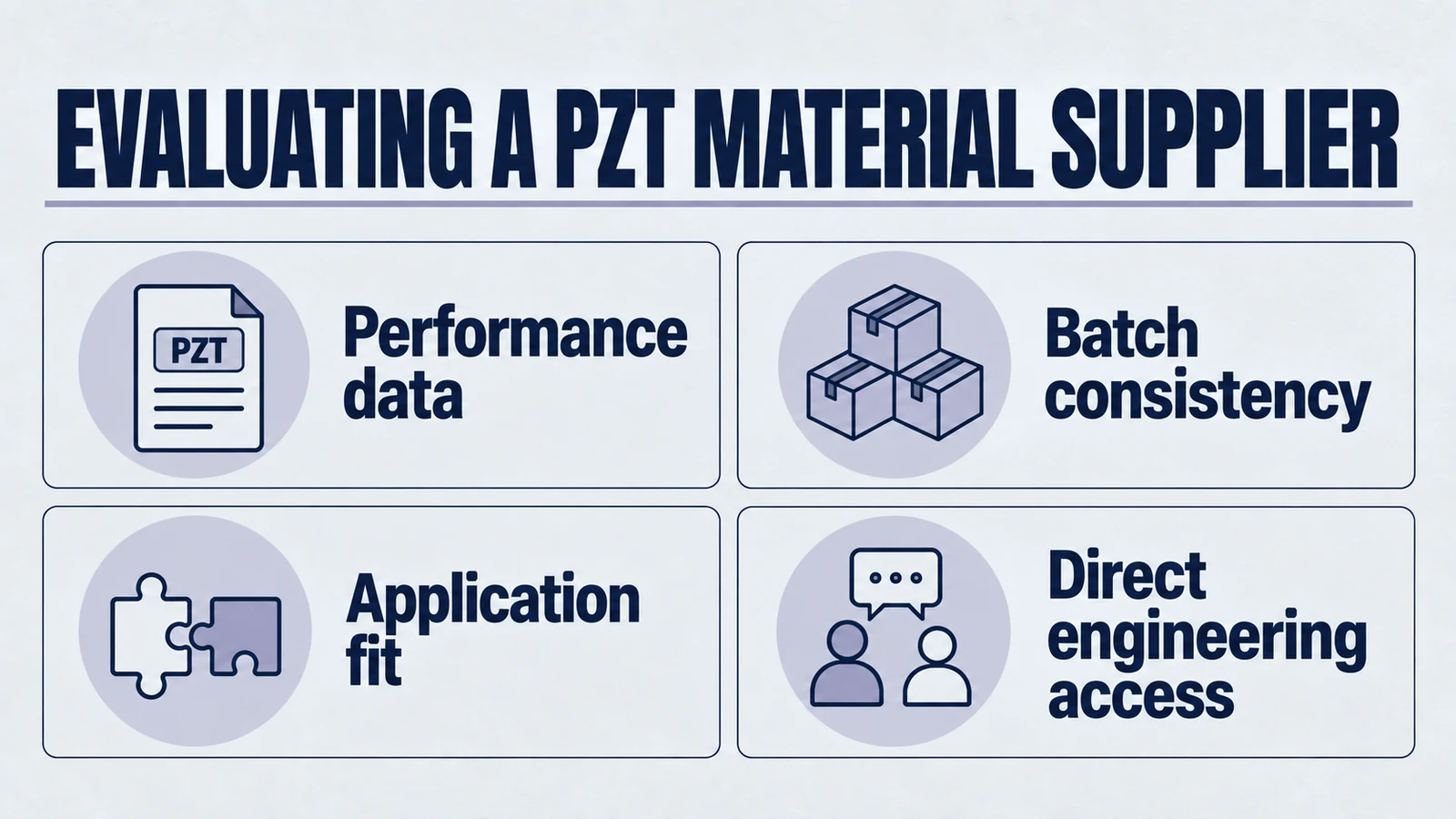
The journey to selecting the right PZT material supplier requires a holistic evaluation that goes far beyond a simple price comparison. The decision rests on four key pillars: a deep understanding of the critical performance metrics on the datasheet and their inherent trade-offs; verification of true quality through an examination of manufacturing processes, consistency data, and certifications; a meticulous alignment of material properties with the specific, demanding requirements of the end application; and a strategic appreciation for the powerful advantages of a manufacturer-direct relationship.
The central message is a call to shift perspective: the ideal PZT material supplier is not a vendor who simply fulfills orders. They are a long-term strategic partner who contributes technical expertise, supports reliability through process evidence, and actively collaborates on innovation. This partnership becomes the bedrock upon which successful, high-performance products are built.
At Yujie Piezo, we apply these principles through project-specific material selection, engineering review, and manufacturing coordination for PZT materials and piezoelectric components. Inspection scope, documentation, and production requirements are confirmed for the component and order.
For engineers looking to understand more about piezoelectric technology fundamentals, we recommend exploring our comprehensive guide on What is PZT? which covers the basic principles behind these remarkable materials.
Additionally, you might find value in our detailed article on The Strategic Advantages of Collaborating with an OEM Manufacturer, which provides broader insights into the benefits of working with specialized piezoelectric manufacturers.
Your next project's success depends on the right piezoelectric foundation. If you're facing a complex design challenge or require a custom PZT solution tailored to your exact specifications, our engineering team is ready to partner with you. Contact us to discuss your application and discover how a dedicated manufacturing partner can make the difference.
Engineering decision notes
PZT material and ceramic selection
Use this article when the choice is not just a shape, but a material tradeoff between sensitivity, loss, coupling, stability, and operating field. For "The Ultimate Guide to Selecting a PZT Material Supplier", the practical value is in turning the topic into a measurable selection or sourcing decision.
YJ Piezo coordinates PZT ceramic projects with manufacturing support, so material formulation, sintering, polarization, electrode process, and outgoing inspection can be reviewed against the final application.
Selection checks
- Separate sensing needs from high-power actuation needs before comparing d33 or coupling values.
- Check dielectric loss, Qm, Curie temperature, aging behavior, and operating field against the real duty cycle.
- Confirm whether the application needs standard PZT grades or a custom formulation and geometry.
Failure risks
- Choosing only the highest d33 can create heat, drift, or depolarization risk in power ultrasonics.
- A ceramic that performs well in free measurement can fail once bonded, clamped, or loaded.
- Material substitutions without batch testing can change capacitance, resonance, and system tuning.
RFQ details
- Is the part used for sensing, actuation, atomization, cleaning, welding, or measurement?
- What field strength, temperature, duty cycle, and mechanical load will the ceramic see?
- Which values must be controlled: d33, capacitance, resonance, impedance, Qm, or dimensional tolerance?
Relevant YJ Piezo pages
- PZT Material Hub
Material grades and application tradeoffs
- Piezoelectric Ceramics
Shapes and ceramic manufacturing options
- PZT Material Supplier Hub
Material control, grade selection, and sourcing support
Application FAQ
- Is the highest d33 always the best PZT choice?
- No. High d33 can be useful for sensitivity, but high-power ultrasonic systems often need lower loss, higher Qm, better thermal stability, and safer operation under field and stress.
- What makes PZT material selection different from catalog buying?
- The right PZT choice depends on geometry, load, drive field, duty cycle, temperature, and inspection targets. A catalog value is only useful when it is tied to the final assembly conditions.