
Not All Mists Are Created Equal: Engineering the Ultrasonic Atomizer for Precision Applications
The Deceptive Simplicity of the Ultrasonic Atomizer
When you hear the term ultrasonic atomizer, you might picture a household humidifier pushing a cool plume into the air. The same broad physical principle also appears inside precision misting, aerosol, coating, and nebulizer device designs: a piezoelectric ceramic element converts an alternating electrical signal into high-frequency mechanical vibration.
But this is where the similarity ends.
Technically, an ultrasonic atomizer is a system. The piezoelectric part inside it is usually a ceramic disc, ring, plate, or bonded element selected for a target frequency, capacitance, vibration mode, and operating load. Operating frequency depends on architecture: some liquid-surface atomizers operate in the MHz range, while mesh designs can operate at lower ultrasonic frequencies. Use model-specific frequency and loaded-assembly measurements.
Product path for this search intent
Match the article topic to the right YJ Piezo product page
Use this article when the choice is not just a shape, but a material tradeoff between sensitivity, loss, coupling, stability, and operating field. For "Not All Mists Are Created Equal: Engineering the Ultrasonic Atomizer for Precision Appl...", the practical value is in turning the topic into a measurable selection or sourcing decision.
- PZT Material Hub
Material grades and application tradeoffs
- Piezoelectric Ceramics
Shapes and ceramic manufacturing options
- PZT Material Supplier Hub
Material control, grade selection, and sourcing support
The terms "ultrasonic atomizer" and "piezoelectric atomizer" are often used interchangeably, but they do not describe the same purchasing decision. The atomizer is the complete system. The piezoelectric ceramic element is the vibration source that device designers must match to the liquid, housing, drive circuit, duty cycle, and target mist behavior.
The difference between a consumer accessory and a precision device is not only the housing. It is the material science, electrode pattern, geometry, bonding, and manufacturing consistency of that piezoelectric engine. For an OEM developing an atomization system, selecting this ceramic element early can reduce redesign work later.
The Anatomy of Failure: Why Off-the-Shelf Atomizers Disappoint in Critical Applications
For engineers in medical-device, industrial, agricultural, and consumer-electronics programs, a component problem is rarely a simple case of "broken." More often, it is an in-application mismatch: a part appears acceptable on a datasheet but does not hold frequency, amplitude, temperature, or output consistency in the actual assembly.
The Medical Device Dilemma: The Trilemma of Precision, Safety, and Portability
In nebulizer device design, the atomization section is not just asked to "make mist." The finished device team normally has to validate aerosol output, droplet-size distribution, cleaning method, material contact path, electrical design, and regulatory documentation at the system level.
- The Precision Challenge: Droplet size and mist output depend on the system design, but the ceramic element contributes through frequency stability, vibration amplitude, and coupling to the membrane or liquid surface.
- The Portability Challenge: Portable products require efficient piezo ceramics, stable capacitance, and compatible drive electronics so the atomization function does not demand unnecessary power.
- The Material Contact Challenge: If the piezo ceramic is near a liquid path, the finished-device manufacturer must evaluate coatings, isolation, adhesives, cleaning chemistry, and material documentation. Component suppliers can support this work with traceable PZT ceramic data and consistent production records.
An OEM that chooses a ceramic element only by nominal frequency or price may discover the real requirements late, when the enclosure, drive circuit, and validation samples are already locked.
The Industrial Coating Problem: The Paradox of Precision vs. Durability
In advanced manufacturing, ultrasonic atomizers are used for high-value precision coatings. This technology is essential for:
- Medical Devices: Applying precise, uniform layers of drug-polymer coatings onto implantable medical stents.
- Alternative Energy: Depositing thin-film anti-reflection or TCO layers on solar cells.
- Electronics: Applying functionalized nanoparticle suspensions in semiconductor manufacturing.
These applications often run for long duty cycles and expose the piezo element to thermal, mechanical, and chemical stress.
- Viscosity and Clogging: Medical and industrial formulations can vary in viscosity, surface tension and suspended solids. Validate mesh/nozzle geometry, residues and cleaning. Ceramic-grade selection supports vibration design but does not itself eliminate clogging.
- The Durability Challenge: The custom piezoelectric ceramic component in an industrial coater must withstand constant high thermo-mechanical loads. Low-quality ceramics are prone to cracking or overheating, leading to a short functional life and a high total cost of ownership (TCO).
For the industrial engineer, the problem is repeatability. Batch #2 of the atomizer component must behave like batch #1, or the coating recipe, drive circuit, and maintenance schedule become unstable.
The Yujie Technology Difference: From Piezoelectric Powder to Precision Performance
Yujie Technology was founded in 1996 and focuses on piezoelectric ceramic components, PZT materials, and custom ceramic shapes. For atomizer and nebulizer-related programs, our role is to support the ceramic element, material selection, geometry, electrode, and test-data side of the design.
Our Philosophy: "From Powder to Performance"
Our core philosophy is "From Powder to Performance." This means controlling the ceramic process from PZT material formulation through forming, sintering, machining, electrode application, poling, and electrical inspection.
Why does this matter for your ultrasonic atomizer? Material variation can change capacitance, resonant behavior, dielectric loss, and heat generation. Process control and batch testing help verify that prototypes and later production lots remain within agreed specifications.
Our Expertise: "Application-Specific" Engineering
Our guiding principle is that the ceramic element should fit the application. Backed by an R&D team with long experience in piezoelectric technology, we help customers compare disc, ring, rectangular, and custom shapes before the mechanical design becomes difficult to change.
- For precision aerosol and sensing designs: High-sensitivity materials such as PZT-5A and PZT-5H can be evaluated when the design needs strong electromechanical response at low drive levels.
- For higher-power industrial designs: Hard PZT materials such as PZT-8 can be considered when the assembly needs lower loss, higher mechanical quality, and better stability under drive.
Our Quality: The Assurance of a Global Partner
We are a trusted global partner, with a robust supply chain serving the world's most demanding markets in North America, Europe, and Asia. This trust is built on a foundation of verifiable quality.
Our component work can include agreed material records, process controls, and electrical testing. The applicable evidence is confirmed for the component and order. Finished atomizer, nebulizer, and aerosol devices still require their own system-level verification by the device manufacturer.
A Practical Guide: How Yujie Co-Engineers Your Ultrasonic Atomizer
Partnering with us is a collaborative engineering process, not a simple transaction.
Clarifying Liquid-Surface and Vibrating-Mesh Architectures
Conventional ultrasonic and vibrating-mesh nebulizers can both use piezoelectric actuation, but their aerosol-generation mechanisms differ. Select using formulation compatibility, validated output, temperature, power and intended use rather than a universal ranking.
- Conventional Ultrasonic Systems: Acoustic energy can generate aerosol at a liquid surface. Heating and formulation suitability depend on the complete device and operating conditions; conventional equipment remains used in medical applications, while mesh devices can also heat formulations.
- Modern "Vibrating Mesh" Tech: Many compact designs use a piezoelectric ceramic ring or related element to vibrate a micro-perforated mesh. The liquid is pushed through precision holes, and the finished assembly controls the final aerosol behavior.
Yujie supports the high-frequency piezoelectric ceramic components used inside these systems, including custom piezoelectric discs, rings, plates, and custom shapes.
The Yujie "Concept to Production" Journey
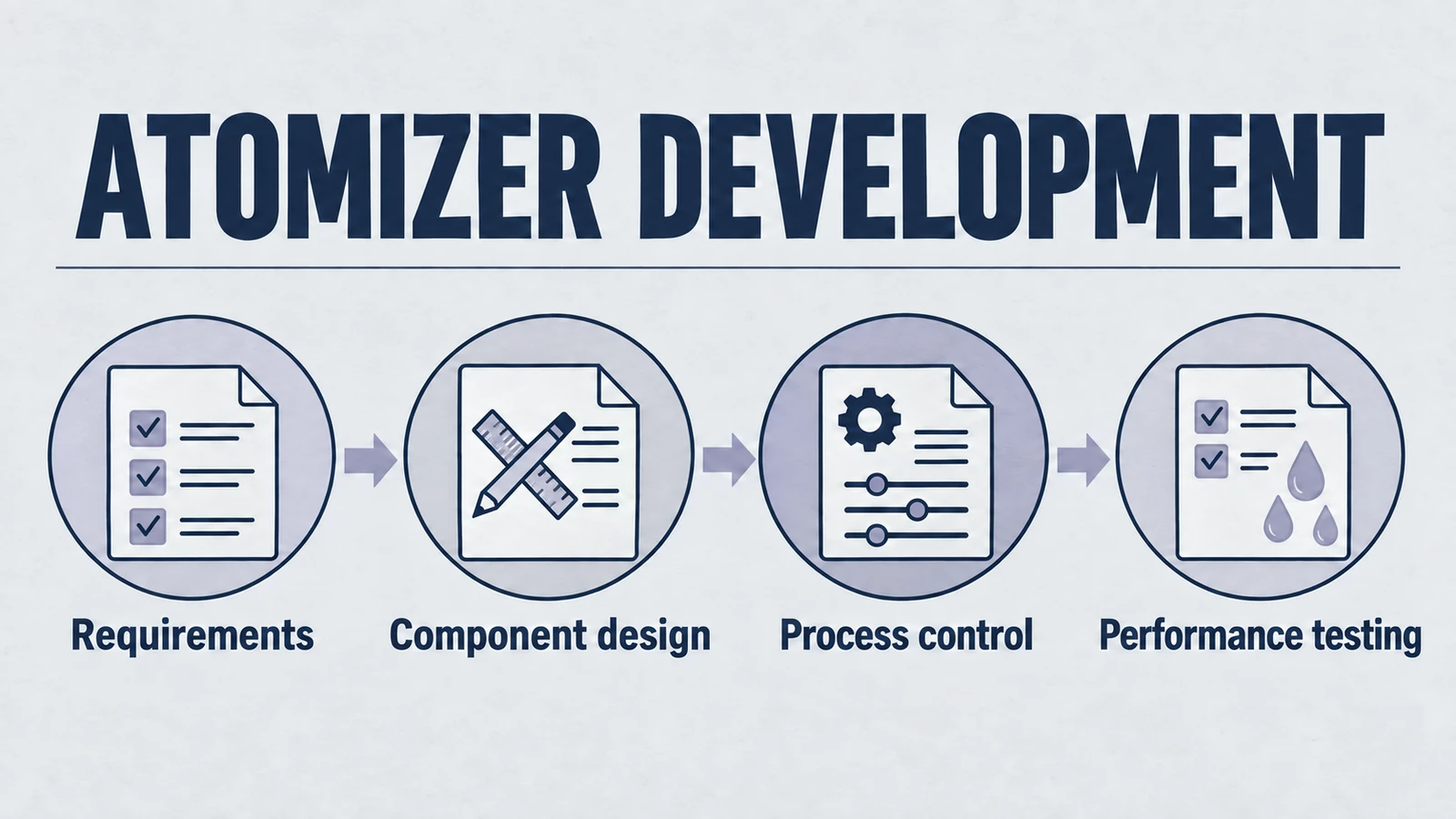
When you bring a project to us, we begin a 4-step co-engineering process:
- Application Analysis: We go beyond the datasheet. We ask about your liquid's viscosity, its chemical composition, the exact droplet size you need (3µm vs. 8µm), your power budget, and your operating environment.
- Material-First Design: Based on your answers, our engineers select a suitable PZT material family, such as high-sensitivity PZT-5A/PZT-5H or hard PZT-8.
- Custom Ceramic Engineering: We support disc, ring, rectangular, and custom ceramic shapes, with electrode and dimensional options for the target vibration mode.
- Manufacturing & Assurance: We manufacture ceramic components in-house with batch traceability and agreed electrical testing so your engineering team can compare prototypes and production samples with clearer data.
| Engineering Challenge | The "Off-the-Shelf" Component | The Yujie "Application-Specific" Solution |
|---|---|---|
| Droplet Size & Consistency | Standardized part; wide variance. Droplet size is nominal and system-dependent. | Co-Engineered Frequency: Ceramic geometry, frequency target, and electrode design are aligned with your liquid path and drive circuit. |
| Component Reliability (e.g., Clogging) | Generic design clogs easily with viscous liquids. Prone to cracking or overheating under continuous industrial use. | Material-First Design: We select robust "hard" PZT-8 for high-power industrial use or design for specific viscosities, with reliability and service life established by application-specific qualification. |
| Contact-Path Documentation | Unknown material origin. Hard to evaluate coatings, isolation strategy, or contact-path documentation. | Verifiable Quality: Agreed material records, inspection data, and ceramic specifications to support the finished-device team's validation work. |
| Power Efficiency & Miniaturization | High dielectric loss; inefficient. Drains batteries quickly in portable devices. Bulky, standard sizes. | Optimized PZT Formulation: We engineer our PZT materials for low energy loss and high efficiency, enabling compact, battery-operated designs. |
| Supply Chain & Consistency | Variable batch-to-batch performance. Risky for scaling production. Transactional supplier. | Vertically Integrated Partner: "From Powder to Performance." Batch control, traceability, and a stable long-term supply from an engineering partner. |
Conclusion: Don't Let a Component Limit Your Innovation
The ultrasonic atomizer is not defined by a mist plume alone. Its performance depends on how the ceramic element, liquid path, membrane, housing, and electronics work together.
The limitations of an off-the-shelf part should not define the boundaries of your innovation. A component that is "in-spec" but fails in your application is a barrier to progress.
Yujie Technology is a partner for "From Concept to Component." Since 1996, we have built material science expertise, ceramic manufacturing scale, and quality systems for global OEM programs.
Your project is custom. Your components demand the same rigor.
Contact the Yujie engineering team today to discuss PZT ceramic material, disc/ring geometry, frequency target, electrode pattern, and sample needs for your atomization system. For broader OEM programs, review our custom piezoelectric component supplier capabilities before sending an RFQ.
Engineering decision notes
PZT material and ceramic selection
Use this article when the choice is not just a shape, but a material tradeoff between sensitivity, loss, coupling, stability, and operating field. For "Not All Mists Are Created Equal: Engineering the Ultrasonic Atomizer for Precision Appl...", the practical value is in turning the topic into a measurable selection or sourcing decision.
YJ Piezo coordinates PZT ceramic projects with manufacturing support, so material formulation, sintering, polarization, electrode process, and outgoing inspection can be reviewed against the final application.
Selection checks
- Separate sensing needs from high-power actuation needs before comparing d33 or coupling values.
- Check dielectric loss, Qm, Curie temperature, aging behavior, and operating field against the real duty cycle.
- Confirm whether the application needs standard PZT grades or a custom formulation and geometry.
Failure risks
- Choosing only the highest d33 can create heat, drift, or depolarization risk in power ultrasonics.
- A ceramic that performs well in free measurement can fail once bonded, clamped, or loaded.
- Material substitutions without batch testing can change capacitance, resonance, and system tuning.
RFQ details
- Is the part used for sensing, actuation, atomization, cleaning, welding, or measurement?
- What field strength, temperature, duty cycle, and mechanical load will the ceramic see?
- Which values must be controlled: d33, capacitance, resonance, impedance, Qm, or dimensional tolerance?
Relevant YJ Piezo pages
- PZT Material Hub
Material grades and application tradeoffs
- Piezoelectric Ceramics
Shapes and ceramic manufacturing options
- PZT Material Supplier Hub
Material control, grade selection, and sourcing support
Application FAQ
- Is the highest d33 always the best PZT choice?
- No. High d33 can be useful for sensitivity, but high-power ultrasonic systems often need lower loss, higher Qm, better thermal stability, and safer operation under field and stress.
- What makes PZT material selection different from catalog buying?
- The right PZT choice depends on geometry, load, drive field, duty cycle, temperature, and inspection targets. A catalog value is only useful when it is tied to the final assembly conditions.