
Ultrasonic Cavitation Transducers for Sonochemistry and Cleaning
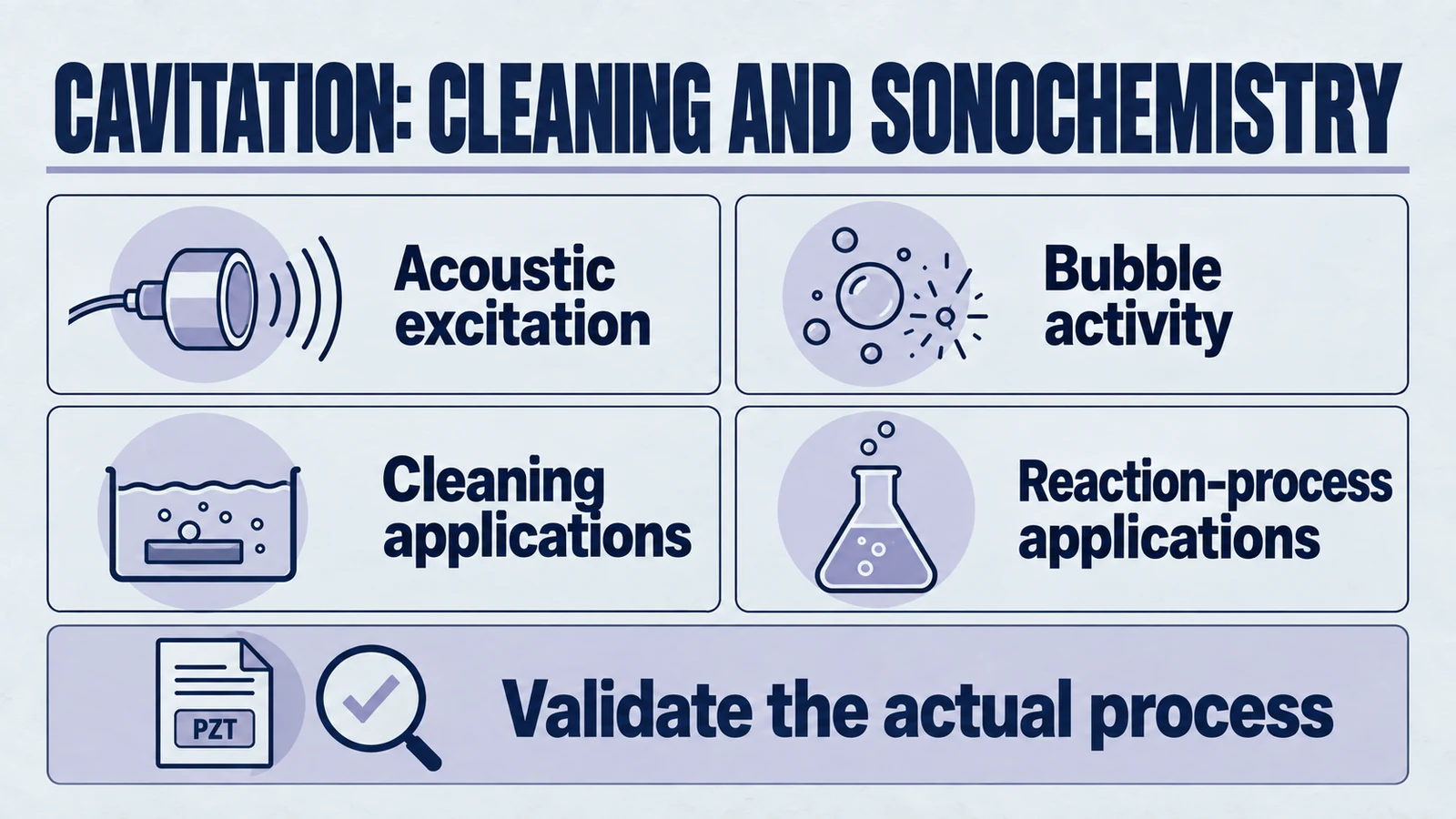
Ultrasonic cavitation transducers are at the heart of a wide range of applications in sonochemistry and precision cleaning. By converting electrical energy into high-frequency sound waves, these devices induce powerful cavitation effects in liquids—creating microscopic bubbles that implode with tremendous energy. This unique phenomenon enables highly efficient chemical reactions and superior cleaning performance. In this article, we explore the science behind ultrasonic cavitation, key design features of the transducers, and how to select the right solution for your industrial or laboratory application.
What Is Ultrasonic Cavitation?
Cavitation refers to the formation and violent collapse of vapor bubbles in a liquid. In ultrasonic systems, this is achieved by high-frequency acoustic waves (typically in the 20–40 kHz range) generated by piezoelectric transducers. When these waves propagate through a liquid, they create alternating high- and low-pressure cycles. During the low-pressure phase, microbubbles form; in the subsequent high-pressure phase, these bubbles collapse, releasing intense localized energy.
This implosion creates highly localized heat, pressure, and microjet activity at the bubble site. These localized conditions make ultrasonic cavitation useful for cleaning and sonochemical reactions when the tank, chemistry, and transducer are matched correctly.
Product path for this search intent
Match the article topic to the right YJ Piezo product page
Use this article when cleaning performance depends on cavitation strength, tank coupling, frequency selection, and long-run thermal behavior. For "Ultrasonic Cavitation Transducers for Sonochemistry and Cleaning", the practical value is in turning the topic into a measurable selection or sourcing decision.
- Ultrasonic Cleaning Transducers
Cleaning models for tank and precision cleaning systems
- Piezoelectric Ring Series
Ring ceramics used in high-power transducer stacks
- Piezoelectric Ceramics
PZT material and geometry options for acoustic output
Applications in Sonochemistry
In sonochemistry, ultrasonic cavitation is used to enhance chemical processes without the need for elevated temperatures or harsh chemicals. Common applications include:
- Synthesis of nanomaterials: Accelerates particle dispersion and size reduction.
- Catalysis: Improves catalyst dispersion and reaction rates.
- Emulsification: Enables stable mixing of immiscible liquids.
- Degradation of pollutants: Breaks down complex organic compounds in water treatment.
Cavitation creates localized high-energy regions, but the exposure field can be spatially nonuniform. Reactor geometry, attenuation, gas and bubble populations, flow and drive affect the result. Validate reaction distribution and scale-up under the intended process rather than inferring uniformity from hot spots.
Role in Ultrasonic Cleaning
Ultrasonic cleaner cavitation is the dominant mechanism for removing contaminants from surfaces. The violent collapse of cavitation bubbles near solid surfaces produces microjets and shock waves that dislodge particles, biofilms, oils, and residues from intricate geometries such as:
- Medical instruments
- Electronic components
- Optical lenses
- Precision mechanical parts
Unlike traditional cleaning methods, ultrasonic cavitation is non-abrasive, solvent-free (when desired), and reaches into blind holes, cracks, and surface crevices.
How Ultrasonic Cavitation Transducers Work
An ultrasonic cavitation transducer typically consists of a piezoelectric ceramic element bonded to a metal backing or horn. When an alternating voltage is applied, the ceramic expands and contracts rapidly, converting electrical energy into mechanical vibrations. These vibrations are transferred to the cleaning or reaction liquid, generating the cavitation effect.
Key performance parameters include:
- Resonant frequency: Determines the size and intensity of cavitation bubbles. Lower frequencies (20–30 kHz) produce more aggressive cavitation; higher frequencies (40–100 kHz) are gentler and suitable for delicate parts.
- Power density: Higher power densities result in more intense cavitation.
- Transducer coupling: Efficient bonding and coupling to tanks or sonochemical reactors is crucial for energy transfer.
Choosing the Right Transducer
Selecting the right ultrasonic cavitation transducer depends on your specific application:
- For industrial ultrasonic cleaning, look for rugged cleaning transducers with high power output and low-frequency operation.
- For laboratory sonochemistry, consider compact probe-style transducers with precision frequency control.
- For continuous flow systems, modular transducer arrays can be integrated into pipes or tanks.
Customization options include:
- Frequency tuning
- Ceramic material selection (PZT-4, PZT-8, etc.)
- Housing and mounting types (flange, bolt-on, immersion)
Partner with an Expert Supplier
Working with an experienced ultrasonic transducer manufacturer ensures optimal performance and reliability. At Yujie, we offer tailored solutions for ultrasonic cavitation transducers used in both cleaning and sonochemistry. With piezoelectric ceramics and acoustic engineering experience built since 1996, we help clients design and source transducers that meet demanding application requirements.
Contact Us
Interested in boosting your sonochemical yield or improving your cleaning performance? Contact us today to discuss your project and request a datasheet or custom solution.
Engineering decision notes
Ultrasonic cleaning and cavitation
Use this article when cleaning performance depends on cavitation strength, tank coupling, frequency selection, and long-run thermal behavior. For "Ultrasonic Cavitation Transducers for Sonochemistry and Cleaning", the practical value is in turning the topic into a measurable selection or sourcing decision.
YJ Piezo evaluates cleaning transducers by acoustic output, impedance stability, ceramic loss, bonding quality, and how the assembly couples into the tank.
Selection checks
- Choose frequency from the cleaning target, part geometry, and contamination type rather than from price alone.
- Review ceramic material, bonding area, impedance, and tank mounting as one acoustic chain.
- Ask whether the transducer is intended for intermittent cleaning, continuous industrial operation, or precision cleaning.
Failure risks
- A transducer can heat water but still produce weak useful cavitation if it is poorly matched to the tank.
- High output without thermal margin can shorten ceramic, adhesive, or cable lifetime.
- Mixing 28 kHz and 40 kHz assumptions can create poor cleaning uniformity or excessive noise.
RFQ details
- What tank size, liquid, duty cycle, and cleaning target are involved?
- Which frequency and power range are currently used or being replaced?
- Do you need impedance records, bonding guidance, or sample validation before production?
Relevant YJ Piezo pages
- Ultrasonic Cleaning Transducers
Cleaning models for tank and precision cleaning systems
- Piezoelectric Ring Series
Ring ceramics used in high-power transducer stacks
- Piezoelectric Ceramics
PZT material and geometry options for acoustic output
Application FAQ
- Why can a cleaning transducer heat liquid but clean poorly?
- Heat only proves energy is entering the system. Useful cleaning needs controlled cavitation, correct frequency, good tank coupling, and stable impedance under load.
- What should I provide for a cleaning transducer quotation?
- Provide tank dimensions, liquid type, target material, duty cycle, desired frequency, current transducer model if replacing one, and whether the system needs continuous industrial operation.