
Ultrasonic Knives After CES 2026: What Really Keeps a Vibrating Blade Stable
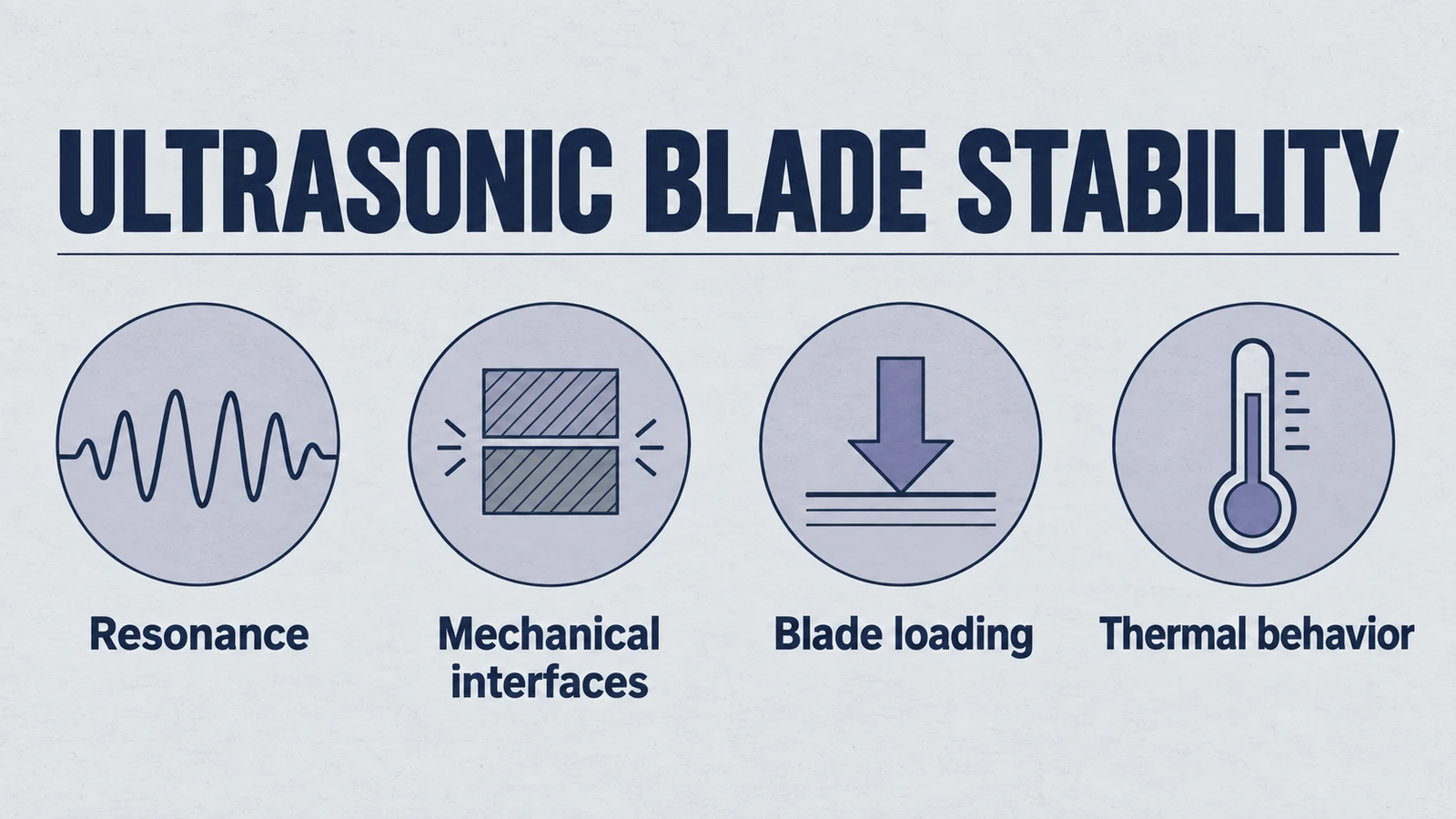
1. Opening Context: From CES Stage to Engineering Bench
At CES 2026, one of the most quietly disruptive kitchen technologies was not a new AI appliance or robotic arm, but a knife. On stage and in hands-on videos, the Seattle Ultrasonics C‑200 ultrasonic chef’s knife appeared to glide through tomatoes, cakes, and sticky foods with almost theatrical ease. Reviewers described the sensation as “cutting through air.”
Short clips circulating after CES show a blade that looks ordinary, sounds silent, and yet behaves differently the moment the ultrasonic drive is activated. There is no visible vibration, no dramatic motion, and no obvious heat. To most viewers, the technology appears almost magical.
For engineers, however, the CES demonstration raises a different set of questions.
Product path for this search intent
Match the article topic to the right YJ Piezo product page
Use this article when the choice is not just a shape, but a material tradeoff between sensitivity, loss, coupling, stability, and operating field. For "Ultrasonic Knives After CES 2026: What Really Keeps a Vibrating Blade Stable", the practical value is in turning the topic into a measurable selection or sourcing decision.
- PZT Material Hub
Material grades and application tradeoffs
- Piezoelectric Ceramics
Shapes and ceramic manufacturing options
- PZT Material Supplier Hub
Material control, grade selection, and sourcing support
How does a battery‑powered handheld ultrasonic knife remain stable when driven continuously at tens of kilohertz. What keeps the blade from overheating. Why does it not rattle apart under billions of vibration cycles. And most importantly, what determines whether this performance lasts beyond the first few weeks or months of use.
This article examines handheld ultrasonic cutting systems through the lens of engineering reality rather than marketing spectacle. Using CES‑era ultrasonic knives such as the C‑200 as a reference point, we analyze how acoustics, materials, and mechanics interact inside a vibrating blade, and why long‑term reliability is far harder than first impressions suggest.
2. What an Ultrasonic Knife Actually Is
Despite consumer framing, an ultrasonic knife is not defined by its sharp edge. It is a continuous‑excitation resonant system.
In its simplest engineering form, a handheld ultrasonic knife consists of three tightly coupled subsystems.
The first is the piezoelectric transducer, which converts electrical energy into longitudinal mechanical vibration. The second is the acoustic waveguide, often described as a horn or booster, which transforms and amplifies that vibration. The third is the blade, which acts simultaneously as a cutting tool and as part of the resonant structure.
In compact CES‑style designs, these elements are often integrated or partially merged to reduce mass and improve ergonomics. That integration improves efficiency, but it also increases sensitivity to geometry, temperature, and load variation.
When activated, the blade vibrates at ultrasonic frequency, typically between 20 kHz and 40 kHz, with amplitudes measured in microns. While the motion is invisible, the mechanical acceleration at the cutting edge is extreme.
This is not a novelty effect. It is the same physical principle used in industrial ultrasonic cutters and welding systems, miniaturized into a handheld form factor with dramatically tighter thermal and structural constraints. The transducer stack typically uses piezoelectric rings or discs to generate the ultrasonic vibration.
3. Why Ultrasonic Cutting Feels Effortless
3.1 Dynamic Fracture Mechanics at the Blade Edge
Conventional cutting relies on a static wedge forcing material failure through applied hand pressure. The required force scales with contact area and the coefficient of friction between blade and material.
Ultrasonic cutting introduces a time-dependent acceleration field. The blade tip undergoes sinusoidal motion
where is vibration amplitude and is angular frequency. The corresponding velocity and acceleration are
As an illustrative assumption, 40 μm peak-to-peak means A = 20 μm. With sinusoidal motion at 33–40 kHz, a_peak = A(2πf)² gives approximately 8.60×10^5–1.263×10^6 m/s², or 8.77×10^4–1.288×10^5 g. These are calculated values for the assumed amplitude, not measured specifications for a named knife.
Large acceleration alone does not establish fracture or yield. Contact stress, blade geometry, material properties, strain rate and intermittent contact determine cutting and failure; relate the motion to stress using an appropriate mechanical model.
3.2 Effective Friction Reduction
When instantaneous vibration velocity exceeds the user-imposed feed rate, the blade intermittently disengages from the material. This suppresses stick-slip behavior and reduces the effective coefficient of friction.
For viscoelastic materials such as cheese, rubber, or biological tissue, ultrasonic excitation prevents adhesion and elastic recoil. The result is cleaner cuts and significantly lower reaction forces at the user’s hand.
3.3 Thermal Reality
Ultrasonic cutting is not a cold process. Internal damping within the blade and dielectric loss within the piezoelectric stack convert acoustic energy into heat. In handheld devices with limited thermal mass, managing this heat is a defining constraint.
4. The Hidden Cost of Continuous Excitation
The CES demonstrations show ultrasonic knives performing short cuts under controlled conditions. Long‑term operation is another matter.
Unlike ultrasonic welding, which is typically intermittent, handheld ultrasonic knives often operate at high repetition or near‑continuous duty. Once activated, the system enters a regime where thermal accumulation becomes unavoidable.
Heat is generated in multiple places.
Within the piezoelectric ceramic, dielectric and mechanical losses convert electrical energy into heat. Within the blade, internal damping and friction at the cutting interface add additional thermal load. In a handheld device, heat dissipation paths are limited by plastic housings, batteries, and ergonomic constraints.
As temperature rises, material properties change.
Piezoelectric coefficients drift. Mechanical stiffness decreases. Resonant frequencies shift. Control electronics must work harder to maintain vibration amplitude. If compensation is imperfect, the system begins operating off resonance, accelerating further heating.
This feedback loop explains why many ultrasonic systems appear stable initially, then degrade non‑linearly after extended use. Engineers sometimes refer to this as a “100‑hour class” failure window, not because failure is documented at that point, but because designs with insufficient thermal margin often cross a stability threshold in that timeframe.
5. Material Choice. Necessary, Not Sufficient
CES coverage often highlights the use of PZT‑8 piezoelectric ceramics as evidence of engineering sophistication. This emphasis is justified, but incomplete.
Hard piezoelectric ceramics such as PZT‑8 are engineered for high‑power ultrasonic actuation. Compared with soft ceramics, they exhibit lower dielectric loss, higher mechanical quality factor, and greater resistance to self‑heating under strong electric fields.
For a handheld ultrasonic knife, this choice is not optional. Using soft piezoelectric materials would lead to rapid thermal runaway. Understanding the differences between material grades is essential—see our geometry and material selection guide for more details. For sensing applications, soft materials are preferred, but for high-power cutting, hard ceramics are essential.
Yet material selection alone does not by itself confirm stability.
Under continuous excitation, even hard ceramics experience temperature‑dependent loss increases and gradual changes in electromechanical behavior. Over time, effective coupling can decrease, requiring higher drive voltage to achieve the same blade motion. In a compact, battery‑powered system, this margin is limited.
The ceramic may survive. The system may not.
6. Geometry and the Problem of Parasitic Modes
Blade geometry is the most underestimated risk factor in handheld ultrasonic knives.
Chef’s knife profiles are long, thin, and asymmetric. From an acoustic standpoint, they are hostile shapes. Such geometries support many closely spaced vibration modes, including bending and torsional modes in addition to the desired longitudinal motion.
At room temperature, designers can tune these parasitic modes away from the operating frequency. Under real use, temperature gradients, residue buildup, sharpening wear, and asymmetric loading cause modal frequencies to drift.
When an unintended mode approaches the drive frequency, mode interaction occurs. Energy leaks from the longitudinal cutting motion into lateral or bending vibration. Cutting efficiency drops. Stress concentrations rise. Fatigue accelerates near the blade root.
This is not a theoretical concern. It is a primary reason why ultrasonic blades in both consumer and industrial systems fail prematurely if modal separation is insufficient across the full operating envelope.
7. Steel Blades in an Ultrasonic World
A striking design choice in CES‑era ultrasonic knives is the use of hardened stainless steel blades rather than titanium, the industrial standard for ultrasonic horns.
From a cutting perspective, this choice is obvious. Steel holds a sharp edge. Titanium does not.
From an acoustic perspective, it is problematic.
Steel has higher density, higher acoustic impedance, and greater internal damping than titanium. When coupled to a titanium or aluminum waveguide, this mismatch reflects a portion of the vibrational energy back into the system. The result is lower efficiency and higher local heating at interfaces.
Why accept this compromise.
Because a kitchen knife must feel like a knife. Edge retention, surface finish, and tactile familiarity matter more than absolute acoustic efficiency. CES‑style designs compensate by limiting power output and treating the blade as a consumable component rather than a lifetime resonator.
This trade‑off defines the reliability envelope of handheld ultrasonic knives.
8. Interfaces, Fasteners, and Quiet Degradation
In long‑term operation, components rarely fail first. Interfaces do.
Detachable blades, threaded connections, and bonded joints are all subject to micro‑motion under ultrasonic vibration. Over time, this leads to preload loss, fretting wear, and the accumulation of oxide debris at contact surfaces.
The symptoms are subtle at first. Increased noise. Reduced cutting effectiveness. Higher operating temperature. Eventually, the system becomes unstable or unsafe.
For CES‑era consumer designs, this means reliability depends as much on maintenance and interface cleanliness as on the piezoelectric stack itself.
9. Control Electronics and the Illusion of Auto‑Tuning
Marketing materials often emphasize automatic frequency tracking. From an engineering perspective, this capability has limits.
As the mechanical system ages, its impedance curve changes shape. Static capacitance increases. Resonance broadens. Parasitic modes distort phase behavior. Simple phase‑locked control strategies can be misled, locking onto suboptimal or even dangerous operating points.
Advanced control algorithms mitigate these risks, but they cannot eliminate them. Control electronics can compensate for drift. They cannot reverse fatigue, wear, or thermal damage.
10. Conclusion. Beyond the CES Demo
The ultrasonic knife unveiled at CES 2026 is not a gimmick. It represents a legitimate transfer of industrial ultrasonic physics into a consumer form factor.
But the engineering challenge does not end with a clean slice on a trade‑show floor.
Long‑term stability depends on thermal headroom, modal separation, interface integrity, and control robustness. These factors evolve over time, under real use, far from cameras and controlled demonstrations.
An ultrasonic knife that performs well after hundreds of hours is not one that was perfectly tuned at launch. It is one designed to tolerate change.
The future of handheld ultrasonic cutting will be defined not by sharper steel or higher voltage, but by how well engineers manage the slow, cumulative forces that act on a vibrating blade long after the CES lights have faded.
Engineering decision notes
PZT material and ceramic selection
Use this article when the choice is not just a shape, but a material tradeoff between sensitivity, loss, coupling, stability, and operating field. For "Ultrasonic Knives After CES 2026: What Really Keeps a Vibrating Blade Stable", the practical value is in turning the topic into a measurable selection or sourcing decision.
YJ Piezo coordinates PZT ceramic projects with manufacturing support, so material formulation, sintering, polarization, electrode process, and outgoing inspection can be reviewed against the final application.
Selection checks
- Separate sensing needs from high-power actuation needs before comparing d33 or coupling values.
- Check dielectric loss, Qm, Curie temperature, aging behavior, and operating field against the real duty cycle.
- Confirm whether the application needs standard PZT grades or a custom formulation and geometry.
Failure risks
- Choosing only the highest d33 can create heat, drift, or depolarization risk in power ultrasonics.
- A ceramic that performs well in free measurement can fail once bonded, clamped, or loaded.
- Material substitutions without batch testing can change capacitance, resonance, and system tuning.
RFQ details
- Is the part used for sensing, actuation, atomization, cleaning, welding, or measurement?
- What field strength, temperature, duty cycle, and mechanical load will the ceramic see?
- Which values must be controlled: d33, capacitance, resonance, impedance, Qm, or dimensional tolerance?
Relevant YJ Piezo pages
- PZT Material Hub
Material grades and application tradeoffs
- Piezoelectric Ceramics
Shapes and ceramic manufacturing options
- PZT Material Supplier Hub
Material control, grade selection, and sourcing support
Application FAQ
- Is the highest d33 always the best PZT choice?
- No. High d33 can be useful for sensitivity, but high-power ultrasonic systems often need lower loss, higher Qm, better thermal stability, and safer operation under field and stress.
- What makes PZT material selection different from catalog buying?
- The right PZT choice depends on geometry, load, drive field, duty cycle, temperature, and inspection targets. A catalog value is only useful when it is tied to the final assembly conditions.