
From Powder to Performance: Yujie's Manufacturing Control for Ultrasonic Nebulizer Piezo Reliability
The OEM's Multi-Million Dollar "Procurement Paradox"
As an R&D manager or product engineer working on a nebulizer device, you may see the ultrasonic nebulizer piezo as a small item on the bill of materials. In practice, the PZT ceramic element inside it can affect vibration stability, temperature rise, power demand, and lot-to-lot repeatability.
This component is the vibration engine of the atomization section. It converts an electrical signal into high-frequency mechanical motion, which the finished assembly uses to generate aerosol or mist.
This brings you to a central challenge we call the procurement paradox. You gather technical datasheets from several suppliers for PZT ceramic discs, rings, or bonded elements. On paper, these documents list comparable frequency, capacitance, coupling, and dimensions.
Product path for this search intent
Match the article topic to the right YJ Piezo product page
Use this article when the choice is not just a shape, but a material tradeoff between sensitivity, loss, coupling, stability, and operating field. For "From Powder to Performance: Yujie's Manufacturing Control for Ultrasonic Nebulizer Piez...", the practical value is in turning the topic into a measurable selection or sourcing decision.
- PZT Material Hub
Material grades and application tradeoffs
- Piezoelectric Ceramics
Shapes and ceramic manufacturing options
- PZT Material Supplier Hub
Material control, grade selection, and sourcing support
This is the trap. The very document intended to mitigate risk often conceals it.
The consumer market reinforces the confusion. A household humidifier and a regulated nebulizer device may both use piezoelectric vibration, but they do not share the same design controls, documentation expectations, or validation workload.
The failures that delay projects may not be visible on a spec sheet. We call these in-application mismatches: a component is mechanically active, yet its behavior in the finished assembly is not stable enough for the design target.
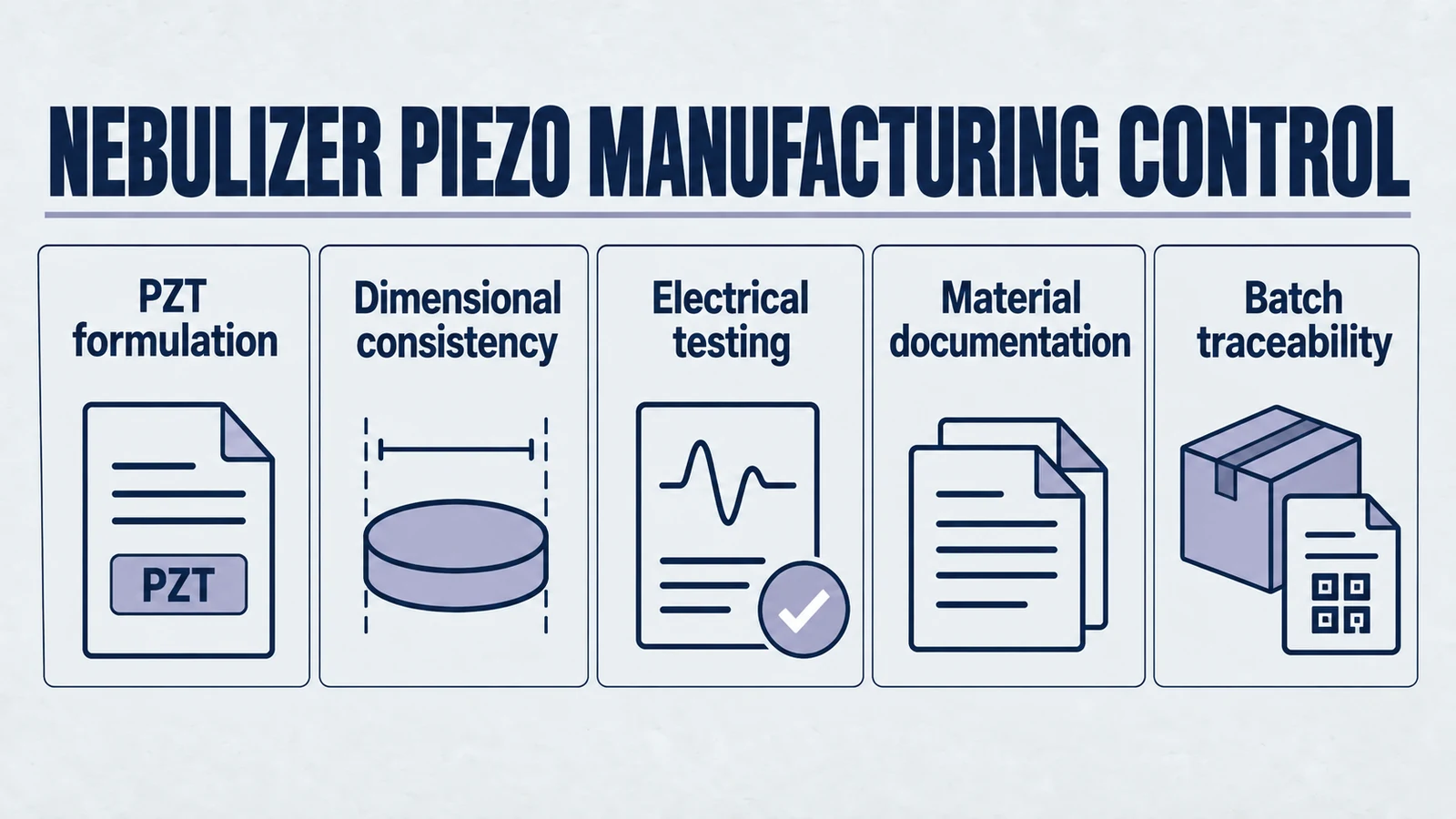
The final device must be verified by the device manufacturer. Yujie's role is to support the piezo ceramic element: PZT material selection, shape, electrode design, batch testing, and traceability.
Defining the Architecture: Where the Piezo Ceramic Element Fits
The term "ultrasonic nebulizer piezo" creates confusion because it can describe different architectures. The ceramic element may drive an immersed surface, a diaphragm, or a vibrating mesh. Each architecture places different requirements on the ceramic.
Technology 1: Conventional Free-Surface Ultrasonic Atomization
This older, high-power method involves a piezo element coupled directly to a liquid volume. It can create mist, but it may bring higher power demand, more heat, and more demanding liquid-contact design.
Technology 2: The Modern "Vibrating Mesh" Standard
Many compact nebulizer device designs use a piezoelectric ceramic ring or related element coupled to a micro-perforated membrane. The ceramic drives the membrane, and the complete device controls liquid feed, drive waveform, and aerosol output.
In this architecture, the ceramic element is often separated from the direct liquid path by the membrane or assembly design. That can simplify some contact-path questions, but it does not remove the need for system-level validation.
The result depends on mesh design, liquid properties, drive electronics, mechanical mounting, and ceramic vibration. A stable PZT ceramic element helps the engineering team work from a more predictable baseline.
The Anatomy of an "In-Spec Failure": Three Ways a Commodity Piezo Destroys Your Device
A datasheet-identical component from a low-control supplier can still create assembly-level problems. Here are three common pathways that a spec sheet may not reveal.
1. Output Drift: When Vibration Behavior Changes
The atomization section is designed around target aerosol output and droplet-size distribution. The finished-device manufacturer validates those targets. The ceramic supplier supports that work by providing stable piezo properties and clear test data.
- Frequency and impedance: Ceramic behavior can shift after bonding, heating, aging, or operation under load.
- Drive matching: The electronics must be matched to the element and the assembly, not just to a catalog frequency.
- Assembly sensitivity: Adhesives, clamping, membrane design, and housing stiffness can change vibration behavior.
2. Material Documentation Gaps
PZT stands for lead zirconate titanate. When a ceramic element is near a liquid path, the finished-device team must define whether it is isolated, coated, encapsulated, or otherwise separated from direct contact. That question belongs to the complete device architecture.
A commodity supplier may not provide enough information about ceramic material, coatings, adhesives, or lot history. Yujie supports OEM review by offering traceable ceramic material information and component-level documentation under the project agreement.
3. Mechanical Failure: Overheating, Cracking, and Short Lifespan
A compact nebulizer device is not the same as a low-cost household humidifier accessory. It may need stable output under repeated operating cycles, limited heat path, and tight packaging.
A common failure mode for a low-quality piezo element is thermo-mechanical breakdown. This cascade begins when the component generates too much heat or is mounted in a way that concentrates stress. High dielectric loss in the PZT material can contribute to this behavior and may vary by batch.
This is the "in-spec failure" in action:
- A "good-on-paper" component from an inconsistent batch has high dielectric loss.
- This can contribute to heating, depending on drive, load and heat removal; it does not alone establish overheating.
- This thermal load leads to piezoceramic cracking and, ultimately, device failure.
When a piezo device fails early, the root cause is often not piezoelectricity itself. It is material selection, manufacturing control, mounting design, or drive conditions.
The Yujie Solution: Manufacturing Control as Your Primary Risk Mitigation Strategy
At Yujie, we focus on the ceramic element and the manufacturing control behind it. We do not present a piezo ceramic as a complete nebulizer device; we support the material and component decisions that make the device team's work more controlled.
"From Powder to Performance": Why Reliability Begins with the PZT Material
Our core belief is that reliability and consistency are not achieved by testing at the end of the line alone. They start with manufacturing control, from raw PZT powder to the finished ceramic element.
This is what we call our commitment to "From Powder to Performance." By controlling the formulation and sintering process of our PZT materials, we can manage properties such as dielectric behavior, mechanical quality, coupling, and dimensional stability.
We are not simply assemblers. We are a piezoelectric manufacturer with roots in piezoelectric products since 1996. This history is the foundation of our material science.
Beyond the Certificate: How We Control Batch-to-Batch Consistency
How do we prove our "From Powder to Performance" philosophy? With a quality system that goes far "Beyond the Datasheet."
- The Baseline: Define the required quality-system evidence, inspection records, and acceptance limits during supplier qualification.
- The Yujie Difference: Our control system is built on multiple layers of process discipline. We implement:
- Statistical Process Control (SPC) for all key parameters during manufacturing.
- Automated Testing Systems for high-volume production where agreed by the control plan.
- Complete Traceability Systems for batch tracking, allowing us to link a final component's performance all the way back to its raw PZT powder batch.
- Advanced Diagnostics: We are technical experts. We employ periodic impedance sweeps, thermal monitoring, and track capacitance, resonance frequency, and Q-factor as baseline indicators for every batch. We don't just ship parts; we ship data-backed reliability.
This entire philosophy is summarized in the table below, which contrasts the "Procurement Paradox" with the Yujie solution.
Table 1: The "Procurement Paradox" – Commodity Datasheet vs. Yujie Manufacturing Reality
| Critical Vector | The Commodity "Datasheet" Promise (The Trap) | The "In-Spec Failure" Risk (The Hidden Reality) | The Yujie "From Powder to Performance" Control Point |
|---|---|---|---|
| Aerosol Output | "Meets specified frequency (e.g., 128 kHz)." | Output Drift: Inconsistent vibration can change mist behavior in the finished assembly. | Stable Ceramic Behavior: Batch-to-batch piezo consistency supports repeatable assembly testing. |
| Material Review | "Material: PZT." | Documentation Gap: Unknown ceramic lot, coating, or isolation strategy complicates contact-path review. | Traceable Component Data: Material records and construction details support the customer's system-level validation. |
| Device Lifespan | "Standard Lifetime." | Thermal Breakdown: "High dielectric loss" that varies by batch causes overheating, cracking, and premature failure. | Controlled Ceramic Process: Vertically integrated manufacturing helps manage dielectric loss and thermal behavior. |
| Supply Chain & Scale | "Interchangeable Component." | The "Procurement Paradox": Components from different suppliers are not interchangeable, leading to unmanageable quality variation. | A Scalable OEM Partner: Documents process controls, change management, inspection scope, and capacity against the forecast for the selected component. |
The OEM Partner Advantage: Compliance, Customization, and Expertise
We are not a catalog supplier; we are a "solutions partner." When you partner with Yujie, you are de-risking your project in three distinct ways:
- Documentation Support: Component data, material records, and batch traceability help your quality team maintain clearer files for the finished product.
- Technical Expertise: Our partners get direct access to technical experts for material choice, geometry, electrode, frequency, and sample discussions.
- Proven Scalability: An innovative prototype is not enough if it cannot be produced consistently. We support the path from sample builds to higher-volume ceramic production.
Your Nebulizer's Reliability Is Not a Commodity
The ultrasonic nebulizer piezo is a technical element inside a larger device, not a generic accessory. A low-cost humidifier component should not be assumed to match the requirements of a regulated nebulizer design.
A datasheet cannot show all batch-to-batch thermal behavior, mounting sensitivity, contact-path documentation, or long-run stability.
The choice for an OEM is not between two spec sheets. It is between a low-cost, high-risk commodity and a long-term, low-risk strategic partnership. It is the choice between an anonymous "catalog supplier" and a "trusted partner in piezoelectric innovation."
Contact the Yujie technical team to discuss PZT ceramic material, ring or disc geometry, electrode pattern, frequency target, and sample requirements for your nebulizer or atomization system.
Companion Guides for Nebulizer Reliability Programs
Engineering decision notes
PZT material and ceramic selection
Use this article when the choice is not just a shape, but a material tradeoff between sensitivity, loss, coupling, stability, and operating field. For "From Powder to Performance: Yujie's Manufacturing Control for Ultrasonic Nebulizer Piez...", the practical value is in turning the topic into a measurable selection or sourcing decision.
YJ Piezo coordinates PZT ceramic projects with manufacturing support, so material formulation, sintering, polarization, electrode process, and outgoing inspection can be reviewed against the final application.
Selection checks
- Separate sensing needs from high-power actuation needs before comparing d33 or coupling values.
- Check dielectric loss, Qm, Curie temperature, aging behavior, and operating field against the real duty cycle.
- Confirm whether the application needs standard PZT grades or a custom formulation and geometry.
Failure risks
- Choosing only the highest d33 can create heat, drift, or depolarization risk in power ultrasonics.
- A ceramic that performs well in free measurement can fail once bonded, clamped, or loaded.
- Material substitutions without batch testing can change capacitance, resonance, and system tuning.
RFQ details
- Is the part used for sensing, actuation, atomization, cleaning, welding, or measurement?
- What field strength, temperature, duty cycle, and mechanical load will the ceramic see?
- Which values must be controlled: d33, capacitance, resonance, impedance, Qm, or dimensional tolerance?
Relevant YJ Piezo pages
- PZT Material Hub
Material grades and application tradeoffs
- Piezoelectric Ceramics
Shapes and ceramic manufacturing options
- PZT Material Supplier Hub
Material control, grade selection, and sourcing support
Application FAQ
- Is the highest d33 always the best PZT choice?
- No. High d33 can be useful for sensitivity, but high-power ultrasonic systems often need lower loss, higher Qm, better thermal stability, and safer operation under field and stress.
- What makes PZT material selection different from catalog buying?
- The right PZT choice depends on geometry, load, drive field, duty cycle, temperature, and inspection targets. A catalog value is only useful when it is tied to the final assembly conditions.