
PZT-8 Ceramics for High-Power Ultrasound: Properties and Limits
Introduction
Lead zirconate titanate (PZT) ceramics are the workhorses of the piezoelectric materials industry, valued for their ability to convert mechanical energy into electrical energy and vice versa. Among these, PZT-8 stands out for its exceptional stability, high mechanical quality factor, and ability to operate under high power conditions. This article explores PZT-8's properties, applications, and performance characteristics in detail—helping engineers, designers, and decision-makers understand when and why to choose it.
Engineering decision focus: Decide if PZT-8 is the right fit based on power density, thermal drift tolerance, and continuous-duty requirements.
What is PZT-8?
Product path for this search intent
Match the article topic to the right YJ Piezo product page
Use this article when the choice is not just a shape, but a material tradeoff between sensitivity, loss, coupling, stability, and operating field. For "PZT-8 Ceramics for High-Power Ultrasound: Properties and Limits", the practical value is in turning the topic into a measurable selection or sourcing decision.
- PZT Material Hub
Material grades and application tradeoffs
- Piezoelectric Ceramics
Shapes and ceramic manufacturing options
- PZT Material Supplier Hub
Material control, grade selection, and sourcing support
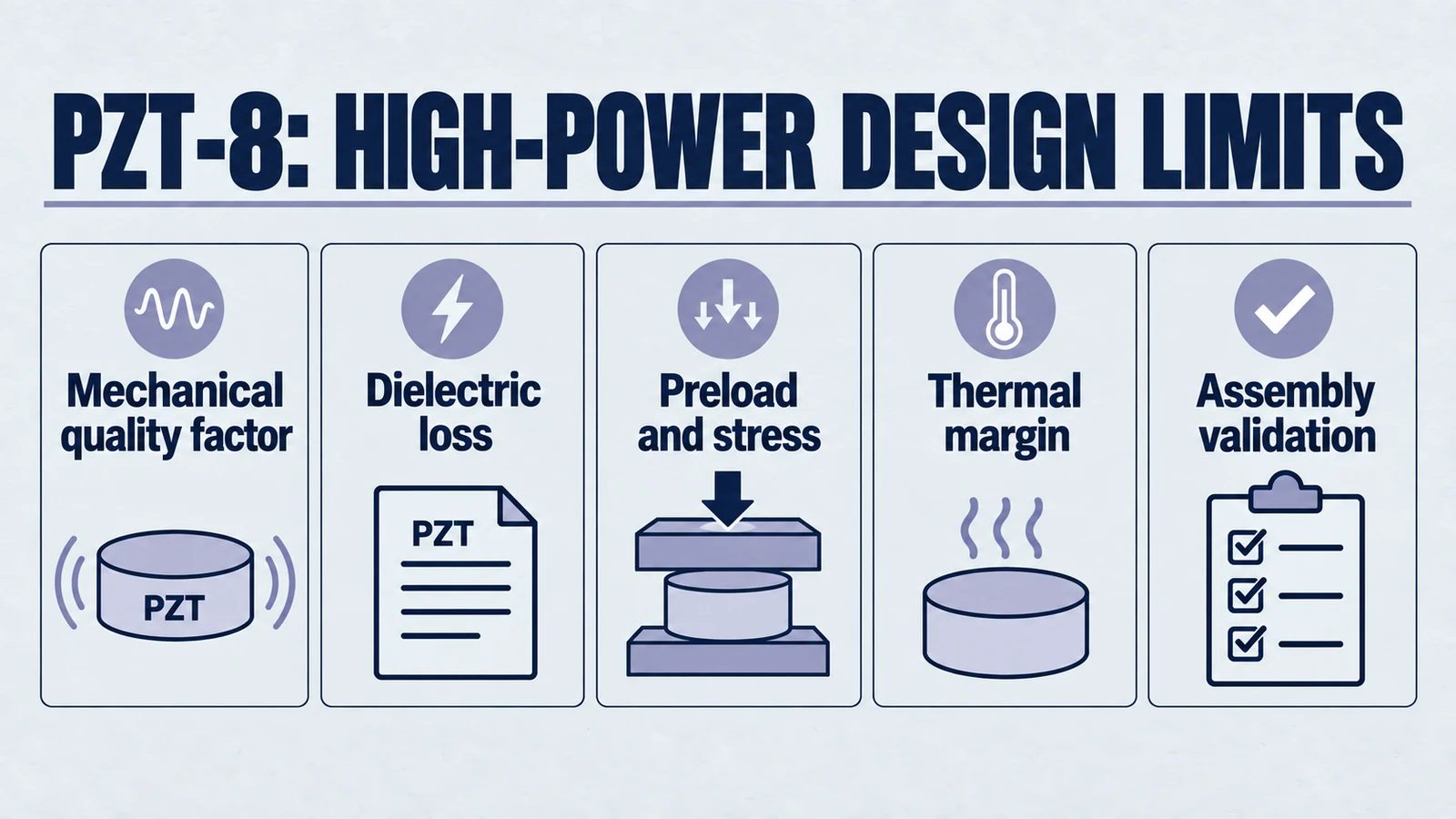
PZT-8 is a hard-type piezoelectric ceramic belonging to the "PZT" family. Its composition is optimized for high mechanical quality factors (Qm) and low dielectric losses, making it suitable for high-power ultrasonic applications.
Key highlights:
- High mechanical quality factor (Qm): Minimizes internal energy loss during operation.
- Low dielectric loss: Reduces heat generation.
- High Curie temperature: Ensures stable performance at elevated temperatures.
- Low aging rate: Maintains consistent properties over long service periods.
Key Properties of PZT-8
Below are the commonly measured parameters for PZT-8:
| Property | Typical Value | Importance |
|---|---|---|
| Electromechanical coupling coefficient (k) | kₚ = 0.53 | Indicates efficiency in converting energy between mechanical and electrical forms |
| Mechanical quality factor (Qm) | ≥ 800 | High Qm means low mechanical energy loss—critical for high-power transducers |
| Dielectric constant (εᵣ) | 1025 ±12.5% | Relates to the material's ability to store electrical energy |
| Dielectric loss (tan δ) | ≤ 0.004 | Lower loss minimizes heat buildup during prolonged operation |
| Piezoelectric constant (d₃₃) | 225 pC/N | Determines how much electrical charge is generated per unit of applied force |
| Curie temperature (Tᶜ) | ≥ 300 °C | Maximum temperature before the material loses piezoelectric properties |
Performance Advantages of PZT-8
- High Power Handling – Its high Qm allows it to sustain continuous operation in ultrasonic systems without significant performance degradation.
- Thermal Stability – Maintains piezoelectric properties under elevated temperatures, suitable for industrial environments.
- Durability – Low aging rates ensure consistent output over thousands of operational hours.
- Energy Efficiency – Low dielectric losses reduce heat generation and energy waste.
Applications of PZT-8
PZT-8's performance profile makes it ideal for high-power and high-frequency applications, including:
1. Ultrasonic Welding
- Plastic Welding – Bonds thermoplastic materials without adhesives using precision plastic welding transducers.
- Metal Welding – Joins thin metal sheets, wires, or foils in automotive and electronics manufacturing with metal welding transducers.
2. Ultrasonic Cleaning
- Industrial Cleaning Systems – Removes contaminants from precision instruments, engine parts, and medical devices.
3. Sonar and Underwater Acoustics
- Marine Navigation & Detection – Used in transducers for depth sounding, fish finding, and underwater communication.
4. Medical Ultrasound Therapy
- focused ultrasound systems – Used in validated focused-ultrasound systems where focused acoustic power and thermal stability are central design constraints.
5. Nondestructive Testing (NDT)
- Flaw Detection & Quality Control – Identifies cracks, voids, and inclusions in metals and composites.
Design Considerations When Using PZT-8
When integrating PZT-8 into a device, consider:
- Resonance Frequency – Optimize dimensions to match desired operational frequency.
- Cooling Requirements – Although PZT-8 has low losses, high-power applications may still require thermal management.
- Mounting & Bonding – Use suitable adhesives or mechanical clamps to avoid stress-induced cracking.
- Drive Circuitry – Ensure the electrical drive matches the impedance of the PZT-8 element to maximize efficiency.
Comparing PZT-8 to Other PZT Types
| Property | PZT-4 (Hard) | PZT-8 (Hard) | PZT-5A (Soft) |
|---|---|---|---|
| Qm | ~500 | ≥800 | ~65 |
| Dielectric Loss | Low | Very Low | Moderate |
| Curie Temp (°C) | 325 | ≥300 | 365 |
| Power Handling | High | Very High | Low |
| Sensitivity | Medium | Medium-Low | High |
Takeaway: PZT-8 is the best choice when maximum stability and durability under high power are more important than absolute sensitivity.
Why Choose PZT-8?
If your application demands reliability under heavy workloads, resistance to thermal and electrical degradation, and long operational life, PZT-8 offers one of the best value propositions in the piezoelectric materials market.
From industrial ultrasonic welding to underwater sonar systems, its balance of stability, efficiency, and power handling makes it the go-to material for high-performance designs.
Conclusion
PZT-8 is a specialized hard-type piezoelectric ceramic optimized for high-power applications. Its combination of low dielectric loss, high Qm, and thermal stability ensures superior performance where other materials might degrade or fail. By understanding its properties and matching them to the right applications, engineers can maximize both performance and reliability.
PZT Rings: Quotes & Volume Pricing
Catalog models are examples. We also make common ceramic shapes in the dimensions you need. For simple shapes, send dimensions and quantity; no drawing is needed to start an enquiry.
Ask for volume pricing on larger orders or annual requirements. Samples, custom designs and development enquiries are welcome too.
Related Engineering Reading
Engineering decision notes
PZT material and ceramic selection
Use this article when the choice is not just a shape, but a material tradeoff between sensitivity, loss, coupling, stability, and operating field. For "PZT-8 Ceramics for High-Power Ultrasound: Properties and Limits", the practical value is in turning the topic into a measurable selection or sourcing decision.
YJ Piezo coordinates PZT ceramic projects with manufacturing support, so material formulation, sintering, polarization, electrode process, and outgoing inspection can be reviewed against the final application.
Selection checks
- Separate sensing needs from high-power actuation needs before comparing d33 or coupling values.
- Check dielectric loss, Qm, Curie temperature, aging behavior, and operating field against the real duty cycle.
- Confirm whether the application needs standard PZT grades or a custom formulation and geometry.
Failure risks
- Choosing only the highest d33 can create heat, drift, or depolarization risk in power ultrasonics.
- A ceramic that performs well in free measurement can fail once bonded, clamped, or loaded.
- Material substitutions without batch testing can change capacitance, resonance, and system tuning.
RFQ details
- Is the part used for sensing, actuation, atomization, cleaning, welding, or measurement?
- What field strength, temperature, duty cycle, and mechanical load will the ceramic see?
- Which values must be controlled: d33, capacitance, resonance, impedance, Qm, or dimensional tolerance?
Relevant YJ Piezo pages
- PZT Material Hub
Material grades and application tradeoffs
- Piezoelectric Ceramics
Shapes and ceramic manufacturing options
- PZT Material Supplier Hub
Material control, grade selection, and sourcing support
Application FAQ
- Is the highest d33 always the best PZT choice?
- No. High d33 can be useful for sensitivity, but high-power ultrasonic systems often need lower loss, higher Qm, better thermal stability, and safer operation under field and stress.
- What makes PZT material selection different from catalog buying?
- The right PZT choice depends on geometry, load, drive field, duty cycle, temperature, and inspection targets. A catalog value is only useful when it is tied to the final assembly conditions.