
The Unsung Hero of Fire Safety: How Piezo Discs Power Smoke Alarm Sounders
Introduction: The Sound That Saves Lives
A smoke alarm’s audible signal is intended to alert occupants. Waking effectiveness varies with hearing, age, sleep and signal characteristics; no signal guarantees awakening through every competing noise. Performance depends on the complete detector, electronics, power, enclosure and sounder design.
This piezo disc is a compact electroacoustic element that transforms a silent electrical signal into a powerful, audible warning. It is the voice of the smoke detector, while the finished alarm's safety performance still depends on the full device design, battery strategy, standards testing, and installation environment.
This report provides an engineering-level exploration of how piezoelectric technology serves as the acoustic output stage in modern smoke detectors. We will delve into the fundamental science of the piezoelectric effect, examine the precise engineering application within an alarm system, and analyze the advantages that make the piezo disc a common choice for compact audible-alert devices.
Product path for this search intent
Match the article topic to the right YJ Piezo product page
Use this article when the choice is not just a shape, but a material tradeoff between sensitivity, loss, coupling, stability, and operating field. For "The Unsung Hero of Fire Safety: How Piezo Discs Power Smoke Alarm Sounders", the practical value is in turning the topic into a measurable selection or sourcing decision.
- PZT Material Hub
Material grades and application tradeoffs
- Piezoelectric Ceramics
Shapes and ceramic manufacturing options
- PZT Material Supplier Hub
Material control, grade selection, and sourcing support
The Science of Sound: A Primer on the Piezoelectric Effect
The operational principle of a piezoelectric sounder is rooted in a fascinating physical phenomenon discovered in 1880 by brothers Jacques and Pierre Curie. They found that applying mechanical stress—such as squeezing or pressing—to certain crystalline materials such as quartz generated a proportional electric charge on their surface. This conversion of mechanical energy into electrical energy is known as the direct piezoelectric effect.
The Inverse Effect: The Engine of Sound
While the direct effect is crucial for sensor applications, the sound-producing capability of a smoke alarm relies on the opposite principle: the inverse piezoelectric effect. This reversible process dictates that when an electric field is applied across a piezoelectric material, it physically deforms—it can stretch, compress, or bend in a precise and predictable way. This remarkable ability to convert electrical energy directly into mechanical motion is the fundamental engine that creates sound in a piezoelectric buzzer.
A piezoelectric sounder generates sound through mechanical motion of its ceramic/diaphragm. It can avoid rubbing armature mechanisms, but it can still fail through electrical, mechanical, environmental or interface damage. Specify and validate the sounder’s operating envelope.
To unlock their piezoelectric properties, ceramics like lead zirconate titanate (PZT) undergo a crucial manufacturing process called "poling." During this process, the material is heated and subjected to a strong, direct current electric field. This forces the randomly oriented electric dipoles within the material's crystalline domains to align with the field, creating a permanent net polarization even after the field is removed. When a voltage is later applied to this "poled" ceramic, the aligned dipoles attempt to reorient themselves with the new field, causing a physical change in the material's overall shape.
Anatomy of an Alarm: How a Piezo Disc Creates Sound
The typical construction of a piezoelectric sounder, or buzzer, is a model of engineering efficiency. It consists of a thin piezo disc, commonly crafted from a PZT ceramic, which is firmly bonded to a slightly larger metal diaphragm, often made of brass or stainless steel. To introduce the electrical signal, thin metal electrodes are applied to both faces of the ceramic disc. This simple composite structure forms the entire sound-producing element.
The Role of the Driver Circuit
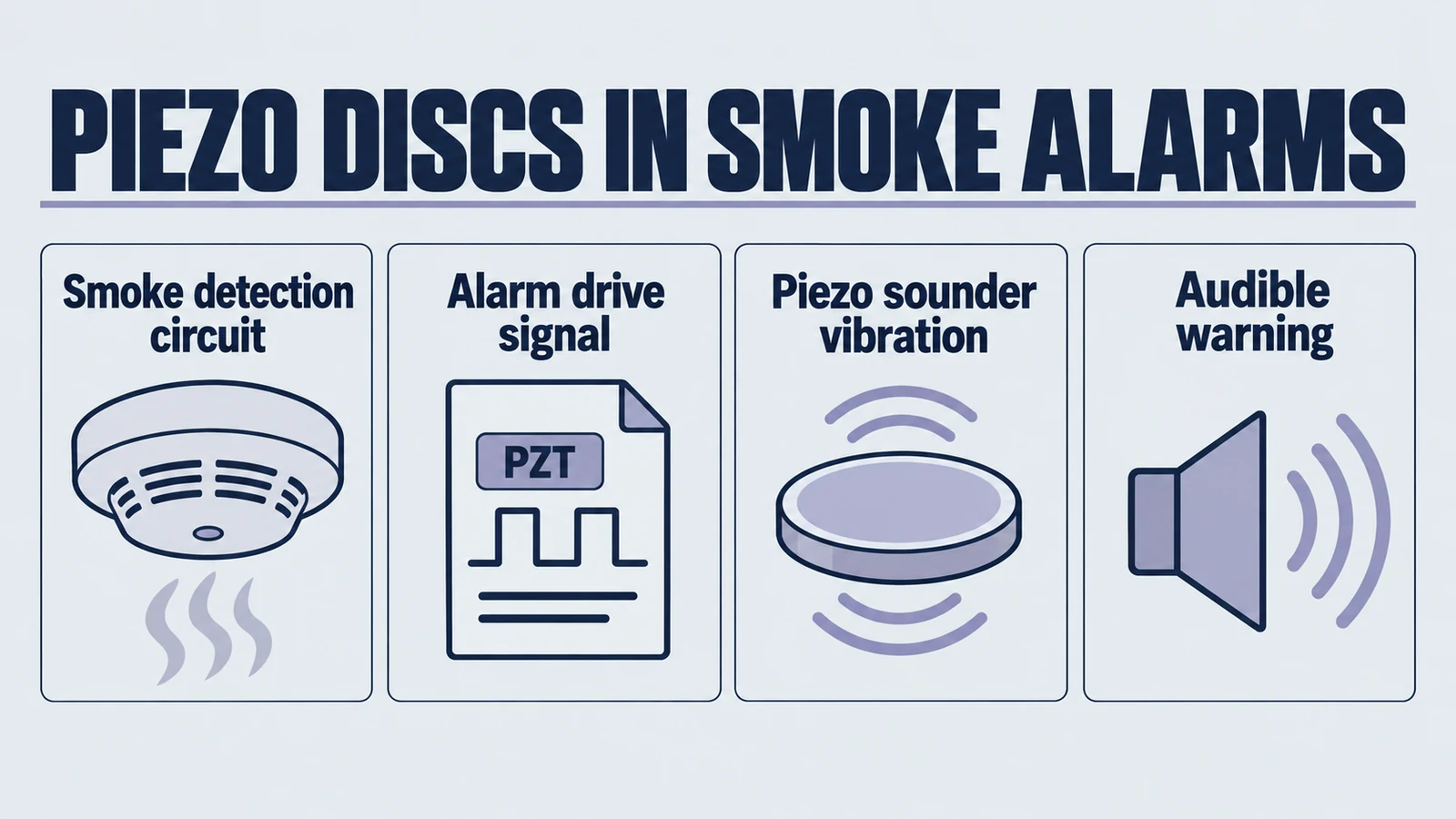
A piezo disc cannot produce a continuous tone from a simple direct current (DC) voltage, such as that from a battery. Applying a DC voltage will cause it to deform once and then hold that position. To create sound, it requires a driver circuit that supplies a rapidly alternating signal—either an alternating current (AC) voltage or a square wave signal. This circuit functions as an oscillator, rapidly switching the polarity of the voltage applied to the disc's electrodes thousands of times per second.
From Vibration to Sound Wave
The process of generating the alarm's piercing sound is a direct result of this electrical and mechanical interplay:
- The driver circuit applies a voltage of one polarity (e.g., positive) to the electrodes. This causes the piezo disc to expand or contract, forcing the bonded metal diaphragm to flex in a corresponding direction (e.g., upwards).
- The circuit instantaneously reverses the voltage polarity (e.g., to negative). The piezo disc deforms in the opposite manner, causing the diaphragm to flex back in the opposite direction (downwards).
- This cycle of flexing and unflexing repeats at a high frequency, precisely controlled by the oscillator in the driver circuit.
- This rapid, piston-like movement of the metal diaphragm creates a series of high-frequency pressure waves in the surrounding air. The human ear interprets these propagating pressure waves as a high-pitched, loud sound.
The characteristics of the sound are directly controlled by the electrical signal. The frequency of the signal from the driver circuit determines the pitch of the tone, while the amplitude of the applied voltage primarily influences its loudness, or Sound Pressure Level (SPL).
Inside the Smoke Detector: The Piezo Disc's Critical Role
To fully appreciate the function of the piezo disc, it is essential to understand its place within the smoke detector's overall system. The disc itself does not detect smoke; it is the final-stage actuator that sounds the alarm. The detection is handled by one of two primary types of sensors.
The Sensing Mechanism
- Ionization Detectors: These devices contain a minuscule amount of a radioactive material, americium-241, within a small chamber. This material emits alpha particles that ionize the air molecules in the chamber, creating a small, steady electrical current between two charged plates. When smoke particles enter this chamber, they attach to the ions, disrupting and reducing the flow of current. The detector's circuitry senses this drop in current and triggers the alarm.
- Photoelectric Detectors: These detectors employ a light-based principle. Inside a chamber, a light-emitting diode (LED) emits a beam of light that is angled away from a photosensor. In clean air, the light beam does not strike the sensor. When smoke enters the chamber, its particles scatter the light, causing some of it to be redirected onto the sensor. When the sensor detects a sufficient amount of light, the alarm is triggered.
The Actuator: Translating Signal to Sound
Regardless of whether the detection method is ionization or photoelectric, the final acoustic step is similar. The sensor's integrated circuit detects the critical change, either the disrupted ion current or the scattered light, and sends a voltage signal to the alarm component. This is where the piezo disc performs its function as an electroacoustic transducer, converting the electrical alarm signal into audible sound.
The smoke detector operates as a "sensory translation" system. It begins by detecting a physical phenomenon that may be imperceptible to a sleeping human: a minute change in ion flow or microscopic light scatter. The sensor's output is an electrical signal. The piezo disc performs the final acoustic translation by converting that electronic data into a physical sound wave that people can hear.
The Engineer's Choice: Why Piezo Discs Dominate Safety Alarms
The prevalence of piezoelectric technology in smoke alarms and other audible-alert devices is not accidental. It is the result of a clear set of engineering advantages that make the piezo disc well suited to compact, battery-powered alarm designs.
1. Solid-State Reliability & Longevity
A piezoelectric sounder avoids some armature mechanisms but still contains a vibrating diaphragm and has defined limits. Follow the finished alarm’s applicable requirements and manufacturer replacement interval. A ten-year replacement recommendation does not establish that an arbitrary disc remains compliant for ten years, or a universal mandate across jurisdictions.
2. Exceptional Power Efficiency
Piezoelectric buzzers are voltage-driven devices that exhibit extremely low current consumption, typically under 30 milliamperes (mA) and often significantly lower. This stands in stark contrast to current-driven magnetic buzzers, which require substantially more power to operate. This low power draw is arguably the most critical feature for battery-operated smoke detectors.
This low power consumption is not merely a component-level feature; it is a system-level enabler. The widespread adoption and public safety benefit of smoke alarms are directly tied to their feasibility as long-life, low-maintenance, battery-powered units. A higher-current sounder would drastically shorten battery life, increasing the frequency of battery changes and elevating the risk of a non-functional unit due to a dead battery—a primary cause of smoke alarm failure.
3. Powerful Sound Output (High SPL)
Despite their minimal power consumption, piezo ceramic elements are efficient at converting electrical energy into acoustic energy when matched with the right diaphragm, housing, and driver. Smoke-alarm designers typically validate Sound Pressure Level (SPL), tone frequency, battery life, and standards requirements at the finished-device level.
4. Design Flexibility & Cost-Effectiveness
Piezo discs are inherently small, thin, and lightweight. This compact form factor makes them perfect for integration into the space-constrained designs of modern consumer electronics, including smoke detectors. Their simple construction and the relatively low cost of the raw materials contribute to low manufacturing costs. This affordability is essential for a mass-produced consumer safety device, helping to ensure that reliable smoke detectors are accessible and can be deployed widely.
A Tale of Two Technologies: Piezoelectric vs. Magnetic Buzzers
To provide a complete technical picture, it is valuable to compare piezoelectric buzzers with their main alternative, magnetic buzzers. While a piezo buzzer uses the inverse piezoelectric effect, a magnetic buzzer operates on electromagnetic principles, using an electric current flowing through a coil to create a fluctuating magnetic field that vibrates a flexible ferromagnetic disk.
| Feature | Piezoelectric Buzzer | Magnetic Buzzer |
|---|---|---|
| Operating Principle | Inverse Piezoelectric Effect (Voltage-driven) | Electromagnetism (Current-driven) |
| Typical Voltage Range | Wide (e.g., 3V - 250V) | Narrow (e.g., 1.5V - 16V) |
| Current Consumption | Very Low (< 30 mA) | Higher (30 mA - 100 mA+) |
| Sound Profile | High-pitched, clear tone | Broader frequency range, often lower pitch |
| Construction | Vibrating ceramic/diaphragm; no rubbing armature required | Contains a coil and moving diaphragm |
| Lifespan & Reliability | Very High due to solid-state design | Good, but susceptible to mechanical wear over time |
| Ideal Applications | Battery-powered devices, alarms, timers | Applications where low voltage is the primary driver |
The data illustrates why piezoelectric technology is often selected for devices where low power consumption, compact size, and long-term stability are important design considerations.
Selecting the Right Component: Partnering for Performance
For engineers and designers developing fire alarm, industrial warning, or other audible-alert systems, the performance of the acoustic actuator is a key design variable. The choice of piezo disc can influence system-level metrics such as battery life, output level, service life, and enclosure design. When sourcing these components, key specifications must be carefully considered, including resonant frequency, SPL at a given voltage and fixture, capacitance, electrode layout, and physical dimensions like diameter and thickness.
In regulated alarm products, component quality, manufacturing consistency, and finished-device verification should be planned together. Yujie supports engineers with PZT ceramic elements, piezo disc geometry options, and material selection guidance for teams building their own audible-alert assemblies.
For related reading on piezoelectric technology applications, explore our comprehensive guides on selecting between piezo rings and discs and PZT material fundamentals.
Contact us to discuss your project requirements. We can help you select PZT ceramic material, disc size, electrode configuration, and test data for your alarm or audible-alert design.
Conclusion: The Small Disc with a Mighty Impact
The piercing sound of a smoke alarm, a sound that has saved countless lives, is powered by the elegant physics of the inverse piezoelectric effect embodied in a simple piezo disc. This technology has become the industry standard not by chance, but because its fundamental characteristics align perfectly with the stringent demands of safety-critical applications.
Its reliability stems from a solid-state design with no coils or armatures. Its power efficiency supports long-life, battery-powered devices. And its ability to produce a loud, attention-grabbing alarm from a compact component explains why piezoelectric sounders remain common in audible-alert engineering.
In the world of alarm engineering, reliable performance often comes from carefully specified components. The humble piezo disc is a testament to this principle: a small piece of ceramic and metal that, through the remarkable properties of piezoelectricity, helps turn electronic detection into audible warning.
Engineering decision notes
PZT material and ceramic selection
Use this article when the choice is not just a shape, but a material tradeoff between sensitivity, loss, coupling, stability, and operating field. For "The Unsung Hero of Fire Safety: How Piezo Discs Power Smoke Alarm Sounders", the practical value is in turning the topic into a measurable selection or sourcing decision.
YJ Piezo coordinates PZT ceramic projects with manufacturing support, so material formulation, sintering, polarization, electrode process, and outgoing inspection can be reviewed against the final application.
Selection checks
- Separate sensing needs from high-power actuation needs before comparing d33 or coupling values.
- Check dielectric loss, Qm, Curie temperature, aging behavior, and operating field against the real duty cycle.
- Confirm whether the application needs standard PZT grades or a custom formulation and geometry.
Failure risks
- Choosing only the highest d33 can create heat, drift, or depolarization risk in power ultrasonics.
- A ceramic that performs well in free measurement can fail once bonded, clamped, or loaded.
- Material substitutions without batch testing can change capacitance, resonance, and system tuning.
RFQ details
- Is the part used for sensing, actuation, atomization, cleaning, welding, or measurement?
- What field strength, temperature, duty cycle, and mechanical load will the ceramic see?
- Which values must be controlled: d33, capacitance, resonance, impedance, Qm, or dimensional tolerance?
Relevant YJ Piezo pages
- PZT Material Hub
Material grades and application tradeoffs
- Piezoelectric Ceramics
Shapes and ceramic manufacturing options
- PZT Material Supplier Hub
Material control, grade selection, and sourcing support
Application FAQ
- Is the highest d33 always the best PZT choice?
- No. High d33 can be useful for sensitivity, but high-power ultrasonic systems often need lower loss, higher Qm, better thermal stability, and safer operation under field and stress.
- What makes PZT material selection different from catalog buying?
- The right PZT choice depends on geometry, load, drive field, duty cycle, temperature, and inspection targets. A catalog value is only useful when it is tied to the final assembly conditions.