
Upgrading Your Ultrasonic Cleaner: When & Why to Replace Transducers
Ultrasonic cleaners are important in industries ranging from medical-instrument cleaning before validated reprocessing to precision engineering and jewelry maintenance. At the heart of these machines lies the ultrasonic transducer—a device that converts electrical energy into high-frequency mechanical vibrations, enabling deep and efficient cleaning. Over time, however, transducers wear out or become less effective, which can significantly reduce cleaning performance.
In this article, we'll explore the key indicators that it's time for an ultrasonic cleaner transducer replacement, the benefits of upgrading, and how to choose the right transducer for your needs.
Understanding Ultrasonic Cleaner Transducers
An ultrasonic cleaner transducer works by transforming high-frequency electrical signals into mechanical vibrations. These vibrations create microscopic cavitation bubbles in the cleaning solution. When these bubbles collapse, they release energy that removes contaminants from surfaces—even in hard-to-reach crevices.
Product path for this search intent
Match the article topic to the right YJ Piezo product page
Use this article when cleaning performance depends on cavitation strength, tank coupling, frequency selection, and long-run thermal behavior. For "Upgrading Your Ultrasonic Cleaner: When & Why to Replace Transducers", the practical value is in turning the topic into a measurable selection or sourcing decision.
- Ultrasonic Cleaning Transducers
Cleaning models for tank and precision cleaning systems
- Piezoelectric Ring Series
Ring ceramics used in high-power transducer stacks
- Piezoelectric Ceramics
PZT material and geometry options for acoustic output
There are two main types of ultrasonic transducers:
- Piezoelectric transducers: Use piezoelectric ceramics (like PZT) to generate vibrations.
- Magnetostrictive transducers: Use magnetostrictive materials to achieve similar effects.
For most small-to-medium ultrasonic cleaners, piezoelectric transducers are preferred due to their efficiency and adaptability. Our HJ-3528B ultrasonic cleaner transducer is a perfect example of this technology.
Signs You Need an Ultrasonic Cleaner Transducer Replacement
Replacing or upgrading your transducers is not just about fixing breakdowns—it's about maintaining performance and extending your equipment's life. Here are the most common indicators:
1. Reduced Cleaning Efficiency
If cleaning cycles take longer, or contaminants remain after cleaning, the transducers may no longer be generating sufficient power.
2. Unusual Noise or Vibration Patterns
Changes in the machine's normal sound can signal degraded transducer performance.
3. Hot Spots in the Cleaning Tank
Uneven cleaning results often point to one or more faulty transducers.
4. Physical Damage or Detachment
Transducers can become detached from the tank wall or show visible cracks.
5. Electrical Faults
Faulty impedance readings or inconsistent power output are warning signs.
Why Upgrade Ultrasonic Transducers Instead of Just Replacing Them
While replacement restores original functionality, upgrading can enhance performance and reliability beyond the initial specifications.
- Higher Power Output: Modern transducers like our high-power HJ-3840 cleaner transducer can generate more intense cavitation, improving cleaning speed and thoroughness.
- Improved Durability: Newer piezoelectric materials offer better resistance to heat and chemical wear.
- Energy Efficiency: Up-to-date designs consume less power for the same or greater output.
- Custom Frequency Options: Tailoring frequency (e.g., 28 kHz for heavy-duty cleaning, 40 kHz for delicate items) can optimize results.
How to Choose the Right Transducer for an Upgrade
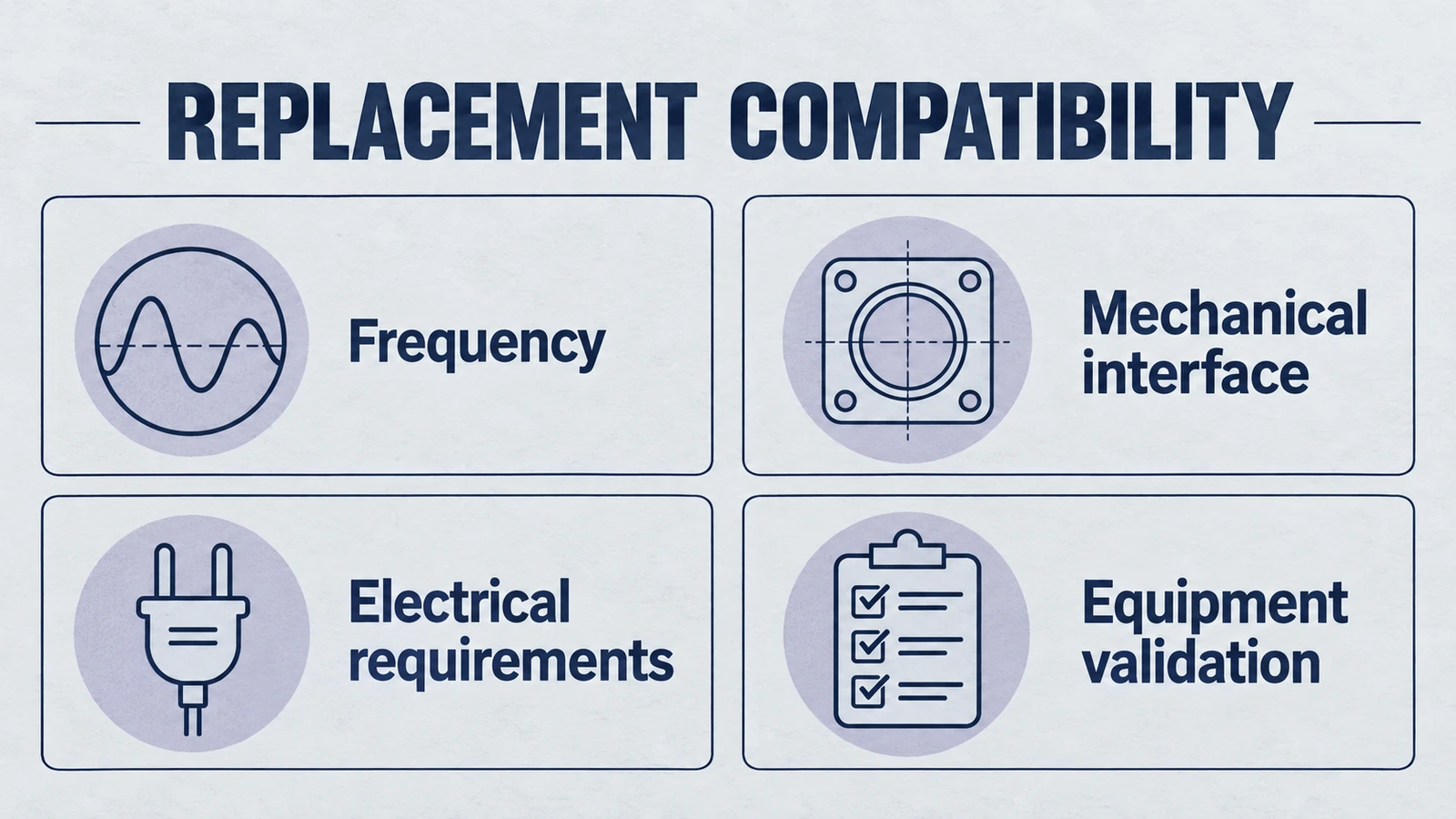
When considering an upgrade ultrasonic transducer solution, keep these factors in mind:
1. Frequency Requirements
Match the transducer frequency to your cleaning application—lower frequencies for robust cleaning, higher for delicate surfaces. Our industrial cleaner transducer HJ-3828 offers excellent performance for heavy-duty applications.
2. Power Rating
Ensure the power output (watts per liter of tank capacity) aligns with your needs. For commercial applications, consider our commercial cleaner transducer HJ-4520.
3. Tank Compatibility
Verify mounting dimensions, bonding method (epoxy or solder), and electrical connections.
4. Material Resistance
Choose materials compatible with your cleaning solvents and temperatures. Our advanced cleaner transducer HJ-4528 offers excellent chemical resistance.
5. Supplier Reputation
Work with a supplier experienced in ultrasonic cleaner transducer replacement to ensure product quality and support.
Popular Transducer Options for Different Applications
Depending on your specific cleaning needs, different transducers may be optimal:
- Professional Applications: The professional cleaner transducer HJ-5025 offers exceptional performance for demanding environments.
- Industrial Settings: For continuous operation, consider our industrial cleaning transducer HJ-5028.
- Portable Units: For smaller systems, the portable cleaner transducer HJ-300ML provides excellent value.
Maintenance Tips to Extend Transducer Life
Even with a new or upgraded transducer, proper maintenance is key:
- Avoid running the cleaner without liquid in the tank.
- Use only compatible cleaning solutions.
- Monitor temperature and avoid prolonged overheating.
- Perform regular inspections for cracks or detachment.
For detailed maintenance guidelines, check our comprehensive guide on ultrasonic transducer troubleshooting.
Installation and Professional Services
While some transducer replacements can be handled in-house, complex upgrades may require professional installation. Our technical team provides comprehensive support for transducer selection, installation guidance, and performance optimization.
Conclusion
Your ultrasonic cleaner's performance is only as good as its transducers. Knowing when to invest in an ultrasonic cleaner transducer replacement—and when to go a step further with an upgrade ultrasonic transducer—can save time, reduce costs, and deliver superior cleaning results.
For expert guidance on selecting or upgrading your ultrasonic cleaner transducers, contact our team at Yujie. We provide high-quality piezoelectric transducers designed for durability, efficiency, and exceptional cleaning performance.
Engineering decision notes
Ultrasonic cleaning and cavitation
Use this article when cleaning performance depends on cavitation strength, tank coupling, frequency selection, and long-run thermal behavior. For "Upgrading Your Ultrasonic Cleaner: When & Why to Replace Transducers", the practical value is in turning the topic into a measurable selection or sourcing decision.
YJ Piezo evaluates cleaning transducers by acoustic output, impedance stability, ceramic loss, bonding quality, and how the assembly couples into the tank.
Selection checks
- Choose frequency from the cleaning target, part geometry, and contamination type rather than from price alone.
- Review ceramic material, bonding area, impedance, and tank mounting as one acoustic chain.
- Ask whether the transducer is intended for intermittent cleaning, continuous industrial operation, or precision cleaning.
Failure risks
- A transducer can heat water but still produce weak useful cavitation if it is poorly matched to the tank.
- High output without thermal margin can shorten ceramic, adhesive, or cable lifetime.
- Mixing 28 kHz and 40 kHz assumptions can create poor cleaning uniformity or excessive noise.
RFQ details
- What tank size, liquid, duty cycle, and cleaning target are involved?
- Which frequency and power range are currently used or being replaced?
- Do you need impedance records, bonding guidance, or sample validation before production?
Relevant YJ Piezo pages
- Ultrasonic Cleaning Transducers
Cleaning models for tank and precision cleaning systems
- Piezoelectric Ring Series
Ring ceramics used in high-power transducer stacks
- Piezoelectric Ceramics
PZT material and geometry options for acoustic output
Application FAQ
- Why can a cleaning transducer heat liquid but clean poorly?
- Heat only proves energy is entering the system. Useful cleaning needs controlled cavitation, correct frequency, good tank coupling, and stable impedance under load.
- What should I provide for a cleaning transducer quotation?
- Provide tank dimensions, liquid type, target material, duty cycle, desired frequency, current transducer model if replacing one, and whether the system needs continuous industrial operation.