
Beyond the Datasheet: Why Your PZT-5 Piezoelectric Material Partner Defines Product Success
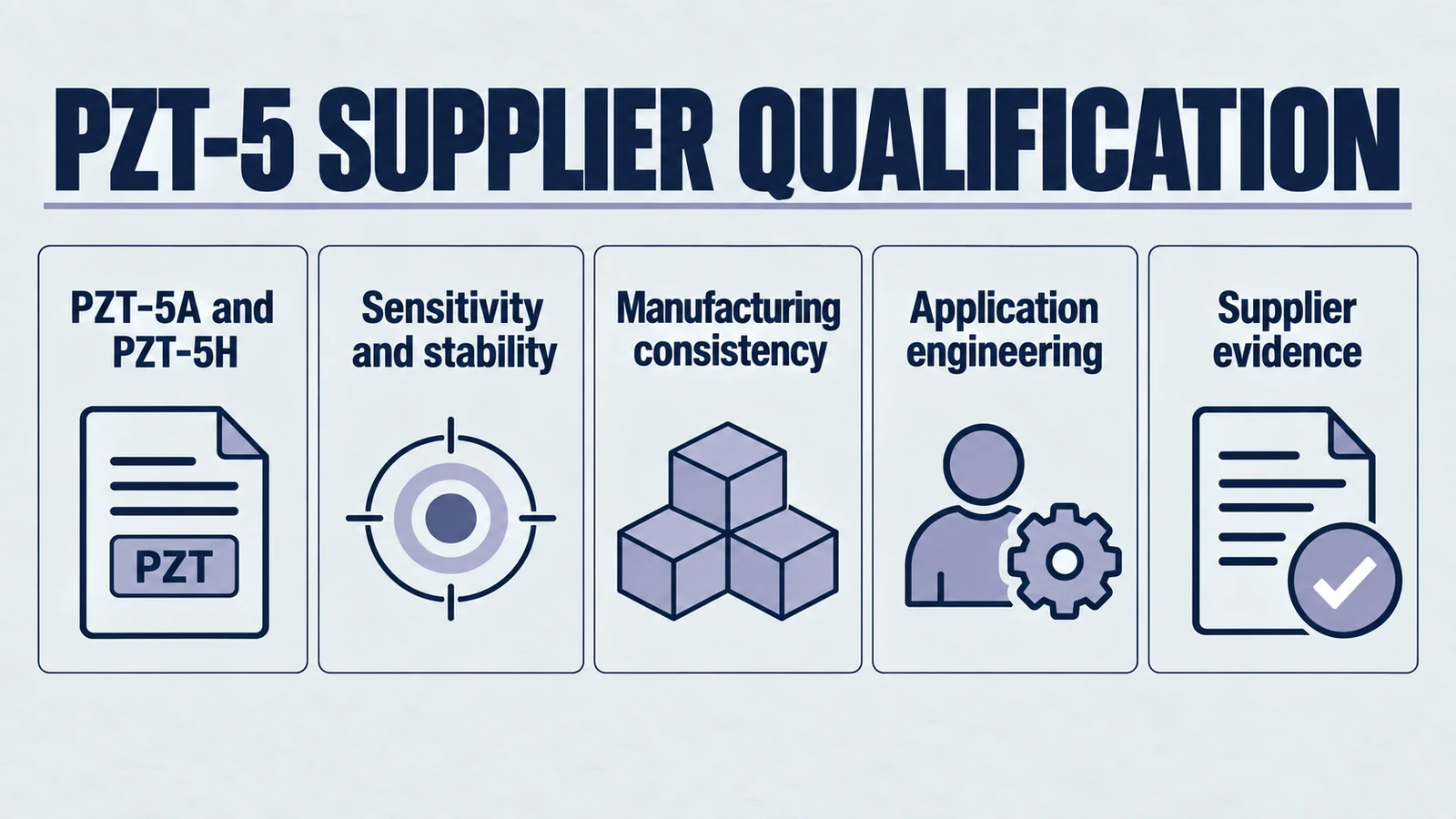
The Strategic Imperative: Beyond a "PZT-5" Label
In the world of high-performance ultrasonic technology, the selection of a core component is rarely a simple procurement task. It is a critical engineering decision with consequences for product performance, reliability, and ultimately, business success. Whether designing a medical imaging probe, an industrial sensor, or a precision micro-positioning actuator, the piezoelectric element is the engine that drives the system. Among the most versatile and widely adopted materials for these applications is PZT-5 piezoelectric material, a family of "soft" lead zirconate titanate ceramics prized for its high sensitivity. Understanding how geometry affects piezoelectric performance is equally important when selecting the right component for your application.
However, a dangerous oversimplification has taken root in many design and sourcing processes. Engineers often specify a material like "PZT-5A" based on a generic datasheet, assuming that this designation represents a universal, interchangeable standard. This assumption can create hidden costs, unforeseen development delays, and serious field reliability problems. The reality is that a component labeled "PZT-5A" from one manufacturer can exhibit different performance characteristics from one made by another, due to variations in chemical formulation and manufacturing processes.
This performance variance is not a minor technicality; it is a significant business risk. Consider a production run of ultrasound transducers where inconsistent resonant frequency, caused by poor material control, leads to unstable acoustic output. This component-level problem can trigger expensive redesign, qualification delays, and quality investigations. The true cost of an inconsistent component is never cheap.
Product path for this search intent
Match the article topic to the right YJ Piezo product page
Use this article when the choice is not just a shape, but a material tradeoff between sensitivity, loss, coupling, stability, and operating field. For "Beyond the Datasheet: Why Your PZT-5 Piezoelectric Material Partner Defines Product Suc...", the practical value is in turning the topic into a measurable selection or sourcing decision.
- PZT Material Hub
Material grades and application tradeoffs
- Piezoelectric Ceramics
Shapes and ceramic manufacturing options
- PZT Material Supplier Hub
Material control, grade selection, and sourcing support
Deconstructing the PZT-5 Family: A Tale of Sensitivity vs. Stability
To make an informed decision, one must first understand the fundamental nature of the material. PZT-5 belongs to the category of "soft" piezoelectric ceramics. Unlike their "hard" PZT counterparts, which are designed for high-power applications like ultrasonic welding, soft PZT-5 piezoelectric material is characterized by high dielectric constants, large piezoelectric charge coefficients, and excellent electromechanical coupling. These properties make them exceptionally well-suited for sensing and receiving applications, where the primary goal is to efficiently convert weak mechanical signals into measurable electrical charges, or vice-versa for generating precise displacements.
Within the PZT-5 family, two primary variants dominate the landscape: PZT-5A and PZT-5H. The choice between them is not arbitrary; it represents a fundamental design trade-off between peak sensitivity and operational stability.
PZT-5A (Navy Type II): The Workhorse of Reliability
PZT-5A is widely regarded as the balanced, general-purpose workhorse of the family. It offers a strong combination of good piezoelectric sensitivity and robust mechanical stability. Its most defining characteristic is a relatively high Curie temperature (the temperature at which the material loses its piezoelectric properties), which makes it highly stable across a wide range of operating temperatures. This thermal stability and reliability make PZT-5A the preferred choice for applications like industrial hydrophones, underwater acoustic transducers, general-purpose acoustic sensors, and displacement actuators where consistent performance in potentially harsh or fluctuating environments is non-negotiable.
PZT-5H (Navy Type VI): The High-Sensitivity Specialist
PZT-5H is the high-performance specialist, engineered for applications where maximum sensitivity is the overriding priority. It exhibits exceptionally high piezoelectric charge coefficients (d33) and electromechanical coupling factors (k33), which can increase charge response under matched conditions. Open-circuit voltage depends on g = d/ε, geometry and electrical loading; a higher d alone does not guarantee a larger voltage signal. This makes it the ideal material for state-of-the-art medical ultrasound imaging, high-fidelity hydrophones for detecting faint acoustic signals, and precision piezoelectric sensors requiring the highest possible resolution. However, this extreme sensitivity comes at a price. PZT-5H has a markedly lower Curie point, which limits its maximum operating temperature and makes its properties more susceptible to change with thermal variations.
The selection process, therefore, hinges on a deep understanding of the application's operational envelope. Prioritizing peak sensitivity with PZT-5H in a high-temperature industrial setting is a recipe for failure, just as specifying PZT-5A for a next-generation diagnostic imaging probe would mean sacrificing critical performance.
Comparative Analysis of PZT-5A and PZT-5H Properties
| Property | Symbol | Unit | PZT-5A (Industry-Typical) | PZT-5H (Industry-Typical) | Performance Implication |
|---|---|---|---|---|---|
| Piezoelectric Charge Constant | d33 | pC/N or pm/V | ~390 | ~650 | Higher d33 = Greater Sensitivity. PZT-5H generates more charge for a given stress, ideal for detecting weak signals. |
| Planar Coupling Factor | kp | - | ~0.65 | ~0.75 | Higher kp = Better Energy Conversion. PZT-5H is more efficient at converting between mechanical and electrical energy. |
| Mechanical Quality Factor | Qm | - | ~80 | ~65 | Higher Qm = Lower Mechanical Loss. PZT-5A is slightly better for resonant applications, though both are low. |
| Curie Temperature | Tc | °C | ~350 | ≈190–200 | Higher Tc = Greater Thermal Stability. PZT-5A can operate at higher temperatures without depolarization. |
| Dielectric Loss | tan δ | % | < 2.0 | ≤ 2.5 | Lower tan δ = Less Heat Generation. Critical for continuous operation, though both are relatively high-loss materials. |
Application Deep Dive: Matching the Material to the Mission
The technical specifications in a table only tell part of the story. Their true meaning becomes clear when connected to the performance of a final product. The success of an entire system is not merely the sum of its parts; it is a multiplicative function where a single mismatched component can degrade the performance of the whole. Material selection is therefore an exercise in system-level optimization.
The Sensitivity Mandate: High-Resolution Medical Imaging & Precision Sensing
In the field of medical diagnostics, particularly ultrasound imaging, the clarity of the image is paramount. This clarity depends directly on the transducer's ability to both generate a clean ultrasonic pulse and, more importantly, detect the faint, complex echoes returning from body tissues. This is where PZT-5H excels.
Its exceptionally high piezoelectric charge constant (d33) means it is incredibly sensitive to the minuscule pressure variations of returning sound waves, converting them into strong, clear electrical signals. Its high electromechanical coupling factor (kp) ensures maximum energy conversion efficiency in both transmitting and receiving modes. The result is an image with higher resolution, better contrast, and greater diagnostic value. For applications like advanced non-destructive testing (NDT) or scientific hydrophones, where detecting the smallest flaw or the faintest signal is the primary objective, the superior sensitivity of PZT-5H is the enabling factor. Various piezoelectric ceramic components including discs, rings, and rectangular plates can be manufactured from these high-sensitivity materials.
The Reliability Requirement: Robust Industrial & Actuator Applications
Now, consider an ultrasonic flow sensor installed in an industrial pipeline or an actuator in an automated manufacturing line. These devices may be subjected to wide temperature swings, continuous operation, and high mechanical loads. In this context, peak sensitivity usually takes a backseat to long-term stability and reliability margin.
This is the domain of industry-typical PZT-5A formulations. Their higher Curie temperature can provide a useful safety margin against depolarization caused by thermal spikes, but Yujie P-series selection should still be checked against the official material table for the selected grade. A device that loses its calibration or fails entirely due to a temperature fluctuation is a critical liability in an industrial setting. The balanced properties of PZT-5A deliver the predictable, repeatable performance that is the bedrock of industrial automation and process control.
The Yujie Difference: From Commodity Component to Engineered Solution
Understanding the nuances of PZT-5A and PZT-5H is the first step. The second, and more critical step, is recognizing that these material properties are not proven by a label alone. They are the result of material science expertise and meticulous manufacturing control. This is where a true manufacturing partner like Yujie distinguishes itself from a commodity supplier. Yujie's business model is built on reducing inconsistency and performance variation in high-performance applications.
Material Mastery & Proprietary Formulations
Yujie directly confronts the "not all PZT-5 is equal" problem by controlling the very foundation of the material. The process begins with stringent qualification of raw material suppliers to ensure the highest purity of foundational oxides. From there, Yujie develops its own proprietary formulations, using specific doping agents in precise quantities to fine-tune material properties for specific application demands.
For instance, Yujie's P52 material maps to the PZT-5H class and is engineered for high-sensitivity sensor and receiving applications, while P51 maps to the more balanced PZT-5A class. This in-house R&D capability means Yujie can move beyond off-the-shelf offerings to discuss formulations and process targets for a client's frequency, sensitivity, or mechanical requirements.
Manufacturing Excellence & Unwavering Consistency
With a foundation of controlled materials, performance is supported through manufacturing discipline. Yujie's experience dates to 1996, with manufacturing operations in Wuxi supporting ceramic processing and component production. The process route, inspection scope, available records, and batch quantity are reviewed for the selected component rather than inferred from a site-wide claim.
A Partnership Approach: Your Extended R&D Team
Perhaps the most significant differentiator is Yujie's philosophy of partnership. Backed by an engineering team with practical piezoelectric experience built since 1996, Yujie can support clients' R&D departments. The engagement is not a simple transaction but a collaborative process. It begins with pre-sale technical consultation to help select an appropriate material and continues through custom design, OEM/ODM solutions, and after-sale support for integration and troubleshooting. This approach helps the chosen piezoelectric element fit the final product's design and validation needs.
The Engineer's Checklist: 5 Critical Questions for Your Piezoelectric Supplier
To navigate the complexities of sourcing and secure the performance your project demands, it is essential to ask the right questions. These inquiries go beyond a simple price quote and probe the core capabilities that define a true manufacturing partner.
- Can you provide batch-to-batch performance data? What are your typical tolerances for key parameters like resonant frequency and capacitance?
This question directly addresses the critical issue of consistency. A capable manufacturer should be able to provide statistical process control (SPC) data that demonstrates their ability to maintain tight tolerances, supporting statistical conformance to agreed limits across production, rather than literal identity of every part. - What is your process for raw material qualification and traceability?
Performance starts with the foundational chemistry. A supplier should be able to detail their process for vetting raw material vendors and ensuring the purity and consistency of the precursor powders, as this is the first step in preventing downstream performance issues. - Do you develop proprietary material formulations, or do you use standard recipes? Can you customize a formulation for my specific application?
This question separates manufacturers with deep R&D capabilities from those who are simply processing standard materials. The ability to create custom formulations is a sign of true material science expertise and a commitment to solving unique engineering challenges. - What level of engineering support do you provide during the design and integration phase?
The ideal supplier is a technical resource. Inquire about access to experienced engineers who can provide guidance on transducer design, component integration, and troubleshooting. This collaborative support can dramatically shorten development cycles and prevent costly design errors. - What are your quality management certifications, and what is your procedure for handling non-conforming parts?
Look for internationally recognized certifications like ISO 9001 as evidence of a robust quality management system. A transparent and well-defined process for handling any issues demonstrates a commitment to quality and customer partnership.
Conclusion: Secure Your Innovation with a Trusted Partner
In the development of high-performance ultrasonic and sensing devices, the selection of a PZT-5 piezoelectric material supplier is one of the most consequential decisions an engineering team can make. As we have seen, a generic datasheet is insufficient proof of performance. The critical differences between PZT-5A and PZT-5H, combined with the significant performance variations that exist between manufacturers, demand a more strategic approach.
Success requires looking beyond the component to the partner—evaluating a supplier based on their material mastery, manufacturing consistency, and depth of engineering expertise. By prioritizing these factors, you are not just buying a ceramic element; you are investing in the reliability, performance, and long-term success of your product. Yujie Technology embodies these principles, delivering not just industry-leading components, but the certainty and support needed to turn ambitious designs into market-leading innovations.
Partner with an expert. Contact the Yujie engineering team today to discuss your application and discover the right material solution.
Explore our detailed PZT material specifications to see the Yujie difference for yourself.
Engineering decision notes
PZT material and ceramic selection
Use this article when the choice is not just a shape, but a material tradeoff between sensitivity, loss, coupling, stability, and operating field. For "Beyond the Datasheet: Why Your PZT-5 Piezoelectric Material Partner Defines Product Suc...", the practical value is in turning the topic into a measurable selection or sourcing decision.
YJ Piezo coordinates PZT ceramic projects with manufacturing support, so material formulation, sintering, polarization, electrode process, and outgoing inspection can be reviewed against the final application.
Selection checks
- Separate sensing needs from high-power actuation needs before comparing d33 or coupling values.
- Check dielectric loss, Qm, Curie temperature, aging behavior, and operating field against the real duty cycle.
- Confirm whether the application needs standard PZT grades or a custom formulation and geometry.
Failure risks
- Choosing only the highest d33 can create heat, drift, or depolarization risk in power ultrasonics.
- A ceramic that performs well in free measurement can fail once bonded, clamped, or loaded.
- Material substitutions without batch testing can change capacitance, resonance, and system tuning.
RFQ details
- Is the part used for sensing, actuation, atomization, cleaning, welding, or measurement?
- What field strength, temperature, duty cycle, and mechanical load will the ceramic see?
- Which values must be controlled: d33, capacitance, resonance, impedance, Qm, or dimensional tolerance?
Relevant YJ Piezo pages
- PZT Material Hub
Material grades and application tradeoffs
- Piezoelectric Ceramics
Shapes and ceramic manufacturing options
- PZT Material Supplier Hub
Material control, grade selection, and sourcing support
Application FAQ
- Is the highest d33 always the best PZT choice?
- No. High d33 can be useful for sensitivity, but high-power ultrasonic systems often need lower loss, higher Qm, better thermal stability, and safer operation under field and stress.
- What makes PZT material selection different from catalog buying?
- The right PZT choice depends on geometry, load, drive field, duty cycle, temperature, and inspection targets. A catalog value is only useful when it is tied to the final assembly conditions.