
Beyond the Datasheet: How to Select a PZT Ring for Optimal Transducer Performance
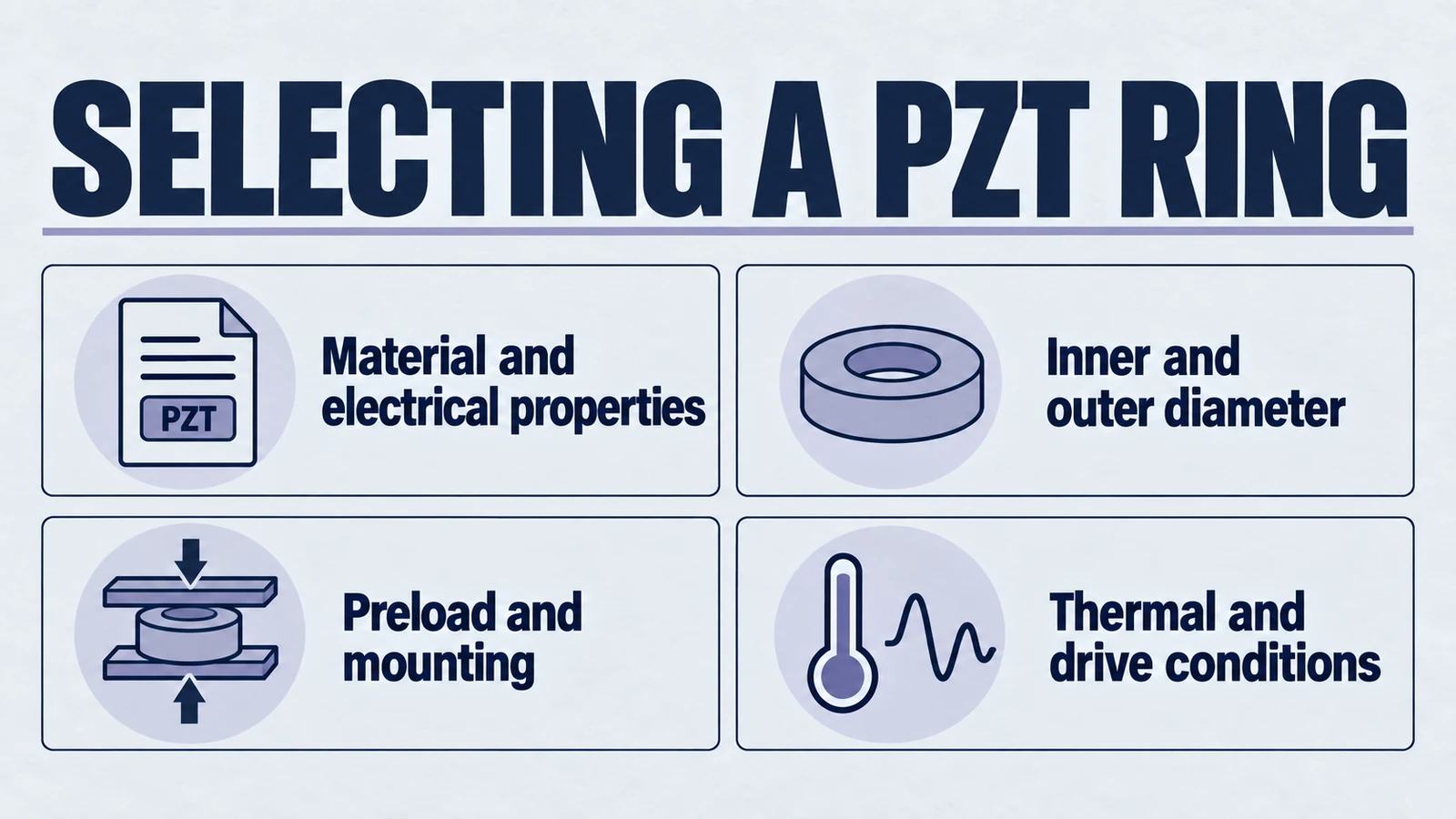
I. Introduction: The Hidden Risks of a "Standard" PZT Ring
Imagine this scenario: a new ultrasonic transducer prototype is underperforming. The power output is inconsistent, the device is overheating, and its resonant frequency is drifting during operation. The PZT rings at its core were specified exactly from a generic datasheet, yet the results are failing crucial validation tests. This situation is a common and costly frustration for R&D engineers and product designers, highlighting a critical truth: not all PZT rings are created equal, even when their datasheets appear identical.
The PZT (Lead Zirconate Titanate) ring is not a passive component; it is the active engine of any ultrasonic device. Its fundamental purpose is to execute the piezoelectric effect—efficiently converting electrical energy into mechanical vibration and, conversely, mechanical stress into an electrical signal. Consequently, subtle variations in its material composition, manufacturing process, and geometric tolerances have a cascading effect on the entire system's performance, reliability, and operational lifespan.
This article moves beyond the surface-level specifications on a typical datasheet to explore the critical material properties, manufacturing nuances, and application-specific trade-offs that determine a PZT ring's true performance. The primary business risk associated with sourcing PZT rings is not the component cost, but the staggering cost of inconsistency. A single batch of substandard rings can lead to expensive product recalls, serious field failures, an erosion of market confidence, and significant regulatory liability, particularly within the medical device sector. This reframes the procurement process from a simple cost analysis into a strategic risk mitigation effort. By partnering with a specialist manufacturer like Yujie, whose piezoelectric ceramics experience has been built since 1996, the component selection process is transformed from a game of chance into a predictable, reliable engineering discipline.
Product path for this search intent
Match the article topic to the right YJ Piezo product page
Use this article when the choice is not just a shape, but a material tradeoff between sensitivity, loss, coupling, stability, and operating field. For "Beyond the Datasheet: How to Select a PZT Ring for Optimal Transducer Performance", the practical value is in turning the topic into a measurable selection or sourcing decision.
- PZT Material Hub
Material grades and application tradeoffs
- Piezoelectric Ceramics
Shapes and ceramic manufacturing options
- PZT Material Supplier Hub
Material control, grade selection, and sourcing support
II. Deconstructing PZT Ring Performance: The Electromechanical Properties That Truly Matter
To make an informed engineering decision, one must look beyond basic outer and inner diameters. The true performance of a PZT ring is dictated by a complex interplay of electromechanical properties rooted in its material science and manufacturing process.
2.1. Material Formulation: The Hard vs. Soft PZT Trade-Off
"PZT" is not a single substance but a family of ceramic formulations, each engineered with specific dopants to optimize certain characteristics. The most fundamental distinction is between "hard" and "soft" PZT ceramics, a choice that presents a critical engineering trade-off between power and sensitivity.
- Hard PZT (e.g., PZT-4, PZT-8): These materials are characterized by a high mechanical quality factor (Qm), low dielectric loss, and exceptional power handling capacity. While they are less sensitive, they exhibit superior stability under high mechanical and electrical loads. This makes them the ideal choice for high-power applications such as industrial ultrasonic cleaning baths and welding transducers, where durability and thermal stability are paramount.
- Soft PZT (e.g., PZT-5A, PZT-5H): This class of materials is known for its high sensitivity, high dielectric constant, and a superior electromechanical coupling coefficient. They excel in applications where detecting faint signals or producing precise, small displacements is the primary goal. Consequently, soft PZT is preferred for sensor assemblies, medical diagnostic imaging, and low-power actuators.
The selection is a multi-variable optimization problem. High sensitivity, a hallmark of soft PZT, often comes at the expense of the power handling and thermal stability found in hard PZT. The goal is to identify the optimal balance for a specific application's duty cycle, power level, and environmental conditions, a task that often requires consultation with material experts.
2.2. The Core Four Performance Metrics
Beyond the hard/soft classification, four key metrics define a PZT ring's functional performance:
- Electromechanical Coupling Coefficient (kp): This is the planar-mode coupling factor under defined test conditions, not a fraction of device input power converted to useful output. Do not transfer it to thickness-mode coupling. Confirm the selected Yujie grade’s nominal data and agreed acceptance limits; a universal 0.42 value across all rings requires a controlled specification.
- Resonant Frequency (Fr) and Impedance (Zm): The resonant frequency is the frequency at which the transducer operates with maximum efficiency. The resonant impedance is the material's opposition to current flow at that specific frequency. For maximum power transfer, the transducer's impedance must be precisely matched to its driving power supply. A low impedance, such as the ≤11 Ω to ≤20 Ω values specified for Yujie's industrial rings, is critical for efficient power delivery and minimizing energy loss as heat.
- Mechanical Quality Factor (Qm): This parameter is the inverse of mechanical damping, representing the material's ability to vibrate with minimal internal energy loss. A high Qm, characteristic of hard PZT, signifies less internal friction. In high-power applications, this translates directly to less heat generation during continuous operation—a crucial factor for preventing thermal depoling and ensuring the long-term reliability of the transducer.
- Dielectric Constant & Capacitance: These electrical properties influence the component's overall impedance and are critical for designing the driving electronics. A high capacitance, while beneficial in some sensor applications, can increase the electrical load and slow down the system's maximum response speed or bandwidth.
III. Matching the PZT Ring to the Mission: An Application-Driven Approach
Understanding the technical parameters is the first step; applying them to real-world challenges is what leads to successful product design. The PZT ring's geometry and material properties must be carefully matched to its intended mission.
3.1. High-Power Industrial Transducers (Ultrasonic Cleaning & Welding)
- Requirements: These applications demand maximum power output, extreme durability, high thermal stability to withstand continuous operation, and consistent performance under heavy mechanical loads.
- PZT Ring Solution: Hard PZT formulations (such as PZT-4 or PZT-8 equivalents) are essential. These rings must possess a high Qm to minimize heat buildup and a very low impedance for efficient power transfer from the generator. The ring shape itself is a key design feature, as its central hole allows multiple rings to be stacked and held under high compressive force with a tensioning screw (a Langevin transducer design), preventing tensile failure during high-amplitude vibration. Yujie's specific models for cleaning and welding are engineered for these demanding tasks.
3.2. Precision Medical Devices (Imaging, Surgical Tools, Atomization)
- Requirements: Medical applications require a different set of priorities. Diagnostic imaging probes need high sensitivity to receive faint ultrasonic echoes. Surgical tools, such as phacoemulsification scalpels for cataract surgery or dental scalers, demand precise and repeatable displacement. Medical nebulizers and atomizers rely on high-frequency vibration to generate a fine, consistent mist for drug delivery.
- PZT Ring Solution: Soft PZT materials from the PZT-5 family are typically used for their high sensitivity and coupling coefficients. For atomizers, thin rings are glued to a membrane to create the aerosolizing effect. In healthcare equipment, material consistency is important, as variations can affect imaging artifacts or device output stability. Miniaturized rings are often required for integration into devices like intravascular catheters and endoscopic tools.
3.3. Sensing and Non-Destructive Testing (NDT)
- Requirements: Sensor applications prioritize excellent signal reception (high sensitivity), long-term stability across changing temperatures, and specific geometries to generate and receive ultrasonic waves for flaw detection, thickness gauging, or flow measurement.
- PZT Ring Solution: Soft PZT is often preferred for its high piezoelectric charge coefficient, which translates mechanical stress into a strong electrical signal. The ring shape is highly versatile for sensor assemblies, including hydrophones for underwater sonar, vibration monitors for predictive maintenance, and transducers for ultrasonic flow meters.
3.4. Actuation and Nanopositioning
- Requirements: These applications demand precise, repeatable, and high-force linear movement for tasks like adjusting optics or controlling micro-valves. Rings are frequently stacked to multiply the total displacement.
- PZT Ring Solution: Stacked ring actuators provide high blocking force in a compact form factor. The geometry of the PZT ring is not merely a shape but an enabling design feature. The central hole is a critical functional element that allows for not only mechanical preloading but also the integration of other system components, such as laser beams in optical tuning systems or needles in micro-dispensing equipment. Furthermore, compared to a solid disc of the same volume, the ring's increased surface area provides superior thermal management by allowing heat to dissipate more quickly, enhancing reliability in high-duty-cycle applications.
IV. The Yujie Advantage: Engineering Certainty into Every Component
Addressing the challenges of inconsistency and performance requires more than just a good datasheet; it requires a manufacturing partner with deep institutional knowledge and an unwavering commitment to quality. Yujie provides this certainty through manufacturing excellence, rigorous quality assurance, and collaborative engineering support.
4.1. From Raw Powder to Polished Component: The Power of Manufacturing Excellence
With manufacturing experience built since 1996, Yujie controls the entire production process, which is essential because piezoelectric properties are not inherent to the material. They are imparted through a complex, multi-stage process of chemical mixing, high-temperature calcining, pressing, sintering, precision machining, electrode application, and high-voltage poling. Yujie's mastery over each step supports strong material consistency from batch to batch, eliminating the performance variance that plagues designers who rely on commodity suppliers. This precision is quantified by their ability to maintain a tight dimensional tolerance control of ±0.02 mm. Such accuracy is critical for ensuring consistent resonant frequencies and seamless mechanical assembly in complex transducer stacks.
4.2. Quality Assurance That Goes Beyond a Final Check
For Yujie piezoelectric ring projects, the inspection plan is defined against the drawing, electrical targets, application, and order scope. Depending on the agreed plan, available checks can include:
- Frequency response analysis to confirm the resonant and anti-resonant frequencies.
- Impedance measurement to ensure it meets the specification for efficient power transfer.
- Electromechanical coupling coefficient (Kp) verification to evidence energy conversion efficiency.
This exhaustive testing regimen helps ensure that every component shipped meets the exact performance characteristics required by the customer's design.
4.3. Your Partner in Performance: Collaborative Customization (OEM/ODM)
Yujie operates not as a catalog supplier but as a collaborative engineering partner. The in-house engineering team works directly with clients to develop the perfect PZT ring solution for their unique application. This OEM/ODM service allows for the precise tailoring of:
- Dimensions: Custom outer diameter, inner diameter, and thickness.
- Material Formulations: Tuning the PZT composition for specific hard or soft properties.
- Resonant Frequencies: Machining components to target specific operational frequencies.
- Electrode Patterns: Providing custom electrode configurations and materials (e.g., silver, gold, nickel) to meet connectivity requirements.
Prototype and production timing are separated and confirmed after the geometry, tooling, material, inspection scope, and validation steps are reviewed.
4.4. A Foundation for Innovation: The Yujie Piezoelectric Ceramic Ring Series
Yujie's standard product line serves as a proven foundation for custom projects, showcasing their capabilities in high-performance industrial applications.
Yujie PZT Ring Specifications for High-Performance Industrial Transducers
| Model | Primary Application | Dimensions (OD/ID x T mm) | Resonant Frequency (KHz) | Impedance (Ω) | Key Benefit |
|---|---|---|---|---|---|
| HJ-38/15A | Ultrasonic Cleaner | Ø38/Ø15×5 | 42 | ≤15 | Balanced power for standard cleaning baths |
| HJ-50/20 | Ultrasonic Cleaner | Ø50/Ø20×5 | 32 | ≤11 | Very low impedance for maximum power transfer |
| HJ-50/32K | Ultrasonic Welding | Ø50/Ø20×6.5 | 32 | Custom | High power handling for robust welding tasks |
| HJ-60/27K | Ultrasonic Welding | Ø60/Ø30×10 | 27 | Custom | Maximum power density for heavy-duty applications |
V. Advanced Considerations & Engineer's FAQ
For engineers pushing the boundaries of performance, a few advanced topics are crucial for ensuring reliability and maximizing output.
5.1. The Importance of Mechanical Preload
When PZT rings are used in a stacked configuration, applying a mechanical preload is essential. Piezoelectric ceramic is exceptionally strong in compression but brittle and weak under tension. The preload bolt supports the entire ceramic stack remains under compression throughout the entire high-amplitude vibration cycle, preventing tensile stress from developing and causing cracks or serious failure. The recommended preload is typically between 10 and 20 MPa for dynamic applications.
5.2. Managing Heat: The Silent Killer of Piezo Performance
Heat, generated from internal dielectric and mechanical losses, is a primary adversary of piezoelectric performance. If a PZT element's temperature rises above its specific "Curie temperature," it will undergo a phase transition and permanently lose its poled piezoelectric properties. The superior surface area of a ring geometry aids in passive cooling, and for extreme high-power applications, forced air or a clean dielectric oil bath can be used for active thermal management.
5.3. Driving Your PZT Ring: Electrical Considerations
The driving electronics play a significant role in the transducer's lifespan. While it may be tempting to use a simple square wave, the rapid voltage change can induce mechanical shockwaves in the ceramic, potentially leading to damage, especially at high voltages. Using a signal with controlled rise and fall times is a safer approach. It is also possible to apply a negative voltage to a PZT element to increase its total displacement range. However, this must be done within strict limits specified by the manufacturer, as exceeding the material's coercive field strength can cause gradual or immediate depoling.
VI. Conclusion: Your PZT Ring is an Engineering Decision, Not a Commodity Purchase
Selecting a PZT ring based solely on a generic datasheet is a significant and unnecessary risk. True performance, consistency, and long-term reliability are born from deep material science expertise, precision manufacturing processes, and rigorous, verifiable quality control. The success of your final product—be it a medical device program, a high-throughput industrial welder, or a hyper-accurate sensor—is fundamentally dependent on the quality and consistency of its core engine. Achieving this requires more than a supplier; it requires a manufacturing partner who understands the complex interplay of electromechanical properties and can collaborate with your team to engineer the perfect solution.
Don't leave your product's performance to chance. Partner with an expert that has refined the science and manufacturing of piezoelectric ceramics since 1996.
Contact the Yujie engineering team today. Let's discuss your application's unique challenges and discover how our custom PZT ring solutions can provide the performance, consistency, and reliability you need. Request your custom quote or schedule a consultation now.
Engineering decision notes
PZT material and ceramic selection
Use this article when the choice is not just a shape, but a material tradeoff between sensitivity, loss, coupling, stability, and operating field. For "Beyond the Datasheet: How to Select a PZT Ring for Optimal Transducer Performance", the practical value is in turning the topic into a measurable selection or sourcing decision.
YJ Piezo coordinates PZT ceramic projects with manufacturing support, so material formulation, sintering, polarization, electrode process, and outgoing inspection can be reviewed against the final application.
Selection checks
- Separate sensing needs from high-power actuation needs before comparing d33 or coupling values.
- Check dielectric loss, Qm, Curie temperature, aging behavior, and operating field against the real duty cycle.
- Confirm whether the application needs standard PZT grades or a custom formulation and geometry.
Failure risks
- Choosing only the highest d33 can create heat, drift, or depolarization risk in power ultrasonics.
- A ceramic that performs well in free measurement can fail once bonded, clamped, or loaded.
- Material substitutions without batch testing can change capacitance, resonance, and system tuning.
RFQ details
- Is the part used for sensing, actuation, atomization, cleaning, welding, or measurement?
- What field strength, temperature, duty cycle, and mechanical load will the ceramic see?
- Which values must be controlled: d33, capacitance, resonance, impedance, Qm, or dimensional tolerance?
Relevant YJ Piezo pages
- PZT Material Hub
Material grades and application tradeoffs
- Piezoelectric Ceramics
Shapes and ceramic manufacturing options
- PZT Material Supplier Hub
Material control, grade selection, and sourcing support
Application FAQ
- Is the highest d33 always the best PZT choice?
- No. High d33 can be useful for sensitivity, but high-power ultrasonic systems often need lower loss, higher Qm, better thermal stability, and safer operation under field and stress.
- What makes PZT material selection different from catalog buying?
- The right PZT choice depends on geometry, load, drive field, duty cycle, temperature, and inspection targets. A catalog value is only useful when it is tied to the final assembly conditions.