
Beyond the Price Tag: How to Identify a Truly Cost-Effective PZT Supplier
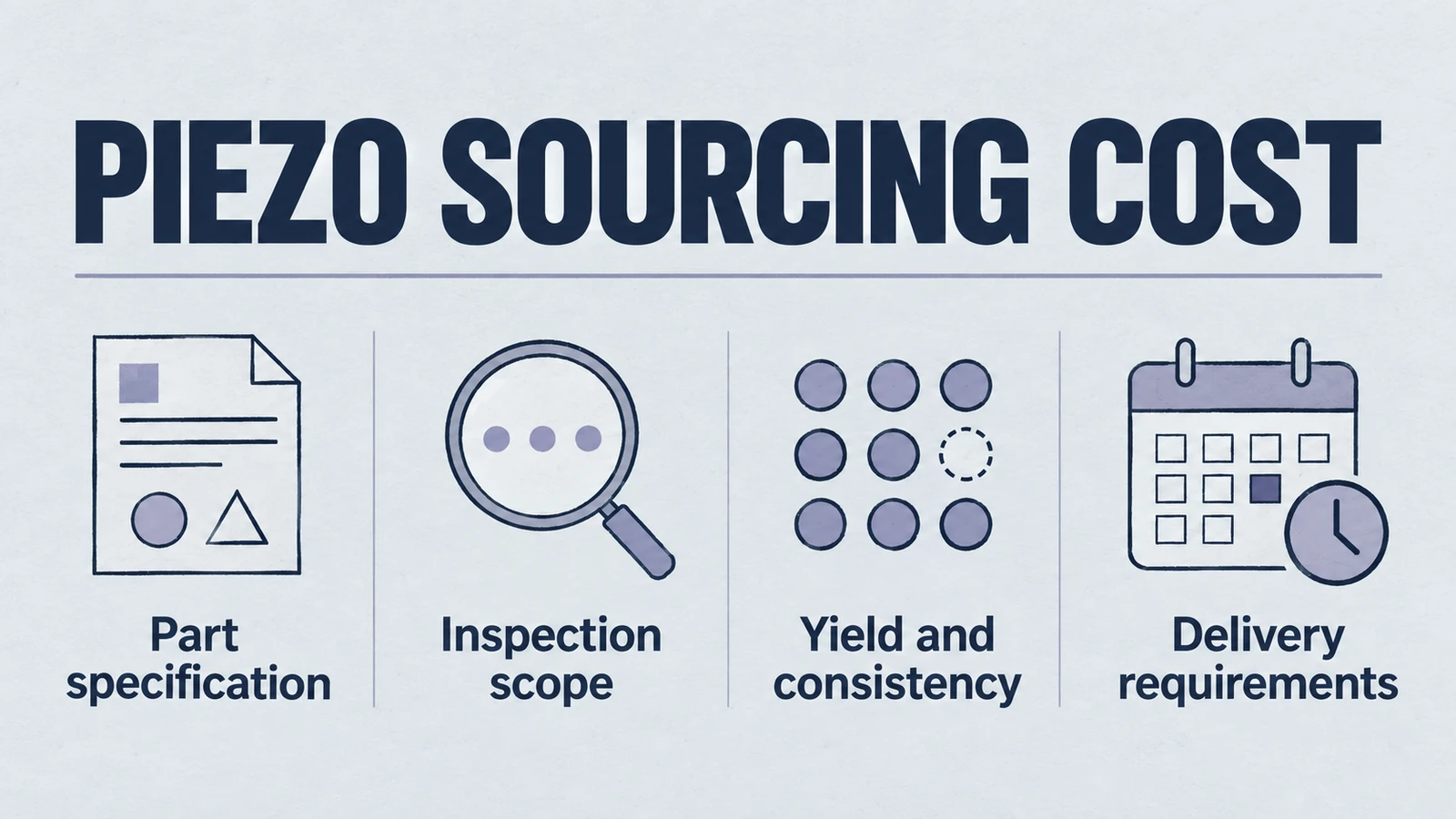
For a practical comparison of order quantities, read the PZT ceramic pricing and volume quotation guide. It explains which specifications to keep fixed and how to describe the purchase.
The Engineer's Dilemma: Navigating the Labyrinth of Cost, Performance, and Risk
Engineering and procurement teams operate under a constant, dual mandate: reduce component costs to meet budget targets while simultaneously advancing product performance and supporting long-term reliability. This challenge is particularly acute when sourcing critical components like PZT (lead zirconate titanate) piezoelectric ceramics. The selection of a PZT supplier is frequently miscategorized as a simple line-item purchase when it is, in fact, a foundational strategic decision with consequences that ripple through the entire product lifecycle. A choice made on the basis of a few cents per unit can ultimately dictate project timelines, manufacturing yields, and the brand's reputation in the marketplace.
The central thesis for any discerning engineer or sourcing manager should be that the per-unit price of a PZT ceramic is a dangerously incomplete and often misleading metric for value. A truly cost-effective supplier is not the one with the lowest quote, but the one that minimizes the Total Cost of Ownership (TCO). This is achieved by systematically eliminating the hidden costs born from inconsistency, de-risking the development and production phases, and ultimately enhancing the final product's performance and market value. The common approach of comparing generic datasheets against price lists is a gateway to these unforeseen expenses, which can delay, degrade, or even cripple a project.
Product path for this search intent
Match the article topic to the right YJ Piezo product page
Use this article when the choice is not just a shape, but a material tradeoff between sensitivity, loss, coupling, stability, and operating field. For "Beyond the Price Tag: How to Identify a Truly Cost-Effective PZT Supplier", the practical value is in turning the topic into a measurable selection or sourcing decision.
- PZT Material Hub
Material grades and application tradeoffs
- Piezoelectric Ceramics
Shapes and ceramic manufacturing options
- PZT Material Supplier Hub
Material control, grade selection, and sourcing support
The supplier landscape can be understood as a value spectrum. At one end lies the transactional component vendor, competing primarily on price and offering standardized, off-the-shelf products. At the other end is the strategic manufacturing partner, who provides a fully engineered solution, deep material science expertise, and a collaborative approach to problem-solving. The initial sourcing decision places a project on a trajectory toward one of these two outcomes. A seemingly minor choice at the procurement stage creates a cascade of effects that determines the path of the entire project. An initial decision based on low upfront cost can introduce systemic risks that later manifest as costly engineering delays, unpredictable manufacturing outcomes, and damaging post-launch failures. This chain of events begins with a "cost-saving" component that may have inconsistent properties or a non-optimal geometry. This forces the design team to invest significant time and resources in creating workarounds—a hidden "design tax"—to compensate for the component's limitations, thereby delaying the project schedule. During production, batch-to-batch inconsistencies from the supplier can lead to variable performance in the final product, increasing scrap rates and quality control overhead. Ultimately, a higher-than-expected field failure rate can occur, damaging brand reputation and incurring substantial warranty and recall costs. Thus, the initial "savings" are directly and causally linked to escalating costs and risks across R&D, manufacturing, and marketing.
Deconstructing "Cost": The Hidden Price of a "Cheap" PZT Component
The most significant expenses associated with a PZT component are often absent from the supplier's invoice. These hidden costs are paid in engineering hours, manufacturing inefficiencies, and market reputation. Understanding them is the first step toward making a genuinely cost-effective sourcing decision.
A. The Cost of Inconsistency: When "Good Enough" Isn't
The promise of a low-cost supplier often hinges on a sample part that meets specifications. However, the true test of a manufacturer is their ability to ensure that production parts consistently meet agreed acceptance limits, supported by process and measurement evidence. A lack of rigorous process control leads to batch-to-batch variability, a critical flaw in high-performance applications. For example, in the manufacturing of medical ultrasound probes, inconsistent piezoelectric elements can cause variations in frequency and sensitivity. This can result in a blurry, distorted, or unusable diagnostic image, a failure that could lead to product recalls, a severe loss of market reputation, and significant regulatory liability.
The root causes of such inconsistency are found deep within the manufacturing process. It begins with the raw materials; inconsistent purity in the precursor oxides of lead, zirconium, and titanium is the "first domino to fall" in a chain reaction leading to unpredictable final properties. It continues through critical thermal stages like sintering, where precise control over temperature profiles and atmospheric conditions determines the ceramic's final density and grain structure, which in turn govern its mechanical and dielectric properties. Finally, the poling process—where the electric field strength, temperature, and duration are applied to align the ferroelectric domains—must be meticulously controlled to impart consistent piezoelectric activity. A failure at any of these stages results in a component that may look correct but will not perform reliably.
B. The Cost of Inflexibility: Paying the "Design Tax"
As technology pushes toward miniaturization and operation in more demanding environments, standard, off-the-shelf components are increasingly creating a "performance ceiling". When engineers are forced to use a component that is not an ideal fit for their application, they must design around its limitations. This workaround process imposes a hidden but substantial "design tax" on the project.
Consider the development of a miniaturized wearable device with haptic feedback. If the only available standard piezoelectric actuator is too large or has an awkward geometry for the compact design, the engineering team must redesign the product housing, modify mounting brackets, and potentially alter adjacent parts to accommodate it. This cascade of modifications adds significant time to design cycles, increases material costs, introduces new potential points of failure, and adds unnecessary weight and complexity to the final system. In this scenario, the "cost-effective" standard part has triggered a series of expensive and inefficient compromises. This problem is becoming more acute as applications in medical implants, high-density electronics, and industrial sensors demand operation under extreme temperatures or unique mechanical loading conditions that standard parts simply cannot meet.
C. The Cost of Failure: The Ultimate Price
The most devastating hidden cost is that of in-field component failure. This is where the initial savings from a low-cost supplier are erased many times over. A severe failure not only incurs the direct costs of replacement and warranty claims but also inflicts lasting damage on a brand's reputation for quality and reliability. This elevates the component selection from a simple engineering task to a critical business-level risk assessment.
In high-reliability applications, failure is not an option. Automotive engine knock sensors, for instance, must reliably detect the onset of detonation to prevent engine damage, a phenomenon that requires high sensitivity and durability. In aerospace, piezoelectric actuators are used for the real-time adjustment of telescope optics to compensate for atmospheric distortion or vibration; a component failure here would render a multi-million-dollar instrument useless. In these contexts, the reliability of the PZT component is paramount, and it is directly tied to the supplier's depth of material science expertise and the rigor of their quality control systems. The true value provided by a superior supplier is not merely the component itself, but the active mitigation of the customer's project risk. These risks—technical, schedule, financial, and brand—are addressed through deep expertise, transparent processes, and a collaborative approach, reframing the value proposition from a simple product to a comprehensive, de-risked solution.
The Three Pillars of a High-Value PZT Partnership: A Framework for Supplier Evaluation
Shifting the focus from per-unit price to Total Cost of Ownership requires a new framework for supplier evaluation. This framework rests on three foundational pillars that separate transactional vendors from true strategic partners. By using these pillars as a guide, engineering and procurement teams can identify suppliers who contribute to long-term value rather than short-term savings.
A. Pillar 1: Deep Material Science Expertise (Beyond the Datasheet)
A premier supplier is a master of material science, not just a fabricator of ceramic shapes. Standard industry designations like PZT-4, PZT-5H, or PZT-8 describe broad families of materials, not precise, universally agreed-upon recipes. Each family can be tailored for specific performance characteristics. A knowledgeable manufacturer develops its own proprietary formulations, using specific doping agents—such as Iron (Fe) for "hard" PZT-4 types or Niobium (Nb) for "soft" PZT-5 types—in precise quantities to fine-tune material properties. This allows for the optimization of key parameters like the mechanical quality factor (Qm), which minimizes heat generation in high-power applications, or the piezoelectric charge coefficient (d₃₃), which maximizes sensitivity in sensor applications.
A supplier's ability to discuss the chemistry of their formulations and how it relates to a specific application's demands is a clear indicator of their expertise. Yujie, for example, offers proprietary materials like P-41, engineered as a PZT-4 equivalent with enhanced high-drive stability for power transducers, and P-81, a PZT-8 equivalent optimized for low dielectric loss in applications like ultrasonic atomizers. This level of specialization is backed by tangible performance metrics, such as achieving a dielectric loss (tan δ) as low as 0.004 for exceptional energy efficiency and a shear mode coefficient (d₁₅) reaching up to 950 pC/N for outstanding response in precision applications.
B. Pillar 2: Verifiable and Transparent Process Control (Beyond the Certificate)
Quality cannot be inspected into a product at the final stage; it must be built into every step of the manufacturing process. While an ISO 9001 certification is a necessary baseline, it only proves that a quality management system exists; it does not, by itself, document the quality of the product that system produces. A high-value partner demonstrates quality through verifiable and transparent process control from start to finish.
This control begins with the qualification of raw materials and extends through critical stages such as calcination, milling, sintering, and poling. A mature quality plan can include incoming material checks, post-sintering measurements, and post-poling verification of piezoelectric properties. The required parameters, sampling level, report fields, and traceability scope should be agreed for the component and program.
C. Pillar 3: Collaborative Engineering Partnership (Beyond the Purchase Order)
The ideal supplier relationship is not transactional but collaborative. A true partner functions as an extension of the customer's engineering team, contributing expertise to solve complex challenges and optimize the final product. This level of partnership is characterized by a deep understanding of the customer's application context. It involves offering proactive design suggestions, providing advanced support like Finite Element Analysis (FEA) simulation to model component behavior, and advising on critical integration challenges such as thermal management, mechanical mounting, and driving circuitry.
This collaborative spirit must be supported by flexible and comprehensive service capabilities. A strategic partner should offer a full suite of OEM and ODM services, guiding a project from rapid prototyping and small-batch sampling for validation all the way to scalable, high-volume production. The ability to design and deliver custom geometries, specialized formulations, and fully packaged and encapsulated transducer assemblies is a hallmark of a supplier dedicated to providing solutions, not just components. This approach prevents costly design errors, reduces the number of prototyping cycles, and ensures the piezoelectric component is perfectly optimized for its intended function.
The Yujie Standard: Where True Cost-Effectiveness is Engineered
Having established the framework of a high-value PZT partnership, it becomes clear that true cost-effectiveness is an engineered outcome. It is the result of a deliberate focus on material science, process control, and collaborative support. Yujie is a company built upon these three pillars, transforming the supplier relationship from a simple transaction into a strategic advantage for its clients.
A Foundation of Trust and Experience
Stability, experience, and a realistic production plan are the bedrock of a reliable supply-chain relationship. Yujie's work in piezoelectric and ultrasonic applications dates to 1996, supported by direct project coordination and manufacturing operations in Wuxi. Capacity, inspection, and documentation are reviewed for the selected component and forecast.
Bridging Theory and Practice: The Yujie Partnership Approach
The difference between a standard vendor and a strategic partner is most evident in their approach to solving customer problems. The following table distills the core arguments of this analysis into a direct comparison, illustrating how Yujie's partnership model delivers a fundamentally lower Total Cost of Ownership.
| Evaluation Criterion | The Standard Transactional Supplier | The Yujie Partnership Approach |
|---|---|---|
| Material Specification | Provides a generic datasheet for a standard PZT type. | Delivers performance data for our proprietary formulations (e.g., P-41), engineered for superior stability and endurance. |
| Quality Assurance | Relies on baseline ISO certification and random batch sampling. | Defines the required parameters, method, sampling level, acceptance limits, and report fields for the selected component. |
| Engineering Support | Awaits a final drawing to provide a quote. | Offers collaborative design review and simulation to optimize component performance and manufacturability before prototyping. |
| Production Scaling | Promises to scale, risking performance drift between batches. | Employs a documented PPAP process to document consistency from the 10th part to the 100,000th, de-risking your production ramp. |
| Supply Chain Philosophy | Acts as a component vendor, quoting standard lead times. | Functions as a strategic partner, offering collaborative forecasting and risk mitigation to ensure supply continuity. |
This table encapsulates Yujie's value proposition. It is a commitment to move beyond selling a component and instead deliver a fully engineered, de-risked solution that enhances the customer's final product and protects their bottom line.
Proven Solutions Across Demanding Industries
The versatility and robustness of Yujie's PZT materials and ultrasonic transducers are proven daily in some of the world's most demanding applications. This cross-industry expertise ensures that solutions are informed by a broad understanding of diverse and stringent requirements. Key sectors served include:
- Medical Equipment: High-performance transducer components for diagnostic ultrasound imaging and validated medical-device programs, where reliability and clarity need to be documented.
- Industrial Manufacturing: Powerful and durable piezoelectric ceramics and transducers for ultrasonic cleaning, precision machining, welding, and non-destructive testing, boosting efficiency and quality.
- Consumer Electronics: Advanced sensors that enhance smart devices with precise motion sensing, haptic feedback, and touch sensitivity.
- Beauty Industry: Precision transducers for aesthetic devices that promote skin rejuvenation and improve product absorption.
- Research and Development: High-precision materials and custom transducers that support groundbreaking scientific research and technology development worldwide.
Conclusion: Your Next Project Deserves More Than a Component. It Deserves a Partner.
The search for a "cost-effective" PZT supplier must evolve beyond a superficial comparison of price tags. True cost-effectiveness is not found in the initial quote but in the long-term value delivered by a strategic manufacturing partner. A genuinely cost-effective supplier is one that actively reduces your Total Cost of Ownership by eliminating the hidden expenses of inconsistency and inflexibility. They minimize your project risk, accelerate your time-to-market, and ultimately enhance the performance, reliability, and reputation of your final product.
This higher standard of value is built upon the three pillars of deep material science expertise, verifiable and transparent process control, and a truly collaborative engineering partnership. Yujie was founded on these principles, with a clear mission to provide not just superior piezoelectric components, but fully engineered solutions that empower innovation. By choosing a partner dedicated to these standards, you ensure your project is built on a foundation of quality and expertise from the very first component.
Don't let a component choice define your project's limits. Partner with a supplier engineered to unlock its full potential. Contact the Yujie engineering team today to discuss your application requirements and discover how a true partnership can redefine what's possible.
Engineering decision notes
PZT material and ceramic selection
Use this article when the choice is not just a shape, but a material tradeoff between sensitivity, loss, coupling, stability, and operating field. For "Beyond the Price Tag: How to Identify a Truly Cost-Effective PZT Supplier", the practical value is in turning the topic into a measurable selection or sourcing decision.
YJ Piezo coordinates PZT ceramic projects with manufacturing support, so material formulation, sintering, polarization, electrode process, and outgoing inspection can be reviewed against the final application.
Selection checks
- Separate sensing needs from high-power actuation needs before comparing d33 or coupling values.
- Check dielectric loss, Qm, Curie temperature, aging behavior, and operating field against the real duty cycle.
- Confirm whether the application needs standard PZT grades or a custom formulation and geometry.
Failure risks
- Choosing only the highest d33 can create heat, drift, or depolarization risk in power ultrasonics.
- A ceramic that performs well in free measurement can fail once bonded, clamped, or loaded.
- Material substitutions without batch testing can change capacitance, resonance, and system tuning.
RFQ details
- Is the part used for sensing, actuation, atomization, cleaning, welding, or measurement?
- What field strength, temperature, duty cycle, and mechanical load will the ceramic see?
- Which values must be controlled: d33, capacitance, resonance, impedance, Qm, or dimensional tolerance?
Relevant YJ Piezo pages
- PZT Material Hub
Material grades and application tradeoffs
- Piezoelectric Ceramics
Shapes and ceramic manufacturing options
- PZT Material Supplier Hub
Material control, grade selection, and sourcing support
Application FAQ
- Is the highest d33 always the best PZT choice?
- No. High d33 can be useful for sensitivity, but high-power ultrasonic systems often need lower loss, higher Qm, better thermal stability, and safer operation under field and stress.
- What makes PZT material selection different from catalog buying?
- The right PZT choice depends on geometry, load, drive field, duty cycle, temperature, and inspection targets. A catalog value is only useful when it is tied to the final assembly conditions.