
Beyond the Datasheet: 5 Critical Hallmarks of a World-Class Piezoelectric Material Supplier
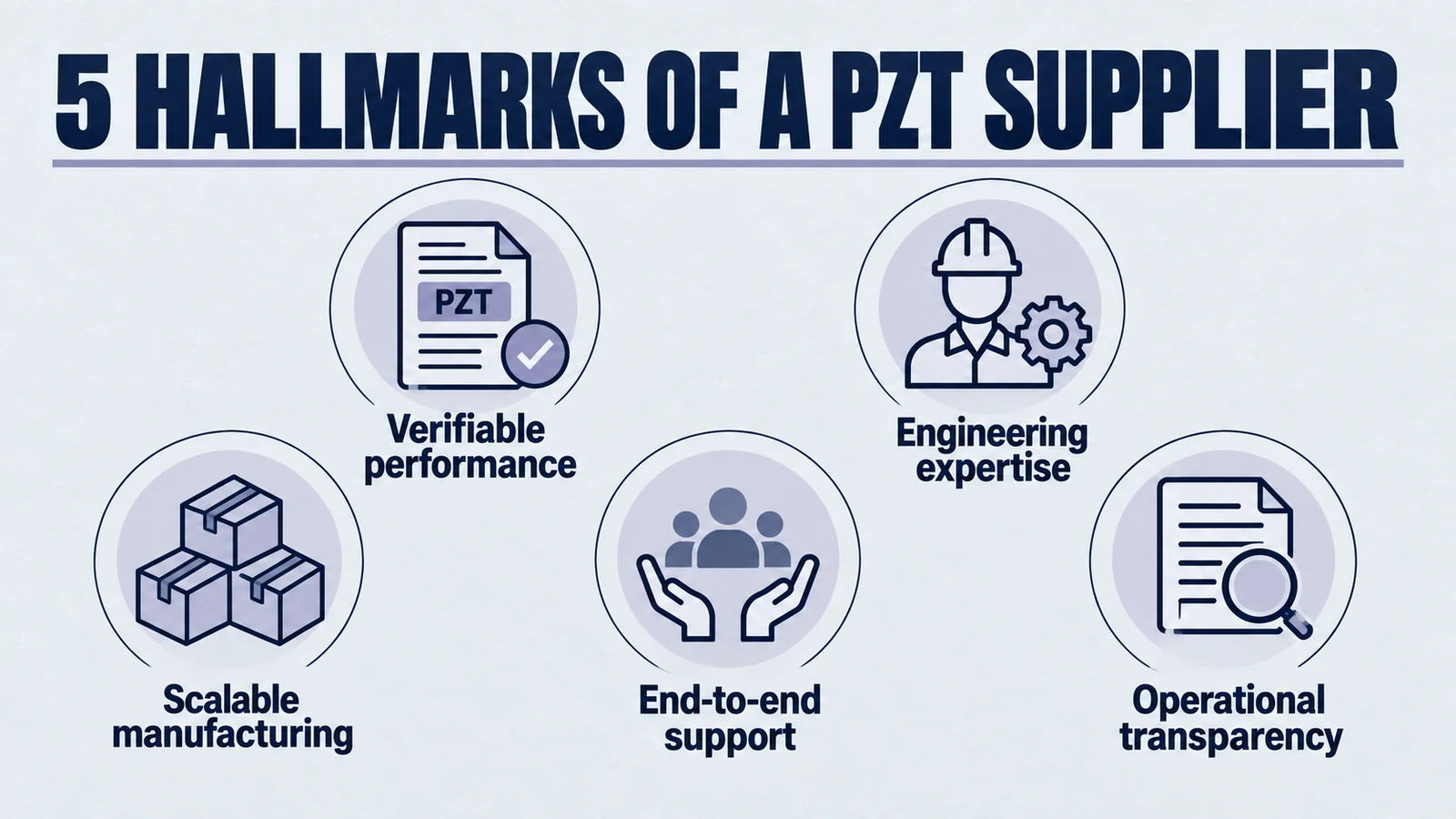
The Strategic Imperative of Supplier Selection
In the world of high-performance technology, selecting a piezoelectric material supplier is often viewed through the narrow lens of datasheets and price quotes. This is a critical oversight. For engineers and innovators in demanding fields like medical technology, industrial automation, and aerospace, this choice is not a simple procurement task; it is a foundational strategic decision. The right supplier acts as a catalyst for innovation, while the wrong one can introduce severe risks that ripple through your entire product lifecycle.
Imagine the consequences of a partnership built on a weak foundation: inconsistent batch performance leading to costly product failures and recalls; a lack of responsive engineering support causing critical project delays; or an inflexible manufacturing process that cripples your ability to scale. These are not hypothetical scenarios; they are the tangible outcomes of choosing a vendor over a partner.
The most forward-thinking companies understand that a world-class supplier is an extension of their own R&D and manufacturing teams. They look beyond the numbers on a spec sheet to evaluate the deeper, more meaningful attributes that define a true technology partner. This article outlines the five critical hallmarks that distinguish such a partner, providing a comprehensive framework for evaluating suppliers and ensuring your next project is built on a foundation of excellence, reliability, and shared success.
Product path for this search intent
Match the article topic to the right YJ Piezo product page
Use this article when the risk is supplier selection, engineering support, validation evidence, integration reliability, and whether the manufacturer can scale from sample to production. For "Beyond the Datasheet: 5 Critical Hallmarks of a World-Class Piezoelectric Material Supp...", the practical value is in turning the topic into a measurable selection or sourcing decision.
- Ultrasonic Transducer Supplier Hub
OEM sourcing and engineering collaboration
- PZT Material Supplier Hub
Material control and grade selection
- Piezoelectric Ceramics
Ceramic manufacturing and custom shapes
I. Hallmark 1: Verifiable Performance and Unwavering Consistency
Peak performance metrics on a datasheet are compelling, but they are merely the starting point. The true measure of an elite piezoelectric material lies in the verifiable, repeatable, and consistent delivery of those specifications in every single component, from the first prototype to the millionth production unit. This is the bedrock of trust and the ultimate document of your device's reliability.
Energy Efficiency as a Core Tenet
In any advanced electronic system, energy efficiency is paramount. Wasted energy often manifests as heat, which can degrade component lifespan, compromise signal integrity, and limit application in sensitive environments. A key indicator of this efficiency in piezoelectric materials is the dielectric loss tangent, or tan δ. A lower tan δ value signifies less energy dissipated as heat during electrical-to-mechanical energy conversion.
At Yujie, we have engineered our PZT materials to achieve an ultra-low loss performance with a tan δ as low as 0.004. This isn't just an abstract number; it's a direct competitive advantage for our clients. For designers of portable medical ultrasound devices, it means longer battery life and improved end user comfort. For high-power industrial ultrasonic transducers, it translates to less cooling required and more stable operation over extended periods, ensuring exceptional energy efficiency and minimal power loss in your devices.
Precision and Sensitivity: The Language of High-Fidelity Applications
Beyond efficiency, the ability of a material to precisely respond to an electrical field is what enables the most advanced applications. The shear strain piezoelectric coefficient, d₁₅, is a critical metric for applications requiring high-precision shear motion, such as advanced sensors and actuators. Our materials deliver an outstanding shear strain response, with d₁₅ values reaching up to 950 pC/N.
This superior sensitivity is the enabling technology behind the crystal-clear images in medical ultrasonic diagnostics, where even the slightest signal variation can be the difference in a diagnosis. It is the force behind non-destructive testing (NDT) sensors that can detect microscopic flaws in critical aerospace components. By focusing on maximizing these performance ceilings, we signal to engineers in the world's most demanding fields that we understand their challenges and have developed materials specifically to solve them.
The Unseen Value of Consistency
Perhaps the most crucial—and often overlooked—aspect of material performance is consistency. A single "golden sample" is useless if its performance cannot be replicated across thousands of units. For an OEM manufacturing medical devices or industrial sensors, batch-to-batch variation is a primary source of supply chain risk, potentially leading to device failures and reputational damage.
This is why our manufacturing philosophy is built around rigorous quality control processes that ensure exceptional batch-to-batch consistency and long-term stability. When a client qualifies a Yujie component in their design, they do so with the confidence that production conformance will be evaluated against the agreed limits and documented inspection plan; part-to-part identity is not guaranteed. This transforms the conversation from simply "What does this component cost?" to "How much risk does this supplier remove from my manufacturing process?" We are not just selling a product; we are selling reliability, predictability, and peace of mind.
II. Hallmark 2: Deep Engineering Expertise and Application-Specific Customization
In advanced technology, an off-the-shelf component is often a compromise—a solution that is adequate but not optimal. A true technology partner recognizes this and possesses the deep engineering expertise to move beyond a standard catalog. They collaborate with you to co-create custom solutions that are perfectly optimized for the unique physics, geometry, and performance requirements of your specific application.
From Custom Formulations to Final Geometries
At Yujie, our comprehensive OEM services are designed to function as an extension of your own R&D team. Our customization capabilities are not limited to simple modifications of shape. We offer a full spectrum of custom solutions that begin at the most fundamental level: the material science itself. Our capabilities include:
- Custom PZT Formulations: We work with clients to develop specialized PZT powders and bulk ceramic formulations with precisely controlled Zr/Ti ratios, tailored to achieve specific piezoelectric coefficients, coupling factors, or temperature stability for their unique application.
- Versatile Geometries: Our manufacturing expertise allows us to produce a complete range of piezoelectric components, including standard discs, rings, and plates, as well as highly complex custom geometries designed to fit challenging form factors or achieve specific vibrational modes.
- Complete Transducer Assemblies: We go beyond the ceramic element to design and manufacture complete ultrasonic transducers and custom assemblies for medical, industrial, and OEM applications.
This vertically integrated approach—from foundational powder to finished assembly—gives us strong control over the final product's performance and quality.
The Power of Experience
This level of customization is only possible when backed by hands-on experience. Our engineering team brings practical piezoelectric manufacturing and application expertise to every project. This is a useful asset for reducing development risk because experienced engineers can anticipate common failure modes early.
Our team's extensive history means they have likely encountered and solved a vast array of complex challenges across countless applications. They have seen what works and, crucially, what doesn't. When you partner with Yujie, you are not just buying a component; you are gaining access to this deep well of practical, hard-won knowledge. This consultative approach can save your team months of trial-and-error, guide you away from potential design pitfalls, and accelerate your time-to-market with a more robust and effective solution. Our diverse portfolio, which includes everything from high-power ultrasonic welding transducers to delicate medical beauty devices and omnidirectional piezoelectric hollow spheres for advanced sonar, stands as a testament to our ability to apply this expertise across the world's most demanding industries.
III. Hallmark 3: Scalable Manufacturing and Project-Specific Quality Controls
A groundbreaking prototype is a remarkable achievement, but its value is only fully realized when it can be manufactured reliably at scale. A world-class piezoelectric material supplier must possess a robust, scalable, and transparent manufacturing infrastructure. This ensures they can support your product's journey from initial concept to full-scale global production without ever compromising on the quality and consistency established during the design phase.
Capacity Review for Real Orders
Speculative promises of future capacity are insufficient when your production schedule is on the line. Yujie's manufacturing operations in Wuxi support piezoelectric ceramic processing and component production, but available capacity depends on geometry, material, tooling, inspection scope, and forecast demand.
- Prototype quantities and validation steps are planned by project
- Batch quantities and delivery schedules are confirmed after technical review
For a new client, the useful evidence is a realistic production plan tied to the selected part: tooling status, process constraints, inspection throughput, packaging, and ramp timing. These details are more meaningful than a single site-wide capacity number.
Quality Evidence Beyond Badges
In today's global marketplace, quality-system evidence is important, particularly for components used in regulated or high-reliability programs. A certificate alone, however, does not document the performance of an individual component.
For procurement teams, final approval should consider the drawing, electrical data, acceptance limits, inspection records, change control, application tests, and any quality-system documents required for the specific program.
IV. Hallmark 4: A Framework for True Partnership: End-to-End Support
The transaction with a component vendor often ends when the parts are shipped. The relationship with a true technology partner is just beginning. A world-class supplier understands that their success is intrinsically linked to their clients' success. They build a comprehensive support framework that spans the entire product lifecycle—from the initial spark of an idea to post-integration troubleshooting—ensuring a seamless, collaborative, and ultimately successful partnership.
This commitment is reflected in our structured, three-stage service model, designed to provide value and support at every step of your journey:
Pre-Sale Services: Building the Foundation
Before a single order is placed, our goal is to help define a practical solution for the target application. This phase is about collaboration, documentation, and early risk reduction.
- Responsive Review: Most inquiries received on business days are reviewed within 24 hours, with the next technical or quotation step based on the information provided.
- Collaborative Design: We offer both standard and customized product solutions (ODM/OEM), backed by expert technical consultations to help you define requirements and select the optimal material and design.
- Tangible Evaluation: We provide comprehensive data sheets and make samples readily available, allowing your team to test and validate our components in your real-world application.
In-Sale Services: Transparency and Trust
During the critical manufacturing phase, we believe in complete transparency. You are not a passive customer; you are a partner in the process.
- Real-Time Visibility: We provide real-time production tracking and detailed quality inspection reports upon request, giving you a clear view into the status and quality of your order.
- Visual Confirmation: For bulk orders, we can provide product photos and videos, offering an extra layer of verification and peace of mind before shipment.
- Documented Timeliness: We provide agreed delivery schedules and production updates so your own planning team can manage timing risk.
After-Sale Services: A Commitment for Life
Our responsibility does not end at your loading dock. We stand behind our products for the long term, offering a level of support that is virtually strong in the industry.
- Lifetime Replacement: For select components, we offer a lifetime replacement document. This is more than a warranty; it is the ultimate statement of our confidence in our manufacturing quality and long-term product reliability. We can only make such an audacious promise because we have absolute faith in our rigorous testing and quality control.
- Expert Integration Support: Our engineering team remains available to provide expert technical support for product integration and troubleshooting, ensuring a smooth transition from component to finished product.
This comprehensive model is validated by the success of our clients. As Hiroshi, the founder of a med-tech start-up in Tokyo, shared, "Yujie's commitment to quality is a real game-changer... Their technical support and fair pricing have truly set them apart." This is the essence of partnership.
V. Hallmark 5: Global Reach with Operational Transparency
In a deeply interconnected global economy, a premier supplier must demonstrate two seemingly opposed qualities: the logistical prowess to manage a reliable global supply chain and a culture of radical openness and transparency. This combination builds the deep trust required for long-term, high-stakes partnerships, assuring clients that they are working with a seasoned global operator who has nothing to hide.
A Proven Global Footprint
Navigating the complexities of international logistics, customs, and diverse regulatory environments requires significant experience. Yujie is not a regional player; we are a seasoned global supplier with a strong international presence. Our products are currently exported to:
- North America
- Europe
- The Middle East
- Africa
- Latin America
- Asia
- Australia
This extensive footprint is proof of our adaptability. It demonstrates that we have mature, proven systems for international compliance (e.g., RoHS, REACH), logistics management, and cross-cultural customer relations. For a multinational corporation, this experience de-risks the process of international procurement, making us an easy and appropriate choice for their global supply chain. Our strategic locations in both Shenzhen and Wuxi, China, further enhance our operational agility, placing our manufacturing hub and potential logistics centers in key industrial regions.
The Ultimate Act of Transparency: An Open Invitation
We believe that the greatest way to build trust is to operate with complete transparency. While some suppliers may operate behind a veil of opacity, we take the opposite approach. We are proud of our facilities, our processes, and our people, and we extend an open invitation to our clients: Visit Our Facilities in Wuxi, China.
This is not a marketing slogan; it is a genuine offer. We encourage you to come and see firsthand the advanced technologies, meticulous processes, and skilled craftsmanship that go into every piezoelectric product we manufacture. A company with something to hide—be it outdated equipment, poor quality control, or substandard working conditions—would never make such an offer. By proactively inviting on-site audits and visits, we are signaling our profound confidence in our operations. We are stating, unequivocally, that our quality and processes meet or exceed the highest global standards, and we welcome you to verify this for yourself. This act of radical transparency is designed to disarm skepticism and build a partnership based on mutual trust and respect from day one.
Supplier Evaluation Framework
To distill these five hallmarks into a practical tool, consider the following framework when evaluating your next potential piezoelectric material supplier. This table contrasts the approach of a standard component vendor with the partnership standard set by a world-class supplier like Yujie.
| Evaluation Criterion | Standard Supplier Approach | The Yujie Partnership Standard |
|---|---|---|
| Material Performance | Offers standard datasheet specifications. | Delivers verifiable, industry-leading metrics (e.g., tan δ ≤ 0.004) with documented batch-to-batch consistency. |
| Customization | Limited custom shapes from existing molds. | Full-spectrum OEM services: custom formulations, geometries, and dedicated engineering support built since 1996. |
| Manufacturing | Undisclosed or third-party production. | Wuxi manufacturing operations with capacity, process controls, and inspection scope reviewed for the selected component. |
| Client Support | Basic sales and post-shipment support. | Pre-sale technical review, production communication, and post-delivery support against the agreed specification and order terms. |
| Transparency | Opaque supply chain. | Global distribution network with an open invitation for facility audits and visits in Wuxi, China. |
Choosing Your Partner for Piezoelectric Innovation
The journey of bringing a revolutionary product to market is fraught with challenges. The choice of your piezoelectric material supplier should not be one of them. As we have explored, this decision transcends a simple comparison of parts; it is a decision about partnership.
The right partner provides more than just components; they provide confidence. They deliver verifiable performance backed by unwavering consistency. They offer deep customization driven by decades of engineering expertise. They possess scalable, certified manufacturing to grow with you. They build a framework for end-to-end partnership that supports you for the entire product lifecycle. And they operate with global reach and radical transparency, earning your trust every step of the way.
Your most demanding applications require more than just a component; they require a dedicated technology partner. Contact Yujie's engineering team today to discuss your specific requirements and discover how a partnership built on performance, customization, and trust can elevate your next project.
Engineering decision notes
OEM integration and supplier qualification
Use this article when the risk is supplier selection, engineering support, validation evidence, integration reliability, and whether the manufacturer can scale from sample to production. For "Beyond the Datasheet: 5 Critical Hallmarks of a World-Class Piezoelectric Material Supp...", the practical value is in turning the topic into a measurable selection or sourcing decision.
YJ Piezo combines direct project coordination with ceramic manufacturing support, so procurement and engineering teams can evaluate material control, application review, sample validation, and production consistency together.
Selection checks
- Ask whether the supplier controls ceramic manufacturing or only assembles purchased elements.
- Review sample policy, inspection records, engineering response quality, and production lead-time stability.
- Compare suppliers and integration paths by validation evidence, not only by unit price and datasheet similarity.
Failure risks
- A low-price sample can pass early tests but fail when batch variation, thermal load, or assembly stress appears.
- A supplier without material control may not explain why impedance, capacitance, or resonance drift occurs.
- Weak RFQ information leads to quotes that are fast but not technically comparable.
RFQ details
- What application, operating environment, and failure cost should the supplier design around?
- Which sample tests and outgoing records are required before pilot production?
- What customization, MOQ, tooling, and delivery constraints must be known before quotation?
Relevant YJ Piezo pages
- Ultrasonic Transducer Supplier Hub
OEM sourcing and engineering collaboration
- PZT Material Supplier Hub
Material control and grade selection
- Piezoelectric Ceramics
Ceramic manufacturing and custom shapes
Application FAQ
- How should an OEM compare piezoelectric suppliers?
- Compare material control, engineering support, test evidence, customization ability, sample policy, and batch consistency. Unit price matters, but only after the technical risk is understood.
- What makes an RFQ technically useful?
- A useful RFQ includes application, dimensions, target frequency, electrical limits, duty cycle, operating medium, environment, expected quantity, required reports, and current failure or replacement context.