
Emerging Trends in Piezoelectric Technology: What's Next?
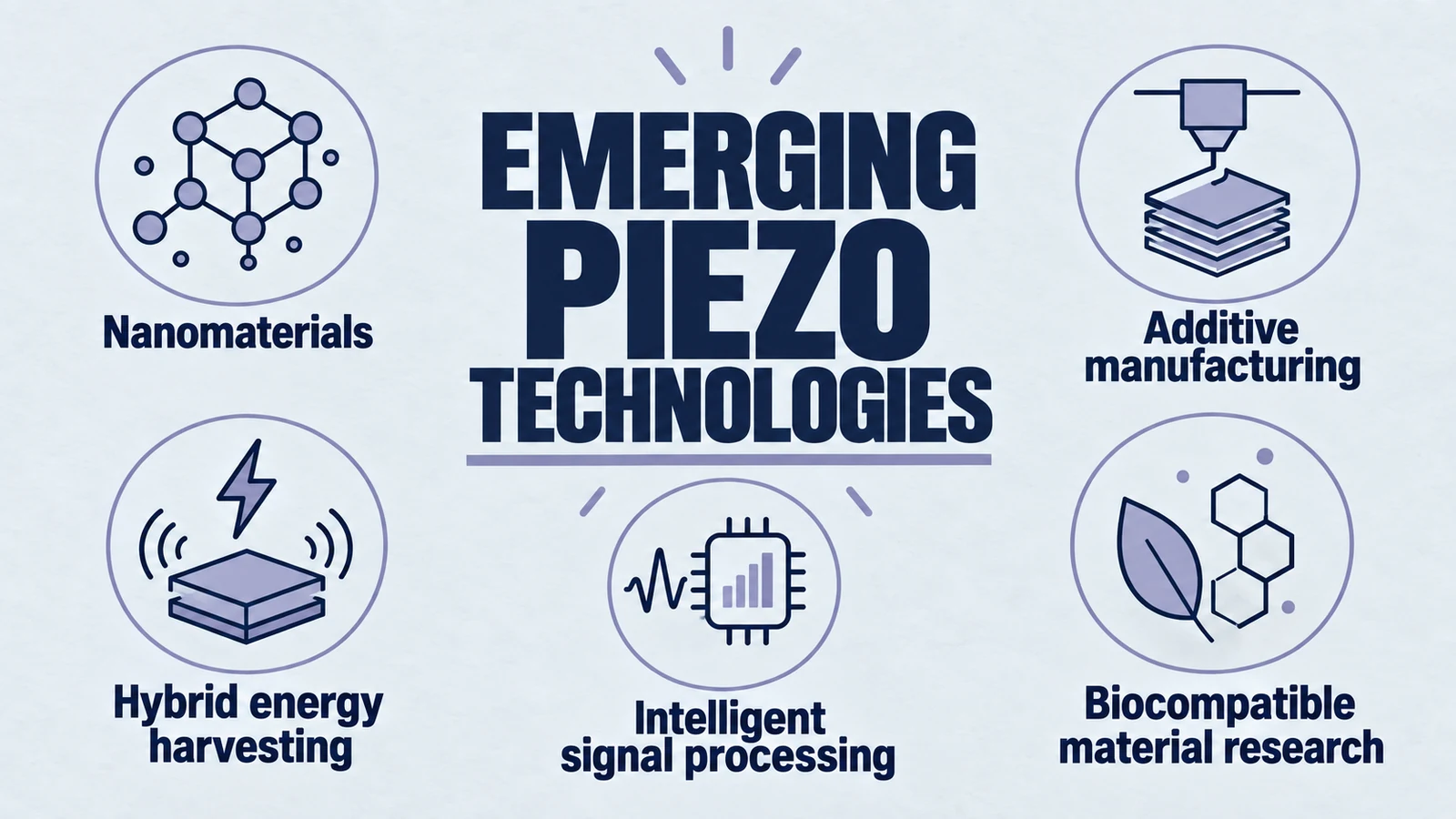
As industries increasingly seek compact, efficient, and highly reliable solutions for sensing, actuation, precision control, and sustainable energy harvesting, piezoelectric technology is undergoing a profound transformation. From its early adoption in ultrasonic medical devices and sonar systems to its expanding use in smart structures, automotive systems, and consumer electronics, the world of piezoelectric applications is rapidly growing in scale, diversity, and complexity.
This article delves into the most dynamic and promising emerging trends in piezoelectric technology—offering a forward-looking perspective on where the field is heading and how innovators across industries can leverage these developments to gain a competitive edge.
1. Piezoelectric Nanomaterials
Recent breakthroughs in nanotechnology have enabled scientists and engineers to unlock extraordinary functionalities from piezoelectric materials at the nanoscale. Cutting-edge materials such as zinc oxide (ZnO) nanowires, barium titanate (BaTiO3) nanoparticles, and lead zirconate titanate (PZT) thin films are now being utilized in a wide range of advanced systems. These nanomaterials exhibit significantly improved piezoelectric coefficients and mechanical flexibility, allowing for:
Product path for this search intent
Match the article topic to the right YJ Piezo product page
Use this article when the choice is not just a shape, but a material tradeoff between sensitivity, loss, coupling, stability, and operating field. For "Emerging Trends in Piezoelectric Technology: What's Next?", the practical value is in turning the topic into a measurable selection or sourcing decision.
- PZT Material Hub
Material grades and application tradeoffs
- Piezoelectric Ceramics
Shapes and ceramic manufacturing options
- PZT Material Supplier Hub
Material control, grade selection, and sourcing support
- Nano-generators and energy harvesters that power low-energy devices such as wearable electronics and implanted biosensors. Learn more about piezoelectric energy harvesting applications.
- Micro-electromechanical systems (MEMS) with improved resolution and miniaturization for healthcare diagnostics and chemical detection
- Transparent and flexible sensors embedded in electronic skin, soft robotics, and adaptive medical bandages
The ability to print or layer these nanomaterials onto pliable substrates opens new frontiers for Internet of Things (IoT) applications and personalized medicine, where form factor and sensitivity are critical. Understanding factors affecting sensor sensitivity is crucial for these advanced applications.
2. Additive Manufacturing of Piezoelectric Components
The integration of additive manufacturing, particularly 3D printing, with piezoelectric technology has been a game changer. Techniques such as robocasting, direct ink writing, and photopolymerization are being refined to produce piezoelectric components with unprecedented precision and design freedom. Applications include:
- Custom transducers tailored for specific ultrasonic imaging needs in medical diagnostics and industrial non-destructive testing (NDT). Explore our acoustic transducer solutions.
- Miniaturized actuators for next-generation aerospace vehicles, micro-drones, and surgical tools. Learn about piezo actuator mechanisms.
- Integrated piezoelectric structures embedded within smart materials and structural composites for real-time feedback and vibration control
This approach drastically reduces time to market, supports digital prototyping, and allows for customization at a much lower cost. The ability to rapidly iterate piezoelectric designs is accelerating innovation in industries ranging from automotive to biomedical. Our custom piezo actuator solutions demonstrate this manufacturing flexibility.
3. Hybrid Piezoelectric Systems for Sustainable Energy Harvesting
In a world increasingly focused on sustainability and autonomous systems, hybrid energy harvesting—combining piezoelectric technology with other modalities like photovoltaic (solar), thermoelectric, and electromagnetic mechanisms—is gaining ground. These systems are capable of collecting energy from multiple ambient sources, making them ideal for:
- Smart civil infrastructure (bridges, rail tracks, roads) where long-term condition monitoring is critical for safety
- Wireless sensor networks in agriculture, marine monitoring, and aerospace, where battery replacement is difficult or impossible
- Self-sustaining wearables that operate without the need for recharging, improving convenience for users and extending device lifespan
By integrating multiple harvesting mechanisms into a compact system, developers can improve energy conversion efficiency, ensure redundancy, and minimize power loss. Our research into future piezoelectric applications explores these sustainable solutions.
4. AI-Enhanced Signal Processing for Intelligent Piezoelectric Systems
The future of piezoelectric technology is not just in materials—it lies in intelligent data interpretation. When paired with artificial intelligence (AI) and machine learning (ML), the high-resolution data produced by piezoelectric sensors becomes exponentially more valuable. Real-time data processing allows for:
- Automated fault detection and early-warning systems in industrial manufacturing lines
- Predictive analytics for machinery maintenance, significantly reducing downtime and operational costs
- Gesture tracking and human-computer interface development for AR/VR systems and smart environments
These smart systems can learn from past patterns, adapt to user behavior, and deliver predictive capabilities that transform how machines respond to their environment. Understanding piezoelectric vs traditional sensors helps appreciate these advanced capabilities.
5. Biocompatible and Biodegradable Piezoelectric Materials
In tandem with growing environmental and biomedical demands, research has increasingly turned toward materials that are not only functional but also sustainable and appropriate for biological applications. Biocompatible piezoelectric polymers like poly-L-lactic acid (PLLA), cellulose nanocrystals, and silk protein-based composites are driving innovations in:
- Implantable power systems studied for battery-free operation, subject to demonstrated energy budgets, packaging life and application-specific validation; they do not generically establish lifelong operation of pacemakers or other implants. Learn about advantages in medical devices.
- Ultrasonic drug delivery tools that enable precise, localized localized delivery concepts, with final outcomes dependent on complete device validation. Explore our beauty and healthcare applications.
- Eco-friendly disposable medical sensors used in one-time diagnostics or in areas with limited waste management
These materials support the broader movement toward greener electronics and medical devices with minimal long-term impact on the human body and environment. Understanding how to choose the right piezoelectric ceramics is essential for biocompatible applications.
Advanced Manufacturing and Quality Control
As piezoelectric technology evolves, manufacturing excellence becomes increasingly important. Modern production techniques ensure:
- Consistent material properties across production batches
- Precision dimensional control for miniaturized applications
- Advanced testing protocols to verify performance parameters
Our commitment to reliable supplier partnerships and OEM manufacturing excellence ensures these quality standards are met consistently.
Industry-Specific Applications
The versatility of modern piezoelectric technology enables specialized solutions across various sectors:
- Medical and Healthcare: Advanced ultrasonic beauty devices and diagnostic equipment
- Industrial Cleaning: High-efficiency ultrasonic cleaning systems for precision parts
- Flow Measurement: Accurate flow detection transducers for process control
- Underwater Applications: Robust underwater transducers for marine exploration
- Welding Technology: Precise ultrasonic welding systems for materials joining
What's Next?
As piezoelectric technology continues to mature, it stands on the verge of enabling revolutionary developments—from smart surfaces that respond to pressure with real-time feedback, to immersive haptic feedback systems that enhance user experience in gaming and virtual reality, to research neural interfaces using electrophysiological electrodes/electronics with piezoelectric ultrasound power or telemetry; the piezoelectric element is not a generic direct decoder of electrical brain signals.
The convergence of material science, AI-driven analytics, and advanced fabrication techniques is creating a synergy that positions piezoelectricity as a foundational component in next-gen innovation. From miniaturized energy harvesters to intelligent tactile sensors, the future of piezoelectric technology is being written today.
For manufacturers, R&D engineers, system integrators, and product designers, understanding and leveraging these trends offers a strategic pathway to differentiation and long-term success. Whether you're exploring strategic OEM partnerships or seeking design guidance for ultrasonic projects, staying informed about these emerging trends is crucial.
Partner with Innovation Leaders
At Yujie Technology, we're at the forefront of these emerging trends in piezoelectric technology. Our comprehensive range of advanced piezoelectric materials and precision-engineered components supports innovation across all these emerging applications.
From traditional PZT material types to cutting-edge nanomaterials, our expertise spans the full spectrum of piezoelectric solutions. We understand the importance of fundamental piezoelectric principles while pushing the boundaries of what's possible with new technologies.
For expert guidance on leveraging emerging piezoelectric technologies for your applications, contact us at business@szyujie.com or visit yujiepiezo.com.
Explore our complete portfolio of innovative solutions and discover how emerging piezoelectric technology trends can transform your next project.
Engineering decision notes
PZT material and ceramic selection
Use this article when the choice is not just a shape, but a material tradeoff between sensitivity, loss, coupling, stability, and operating field. For "Emerging Trends in Piezoelectric Technology: What's Next?", the practical value is in turning the topic into a measurable selection or sourcing decision.
YJ Piezo coordinates PZT ceramic projects with manufacturing support, so material formulation, sintering, polarization, electrode process, and outgoing inspection can be reviewed against the final application.
Selection checks
- Separate sensing needs from high-power actuation needs before comparing d33 or coupling values.
- Check dielectric loss, Qm, Curie temperature, aging behavior, and operating field against the real duty cycle.
- Confirm whether the application needs standard PZT grades or a custom formulation and geometry.
Failure risks
- Choosing only the highest d33 can create heat, drift, or depolarization risk in power ultrasonics.
- A ceramic that performs well in free measurement can fail once bonded, clamped, or loaded.
- Material substitutions without batch testing can change capacitance, resonance, and system tuning.
RFQ details
- Is the part used for sensing, actuation, atomization, cleaning, welding, or measurement?
- What field strength, temperature, duty cycle, and mechanical load will the ceramic see?
- Which values must be controlled: d33, capacitance, resonance, impedance, Qm, or dimensional tolerance?
Relevant YJ Piezo pages
- PZT Material Hub
Material grades and application tradeoffs
- Piezoelectric Ceramics
Shapes and ceramic manufacturing options
- PZT Material Supplier Hub
Material control, grade selection, and sourcing support
Application FAQ
- Is the highest d33 always the best PZT choice?
- No. High d33 can be useful for sensitivity, but high-power ultrasonic systems often need lower loss, higher Qm, better thermal stability, and safer operation under field and stress.
- What makes PZT material selection different from catalog buying?
- The right PZT choice depends on geometry, load, drive field, duty cycle, temperature, and inspection targets. A catalog value is only useful when it is tied to the final assembly conditions.