
FAQs About Piezoelectric Ceramics: Everything You Need to Know
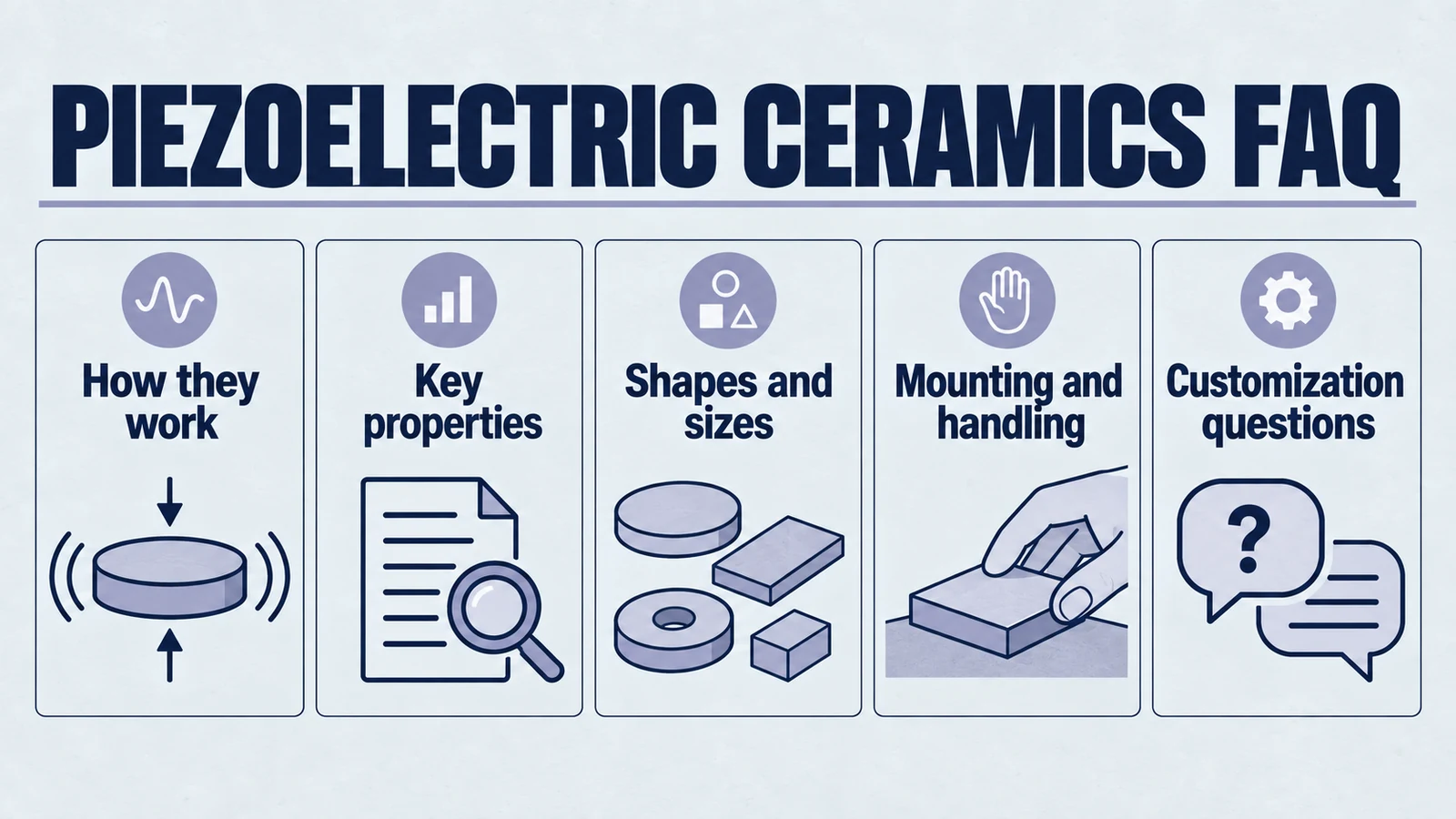
Piezoelectric ceramics are vital components in a wide range of modern technologies. From cutting-edge ultrasound machines and energy-harvesting wearables to high-precision industrial automation systems, these materials are integral to converting energy between mechanical and electrical forms. Despite their widespread use, professionals across industries often have questions about what these ceramics are, how they function, and how to select or customize them effectively. This in-depth FAQ addresses the most common and important queries about piezoelectric ceramics to help engineers, procurement teams, and researchers make informed decisions.
What Are Piezoelectric Ceramics?
Piezoelectric ceramics are specialized functional materials that exhibit the piezoelectric effect—the ability to generate an electric charge in response to applied mechanical stress, and vice versa. These materials are generally synthesized from ferroelectric compounds, most commonly lead zirconate titanate (PZT), through a process involving controlled doping, sintering, and poling. The result is a ceramic that can precisely convert mechanical energy into electrical signals and back again, making it invaluable in sensing, actuation, and energy conversion.
Understanding the science behind piezoelectricity helps appreciate how these materials function at the atomic level. For detailed technical specifications, explore our comprehensive piezoelectric materials guide.
Product path for this search intent
Match the article topic to the right YJ Piezo product page
Use this article when the choice is not just a shape, but a material tradeoff between sensitivity, loss, coupling, stability, and operating field. For "FAQs About Piezoelectric Ceramics: Everything You Need to Know", the practical value is in turning the topic into a measurable selection or sourcing decision.
- PZT Material Hub
Material grades and application tradeoffs
- Piezoelectric Ceramics
Shapes and ceramic manufacturing options
- PZT Material Supplier Hub
Material control, grade selection, and sourcing support
How Do Piezoelectric Ceramics Work?
The working principle of piezoelectric ceramics is rooted in the deformation of their crystal lattice. When mechanical pressure is applied, the ceramic's internal dipole structure shifts, resulting in a measurable voltage across its surfaces. Conversely, when an electric field is applied, the lattice distorts, producing a physical displacement. This bidirectional capability allows piezoelectric ceramics to act as both sensors and actuators, making them highly versatile.
Their rapid response time, high sensitivity, and compact size further enhance their appeal across industries. Learn more about piezo sensor working principles and piezo actuator mechanisms for detailed operational insights.
What Are the Common Applications?
Piezoelectric ceramics are used in a diverse range of applications, including:
- Medical Devices: Ultrasound imaging probes, dental scalers, surgical handpieces, nebulizers. Discover the advantages of piezoelectric sensors in medical devices.
- Industrial Equipment: Ultrasonic cleaners, liquid level monitors, process control sensors, welding systems. Our cleaning transducers demonstrate industrial applications.
- Consumer Electronics: Smartphones (haptic feedback), buzzers, microphones, piezo lighters, electronic toys
- Automotive Systems: Fuel injector controllers, knock sensors, parking assist sensors, airbag triggers
- Aerospace and Defense: Navigation systems, vibration dampers, active control surfaces
- Energy Harvesting: Remote sensors, self-powered IoT devices, environmental monitoring systems. Learn about piezoelectric energy harvesting applications.
Explore our comprehensive guide to applications of piezoelectric transducers across industries for more detailed examples.
What Are the Key Performance Parameters?
Choosing the right piezoelectric ceramics requires a close look at their technical characteristics. Key parameters include:
- Electromechanical coupling coefficient (k): Indicates how efficiently energy is converted between electrical and mechanical forms
- Piezoelectric constant (d33, d31, etc.): Measures the amount of mechanical strain produced per unit electric field
- Dielectric constant (εr): Affects how the ceramic behaves as a capacitor, influencing impedance and signal strength
- Curie temperature (Tc): The ferroelectric phase-transition temperature for the composition; obtain the qualified material and assembly operating limits separately
- Mechanical quality factor (Qm): Reflects energy loss and is crucial in resonant applications like ultrasonic transducers
- Frequency constant and acoustic velocity: Important in designing components for precise resonance and sound wave propagation
Understanding factors affecting piezoelectric sensor sensitivity helps optimize these parameters for specific applications. For detailed specifications, refer to our material properties database.
What Shapes and Sizes Are Available?
Piezoelectric ceramics are manufactured in a wide variety of geometries to suit different functional requirements. Common forms include:
- Circular Discs and Rings
- Cylindrical Tubes and Rods
- Square and Rectangular Plates
- Hollow and Solid Spheres
- Multilayer Stacks
- Custom 3D shapes based on application needs
These can be fabricated with varying thicknesses, electrode patterns, and poling directions, depending on the intended mode of operation (thickness mode, longitudinal mode, shear mode, etc.). Learn about how to choose the right piezoelectric ceramics for your specific geometry requirements.
Are Lead-Free Piezoelectric Ceramics Available?
Yes. In response to growing environmental and regulatory pressures, lead-free piezoelectric ceramics have been developed as alternatives to PZT-based materials. Examples include potassium sodium niobate (KNN), bismuth sodium titanate (BNT), and lithium niobate-based compounds. Lead-free composition alone does not establish RoHS or REACH conformity; obtain the actual part/material declarations and assess applicable restrictions and obligations. These alternatives they often come with trade-offs in performance, particularly in applications that demand high sensitivity, stability, or operational temperature range.
Understanding PZT powder analysis helps appreciate the material science behind both traditional and lead-free formulations. Consider emerging trends in piezoelectric technology for future-proof material selection.
How Are They Mounted and Integrated?
The integration of piezoelectric ceramics into devices is a critical step that impacts performance and longevity. Common mounting methods include:
- Adhesive bonding: Using high-strength epoxies or conductive adhesives to attach ceramics to substrates
- Mechanical clamping: Useful for temporary or high-vibration settings
- Soldering or conductive pastes: For attaching electrodes, especially in high-frequency applications
- Encapsulation: Enclosing the ceramic in protective housings (metal, plastic, or polymer) to shield against moisture, dust, and mechanical shock
- PCB integration: For micro-ceramic components used in compact electronic assemblies
Attention to thermal expansion, alignment, and electrical insulation is necessary to ensure reliable operation. Follow our design tips for ultrasonic transducer projects for best practices.
What Should You Consider When Choosing a Supplier?
Sourcing high-quality piezoelectric ceramics is more than just a matter of cost. A reliable supplier should offer:
- Consistent material quality and tight tolerances
- Comprehensive technical documentation and support
- Ability to produce both standardized and custom designs
- Batch-to-batch repeatability
- International compliance (ISO, RoHS, REACH)
- Rapid prototyping and sample availability
Establishing a long-term relationship with a knowledgeable supplier can streamline your development cycles and ensure higher product reliability. Our guide on choosing a reliable supplier for piezoelectric ceramics provides detailed evaluation criteria.
Use our piezoelectric ceramic procurement checklist to ensure you're asking the right questions. Understanding strategic advantages of OEM partnerships can also inform your supplier selection process.
Can You Customize Piezoelectric Ceramics?
Yes. One of the biggest advantages of working with a manufacturer like Yujie is the ability to obtain fully customized piezoelectric ceramics. Customization options include:
- Tailored dimensions and aspect ratios
- Specific resonant or anti-resonant frequencies
- Customized electrode materials (silver, nickel, gold, etc.) and patterns (interdigital, full coverage)
- Special poling configurations
- Integration with backing or matching layers for transducer applications
These customizations ensure that the final component is finely tuned for its target application, whether it's an ultrasonic scalpel, sonar device, or micro-positioning actuator. Explore our custom piezo actuator solutions and OEM manufacturing capabilities.
How Do You Store and Handle Them?
Piezoelectric ceramics are precision materials that require careful handling and storage to prevent performance degradation. Best practices include:
- Dry, sealed storage: Store in anti-static bags or vacuum-sealed containers with desiccants
- Minimal mechanical stress: Avoid dropping, bending, or applying uneven pressure
- Controlled temperatures: Keep within a stable temperature range, well below the Curie point
- Avoid exposure to corrosive substances or humidity
- Use non-metallic tweezers or gloves when handling small parts
Following these guidelines will help preserve their integrity from storage through installation. Understanding why quality matters in piezoelectric components emphasizes the importance of proper handling.
Specialized Applications and Considerations
Different applications of piezoelectric ceramics require specific considerations:
- Beauty and Healthcare: Piezoelectric materials in beauty devices require biocompatible formulations and gentle actuation
- Underwater Applications: Our underwater transducers demonstrate specialized sealing and corrosion resistance
- Flow Measurement: Flow detection systems and bubble sensors need high sensitivity and stability
- Acoustic Applications: Acoustic transducers require precise frequency control and low distortion
Future Trends and Innovations
The field of piezoelectric ceramics continues to evolve with emerging technologies:
- Nanomaterials: Enhanced sensitivity and miniaturization capabilities
- 3D Printing: Custom geometries and rapid prototyping
- Smart Systems: AI-enhanced signal processing and adaptive behavior
- Sustainable Materials: Biodegradable and eco-friendly formulations
Stay informed about future developments in piezoelectric ceramics and explore how ultrasonic transducer science continues advancing.
Comparison with Traditional Technologies
Understanding the advantages of piezoelectric ceramics over traditional solutions helps in material selection:
- Higher precision than electromagnetic actuators
- Better sensitivity than strain gauge sensors
- Faster response than thermal systems
- More compact than pneumatic solutions
Our analysis of piezoelectric vs traditional sensors provides detailed comparisons to help with technology selection.
Where Can You Learn More?
Whether you're developing a next-generation medical instrument or enhancing an industrial sensing platform, understanding piezoelectric ceramics is crucial. For more technical specifications, material datasheets, and custom consultation, contact our team at business@szyujie.com or explore our offerings at yujiepiezo.com.
We provide expert support to help you select or design the right ceramic material for your application, whether you're in R&D, prototyping, or mass production stages. Explore our comprehensive range of piezoelectric products and advanced materials.
Conclusion
Piezoelectric ceramics play an important role in modern engineering and product design. Their unique ability to bridge mechanical and electrical domains unlocks innovation in industries as diverse as healthcare, automotive, consumer electronics, and aerospace. By understanding their working principles, material properties, integration methods, and sourcing strategies, you can make better-informed decisions that enhance performance, reduce costs, and accelerate product development.
At Yujie, we are committed to helping our partners succeed with high-performance piezoelectric ceramics and responsive technical support. Let us know how we can help you bring your ideas to life.
Ready to explore piezoelectric ceramic solutions for your application? Contact us today for expert consultation and custom component development. Visit our materials section for detailed specifications and technical documentation.
Engineering decision notes
PZT material and ceramic selection
Use this article when the choice is not just a shape, but a material tradeoff between sensitivity, loss, coupling, stability, and operating field. For "FAQs About Piezoelectric Ceramics: Everything You Need to Know", the practical value is in turning the topic into a measurable selection or sourcing decision.
YJ Piezo coordinates PZT ceramic projects with manufacturing support, so material formulation, sintering, polarization, electrode process, and outgoing inspection can be reviewed against the final application.
Selection checks
- Separate sensing needs from high-power actuation needs before comparing d33 or coupling values.
- Check dielectric loss, Qm, Curie temperature, aging behavior, and operating field against the real duty cycle.
- Confirm whether the application needs standard PZT grades or a custom formulation and geometry.
Failure risks
- Choosing only the highest d33 can create heat, drift, or depolarization risk in power ultrasonics.
- A ceramic that performs well in free measurement can fail once bonded, clamped, or loaded.
- Material substitutions without batch testing can change capacitance, resonance, and system tuning.
RFQ details
- Is the part used for sensing, actuation, atomization, cleaning, welding, or measurement?
- What field strength, temperature, duty cycle, and mechanical load will the ceramic see?
- Which values must be controlled: d33, capacitance, resonance, impedance, Qm, or dimensional tolerance?
Relevant YJ Piezo pages
- PZT Material Hub
Material grades and application tradeoffs
- Piezoelectric Ceramics
Shapes and ceramic manufacturing options
- PZT Material Supplier Hub
Material control, grade selection, and sourcing support
Application FAQ
- Is the highest d33 always the best PZT choice?
- No. High d33 can be useful for sensitivity, but high-power ultrasonic systems often need lower loss, higher Qm, better thermal stability, and safer operation under field and stress.
- What makes PZT material selection different from catalog buying?
- The right PZT choice depends on geometry, load, drive field, duty cycle, temperature, and inspection targets. A catalog value is only useful when it is tied to the final assembly conditions.