
High-Frequency Ultrasonic Transducers: Achieving High-Resolution Imaging
In advanced medical imaging, nondestructive testing, and precision scientific applications, the high frequency ultrasonic transducer plays a critical role. Many conventional medical and NDT probes already operate in the MHz range. Here, high-frequency refers illustratively to approximately 20 MHz and above; actual resolution depends on bandwidth, pulse length, aperture, focusing, medium and depth. This blog explores how MHz ultrasound transducers function, their key design considerations, and their applications across industries.
Understanding High-Frequency Ultrasonic Transducers
An ultrasonic transducer converts electrical signals into mechanical vibrations and vice versa. At higher frequencies—typically above 20 MHz—the ultrasound wavelength becomes much shorter. Shorter wavelength can support finer resolution, but micrometer-scale performance must be demonstrated for the actual probe/system and imaging depth.
However, there is a trade-off: as frequency increases, the penetration depth decreases. High-frequency ultrasonic transducers excel in applications that require surface or near-surface imaging, where resolution is prioritized over depth.
Product path for this search intent
Match the article topic to the right YJ Piezo product page
Use this article as an application note that connects piezoelectric material behavior, transducer design, and OEM sourcing decisions. For "High-Frequency Ultrasonic Transducers: Achieving High-Resolution Imaging", the practical value is in turning the topic into a measurable selection or sourcing decision.
- Piezoelectric Ceramics
PZT shapes, materials, and custom manufacturing
- PZT Material Hub
Material property tradeoffs and grade selection
- Ultrasonic Transducer Supplier Hub
OEM transducer development and sourcing
Design Characteristics of MHz Ultrasound Transducers
The performance of a high frequency ultrasonic transducer depends on multiple design parameters:
1. Piezoelectric Material Selection
Advanced ceramics like lead zirconate titanate (PZT) or single-crystal materials are used for their strong piezoelectric properties and ability to operate efficiently at MHz frequencies.
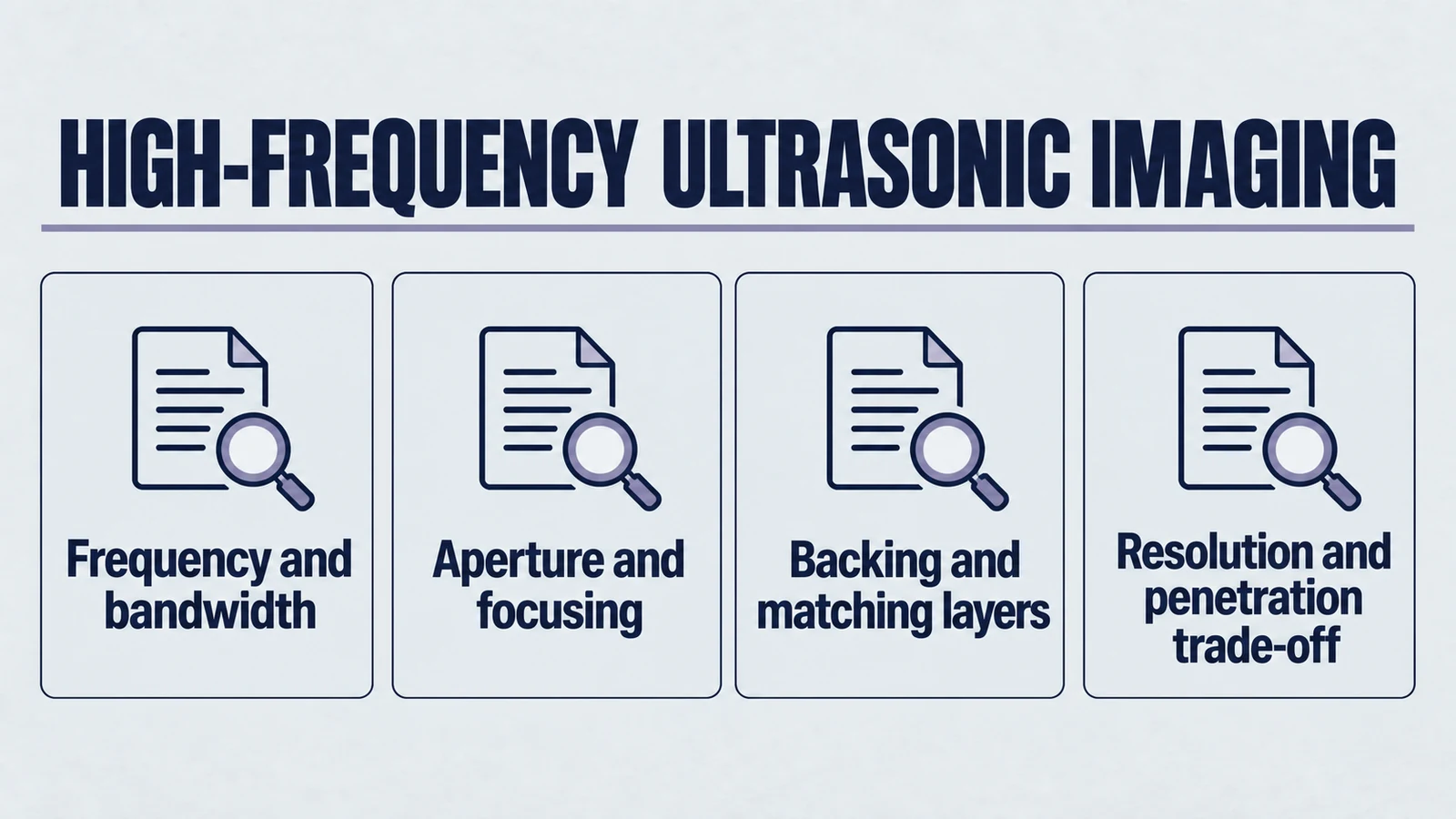
2. Frequency Range and Bandwidth
High-frequency probes can operate from 20 MHz up to over 100 MHz. Wider bandwidth supports better axial resolution, which is crucial for distinguishing between thin tissue layers or identifying micro-defects. Our high-frequency transducers are specifically designed for such demanding applications.
3. Aperture Size and Focusing
At fixed wavelength and focal length, increasing the effective aperture generally narrows the focal beam and improves lateral resolution. Aperture, focusing, apodization and sensitivity must be designed together; axial resolution depends principally on pulse length/bandwidth.
4. Backing and Matching Layers
Proper acoustic matching layers reduce reflection losses at the interface between the transducer and the medium (such as tissue or water). Backing materials help dampen unwanted vibrations, improving image clarity.
Applications of High-Frequency Ultrasonic Transducers
High-frequency probes are utilized in a wide variety of sectors due to their precision and high-resolution imaging capabilities:
1. Medical Imaging
- Dermatology and Ophthalmology: MHz ultrasound transducers can resolve fine tissue layers in skin and eye imaging.
- Intravascular Ultrasound (IVUS): Used for imaging inside blood vessels to detect plaque buildup and assess cardiovascular health.
- Small Animal Imaging: In research, high-frequency ultrasound is employed for studying animal models at microscopic levels.
2. Nondestructive Testing (NDT)
- Microelectronics Inspection: Identifying defects in semiconductor wafers or integrated circuits.
- Composite Materials: Detecting delamination or voids in aerospace components where precision is critical.
3. Industrial and Scientific Applications
- Material Characterization: Assessing elastic properties of thin films and microstructures using our advanced piezoelectric components.
- Biological Research: Studying cell mechanics and tissue microstructures in laboratories.
Challenges and Future Directions
While MHz ultrasound transducers offer strong resolution, challenges include:
- Limited Penetration Depth: Suitable mostly for surface or shallow imaging.
- Fabrication Complexity: Manufacturing requires high-precision techniques, raising costs.
- Signal Attenuation: High-frequency signals experience more attenuation in biological tissue and industrial materials.
Future innovations are addressing these limitations. Advances in CMUT (Capacitive Micromachined Ultrasonic Transducer) technology, novel piezoelectric materials, and AI-driven image processing are expanding the capabilities of high-frequency ultrasound systems.
Why Choose Yujie for High-Frequency Ultrasonic Transducers?
At Yujie, we specialize in manufacturing precision piezoelectric transducers that meet the demanding requirements of high-frequency applications. Our expertise in advanced ceramic materials and custom transducer design ensures optimal performance for your specific imaging needs.
Conclusion
The high frequency ultrasonic transducer is an important tool for applications where high-resolution imaging is critical. From medical diagnostics to microelectronics inspection, MHz ultrasound transducers provide strong precision that enables breakthroughs in research, safety, and healthcare. As technology continues to evolve, these devices will only become more powerful, accessible, and versatile.
Ready to explore high-resolution imaging solutions? Contact us today to discuss your high frequency ultrasonic transducer requirements and discover how our advanced piezoelectric technology can enhance your applications.
Engineering decision notes
Piezoelectric application engineering
Use this article as an application note that connects piezoelectric material behavior, transducer design, and OEM sourcing decisions. For "High-Frequency Ultrasonic Transducers: Achieving High-Resolution Imaging", the practical value is in turning the topic into a measurable selection or sourcing decision.
YJ Piezo reviews piezoelectric projects from material, geometry, electrode, assembly, and outgoing inspection together so the final part fits the real operating condition.
Selection checks
- Clarify whether the design is primarily sensing, actuation, power ultrasonics, atomization, or acoustic measurement.
- Connect the article topic to geometry, material grade, tolerance, operating field, and validation method.
- Define which measurements matter before comparing suppliers: resonance, impedance, capacitance, d33, Qm, or acoustic output.
Failure risks
- A component can meet a simple datasheet value and still fail after bonding, clamping, heat, or acoustic loading.
- Generic material selection can create drift, heating, weak output, or unstable resonance.
- Insufficient RFQ detail forces suppliers to quote assumptions instead of the real engineering requirement.
RFQ details
- What is the operating mode and target application?
- Which electrical, mechanical, and environmental limits must be controlled?
- What sample evidence or outgoing reports are needed before production approval?
Relevant YJ Piezo pages
- Piezoelectric Ceramics
PZT shapes, materials, and custom manufacturing
- PZT Material Hub
Material property tradeoffs and grade selection
- Ultrasonic Transducer Supplier Hub
OEM transducer development and sourcing
Application FAQ
- What extra detail makes a piezoelectric article more useful for engineers?
- Useful detail connects the topic to material choice, geometry, operating load, measurable acceptance criteria, and supplier evidence. That helps readers move from background knowledge to a sourcing or design decision.
- What information should I send YJ Piezo for application guidance?
- Send the application, target dimensions, frequency or sensitivity target, operating medium, duty cycle, temperature range, expected quantity, and any current test data or failure symptoms.