
Piezoelectric Motors: Understanding "Squiggle" Motors and Ultrasonic Drives
Piezoelectric Motors: Understanding "Squiggle" Motors and Ultrasonic Drives
Piezoelectric motors support precision motion control in industries where compact size, silent operation, and high-resolution positioning are critical. Unlike conventional electromagnetic motors, piezoelectric motors rely on the deformation of piezoelectric ceramics to generate motion—offering distinct advantages in specific applications. In this article, we explore the principles behind piezoelectric motors, with a special focus on ultrasonic motors and "squiggle" motors, and examine their key applications across various industries.
What is a Piezoelectric Motor?
A piezoelectric motor is a type of actuator that uses the deformation of piezoelectric materials to produce mechanical displacement. When a voltage is applied to these materials, they change shape—expanding or contracting at microscopic scales. By carefully controlling the input signal and structural configuration, this deformation can be converted into controlled rotary or linear motion.
Product path for this search intent
Match the article topic to the right YJ Piezo product page
Use this article when the choice is not just a shape, but a material tradeoff between sensitivity, loss, coupling, stability, and operating field. For "Piezoelectric Motors: Understanding "Squiggle" Motors and Ultrasonic Drives", the practical value is in turning the topic into a measurable selection or sourcing decision.
- PZT Material Hub
Material grades and application tradeoffs
- Piezoelectric Ceramics
Shapes and ceramic manufacturing options
- PZT Material Supplier Hub
Material control, grade selection, and sourcing support
How They Differ from Electromagnetic Motors
- No magnetic-force actuation: MR suitability still requires assessment of the complete motor, materials, drive electronics, wiring and imaging interaction.
- Compact and precise: These motors are typically smaller and capable of nanometer-scale positioning.
- Silent operation: With minimal moving parts, they produce less noise and vibration.
Ultrasonic Motor Principle
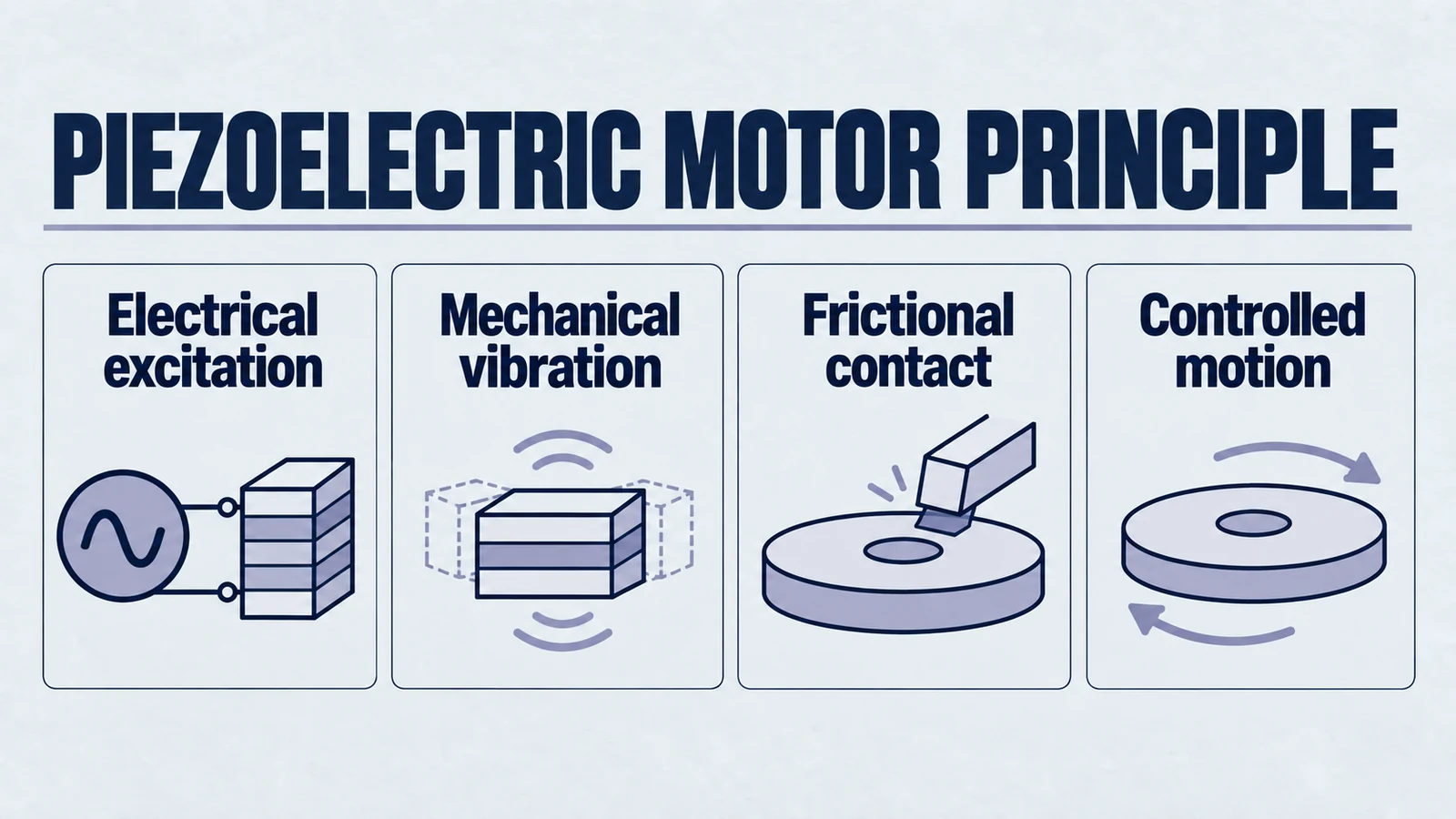
Ultrasonic motors are one of the most common types of piezoelectric motors. They operate on the principle of high-frequency vibrations induced by piezoelectric ceramics.
Operating Principle
- Piezoelectric excitation: High-frequency AC voltage is applied to a piezoelectric element.
- Standing or traveling wave: The ceramic substrate generates ultrasonic vibrations.
- Frictional drive: A rotor or slider in contact with the vibrating substrate is driven by friction.
The result is continuous motion with precise control. These motors are ideal where smooth, fast, and controlled motion is essential, especially in applications that demand high torque at low speed.
Benefits of Ultrasonic Motors
- High torque-to-size ratio
- Electromagnetic emissions and susceptibility require complete-system testing
- Low heat generation
- Fast response time
The "Squiggle" Motor: A Unique Linear Drive
"Squiggle" motors are a subtype of linear piezoelectric motors developed for ultra-compact environments. Unlike traditional motors with a shaft or rotor, these motors use the vibrational motion of piezo elements to create linear displacement through a threaded drive shaft.
Key Characteristics
- Miniature size: Some squiggle motors measure just a few millimeters across.
- High resolution: Capable of sub-micron positioning.
- Self-locking: Holds position without continuous power.
How It Works
Two or more piezo elements vibrate in carefully phased patterns, creating elliptical motions. This motion causes a nut to rotate around a threaded screw, driving it linearly—hence the "squiggling" action that gives the motor its name.
Piezo Motor Applications
Piezoelectric motors are now widely adopted in industries demanding compact, precise, and low-noise actuation:
Medical Equipment
- Surgical tools with micrometer precision
- MR applications only after the complete configuration’s safety and image compatibility are established
- Medical ultrasonic devices requiring precise positioning
Industrial Automation
- Precision stages in semiconductor manufacturing
- Optical alignment systems
- Automated positioning systems
Consumer Electronics
- Autofocus and zoom in smartphone cameras
- Miniature haptic feedback systems
- Beauty device mechanisms
Aerospace & Defense
- Satellite mirror adjustments
- Vibration-free navigation components
- Precision antenna positioning
Challenges and Considerations
While piezoelectric motors offer distinct advantages, they also come with challenges:
- Cost: Advanced ceramics and control electronics can be expensive.
- Drive electronics: Require specialized drivers for high-frequency operation.
- Wear: Friction-based drive mechanisms may degrade over time.
Future Trends in Piezoelectric Motor Technology
The field of piezoelectric motors continues to evolve with emerging trends in piezoelectric technology:
- Improved materials: New PZT formulations offering better performance
- Enhanced control systems: Advanced driver electronics for smoother operation
- Integration capabilities: Better compatibility with modern automation systems
Conclusion
Piezoelectric motors, including ultrasonic drives and squiggle motors, offer strong advantages in precision motion control, particularly in size-constrained and magnetically sensitive environments. As piezo motor applications continue to expand, their role in enabling innovation in medical, industrial, and consumer products will only grow.
For engineers, designers, and procurement specialists, understanding the ultrasonic motor principle and the unique features of each piezoelectric motor type is key to selecting the right motion technology.
Looking for high-performance piezoelectric components or custom motor solutions? Contact Yujie Technology to explore our full range of piezo materials and devices.
Engineering decision notes
PZT material and ceramic selection
Use this article when the choice is not just a shape, but a material tradeoff between sensitivity, loss, coupling, stability, and operating field. For "Piezoelectric Motors: Understanding "Squiggle" Motors and Ultrasonic Drives", the practical value is in turning the topic into a measurable selection or sourcing decision.
YJ Piezo coordinates PZT ceramic projects with manufacturing support, so material formulation, sintering, polarization, electrode process, and outgoing inspection can be reviewed against the final application.
Selection checks
- Separate sensing needs from high-power actuation needs before comparing d33 or coupling values.
- Check dielectric loss, Qm, Curie temperature, aging behavior, and operating field against the real duty cycle.
- Confirm whether the application needs standard PZT grades or a custom formulation and geometry.
Failure risks
- Choosing only the highest d33 can create heat, drift, or depolarization risk in power ultrasonics.
- A ceramic that performs well in free measurement can fail once bonded, clamped, or loaded.
- Material substitutions without batch testing can change capacitance, resonance, and system tuning.
RFQ details
- Is the part used for sensing, actuation, atomization, cleaning, welding, or measurement?
- What field strength, temperature, duty cycle, and mechanical load will the ceramic see?
- Which values must be controlled: d33, capacitance, resonance, impedance, Qm, or dimensional tolerance?
Relevant YJ Piezo pages
- PZT Material Hub
Material grades and application tradeoffs
- Piezoelectric Ceramics
Shapes and ceramic manufacturing options
- PZT Material Supplier Hub
Material control, grade selection, and sourcing support
Application FAQ
- Is the highest d33 always the best PZT choice?
- No. High d33 can be useful for sensitivity, but high-power ultrasonic systems often need lower loss, higher Qm, better thermal stability, and safer operation under field and stress.
- What makes PZT material selection different from catalog buying?
- The right PZT choice depends on geometry, load, drive field, duty cycle, temperature, and inspection targets. A catalog value is only useful when it is tied to the final assembly conditions.