
Piezoelectric Tubes for Precision Sensing: Applications and Benefits
In the world of precision sensing, piezoelectric tubes have emerged as a crucial component, offering high sensitivity, fast response times, and compact integration for various industrial, medical, and research applications. This article explores what a piezoelectric tube is, its working principle, key benefits, and where these piezo tube sensors are being deployed to enhance accuracy and efficiency.
What Is a Piezoelectric Tube?
A piezoelectric tube is a hollow cylindrical structure made from piezoelectric ceramics such as PZT, which can expand, contract, or bend when an electrical voltage is applied and generate voltage when subjected to mechanical stress. The geometry of the tube allows it to be used for multi-axis actuation and sensing, making it ideal for precision control and measurement tasks.
Working Principle of Piezo Tube Sensors
Product path for this search intent
Match the article topic to the right YJ Piezo product page
Use this article when the choice is not just a shape, but a material tradeoff between sensitivity, loss, coupling, stability, and operating field. For "Piezoelectric Tubes for Precision Sensing: Applications and Benefits", the practical value is in turning the topic into a measurable selection or sourcing decision.
- PZT Material Hub
Material grades and application tradeoffs
- Piezoelectric Ceramics
Shapes and ceramic manufacturing options
- PZT Material Supplier Hub
Material control, grade selection, and sourcing support
Piezoelectric tubes operate based on the piezoelectric effect: the material deforms when an electric field is applied and generates an electric charge when deformed by an external force. In sensing applications, when the tube is subjected to mechanical vibrations or displacements, it produces a measurable voltage output proportional to the mechanical input, enabling accurate detection of displacement, pressure, or vibration levels.
Key Benefits of Using Piezoelectric Tubes
- High Sensitivity: Capable of detecting minute displacements and forces, enabling precise measurement and control.
- Fast Response: Reacts rapidly to changes in input, making it suitable for dynamic measurement environments.
- Compact Design: The tube structure allows for integration into small devices and systems where space is limited.
- Multi-Axis Capabilities: Enables sensing or actuation in radial and axial directions, suitable for scanning and alignment applications.
- Reliability and Longevity: Piezoelectric ceramics offer stable performance over extended use, reducing maintenance needs.
Applications of Piezoelectric Tubes in Precision Sensing
- AFM and Precision Scanning: Piezoelectric tubes are used in Atomic Force Microscopes (AFM) to control the scanning tip with nanometer precision, enabling high-resolution surface imaging.
- Optical Fiber Alignment: They allow precise adjustment and alignment of optical fibers in telecommunication and laser systems.
- Vibration Sensing: Piezo tube sensors can detect vibrations in machinery for condition monitoring and predictive maintenance.
- Medical Devices: They are integrated into precision dispensing systems, micro-dosing devices, and ultrasonic medical instruments for accurate control.
- Micropositioning Systems: Used in semiconductor and MEMS fabrication equipment for precise stage movement.
- Space and Aerospace Applications: Employed in satellite instruments for fine alignment and stabilization tasks.
Design Considerations for Piezoelectric Tubes
When selecting or designing a piezoelectric tube for sensing applications, consider:
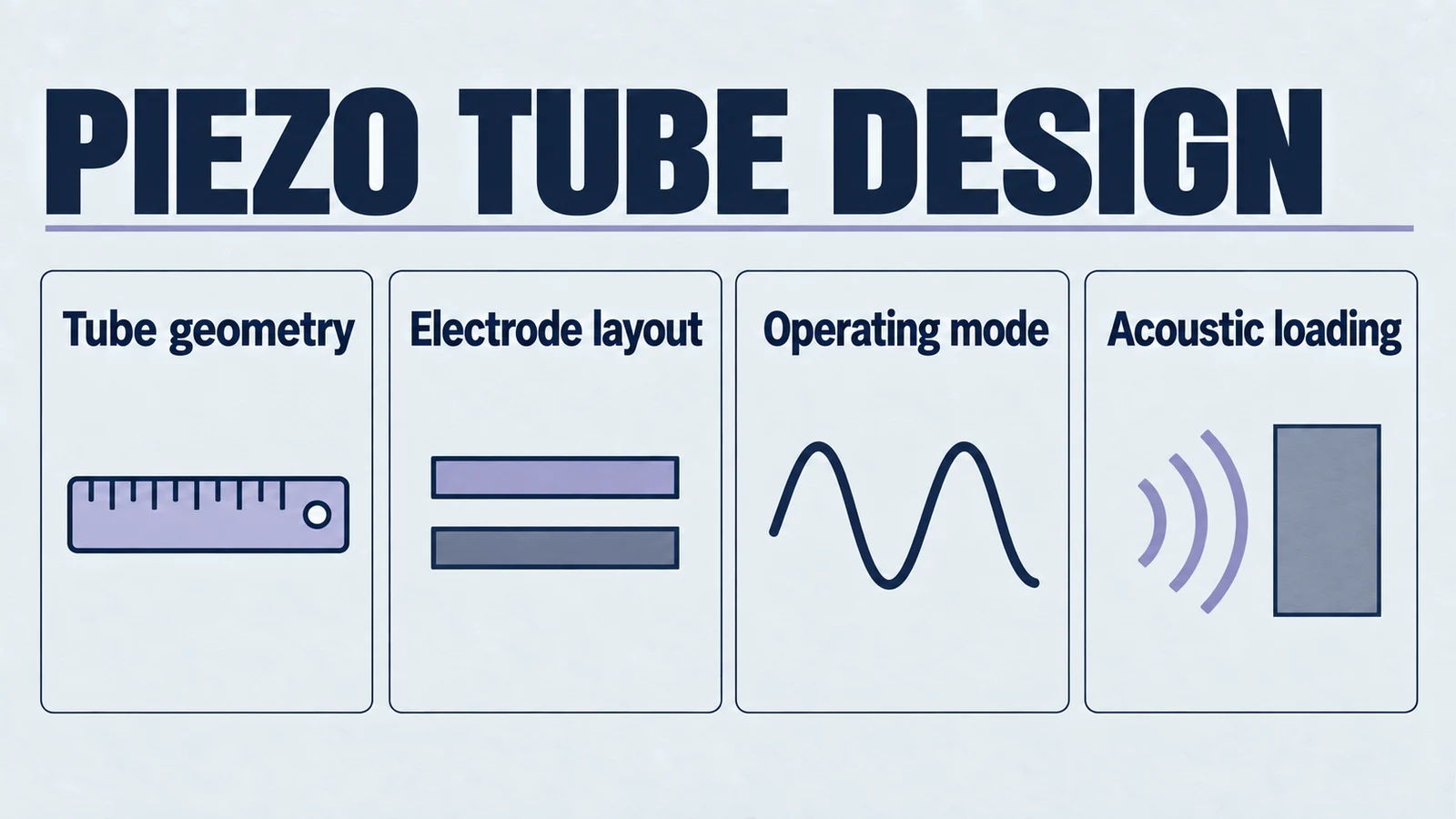
- Outer and inner diameter, wall thickness, and length according to the displacement and stiffness required.
- Type of piezoelectric material to match the sensitivity and operational temperature range needed.
- Electrode configuration for the desired mode of operation (axial or radial sensing).
- Compatibility with the driving electronics and measurement systems.
Tube Series Products for Precision Applications
At Yujie, we offer specialized tube series piezoelectric components designed for precision sensing and actuation applications. Our piezoelectric tubes are manufactured with high-quality PZT materials to ensure optimal performance in demanding environments.
Related Piezoelectric Components
For different application requirements, you might also consider:
- Ring series piezoelectric components for applications requiring central mounting holes
- Disc series components for flat surface applications
- Comparing rings vs. discs for optimal element selection
Why Choose Yujie for Your Piezo Tube Sensor Needs
At Yujie, we manufacture high-quality piezoelectric tubes tailored for precision sensing, offering:
- A wide range of standard and custom sizes
- High-performance PZT materials ensuring sensitivity and stability
- Technical support for integration into your systems
- Consistent quality backed by manufacturing expertise built since 1996
If you are looking to enhance the precision and reliability of your sensing systems using piezoelectric tubes or piezo tube sensors, contact our team today to discuss your requirements.
Troubleshooting and Maintenance
For optimal performance of your piezo tube sensors, it's important to understand common issues and preventive measures. Learn more about troubleshooting piezo devices and testing and measuring piezoelectric materials.
Conclusion
Piezoelectric tubes play a vital role in precision sensing, offering strong sensitivity, speed, and reliability in compact form factors. Their applications span across high-tech fields, including microscopy, optical alignment, vibration detection, and advanced medical devices. By choosing the right piezoelectric tube, you can significantly improve the accuracy and efficiency of your systems, staying ahead in competitive, technology-driven industries.
Interested in learning more or requesting a quote? Visit our contact page to start your precision sensing upgrade today.
Engineering decision notes
PZT material and ceramic selection
Use this article when the choice is not just a shape, but a material tradeoff between sensitivity, loss, coupling, stability, and operating field. For "Piezoelectric Tubes for Precision Sensing: Applications and Benefits", the practical value is in turning the topic into a measurable selection or sourcing decision.
YJ Piezo coordinates PZT ceramic projects with manufacturing support, so material formulation, sintering, polarization, electrode process, and outgoing inspection can be reviewed against the final application.
Selection checks
- Separate sensing needs from high-power actuation needs before comparing d33 or coupling values.
- Check dielectric loss, Qm, Curie temperature, aging behavior, and operating field against the real duty cycle.
- Confirm whether the application needs standard PZT grades or a custom formulation and geometry.
Failure risks
- Choosing only the highest d33 can create heat, drift, or depolarization risk in power ultrasonics.
- A ceramic that performs well in free measurement can fail once bonded, clamped, or loaded.
- Material substitutions without batch testing can change capacitance, resonance, and system tuning.
RFQ details
- Is the part used for sensing, actuation, atomization, cleaning, welding, or measurement?
- What field strength, temperature, duty cycle, and mechanical load will the ceramic see?
- Which values must be controlled: d33, capacitance, resonance, impedance, Qm, or dimensional tolerance?
Relevant YJ Piezo pages
- PZT Material Hub
Material grades and application tradeoffs
- Piezoelectric Ceramics
Shapes and ceramic manufacturing options
- PZT Material Supplier Hub
Material control, grade selection, and sourcing support
Application FAQ
- Is the highest d33 always the best PZT choice?
- No. High d33 can be useful for sensitivity, but high-power ultrasonic systems often need lower loss, higher Qm, better thermal stability, and safer operation under field and stress.
- What makes PZT material selection different from catalog buying?
- The right PZT choice depends on geometry, load, drive field, duty cycle, temperature, and inspection targets. A catalog value is only useful when it is tied to the final assembly conditions.