
From Powder to Performance: Deconstructing Reliability with Yujie, Your Piezoelectric Ceramic Manufacturing Partner
Introduction: The High Cost of Component Variance
In high-performance engineering, devices for medical diagnostics, industrial automation, and advanced consumer electronics often depend on consistent component behavior. For engineers and original equipment manufacturers (OEMs), the selection of a piezoelectric ceramic component is more than a simple procurement decision. An out-of-spec ceramic element integrated into a medical ultrasound transducer, an industrial welding horn, or a sonar array can create system-level risk, rework, warranty exposure, and validation delays. The upfront component cost should therefore be weighed against the cost of qualification, incoming inspection, and field reliability.
This reality demands a re-evaluation of what constitutes a "reliable" supplier. Predictable reliability is not a marketing slogan; it comes from documented control over materials, processing, inspection, and support during system integration. Since its founding in 1996, Yujie Ltd. has focused on piezoelectric ceramic manufacturing and engineering support for OEM teams. This analysis breaks supplier reliability into four practical pillars: material science, process control, verification, and engineering partnership.
The Bedrock of Performance: Reliability Engineered at the Material Level
Product path for this search intent
Match the article topic to the right YJ Piezo product page
Use this article when the choice is not just a shape, but a material tradeoff between sensitivity, loss, coupling, stability, and operating field. For "From Powder to Performance: Deconstructing Reliability with Yujie, Your Piezoelectric C...", the practical value is in turning the topic into a measurable selection or sourcing decision.
- PZT Material Hub
Material grades and application tradeoffs
- Piezoelectric Ceramics
Shapes and ceramic manufacturing options
- PZT Material Supplier Hub
Material control, grade selection, and sourcing support
The integrity of any piezoelectric device begins at the material level. A well-machined component made from the wrong material can still miss the operating target. Yujie's manufacturing philosophy therefore starts with the chemistry of piezoelectric ceramics, then connects material choice to geometry, poling, electrodes, and final testing. This gives OEM teams a stronger basis for consistent component behavior.
In-House Formulation and Application-Specific Chemistry
Unlike manufacturers who rely on third-party, off-the-shelf powders, Yujie's control over reliability begins with the in-house formulation of its PZT (lead zirconate titanate) materials. The process starts with the precise weighing and mixing of high-purity metal oxides—including lead, zirconium, and titanium—along with proprietary doping agents that fine-tune the material's final properties. This mixture undergoes calcination at approximately 1000°C to form the PZT crystalline structure, followed by milling and spray-drying to create uniform granules essential for consistent pressing. This vertical integration at the most foundational chemical level is a crucial differentiator. It eliminates a massive source of variability that manufacturers who purchase pre-made powders cannot control, allowing Yujie to engineer materials for specific, demanding applications. Understanding how geometry affects performance is equally important in the design process.
This deep material expertise is evident in Yujie's diverse portfolio of proprietary PZT grades. The company offers a spectrum of formulations, from "hard" PZT materials to "soft" PZT variants, each optimized for different physical demands. For instance, high-power ultrasonic applications like industrial cleaning and welding require "hard" ceramics, such as Yujie's P-81 (equivalent to PZT-8), which offer low energy loss, high mechanical stability, and excellent resistance to depolarization under high electrical drive. Conversely, high-sensitivity applications like medical diagnostic sensors, underwater acoustics, or non-destructive testing (NDT) probes benefit from "soft" PZT ceramics like P-33 (equivalent to PZT-5A), which provide higher piezoelectric charge coefficients and greater responsiveness to minute mechanical stresses. This ability to match the material chemistry to the application physics is the first and most critical step in ensuring a component will perform reliably in its intended environment.
Translating Material Science into Quantifiable Performance
Yujie's material science work is documented through measurable performance metrics. Two key specifications are especially useful during component comparison:
- Low Dielectric Loss: A key indicator of energy efficiency in a piezoelectric material is its dielectric loss tangent, represented as tan δ. This value quantifies the energy dissipated as heat when the material is subjected to an electric field. A lower tan δ can help reduce heat buildup in high-duty-cycle industrial systems. Yujie PZT grades can be selected for low-loss operation where the application requires it.
- Sensitivity and Response: For sensing applications, the piezoelectric charge coefficient is an important comparison metric. Yujie's material data can support sensor and actuator designs where signal response, displacement, and repeatability must be balanced against temperature, drive level, and mechanical loading.
By controlling the PZT formulation from the raw oxides, Yujie builds these elite performance characteristics into the very DNA of the material, establishing a foundation of reliability that cannot be achieved through downstream processing alone.
The Blueprint for Consistency: Meticulous Process Control from Concept to Component
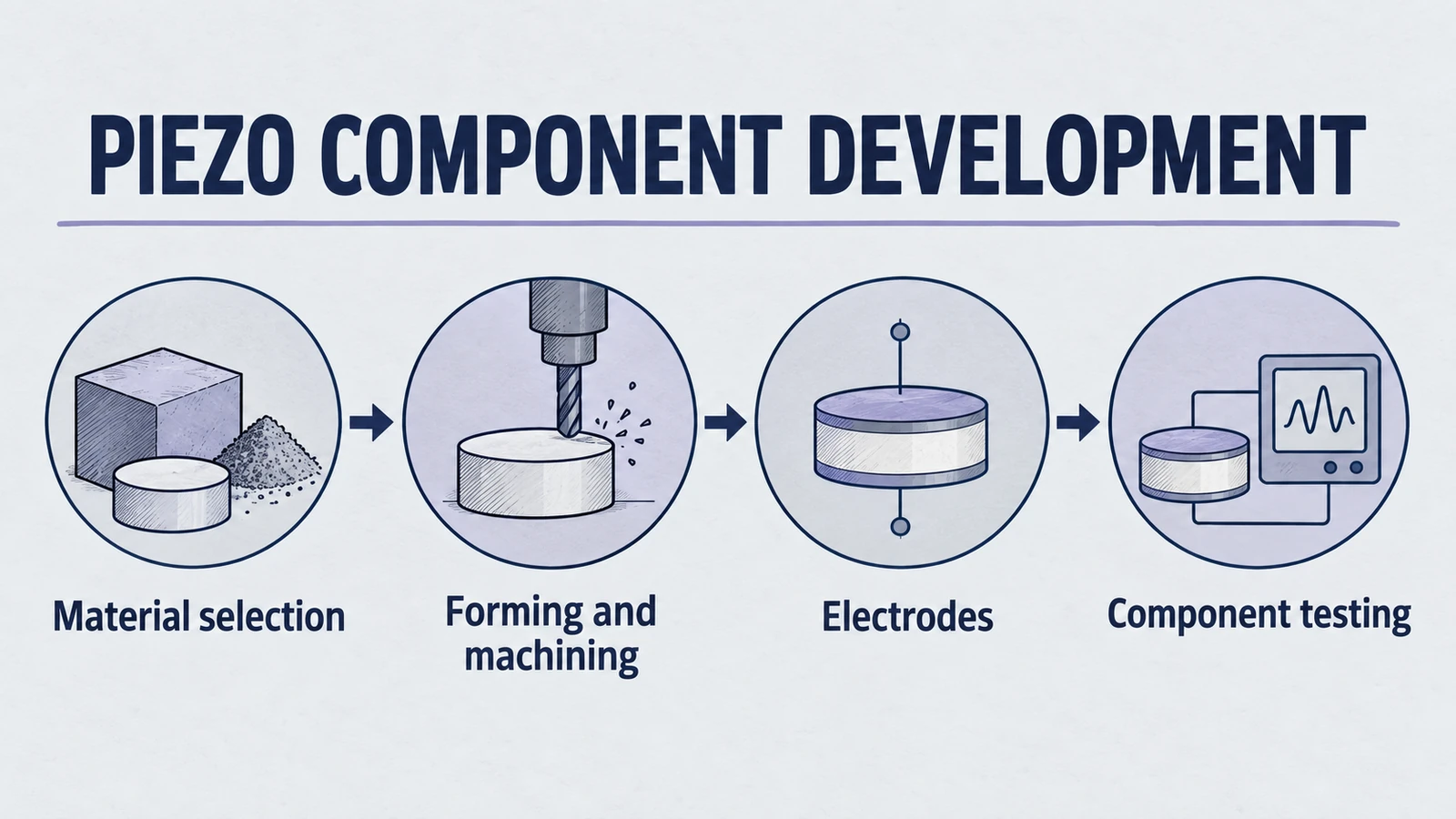
With a foundation of application-specific materials, the next pillar of reliability is the ability to translate material targets into repeatable components. Yujie's manufacturing operations in Wuxi support piezoelectric ceramic components, with the process route, inspection scope, and available batch quantity reviewed for the selected geometry and order.
Precision Forming and the Art of Machining Hardened Ceramics
The manufacturing journey begins with compacting the prepared PZT granules into a "green" (unfired) shape using powerful hydraulic presses. While simple geometries can be pressed directly, complex shapes like tubes, hemispheres, or components with intricate contours require advanced machining. A critical decision point is whether to machine the softer green part or the final, sintered ceramic. For the highest precision, machining the sintered ceramic is necessary; however, this presents a significant engineering challenge. Sintered PZT is extremely hard and brittle, making it "notoriously difficult to machine without introducing micro-cracks or chipping that can lead to component failure".
These micro-cracks represent a grave threat to long-term reliability. They act as stress concentration points that may not be detectable during standard post-production electrical tests. However, when the component is subjected to the high-frequency mechanical vibrations and electrical fields of real-world operation, these latent defects can propagate, eventually leading to a severe fracture and premature field failure. Yujie mitigates this critical risk by leveraging decades of specialized experience and advanced diamond-tipped tools to machine hardened ceramics to tight dimensional tolerances. This expertise in preventing the formation of latent defects is a crucial, often overlooked, factor in ensuring the long-term operational integrity of every component.
Controlled Sintering and Poling for Optimal Properties
After forming, the green parts undergo sintering in a high-temperature furnace. This is not a simple baking process; it is a precisely controlled thermodynamic event. Yujie meticulously manages the entire temperature profile—including ramp rates, hold times, and atmospheric conditions—because this profile "directly determines the final density and grain structure, which in turn influence the ceramic's mechanical strength and electrical properties". Following sintering, conductive silver electrodes are applied, and the component undergoes poling. During this final critical step, a strong DC electric field is applied at an elevated temperature to align the ferroelectric domains within the ceramic, imparting its piezoelectric properties. The electric field strength, temperature, and duration of the poling process are meticulously managed to ensure maximum piezoelectric activity and consistent performance from part to part. Process control supports repeatable production within agreed limits; request relevant capability and batch evidence instead of assuming literal part-to-part identity.
The Assurance of Quality: A System of Total Verification
In an industry where performance is paramount, a quality certificate on a website is not sufficient evidence of component reliability. For high-reliability components, the required parameters, inspection method, sampling level, acceptance limits, and report fields should be agreed for the selected product and program.
Inspection Plans Beyond Certificates
Quality-system evidence can be a useful foundation for supplier qualification. However, for medical-device, aerospace, or industrial automation programs, a certificate by itself does not confirm the performance of an individual component.
The critical point of differentiation lies in the testing methodology. Many suppliers rely on statistical batch sampling, which can be sufficient for some applications but may not provide enough data for high-reliability programs. Yujie can perform documented testing on critical parameters such as capacitance (C), dissipation factor (tan δ), resonant frequency (Fr), and piezoelectric charge coefficient (d₃₃), with the inspection plan aligned to the customer's application and order requirements.
Data Transparency and Component-Level Traceability
The agreed testing protocol can be paired with batch records or measured data when required. The available report fields, sampling level, lot identification, and traceability scope should be confirmed during quotation rather than assumed for every shipment.
Agreed data can support the customer's incoming quality control, but it does not replace the customer's own validation or finished-system responsibilities. The goal is a documented, reviewable basis for acceptance rather than blind trust.
The Partnership Multiplier: De-Risking Innovation with Expert Engineering Collaboration
The most reliable component in the world can still fail if it is improperly designed into a system. Recognizing this, a truly reliable manufacturer must extend its responsibility beyond the factory floor and act as an expert engineering partner. Yujie's fourth pillar of reliability is its collaborative model, which is designed to de-risk the entire product development lifecycle for its clients, from initial concept to high-volume production. This approach is built on the distinction between a transactional "vendor" and a collaborative "partner".
Proactive Design Optimization and Expert Consultation
With an engineering team experienced in piezoelectric technology since 1996, Yujie provides more than just components; it provides engineering support. The partnership begins long before a purchase order is issued, with pre-sale technical consultation and direct access to engineering experts. Yujie offers OEM and ODM services, working with clients to develop custom formulations, geometries, and electrode patterns tailored to their application needs.
Crucially, this support includes advanced simulation tools like Finite Element Analysis (FEA). FEA allows Yujie's engineers to model a component's performance—such as its vibrational modes and resonant frequencies—within the customer's intended assembly. This proactive analysis helps optimize designs, solve complex integration challenges, and ensure manufacturability before committing to expensive physical tooling, dramatically shortening development cycles and preventing costly design errors.
Seamless and Documented Scalability
A frequent point of failure in supplier relationships is the transition from a successful prototype to high-volume mass production. Performance and quality can degrade as volumes increase if processes are not robustly controlled. Yujie addresses this critical challenge with a documented, mature methodology for process validation: the Production Part Approval Process (PPAP). Originating in the automotive industry, PPAP is a rigorous framework for ensuring that a supplier's production process is capable of consistently producing parts that meet all design requirements at scale.
Where required, request the actual PPAP package and its scope. It documents production conformance and process capability against agreed requirements; it does not establish that every production unit has exactly the prototype’s response, or that every supplier uses the same approval process.
Making the Strategic Choice for a Truly Reliable Piezoelectric Partner
The evidence is clear: true reliability in a piezoelectric ceramic component is not a single attribute but the emergent property of a holistic, deeply integrated system. It is born from a mastery of material science that controls performance at the chemical level. It is solidified through meticulous process control that ensures consistency from the first part to the last. It is proven through a system of total verification that provides transparent, component-level data. And it is maximized through an engineering partnership that de-risks innovation and ensures project success.
When evaluating a potential piezoelectric ceramic manufacturer, engineers and procurement managers must look beyond the datasheet and the price quote. They must make a strategic decision based on the supplier's fundamental capabilities and quality philosophy. The following table serves as a litmus test to distinguish a commodity vendor from a true engineering partner.
| Evaluation Criteria | The Commodity Supplier Approach | The Yujie Engineering Partner Standard |
|---|---|---|
| Material Control & Science | Uses standard, off-the-shelf PZT material grades. | Develops proprietary formulations (e.g., P-41, P-81) and custom material solutions engineered from raw oxides for optimal performance. |
| Quality & Testing | Provides only general certification statements or an undefined sampling claim. | Defines the required parameters, method, sampling level, and acceptance limits for the selected component. |
| Data Transparency | Provides a generic datasheet with typical values. | Confirms the available report fields and traceability scope during quotation and records them in the order requirements. |
| Engineering Support | Awaits final drawings to provide a price quote. | Offers collaborative design review, FEA simulation to optimize performance pre-tooling, and direct access to expert engineers. |
| Scalability Assurance | Promises future production capacity can be met. | Utilizes a documented Production Part Approval Process (PPAP) to seamlessly scale from prototype to high-volume production with documented quality. |
Conclusion: Your Partner for Reliable, High-Performance Components
By choosing a partner who embodies these higher standards, you are not just buying a component; you are investing in performance, mitigating risk, and ensuring the long-term success of your product. To move beyond the limitations of standard suppliers, partner with Yujie Technology.
Explore our comprehensive range of piezoelectric discs, rings, plates, and tubes. Discover our application-specific solutions for ultrasonic cleaning, welding, beauty devices, and sensing applications. Contact our engineering team today to discuss the specific requirements of your application and discover the tangible difference a truly reliable manufacturing partner can make.
Engineering decision notes
PZT material and ceramic selection
Use this article when the choice is not just a shape, but a material tradeoff between sensitivity, loss, coupling, stability, and operating field. For "From Powder to Performance: Deconstructing Reliability with Yujie, Your Piezoelectric C...", the practical value is in turning the topic into a measurable selection or sourcing decision.
YJ Piezo coordinates PZT ceramic projects with manufacturing support, so material formulation, sintering, polarization, electrode process, and outgoing inspection can be reviewed against the final application.
Selection checks
- Separate sensing needs from high-power actuation needs before comparing d33 or coupling values.
- Check dielectric loss, Qm, Curie temperature, aging behavior, and operating field against the real duty cycle.
- Confirm whether the application needs standard PZT grades or a custom formulation and geometry.
Failure risks
- Choosing only the highest d33 can create heat, drift, or depolarization risk in power ultrasonics.
- A ceramic that performs well in free measurement can fail once bonded, clamped, or loaded.
- Material substitutions without batch testing can change capacitance, resonance, and system tuning.
RFQ details
- Is the part used for sensing, actuation, atomization, cleaning, welding, or measurement?
- What field strength, temperature, duty cycle, and mechanical load will the ceramic see?
- Which values must be controlled: d33, capacitance, resonance, impedance, Qm, or dimensional tolerance?
Relevant YJ Piezo pages
- PZT Material Hub
Material grades and application tradeoffs
- Piezoelectric Ceramics
Shapes and ceramic manufacturing options
- PZT Material Supplier Hub
Material control, grade selection, and sourcing support
Application FAQ
- Is the highest d33 always the best PZT choice?
- No. High d33 can be useful for sensitivity, but high-power ultrasonic systems often need lower loss, higher Qm, better thermal stability, and safer operation under field and stress.
- What makes PZT material selection different from catalog buying?
- The right PZT choice depends on geometry, load, drive field, duty cycle, temperature, and inspection targets. A catalog value is only useful when it is tied to the final assembly conditions.