
PZT Material Properties Table: d33, Qm, Curie Temperature, and Grade Selection
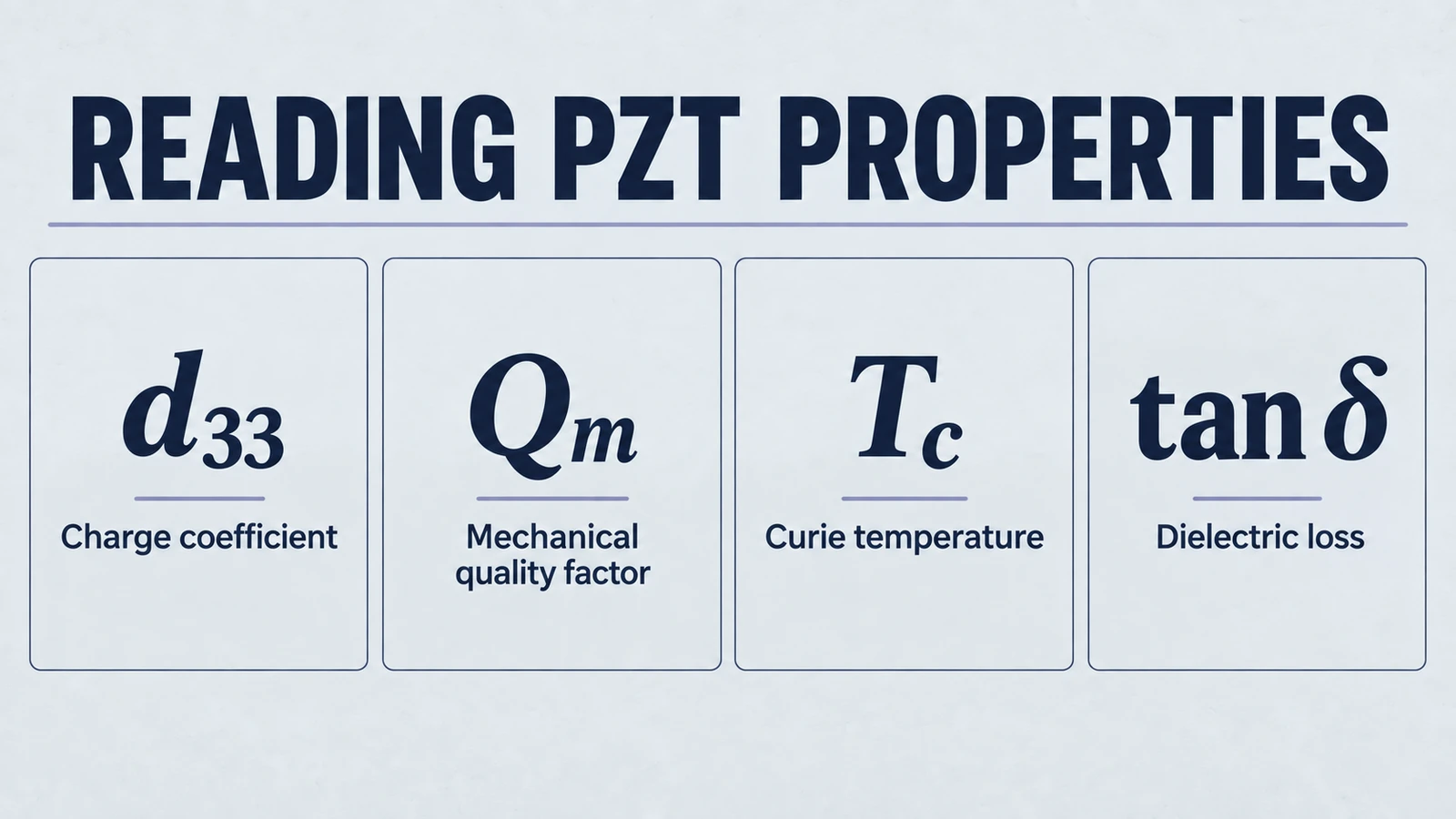
A PZT material properties table is useful only when the numbers are connected to the job the ceramic must do. Many teams compare lead zirconate titanate grades by scanning for the biggest d33 value, the highest coupling coefficient, or the widest Curie temperature. That shortcut can produce a reasonable first impression, but it does not produce a reliable material decision. A piezoelectric ceramic that looks strong in one column can be the wrong choice once the design includes duty cycle, heat, impedance matching, mounting stress, aging, and production repeatability.
This guide explains how to read the Yujie PZT material specifications table as an engineering decision tool. It is written for buyers and engineers who need to compare PZT grades before requesting samples, not for readers who only need a basic definition. If you need the starting point first, read what PZT material means and the broader soft vs hard PZT selection guide. Here the question is narrower: how should a team move from table values to a grade shortlist?
For this article, one site-wide mapping is explicit: P51 corresponds to PZT-5A, and P52 corresponds to PZT-5H. Other Yujie table grades are kept by their table names, such as P-33, P-43, P-44, and P-81, unless the project documentation confirms a specific external shorthand. That discipline matters because a material table should reduce ambiguity, not create a second naming problem.
Start With the Operating Role, Not the Highest Number
Product path for this search intent
Match the article topic to the right YJ Piezo product page
Use this article when the choice is not just a shape, but a material tradeoff between sensitivity, loss, coupling, stability, and operating field. For "PZT Material Properties Table: d33, Qm, Curie Temperature, and Grade Selection", the practical value is in turning the topic into a measurable selection or sourcing decision.
- PZT Material Hub
Material grades and application tradeoffs
- Piezoelectric Ceramics
Shapes and ceramic manufacturing options
- PZT Material Supplier Hub
Material control, grade selection, and sourcing support
The first screening question is not "which PZT grade has the best properties?" The better question is "which property becomes expensive if it is wrong?" A low-power receive sensor is punished by weak signal and front-end noise. A cleaning or welding element is punished by dielectric loss, self-heating, and unstable resonance. A compact precision actuator is punished by capacitance, drift, and mechanical fit. A long-life measurement device is punished by aging and temperature sensitivity. These are different decision problems even when they all use PZT ceramics.
That is why a material properties table should be read in layers. First, identify whether the device is receive-dominant, transmit-dominant, mixed-duty, or static/actuation-oriented. Then check which columns govern the risk: d33 and permittivity for sensitivity, Qm and dielectric loss for dynamic drive, Curie temperature for thermal margin, and time or temperature variation for stability. Only after that should the team compare grade names.
A practical rule is simple: if the system fails because the signal is too small, sensitivity columns deserve more attention. If the system fails because it heats, detunes, rings too long, or loses calibration, stability and loss columns deserve more attention. The table is not a ranking board. It is a risk map.
A Quick Reading Order
- Define the acoustic or mechanical role. Decide whether the ceramic mainly receives, transmits, actuates, senses, or holds resonance under duty.
- Screen the thermal window. Use Curie temperature and expected operating temperature to avoid a narrow-margin shortlist.
- Check the loss path. Use dielectric loss and Qm to understand whether dynamic operation can stay stable.
- Use d33 after the constraints are known. A higher d33 helps only when the rest of the design can support it.
- Verify with geometry and electronics. The same grade can behave differently in discs, rings, plates, and bonded assemblies.
What Each PZT Property Actually Tells You
d33: Useful Sensitivity, Not Automatic Superiority
The d33 value is one of the most visible numbers in any PZT material table because it connects directly to piezoelectric response along the polarization direction. A higher d33 usually suggests stronger charge or strain response under the relevant loading condition. That is why engineers often look at d33 first when they are designing sensors, receivers, actuators, or low-drive transducers.
The trap is treating d33 as the whole decision. A high d33 material can also bring higher permittivity, more front-end loading, more drift, or a narrower thermal comfort zone. For power ultrasonics, the higher d33 option can be less attractive if loss and heating dominate. The companion article why high d33 is not always better in power ultrasonics covers that point in detail.
Use d33 as a signal-strength indicator after the system role is clear. Do not use it as the first and final ranking metric.
Qm: Resonance Efficiency and Ringing Risk
Mechanical quality factor, usually written as Qm, describes how sharply the material stores mechanical energy around resonance. High Qm is valuable when the device needs efficient resonant drive, stable acoustic output, and lower mechanical loss. That is why high-Qm material logic appears in welding, cleaning, cutting, and other continuous or repeated-drive systems.
High Qm can also mean narrower bandwidth and longer ring-down. That is not always a problem. In a transmit stack, it can be a strength. In a pulse-echo probe, a high-Q resonant tail may reduce echo separation. This is why the PZT-4 vs PZT-5A ultrasonic transducer guide starts with architecture instead of grade labels.
Use Qm to decide whether the ceramic should behave like an efficient resonant energy store or a more damped receive element. The right answer depends on whether the system needs to push sound, resolve sound, or balance both.
Curie Temperature: Thermal Margin Before Performance Claims
Curie temperature indicates a transition, not a qualified operating limit. Conventional PZT loses its ferroelectric state at the transition; individual coefficients need not decrease monotonically on approach. Use validated lower operating limits for the exact grade and assembly, including ambient heat, self-heating, bonds, duty cycle and thermal excursions.
This is one reason P51 and P52 should not be selected only by sensitivity. In the Yujie table, P51 has a wider Curie temperature margin than P52, while P52 has higher d33 and higher permittivity. That is the practical basis of the PZT-5H vs PZT-5A sensitivity and stability comparison. P52 can be justified in sensitivity-first designs, but P51 is often a safer baseline when heat, time, and calibration retention matter.
Use Curie temperature early in the screening process. If the thermal margin is not credible, the rest of the table cannot rescue the choice.
Dielectric Loss: The Quiet Driver of Heat and Drift
Dielectric loss tells you how much electrical energy is converted into heat under alternating field conditions. In low-duty sensing, it may not be the first concern. In dynamic or resonant systems, it becomes one of the most important columns in the table. Higher frequency, higher voltage, larger capacitance, and longer duty cycle all make loss more visible.
This is why a material with attractive sensitivity can still fail a power-oriented design review. The ceramic may heat, the resonance may drift, the generator may lose stable matching, and the final acoustic output may become less predictable. For high-power work, compare the loss column together with Qm, Curie temperature, and package heat path. The high-Qm and low-loss PZT-8 design guide is a useful companion for that decision space.
Permittivity and Capacitance: Electronics Burden Hidden in the Material Choice
Relative permittivity affects capacitance at fixed geometry, voltage sensitivity, noise and front-end loading. It does not independently guarantee stronger receive output. In an ideal charge amplifier, feedback capacitance sets charge-to-voltage gain; source capacitance affects practical noise and bandwidth. Confirm cable loading, amplifier topology and temperature dependence.
In procurement discussions, this is often where materials and electronics teams talk past each other. One team sees a stronger ceramic response. The other sees a harder analog interface. Before approving a high-permittivity grade, confirm the expected capacitance range, cable length, amplifier topology, driver voltage, and acceptable drift. If those are not defined, the material table is being used too early.
Time and Temperature Variation: Long-Term Trust
A PZT grade is not finished being evaluated after the first room-temperature measurement. Aging, thermal cycling, and repeated field or stress exposure can change the useful response. The table's time variation and temperature relative change rows help engineers decide whether the initial result will remain credible across storage, shipment, calibration intervals, and field use.
These columns matter most when the device will be difficult to recalibrate, deployed in changing environments, or expected to hold stable output for long periods. For those applications, a slightly lower initial response can be the better engineering choice if it reduces compensation burden and field uncertainty.
Grade Selection Matrix
The matrix below is a practical first-pass screen. It should not replace validation, but it prevents the most common selection error: choosing a PZT grade from one attractive number while ignoring the operating role.
| Design Need | Table Columns to Prioritize | Likely Shortlist Direction | Engineering Caution |
|---|---|---|---|
| High-sensitivity receive or low-drive sensing | d33, permittivity, coupling, capacitance target | P52 / PZT-5H may be considered when sensitivity is the bottleneck | Confirm thermal drift, capacitance loading, and calibration strategy before locking the grade. |
| Balanced industrial sensing and moderate actuation | d33, Curie temperature, time variation, dielectric stability | P51 / PZT-5A is often the safer soft-PZT baseline | Do not move to P52 unless the extra sensitivity solves a real system limit. |
| Cleaning, welding, or repeated resonant drive | Qm, dielectric loss, Curie temperature, frequency constants | High-Qm, low-loss grades such as P-81 become more relevant | Final choice must include stack preload, generator matching, cooling path, and duty cycle. |
| Disc, ring, or rectangular component sourcing | Material constants plus geometry, tolerance, impedance, and frequency target | Start from the material family, then validate the actual geometry | A material table cannot predict every mode shape or mounting effect by itself. |
| Long-life field measurement or hard-to-service equipment | Curie temperature, time variation, temperature variation, loss stability | Choose the wider-margin grade, not just the most responsive grade | Lower compensation and recalibration burden may matter more than peak initial output. |
How to Use the Matrix With Product Geometry
After the grade shortlist is clear, geometry becomes the next filter. Piezo discs are common for compact sensing, buzzers, atomizing structures, and many thickness-mode designs. Piezo rings are common when the design needs a central opening, bolt preload, fluid path, or stack integration. Rectangular plates are useful when the mechanical interface, bending mode, or package footprint drives the shape.
The material table tells you what the ceramic family can offer. Geometry tells you whether that promise survives the actual mode shape. That is why a disc and ring made from a similar grade can still need different frequency targets, impedance checks, and production tolerances.
Common Misreads of PZT Material Tables
Mistake 1: Treating PZT-5H as the Universal Upgrade
P52 / PZT-5H can be an excellent sensitivity-first material, but it is not a universal upgrade from P51 / PZT-5A. The higher response must be weighed against thermal margin, dielectric behavior, aging, and electronics loading. If the system already has enough signal, P52 can add complexity without adding useful performance.
Mistake 2: Treating Hard PZT as Always More Reliable
Harder, high-Qm materials are often better for resonant power delivery, but they can be the wrong fit for bandwidth-sensitive receive designs. Reliability is not a personality trait of a grade. It is a relationship between material, geometry, drive, mounting, and environment.
Mistake 3: Ignoring the Electronics Interface
A ceramic is not installed into a spreadsheet. It is installed into a circuit, a housing, a cable path, and a mechanical stack. Capacitance, impedance, and temperature behavior must be compatible with the driver or sensing front end. If the electronics team has not reviewed the material shortlist, the selection is incomplete.
Mistake 4: Comparing Materials Without Sample Conditions
Material properties depend on measurement timing, polarization history, geometry, and test conditions. The Yujie table notes that most performance parameters are measured ten days after polarization. That detail matters because early post-poling behavior is not always identical to stabilized production behavior. Ask how the sample will be measured and what acceptance window will be used.
RFQ Checklist Before Requesting PZT Samples
A clear RFQ turns the material table into a faster recommendation. Before requesting samples, prepare the application context instead of sending only a target grade name.
- Device role: receive, transmit, actuation, sensing, cleaning, welding, flow, atomizing, or mixed-duty use.
- Geometry: disc, ring, rectangular plate, tube, curved element, or custom shape, with dimensions and tolerance targets.
- Electrical target: frequency, impedance, capacitance range, drive voltage, duty cycle, cable length, and circuit interface.
- Thermal environment: ambient range, self-heating expectation, cooling path, and maximum continuous operating condition.
- Validation method: resonance sweep, impedance check, capacitance check, acoustic output test, aging check, or batch consistency report.
- Procurement constraints: sample quantity, pilot build quantity, production timeline, reporting needs, and whether existing tooling can be used.
For power-oriented hardware, include whether the project resembles ultrasonic cleaning transducers, ultrasonic welding transducers, or another high-duty acoustic system. For material or geometry uncertainty, send the table values you are considering and the failure mode you are trying to avoid. That gives the engineering team a useful starting point.
If you are ready to compare candidate grades, send the operating role, geometry, frequency target, duty cycle, and sample quantity. A good material recommendation should explain why a grade fits the operating window, not simply repeat the highest number in the PZT material properties table.
Related Technical Reading
- d33, k, and Qm explained for a deeper parameter-by-parameter reference.
- PZT-4 vs PZT-5A for ultrasonic transducer design when architecture decides the material shortlist.
- PZT-5H vs PZT-5A when sensitivity and long-term stability are in tension.
- Soft vs hard PZT when your team needs a broader material-family overview.
- Yujie PZT material specifications for the table values behind this guide.
Engineering decision notes
PZT material and ceramic selection
Use this article when the choice is not just a shape, but a material tradeoff between sensitivity, loss, coupling, stability, and operating field. For "PZT Material Properties Table: d33, Qm, Curie Temperature, and Grade Selection", the practical value is in turning the topic into a measurable selection or sourcing decision.
YJ Piezo coordinates PZT ceramic projects with manufacturing support, so material formulation, sintering, polarization, electrode process, and outgoing inspection can be reviewed against the final application.
Selection checks
- Separate sensing needs from high-power actuation needs before comparing d33 or coupling values.
- Check dielectric loss, Qm, Curie temperature, aging behavior, and operating field against the real duty cycle.
- Confirm whether the application needs standard PZT grades or a custom formulation and geometry.
Failure risks
- Choosing only the highest d33 can create heat, drift, or depolarization risk in power ultrasonics.
- A ceramic that performs well in free measurement can fail once bonded, clamped, or loaded.
- Material substitutions without batch testing can change capacitance, resonance, and system tuning.
RFQ details
- Is the part used for sensing, actuation, atomization, cleaning, welding, or measurement?
- What field strength, temperature, duty cycle, and mechanical load will the ceramic see?
- Which values must be controlled: d33, capacitance, resonance, impedance, Qm, or dimensional tolerance?
Relevant YJ Piezo pages
- PZT Material Hub
Material grades and application tradeoffs
- Piezoelectric Ceramics
Shapes and ceramic manufacturing options
- PZT Material Supplier Hub
Material control, grade selection, and sourcing support
Application FAQ
- Is the highest d33 always the best PZT choice?
- No. High d33 can be useful for sensitivity, but high-power ultrasonic systems often need lower loss, higher Qm, better thermal stability, and safer operation under field and stress.
- What makes PZT material selection different from catalog buying?
- The right PZT choice depends on geometry, load, drive field, duty cycle, temperature, and inspection targets. A catalog value is only useful when it is tied to the final assembly conditions.