
The Science Behind Ultrasonic Welding: Physics, Applications, and Optimization
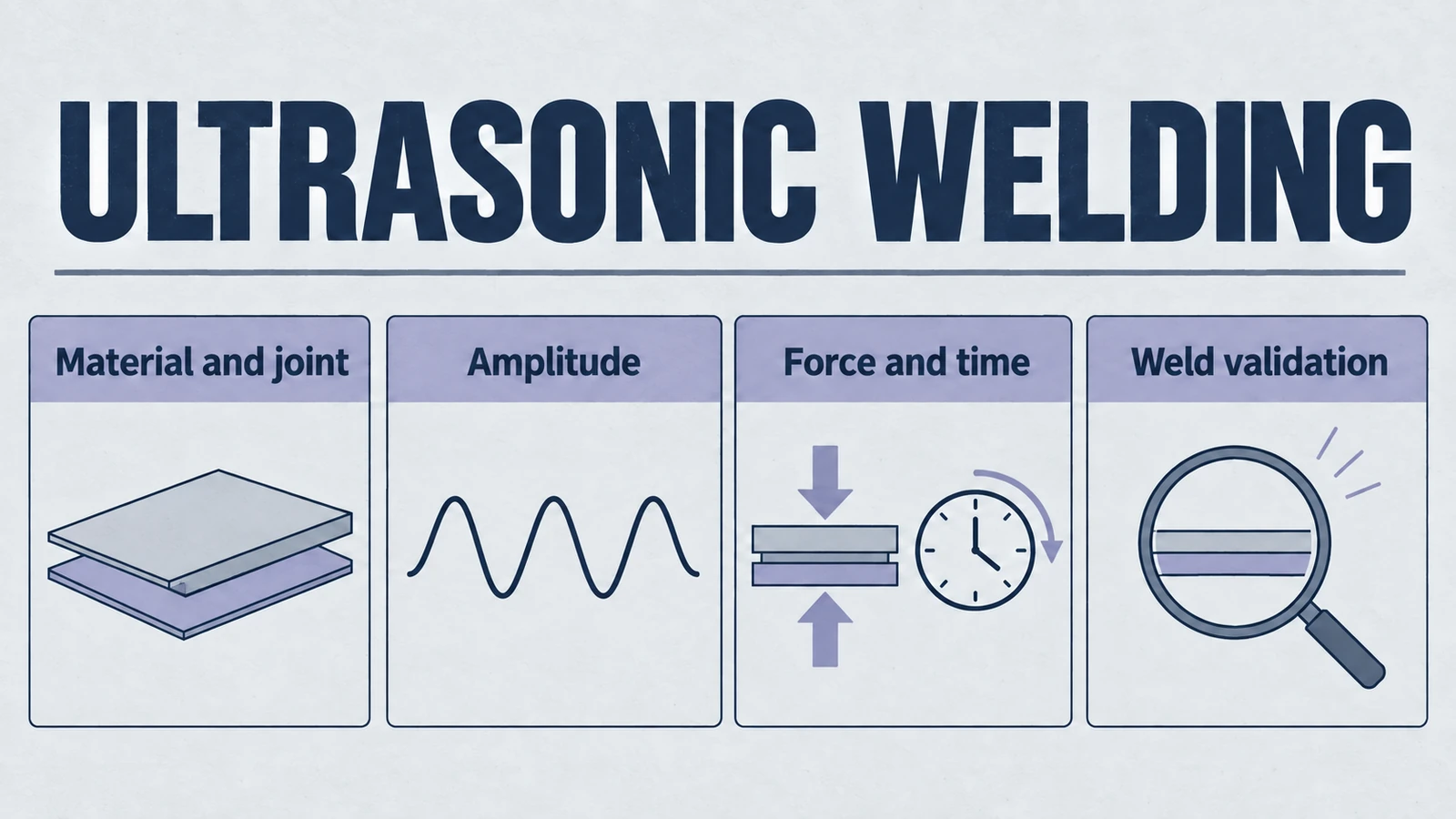
Ultrasonic welding applies high-frequency mechanical vibration to join materials. Thermoplastic welding creates local melting and resolidification; ultrasonic metal welding is generally a solid-state process. Select and qualify the mechanism and process for the actual material pair.
1. Understanding the Physics of Ultrasonic Welding
At its core, ultrasonic welding works by converting electrical energy into high-frequency mechanical vibrations, typically in the range of 20 kHz to 70 kHz. The process involves four key components:
- Power Supply – Converts low-frequency electrical energy into high-frequency power.
- Converter (Transducer) – Transforms electrical signals into mechanical vibrations.
- Booster – Modifies the amplitude of these vibrations.
- Horn (Sonotrode) – Directly delivers the vibrations to the materials being joined.
Product path for this search intent
Match the article topic to the right YJ Piezo product page
Use this article as an application note that connects piezoelectric material behavior, transducer design, and OEM sourcing decisions. For "The Science Behind Ultrasonic Welding: Physics, Applications, and Optimization", the practical value is in turning the topic into a measurable selection or sourcing decision.
- Piezoelectric Ceramics
PZT shapes, materials, and custom manufacturing
- PZT Material Hub
Material property tradeoffs and grade selection
- Ultrasonic Transducer Supplier Hub
OEM transducer development and sourcing
Under applied force, vibration can generate localized heating through interfacial and material dissipation. Thermoplastics fuse after local melting, while metal welding generally joins without bulk melting. Weld strength, deformation and surrounding damage depend on the material, joint, tooling and validated cycle; locality of heat is not a damage-free guarantee.
Key Physics Concepts:
- Acoustic Energy Transmission: Efficient transfer of mechanical vibrations from horn to workpiece is critical.
- Interfacial Friction: Vibrations cause microscopic rubbing, creating localized heat.
- Solid-State Bonding: In metals, atomic diffusion can occur at the interface without full melting.
2. Applications of Ultrasonic Welding
Ultrasonic welding's versatility makes it an ideal solution across industries:
A. Electronics Manufacturing
- PCB assembly: Attaching delicate wires without excessive heat.
- Lithium-ion battery assembly: Welding thin metal foils for current collectors.
B. Automotive Industry
- Plastic components: Dashboards, interior panels, and under-the-hood parts.
- Wiring harnesses: Creating durable electrical connections without solder.
C. Medical Devices
- Catheters and filters: Qualify joint strength, cleanliness and the applicable sterilization process separately; welding alone does not establish sterility.
- Surgical instruments: Joining dissimilar materials while maintaining strength.
D. Packaging Industry
- Sealing blister packs: Tamper-proof and airtight seals.
- Food packaging: Localized heating can seal compatible films without externally heated tooling; validate seal integrity and product exposure.
Why Industries Choose Ultrasonic Welding:
- Speed: Typical welds are completed in under one second.
- Energy Efficiency: Lower power consumption compared to traditional methods.
- Eco-Friendly: No adhesives, solvents, or emissions.
3. Optimization Strategies for Ultrasonic Welding
Achieving high-quality, repeatable ultrasonic welds requires careful process optimization. Below are key factors to consider:
1. Material Compatibility
- Plastics: Amorphous polymers like ABS and polycarbonate respond well to ultrasonic welding.
- Metals: Non-ferrous metals such as aluminum, copper, and brass are ideal.
- Avoid combinations with vastly different melting points unless using advanced horn designs.
2. Frequency and Amplitude Control
- Lower frequencies (20–30 kHz) are better for larger, thicker parts.
- Higher frequencies (35–70 kHz) suit delicate, small parts.
- Fine-tune amplitude to balance weld strength and surface aesthetics.
3. Pressure and Weld Time
- Too much pressure can deform parts; too little results in weak bonds.
- Optimal weld times prevent overheating and material degradation.
4. Horn Design and Maintenance
- Horn shape should match part geometry for even energy distribution.
- Regular inspection prevents performance loss from wear.
5. Quality Monitoring and Testing
- Use appropriate nondestructive inspection and separate destructive mechanical tests, such as tensile-strength testing, according to the validation plan.
- Implement in-line process monitoring to track power, time, and displacement.
Industrial Applications Examples
- Automotive: Interior panels, wiring harnesses, sensor housings using metal welding transducers.
- Electronics: Component assembly, battery tabs, cable splicing with precision welding transducers.
- Medical: Sterile packaging, catheter assembly, filter welding using plastic welding transducers.
- Packaging: Blister sealing, tube ends, tamper-evident closures with industrial welding systems.
4. Conclusion
As industries continue to push for faster production cycles, reduced environmental impact, and improved product reliability, ultrasonic welding is becoming a cornerstone technology in modern manufacturing. Engineers and decision-makers who understand the physics, applications, and optimization strategies behind ultrasonic welding will be well-positioned to leverage its full potential.
If you are considering custom ultrasonic welding solutions for your production line, working with an experienced supplier who can provide tailored horn designs, process optimization, and quality control will ensure maximum return on investment.
To learn about ultrasonic welding feasibility for your applications, contact our technical experts for process evaluation and equipment recommendations.
Engineering decision notes
Piezoelectric application engineering
Use this article as an application note that connects piezoelectric material behavior, transducer design, and OEM sourcing decisions. For "The Science Behind Ultrasonic Welding: Physics, Applications, and Optimization", the practical value is in turning the topic into a measurable selection or sourcing decision.
YJ Piezo reviews piezoelectric projects from material, geometry, electrode, assembly, and outgoing inspection together so the final part fits the real operating condition.
Selection checks
- Clarify whether the design is primarily sensing, actuation, power ultrasonics, atomization, or acoustic measurement.
- Connect the article topic to geometry, material grade, tolerance, operating field, and validation method.
- Define which measurements matter before comparing suppliers: resonance, impedance, capacitance, d33, Qm, or acoustic output.
Failure risks
- A component can meet a simple datasheet value and still fail after bonding, clamping, heat, or acoustic loading.
- Generic material selection can create drift, heating, weak output, or unstable resonance.
- Insufficient RFQ detail forces suppliers to quote assumptions instead of the real engineering requirement.
RFQ details
- What is the operating mode and target application?
- Which electrical, mechanical, and environmental limits must be controlled?
- What sample evidence or outgoing reports are needed before production approval?
Relevant YJ Piezo pages
- Piezoelectric Ceramics
PZT shapes, materials, and custom manufacturing
- PZT Material Hub
Material property tradeoffs and grade selection
- Ultrasonic Transducer Supplier Hub
OEM transducer development and sourcing
Application FAQ
- What extra detail makes a piezoelectric article more useful for engineers?
- Useful detail connects the topic to material choice, geometry, operating load, measurable acceptance criteria, and supplier evidence. That helps readers move from background knowledge to a sourcing or design decision.
- What information should I send YJ Piezo for application guidance?
- Send the application, target dimensions, frequency or sensitivity target, operating medium, duty cycle, temperature range, expected quantity, and any current test data or failure symptoms.