
Ultrasonic Welding Transducers: Improving Plastic Welding Processes
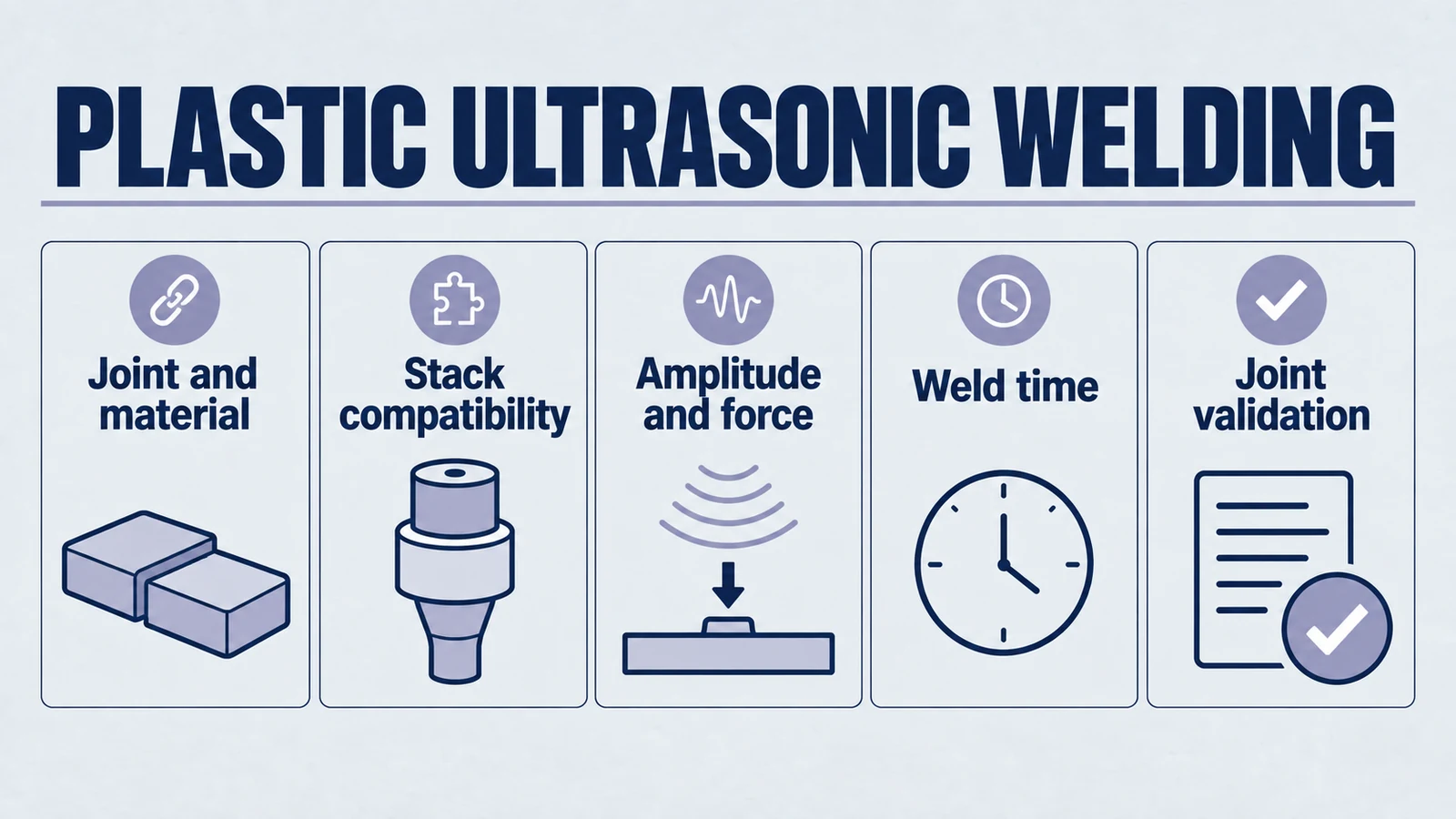
In modern plastic manufacturing, achieving strong, clean, and reliable bonds is essential across industries such as automotive, medical, electronics, and packaging. One of the most effective methods for joining thermoplastics is ultrasonic welding—a process that relies heavily on a precise and powerful component known as the ultrasonic welding transducer, sometimes also referred to as an ultrasonic welding converter.
This article explores how ultrasonic welding transducers work, their role in improving plastic welding processes, and what engineers and procurement specialists should consider when choosing a converter for their ultrasonic welding systems.
What is an Ultrasonic Welding Transducer?
An ultrasonic welding transducer is a core component of an ultrasonic welding system. It converts high-frequency electrical signals—usually in the 15 kHz to 40 kHz range—into high-frequency mechanical vibrations. These vibrations are transmitted through a booster and horn to the plastic materials being welded, causing localized melting and fusion at the joint.
Product path for this search intent
Match the article topic to the right YJ Piezo product page
Use this article as an application note that connects piezoelectric material behavior, transducer design, and OEM sourcing decisions. For "Ultrasonic Welding Transducers: Improving Plastic Welding Processes", the practical value is in turning the topic into a measurable selection or sourcing decision.
- Piezoelectric Ceramics
PZT shapes, materials, and custom manufacturing
- PZT Material Hub
Material property tradeoffs and grade selection
- Ultrasonic Transducer Supplier Hub
OEM transducer development and sourcing
The term ultrasonic welding converter is often used interchangeably with transducer, particularly in North American markets.
Key Components of an Ultrasonic Welding Stack:
- Generator: Supplies high-frequency electrical energy.
- Transducer/Converter: Converts electrical signals into mechanical vibration.
- Booster: Modifies amplitude.
- Horn (Sonotrode): Applies the vibration directly to the material.
How Ultrasonic Welding Transducers Enhance the Process
1. Precision and Consistency
Transducers are designed to vibrate at a precise resonant frequency. High-quality transducers maintain frequency stability and amplitude output over thousands of cycles, ensuring consistent welds. This is especially critical in industries like automotive or medical devices, where consistency is non-negotiable.
2. Energy Efficiency
By efficiently converting electrical input into mechanical motion, advanced ultrasonic welding converters minimize energy loss and reduce heat generation outside the weld zone. This leads to shorter cycle times and lower power consumption.
3. Improved Weld Quality
Uniform mechanical vibration ensures even energy distribution across the weld interface, reducing flash, burn marks, or weak joints. With the right converter, manufacturers can achieve nearly invisible, high-strength welds even on small or intricate parts.
4. Durability and Reliability
Well-built transducers use quality piezoelectric ceramics and robust metal housings to withstand mechanical stress and thermal cycling. This reduces downtime and maintenance costs over time.
Key Specifications to Consider When Selecting a Transducer
When selecting an ultrasonic welding transducer or converter, engineers should evaluate:
- Operating Frequency: 20 kHz and 35 kHz are most common for plastic welding. Frequency must match the generator and horn.
- Power Rating: Choose a transducer that can handle the required welding power, typically from 500W to over 3000W.
- Piezoelectric Stack Design: Number and quality of ceramic discs affect performance.
- Connector Type: Electrical and mechanical compatibility with existing systems.
- Cooling Method: Some systems require air or water cooling, especially for high-duty cycles.
- Resonance Stability: Resistance to frequency drift ensures long-term accuracy.
Common Applications of Ultrasonic Welding Transducers
- Automotive components: Instrument panels, tail lamps, sensors
- Medical devices: Catheters, IV components, surgical tools
- Electronics: USB cases, battery enclosures, wire terminations
- Consumer products: Toys, containers, cosmetic packaging
- Textiles and nonwovens: Masks, filters, synthetic fabrics
Each application may demand a customized ultrasonic welding stack, starting with the right transducer.
Choosing the Right Supplier
Not all transducers are created equal. For critical applications, it's essential to work with a supplier that offers:
- In-house piezoelectric ceramic manufacturing
- Frequency and amplitude matching services
- Customization for specialized weld geometries
- Reliable quality control and batch traceability
- Responsive engineering support and short lead times
At Yujie, we offer a full range of ultrasonic welding transducers and converters designed for both OEMs and integrators. Whether you're developing a compact handheld welder or a high-throughput robotic line, our team can support your requirements with tailored solutions.
Conclusion
The ultrasonic welding transducer is more than just a part—it's the heart of any ultrasonic welding system. By choosing a high-quality, precisely matched converter, manufacturers can improve weld strength, reduce defects, and increase production efficiency.
If you're looking to upgrade your ultrasonic welding setup or need a reliable source for custom transducers, contact us today to discuss your application.
Engineering decision notes
Piezoelectric application engineering
Use this article as an application note that connects piezoelectric material behavior, transducer design, and OEM sourcing decisions. For "Ultrasonic Welding Transducers: Improving Plastic Welding Processes", the practical value is in turning the topic into a measurable selection or sourcing decision.
YJ Piezo reviews piezoelectric projects from material, geometry, electrode, assembly, and outgoing inspection together so the final part fits the real operating condition.
Selection checks
- Clarify whether the design is primarily sensing, actuation, power ultrasonics, atomization, or acoustic measurement.
- Connect the article topic to geometry, material grade, tolerance, operating field, and validation method.
- Define which measurements matter before comparing suppliers: resonance, impedance, capacitance, d33, Qm, or acoustic output.
Failure risks
- A component can meet a simple datasheet value and still fail after bonding, clamping, heat, or acoustic loading.
- Generic material selection can create drift, heating, weak output, or unstable resonance.
- Insufficient RFQ detail forces suppliers to quote assumptions instead of the real engineering requirement.
RFQ details
- What is the operating mode and target application?
- Which electrical, mechanical, and environmental limits must be controlled?
- What sample evidence or outgoing reports are needed before production approval?
Relevant YJ Piezo pages
- Piezoelectric Ceramics
PZT shapes, materials, and custom manufacturing
- PZT Material Hub
Material property tradeoffs and grade selection
- Ultrasonic Transducer Supplier Hub
OEM transducer development and sourcing
Application FAQ
- What extra detail makes a piezoelectric article more useful for engineers?
- Useful detail connects the topic to material choice, geometry, operating load, measurable acceptance criteria, and supplier evidence. That helps readers move from background knowledge to a sourcing or design decision.
- What information should I send YJ Piezo for application guidance?
- Send the application, target dimensions, frequency or sensitivity target, operating medium, duty cycle, temperature range, expected quantity, and any current test data or failure symptoms.