
Beyond the Catalog: The Strategic Imperative for Sourcing Custom Piezoelectric Ceramics from China
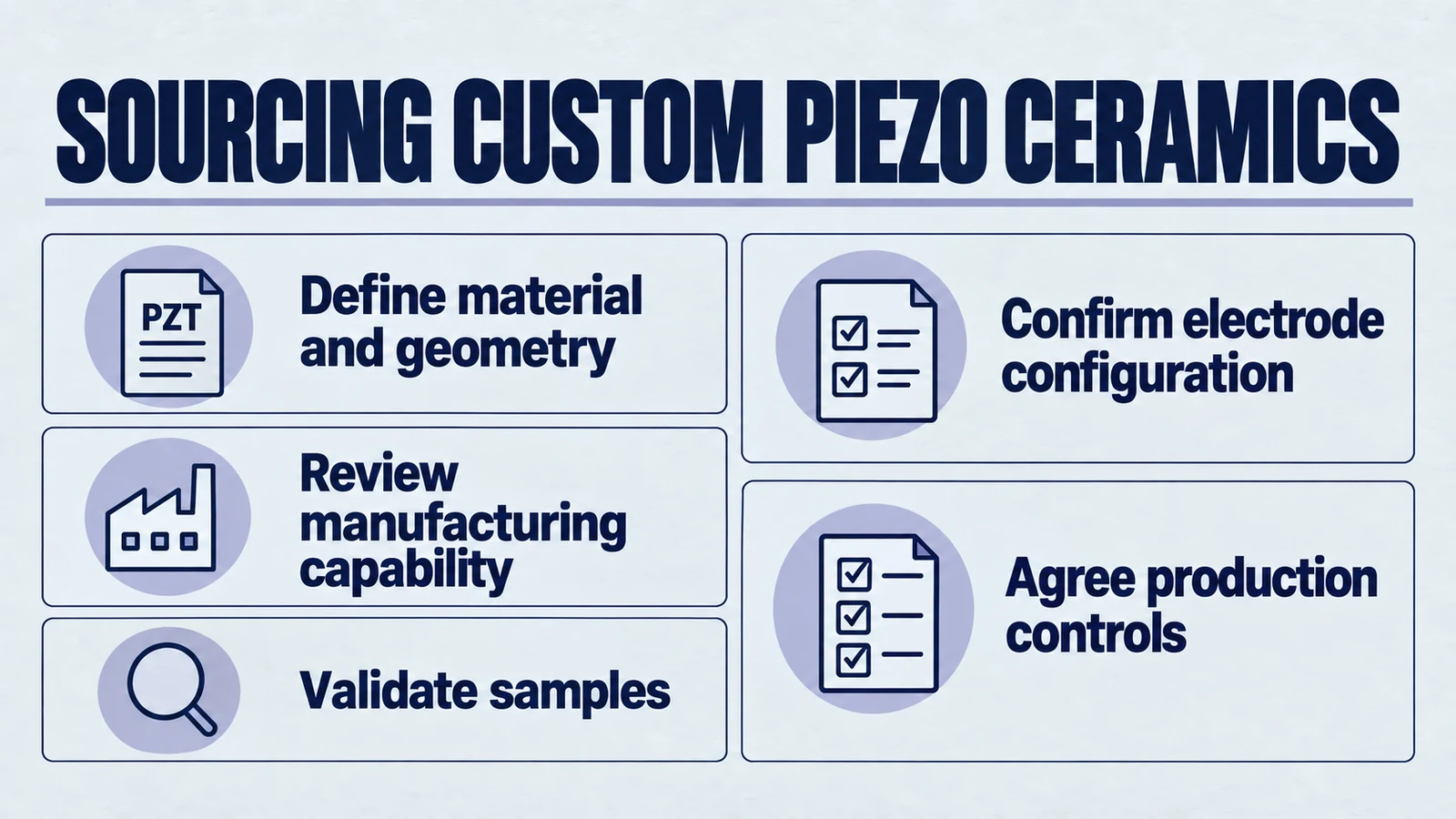
The Performance Ceiling of Off-the-Shelf Piezo Components
In the landscape of modern engineering, standard piezoelectric components serve as foundational building blocks for a vast array of applications. From simple sensors to basic actuators, off-the-shelf parts provide reliable, cost-effective solutions for conventional design challenges. However, a significant and growing number of advanced systems—particularly in sectors like medical technology, aerospace, and industrial automation—are relentlessly pushing the boundaries of performance. In these demanding fields, innovation is often constrained not by the limits of imagination, but by the inherent limitations of catalog components. Engineers and system designers are increasingly encountering a "performance ceiling" where standard parts are no longer sufficient to meet the sophisticated requirements of next-generation technology.
This performance gap becomes evident when projects face specific, non-negotiable engineering constraints. Standard components, designed for the broadest possible market, often fail when confronted with specialized operational demands. Key scenarios where off-the-shelf solutions consistently fall short include:
- Confined Space and Miniaturization: The drive towards smaller, more powerful devices, especially in medical implants, wearables, and high-density electronics, imposes severe spatial limitations. Standard piezoelectric rectangular plates, with their fixed geometries, are often too large or improperly shaped for these compact designs, forcing compromises in functionality or overall product size.
- Extreme Operating Environments: Many advanced applications require components to function flawlessly under harsh conditions. Piezoelectric cleaning transducers and sensors may need to operate at extraordinarily high temperatures, with some industrial processes requiring stability up to 300°C, far exceeding the tolerance of standard materials and assemblies.
- Unique Loading and Measurement Conditions: Certain applications, such as precision manufacturing or materials testing, necessitate the measurement of very small force variations under a significant initial load (preload). Standard sensors lack the specialized design and adjustable electronics needed to isolate and accurately measure these minute changes, leading to poor resolution and unreliable data.
- High Dynamics and Overload Stability: Systems in aerospace and industrial robotics often require components that exhibit both a highly dynamic response to capture fast-changing events and extreme overload stability to withstand unexpected shocks or forces. A component optimized for one of these characteristics in a standard catalog is often deficient in the other, creating a critical design trade-off that can compromise system safety and performance.
Product path for this search intent
Match the article topic to the right YJ Piezo product page
Use this article when the risk is supplier selection, engineering support, validation evidence, integration reliability, and whether the manufacturer can scale from sample to production. For "Beyond the Catalog: The Strategic Imperative for Sourcing Custom Piezoelectric Ceramics...", the practical value is in turning the topic into a measurable selection or sourcing decision.
- Ultrasonic Transducer Supplier Hub
OEM sourcing and engineering collaboration
- PZT Material Supplier Hub
Material control and grade selection
- Piezoelectric Ceramics
Ceramic manufacturing and custom shapes
When engineers are forced to use a component that is not an ideal fit, they must design around its limitations. This workaround process imposes a hidden but substantial "design tax" on the project. For instance, if the only available standard sensor is too large for a designated cavity, the engineering team must redesign the housing, modify mounting brackets, and potentially alter adjacent parts to accommodate it. This cascade of modifications adds significant time to design cycles, increases material costs, introduces new potential points of failure, and adds unnecessary weight and complexity to the final system. Consequently, a seemingly "cost-effective" standard part can trigger a series of expensive and inefficient compromises, proving that the problem is not merely a component performance gap but a systemic inefficiency. The critical question for innovators then becomes: when progress is hindered by the availability of suitable components, where do engineers turn for a solution that optimizes the entire system?
Deconstructing Customization: A Framework for Engineering Bespoke Piezoelectric Ceramics
The answer lies in moving beyond the catalog to custom-engineered solutions. The term "customization" in the context of piezoelectric ceramics extends far beyond simple adjustments to length or diameter. It represents a multi-disciplinary engineering process that synthesizes material science, mechanical design, and electrical engineering to create a component perfectly tailored to its intended application. A truly bespoke piezoelectric device is not merely a part; it is an integrated solution designed from the ground up to meet a precise set of performance criteria. Understanding the key parameters that can be tailored is essential for any engineer looking to unlock the full potential of this technology.
This detailed customization framework can be broken down into several critical domains, each offering a distinct lever to control and optimize final performance.
Material Composition
The foundation of any piezoelectric device is the ceramic material itself. The choice of composition directly dictates the component's core electromechanical properties. Manufacturers can formulate and select from a range of materials to achieve specific behaviors. For instance, "hard" PZT (lead zirconate titanate) formulations like PZT-8 are ideal for high-power, high-frequency applications such as ultrasonic welding and industrial cleaning systems, where they offer low mechanical loss and high coercive field strength to resist depolarization under strong electric fields. Conversely, "soft" PZT materials exhibit higher sensitivity and a greater piezoelectric charge coefficient, making them better suited for sensor applications and low-power actuators. Furthermore, in response to global environmental regulations and market demand, there is a significant and growing trend toward the development and use of lead-free piezoelectric alternatives, such as barium titanate, for applications in medical devices and consumer electronics. A capable manufacturing partner can guide the selection of the ideal material to balance performance, cost, and regulatory compliance.
Geometry and Dimensions
While material selection sets the intrinsic properties, the physical geometry of the ceramic element defines its extrinsic behavior, particularly its acoustic and vibratory characteristics. Custom shapes—including discs, rings, plates, tubes, spheres, and more complex forms—are engineered not just to fit into a designated physical space, but to fundamentally control the device's resonant frequency and mode of vibration. Advanced cutting and machining techniques allow for dimensional tolerances within ± 0.001 inches, ensuring high consistency for resonant devices where even minor variations can significantly impact performance. This geometric precision is critical for applications ranging from flow meters that rely on a specific frequency to medical ultrasound transducers where the shape of the element determines the focus and shape of the acoustic beam.
Electrode Configuration
The electrodes applied to the ceramic surface are the interface through which electrical energy is delivered or extracted. Customizing the electrode material (e.g., silver, nickel, gold) and its pattern is a powerful tool for enhancing functionality. For example, wrap-around electrodes can simplify wiring and assembly processes in compact devices. More complex patterns can create multi-element transducers from a single piece of ceramic, forming the basis for phased arrays. Phased array transducers, used in advanced medical imaging and non-destructive testing, allow for electronic steering and focusing of the ultrasonic beam without any moving parts, a capability requiring independently driven elements, controlled delays and appropriate acoustic/electronic design; electrode pattern alone is insufficient.
Advanced Packaging and Assembly
For many demanding applications, the raw ceramic element is only the starting point. The process of packaging—encapsulating the brittle ceramic in a protective and functional housing—is often the most critical aspect of customization. Professional packaging transforms a fragile component into a robust, reliable transducer ready for real-world deployment. This process provides five core benefits:
- Robustness: Piezoelectric ceramics are inherently brittle and susceptible to cracking from mechanical shock. Packaging the ceramic between layers of polymers or composites distributes strain and protects the element from impact, dramatically increasing its durability.
- Integrated Electrical Connections: Soldering wires directly to the thin silvering on a raw ceramic is notoriously difficult and can be unreliable. Professional packaging integrates the ceramic into a flexible circuit (similar to a printed circuit board), providing robust solder pads or connectors for easy and reliable electrical integration.
- Packaging and Insulation: Encapsulation, dust/immersion protection and gas-leak hermeticity are distinct properties. Request the relevant leakage/environmental tests and exact assembly limits; encapsulation alone does not establish hermetic sealing or submersion reliability.
- Simplified Mechanical Integration: Integrating a raw ceramic wafer into a larger mechanical system can be challenging. A packaged transducer can be designed with custom shapes, mounting holes, and other features that allow for simple and secure mechanical assembly.
- Lead Exposure Mitigation: The most common piezoelectric material, PZT, contains lead. Packaging fully encapsulates the ceramic, isolating the lead and mitigating health and safety concerns for handlers and end-users.
By systematically addressing these parameters—from the atomic structure of the material to the final protective housing—engineers can collaborate with a manufacturing partner to develop a truly custom solution. This collaborative process, which involves defining key parameters like stroke length, blocking force, and drive voltage for actuators, ensures the final component is not just a part that fits, but a solution that elevates the performance of the entire system.
| Parameter | Description | Impact on Application Performance |
|---|---|---|
| Material Composition | Selection of specific PZT formulations (e.g., hard PZT-8 vs. soft PZT-5) or lead-free alternatives. | Determines power handling, sensitivity (d₃₃ coefficient), Curie transition and separately qualified operating-temperature limits, and electromechanical coupling factor (Kₚ). |
| Geometry & Dimensions | Custom shapes (discs, rings, plates, tubes) and precise dimensional tolerances (within ± 0.001 inch). | Defines resonant frequency, vibration mode, acoustic impedance matching, and physical integration into space-constrained devices. |
| Electrode Pattern | Customization of electrode material (e.g., silver, nickel) and pattern on the ceramic surface. | Enables specific functionalities like beam focusing, multi-element arrays, or wrap-around contacts for easier wiring and assembly. |
| Protective Packaging | Encapsulation of the raw ceramic in polymers, FR4, or other materials to create a robust, sealed unit. | Dramatically increases durability, requires separate validated leakage and environmental protection for the intended exposure, simplifies electrical connections, and eases mechanical mounting. |
| Drive Electronics & Calibration | Tailoring the amplifier and control loop (for closed-loop systems) to the specific actuator. | Optimizes resolution, step size, response time, and long-term stability for precision positioning applications. |
The New China Paradigm: From Cost-Effective Sourcing to Innovation Partnership
The decision to pursue a custom piezoelectric solution naturally leads to the question of sourcing. For decades, the global perception of manufacturing in China was dominated by the narrative of low labor costs. While this was once a primary driver, that paradigm is now profoundly outdated. Today, sourcing highly technical components like custom piezoelectric ceramics from China is no longer just an outsourcing decision for cost reduction; it is a strategic move to engage with a global epicenter of advanced manufacturing, supply chain efficiency, and rapid innovation. This "New China Paradigm" is built on a foundation of tangible, data-driven advantages that are crucial for companies developing cutting-edge products.
A primary factor is China's manufacturing scale and supplier depth. The country's piezoelectric materials ecosystem is supported by sustained equipment investment, specialized labor, and a broad upstream and downstream supply chain. For international clients, this translates into access to specialized knowledge and production capacity.
This market scale is supported by a profound shift towards advanced manufacturing and precision engineering. Leading Chinese manufacturers have invested heavily in state-of-the-art equipment and technologies, enabling the production of components with exceptional precision and consistency. They increasingly adhere to stringent international quality standards and certifications, such as ISO, ensuring that their products meet the rigorous demands of global markets in Europe and North America. This commitment to quality control is a critical part of the modern manufacturing process in China, dispelling outdated notions of inferior product quality.
Perhaps the most compelling aspect of the new paradigm is the transition from mere production to active innovation. The Chinese piezoelectric market is a hotbed of material science advancements, driven by both regulatory pressures and market opportunities. There is a significant push toward developing high-performance, lead-free materials to comply with environmental standards, as well as innovation in advanced composites and smart materials that offer enhanced durability and functionality. Partnering with a Chinese manufacturer provides direct access to this ongoing research and development, allowing companies to incorporate the latest material innovations into their products.
This entire ecosystem is underpinned by a highly efficient and resilient supply chain. China's well-developed infrastructure and proximity to raw material suppliers reduce transportation costs and shorten lead times—a critical advantage for complex custom projects that require rapid prototyping and iteration. This efficiency is managed by a large, skilled, and educated workforce capable of executing complex manufacturing processes and maintaining high quality standards.
A powerful, self-reinforcing dynamic is at play: adoption of piezoelectric technology within China's domestic industries creates pressure for better materials, smaller components, and more consistent high-volume production. Consumer electronics, automotive manufacturing, and medical-device programs all demand stable piezoelectric components. To compete in this environment, Chinese component manufacturers must improve precision manufacturing, quality control, and application engineering. International firms sourcing custom piezoelectric ceramics from China can benefit from this supplier ecosystem when they verify capabilities, documentation, and production controls carefully.
Application Deep Dive: Where Custom Chinese Piezoelectric Ceramics Can Add Value
The theoretical advantages of custom-engineered piezoelectric ceramics become tangible when examined through the lens of specific, high-stakes applications. Across a range of industries, bespoke components are not just incremental improvements but enabling technologies, allowing for breakthroughs in performance, reliability, and functionality that would be impossible with standard parts.
1. Medical Technology: Precision and Reliability
In healthcare equipment, custom piezoelectric transducers can support demanding imaging, sensing, and actuation requirements. In advanced ultrasonic imaging, for example, transducers must be tailored for specific frequencies, focal depths, and beam shapes to produce high-resolution images. Customizing the ceramic's geometry, material composition, and matching layers allows device manufacturers to create probes for specialized applications, from intravascular ultrasound to high-frequency dermatology imaging. Other medical device programs may use custom piezo elements in focused ultrasound equipment or ultrasonic instruments, but output limits, use cases, risk controls, and regulatory submissions remain the responsibility of the finished-device manufacturer.
2. Industrial Automation: Speed and Endurance
The world of industrial automation is defined by a relentless pursuit of speed, precision, and uptime. Custom piezoelectric solutions are critical for achieving the nanometer-level control required in the most demanding processes. In semiconductor manufacturing, custom piezo actuators are essential components in wafer inspection systems, lithography stages, and mask alignment tools, where their ability to produce rapid, repeatable, and vibration-free motion is paramount. In the realm of industrial assembly, ultrasonic welding has become a key technology for joining plastics and thin metals in the automotive and electronics industries. These systems require robust, high-power transducers, often made from hard PZT-8 ceramics, that are custom-designed to match the specific frequency and power requirements of the welding horn (sonotrode) and the materials being joined. Customization ensures maximum energy transfer, resulting in stronger, more consistent welds and longer tool life.
3. Aerospace & Defense: Robustness in Extreme Conditions
The aerospace and defense sectors operate under the most stringent performance and reliability standards. Components must withstand extreme temperatures, vibration, and mechanical shock while performing flawlessly. Custom, robustly packaged piezoelectric sensors are widely used for structural health monitoring in aircraft, where they are embedded within composite materials to detect stresses, impacts, or the formation of micro-cracks in real-time. In defense, piezoelectric materials are fundamental to sonar and underwater acoustic systems. Transducers for marine navigation, submarine detection, and underwater communication must be customized for specific operating frequencies, beam patterns, and the ability to withstand immense hydrostatic pressure, requiring sophisticated material science and mechanical design. Their high sensitivity and reliability also make them crucial for smart guidance systems and fuzes in advanced munitions.
4. Automotive & Consumer Electronics: Miniaturization and Smart Features
The proliferation of smart, connected devices in the automotive and consumer electronics industries has created massive demand for compact, efficient, and high-performance piezoelectric components. In modern vehicles, custom piezo actuators are used in advanced fuel injection systems for more precise fuel delivery, leading to improved efficiency and reduced emissions. Piezoelectric sensors are also integral to tire pressure monitoring systems, knock sensors, and advanced driver-assistance systems (ADAS). In consumer electronics, the impact is even more visible. The push for thinner, lighter smartphones and wearables has driven the adoption of miniaturized piezoelectric speakers, microphones, and haptic feedback actuators. China's massive domestic market for these devices has made it a leader in developing custom piezo solutions that deliver rich haptic responses and clear audio in incredibly small form factors, enhancing the user experience.
A Blueprint for Partnership: Vetting and Selecting Your Custom Piezoelectric Manufacturer in China
Successfully leveraging the benefits of custom piezoelectric ceramics hinges on selecting the right manufacturing partner. The process of developing a bespoke component is inherently collaborative, requiring deep technical expertise, transparent communication, and a shared commitment to achieving the project's goals. For engineers and sourcing managers, navigating the landscape of potential suppliers in China requires a clear set of criteria to distinguish a simple fabricator from a true engineering partner. This blueprint provides a checklist of non-negotiable attributes to look for in a world-class custom piezoelectric manufacturer.
A critical starting point is to evaluate the supplier's core competency and experience. The ideal partner is not just a manufacturer but a specialist in collaborative design and production for external clients. Look for a company with a long and verifiable history of providing deep OEM (Original Equipment Manufacturer) and ODM (Original Design Manufacturer) services. A track record spanning over two decades, for instance, demonstrates stability and a wealth of experience in solving diverse and complex engineering challenges for a global clientele.
The partner's internal capabilities are paramount. A true partner must possess in-house engineering and simulation capabilities. The ability to perform finite element analysis (FEA) and other simulations is crucial for validating and iterating on custom designs before committing to expensive physical prototypes. This collaborative design process allows for the optimization of performance, identification of potential failure modes, and refinement of the component's geometry and material properties. This expertise is the bridge between a theoretical concept and a reliable, manufacturable product. A supplier that only manufactures to a print cannot provide this level of value. They must be able to analyze a design and provide critical feedback, asking questions like, "Could a minor change to this dimension improve the resonant characteristics?" or "Can we use a different electrode pattern to simplify your final assembly process?" This "Design for Manufacturability" (DFM) feedback is an invaluable service that saves time, reduces cost, and improves the final product's reliability.
Material expertise is another non-negotiable. The manufacturer should demonstrate material flexibility and deep knowledge of various piezoelectric compositions. They should be able to consult on the trade-offs between different PZT grades, lead-free alternatives, and other piezoelectric materials, guiding the selection process to perfectly match the application's requirements for power, sensitivity, and operating environment.
The entire engagement should be governed by a transparent and collaborative process. From the initial concept discussion to final production, the partner's engineers should work closely with the client's team, ensuring alignment at every stage. This includes clear communication protocols, regular progress updates, and a structured approach to design reviews and approvals.
Furthermore, quality cannot be an afterthought. Insist on verifiable quality assurance and international certifications. A commitment to quality is demonstrated by adherence to standards like ISO 9001 and the ability to provide comprehensive testing and validation data for all components. This ensures that every part, from the first prototype to the millionth production unit, meets the agreed-upon specifications.
Finally, the partner must have scalable production capabilities. The ability to support the entire product lifecycle, from small-batch prototypes for initial testing to high-volume production runs for market launch, is essential. This flexibility ensures that the partner can grow with the project, providing a stable and reliable supply chain as demand increases.
By using this checklist, companies can mitigate the risks associated with global sourcing and identify a partner that will function as an extension of their own engineering team—one that is equipped to turn the most complex design challenges into high-performance, market-ready solutions.
Conclusion: Engineering Your Competitive Edge with a Specialized Partner
The trajectory of technological advancement is clear: systems are becoming more intelligent, more compact, and more capable. In this environment, relying solely on standard, off-the-shelf components is no longer a viable strategy for innovation. A performance ceiling exists, and breaking through it requires a move from generic parts to solutions engineered for a specific purpose. Custom piezoelectric ceramics represent a powerful tool for achieving this, offering tailored performance that can unlock new levels of efficiency, precision, and reliability.
The evidence strongly indicates that the modern Chinese manufacturing ecosystem has evolved far beyond its origins as a low-cost production center. It now stands as a global hub of innovation, advanced engineering, and supply chain excellence, making it the ideal environment for developing and sourcing these sophisticated custom components. The decision to partner with a specialized manufacturer in China is a strategic one, providing access to cutting-edge material science, precision manufacturing capabilities, and a depth of experience forged in the world's most competitive high-tech markets.
Ultimately, sourcing custom piezoelectric ceramics from a dedicated partner is about more than just acquiring a component; it is about engineering a competitive advantage. It is about optimizing an entire system rather than compromising a design, mitigating project risk through collaborative engineering, and accelerating the journey from concept to market.
Your most complex engineering challenges require more than a part number from a catalog. They require a dedicated engineering partner. Contact the specialists at Yujie to discuss your specific application requirements and discover how a custom piezoelectric solution can unlock the next level of performance for your system.
Engineering decision notes
OEM integration and supplier qualification
Use this article when the risk is supplier selection, engineering support, validation evidence, integration reliability, and whether the manufacturer can scale from sample to production. For "Beyond the Catalog: The Strategic Imperative for Sourcing Custom Piezoelectric Ceramics...", the practical value is in turning the topic into a measurable selection or sourcing decision.
YJ Piezo combines direct project coordination with ceramic manufacturing support, so procurement and engineering teams can evaluate material control, application review, sample validation, and production consistency together.
Selection checks
- Ask whether the supplier controls ceramic manufacturing or only assembles purchased elements.
- Review sample policy, inspection records, engineering response quality, and production lead-time stability.
- Compare suppliers and integration paths by validation evidence, not only by unit price and datasheet similarity.
Failure risks
- A low-price sample can pass early tests but fail when batch variation, thermal load, or assembly stress appears.
- A supplier without material control may not explain why impedance, capacitance, or resonance drift occurs.
- Weak RFQ information leads to quotes that are fast but not technically comparable.
RFQ details
- What application, operating environment, and failure cost should the supplier design around?
- Which sample tests and outgoing records are required before pilot production?
- What customization, MOQ, tooling, and delivery constraints must be known before quotation?
Relevant YJ Piezo pages
- Ultrasonic Transducer Supplier Hub
OEM sourcing and engineering collaboration
- PZT Material Supplier Hub
Material control and grade selection
- Piezoelectric Ceramics
Ceramic manufacturing and custom shapes
Application FAQ
- How should an OEM compare piezoelectric suppliers?
- Compare material control, engineering support, test evidence, customization ability, sample policy, and batch consistency. Unit price matters, but only after the technical risk is understood.
- What makes an RFQ technically useful?
- A useful RFQ includes application, dimensions, target frequency, electrical limits, duty cycle, operating medium, environment, expected quantity, required reports, and current failure or replacement context.