
Beyond the Disc: Unlocking Precision with Custom Rectangular Piezo Plates
Introduction: Precision Engineering Starts with the Right Shape
In the pursuit of high-performance engineering, a system is often only as strong as its most constrained component. For designers working at the cutting edge of medical, industrial, and consumer electronics, this limitation frequently arises from relying on off-the-shelf components that offer a "good enough" fit but fail to unlock a product's true potential. Within the realm of smart materials, piezoelectric technology stands out for its unique ability to convert mechanical energy into electrical signals (the direct effect) and vice-versa (the inverse effect), making it foundational for both sensors and actuators. While material selection is paramount, a frequently overlooked variable is the component's geometry. The shape of a piezoelectric element is not merely a matter of packaging; it is a fundamental design parameter that dictates its performance.
This is where the custom rectangular piezo plate emerges as a powerful and versatile solution. Moving beyond the ubiquitous disc and ring formats, a precisely tailored rectangular plate can solve complex engineering challenges that are impossible to address with radially symmetric components. By carefully defining the length, width, and thickness, engineers can fundamentally transform the behavior of a component to achieve targeted outcomes in actuation, sensing, and energy harvesting. This report explores how custom rectangular piezo plates serve as the building blocks for next-generation applications and how partnering with a bespoke solutions provider is the key to unlocking strong precision and performance.
Use this page when rectangular plates are already on the shortlist: if you are still comparing rectangular plates with discs, rings, tubes, or focused curved ceramics, start with the broader overview of piezoelectric ceramic geometries and then return here when the rectangular path is the one you need to evaluate.
Product path for this search intent
Match the article topic to the right YJ Piezo product page
Use this article when the choice is not just a shape, but a material tradeoff between sensitivity, loss, coupling, stability, and operating field. For "Beyond the Disc: Unlocking Precision with Custom Rectangular Piezo Plates", the practical value is in turning the topic into a measurable selection or sourcing decision.
- PZT Material Hub
Material grades and application tradeoffs
- Piezoelectric Ceramics
Shapes and ceramic manufacturing options
- PZT Material Supplier Hub
Material control, grade selection, and sourcing support
The Foundational Advantage: Why Rectangular Piezo Plates?
The decision to specify a custom rectangular piezo plate over a standard disc is an act of engineering intent. It signifies a shift from a general-purpose component to a specialized tool designed for anisotropic, or direction-dependent, performance. Unlike a radially symmetric disc, a rectangular transducer possesses distinct axes that can be aligned with specific mechanical or electrical vectors within a system to maximize efficiency, sensitivity, and control.
The primary advantages of the rectangular form factor are rooted in its geometry:
- Directional Actuation and Linear Motion: While a piezo disc expands and contracts radially, a rectangular plate can be designed to produce preferential displacement along its length. This makes it a natural choice for linear actuators, "stripe" or bender actuators, and applications requiring controlled, directional movement.
- Uniform Force Distribution and Sensing: In sensing applications, a rectangular plate can be oriented to be most sensitive to stress along a specific axis. This is critical in fields like structural health monitoring, where stress concentrations in beams or panels occur in predictable directions. The uniform shape allows for more consistent pressure sensing over a defined area.
- Efficient Tiling for Large-Scale Arrays: The straight edges and flat surfaces of rectangular plates allow them to be tiled together with minimal wasted space. This is essential for creating large-scale, high-density arrays for applications like industrial non-destructive testing (NDT) and advanced medical ultrasound imaging, where a wide aperture is required for high-resolution results.
- Ideal for Cantilever and Beam Configurations: Rectangular plates are the natural geometry for cantilever beam designs, which are fundamental to many vibration sensors and energy harvesting devices. In this configuration, the plate is fixed at one end, and vibrations cause it to bend, maximizing strain and thus the electrical output. This principle is leveraged in aerospace applications where rectangular piezoelectric patches are bonded to turbine blades to actively damp harmful vibrations.
By leveraging these geometric benefits, engineers can create "smart structures" where the piezoelectric component is not just an add-on but an integrated part of the system's mechanical and electrical design.
Engineering the Perfect Fit: Key Parameters for Custom Piezo Plates
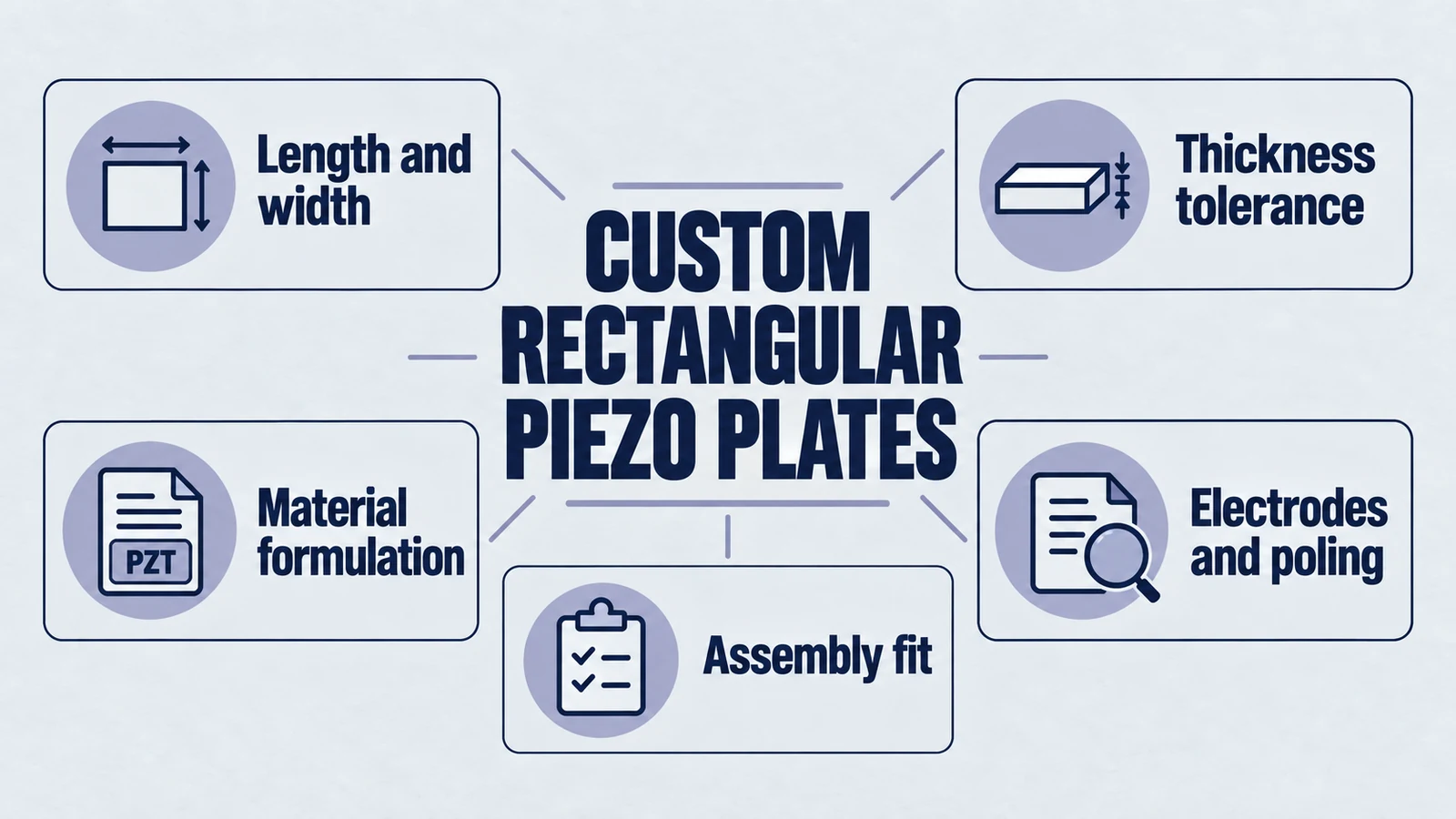
Creating the optimal rectangular piezo plate requires a systems-thinking approach where material science, dimensional engineering, and electrical configuration are considered in concert. A change in one parameter necessitates a re-evaluation of the others, making expert consultation crucial. The customization process can be broken down into three interdependent pillars.
Material Formulation (The "What")
The foundation of any piezo component is its material composition. The choice between "soft" and "hard" PZT (lead zirconate titanate) ceramics is the first and most critical decision, as it defines the component's core behavior.
- Soft PZT: Materials like PZT-5A and PZT-5H are characterized by high piezoelectric charge constants (d₃₃), high sensitivity, and high permittivity. These properties make them ideal for sensing applications that require a strong electrical response to a small mechanical stress. They are the material of choice for medical imaging transducers, sensitive acoustic sensors, and low-power actuators where large displacement is needed.
- Hard PZT: Materials such as PZT-4 and PZT-8 exhibit high mechanical quality factors (Qₘ), excellent stability under high mechanical loads and strong electric fields, and high Curie temperatures. These robust characteristics are essential for high-power applications, including ultrasonic cleaning and welding transducers, sonar projectors, and industrial actuators that must operate reliably under demanding conditions.
A specialist manufacturer can provide custom PZT formulations to fine-tune these properties for a specific application's requirements.
Dimensional Engineering (The "How Big")
For a rectangular piezo plate, the dimensions are not arbitrary measurements but critical inputs that define its mechanical and electrical response.
- Thickness: This is arguably the most influential dimension. A thinner plate requires a lower voltage to achieve a given electric field, making it suitable for low-voltage actuators. However, thickness is also inversely proportional to the fundamental thickness-mode resonant frequency; thinner plates generally give higher thickness-mode frequencies for a given material and boundary condition.
- Length & Width (Aspect Ratio): The ratio of length to width (L/W) is a key design parameter that governs the plate's bending modes and vibrational behavior. For bender actuators, a high aspect ratio maximizes tip displacement. For energy harvesters, the aspect ratio is tuned to match the device's resonant frequency to the ambient vibration source, maximizing power output as demonstrated in analyses of piezoelectric generators.
- Tolerances: In precision applications, especially when building arrays or systems with tight integration, dimensional consistency is vital. Advanced machining and lapping techniques, often borrowed from the semiconductor industry, are required to achieve tight tolerances, often better than ±0.1 mm, ensuring batch-to-batch repeatability.
Electrode & Poling Configuration (The "How it Works")
The final step in creating a functional piezo component is the application of electrodes and the polarization (poling) process. This is where the material is imbued with its piezoelectric properties.
- Electroding: A uniform, strongly adhered metallic layer (typically silver) is applied to the ceramic surfaces to ensure a reliable electrical connection and consistent performance.
- Poling: The ceramic is heated and subjected to a strong DC electric field, which aligns the material's internal electric domains. The direction of this poling field determines the plate's operational mode. Poling perpendicular to the main faces enables the thickness mode (d₃₃), causing the plate to expand and contract like a piston. Poling parallel to the main faces and applying a field perpendicular to them induces a shear mode (d₁₅), causing a lateral deformation. This final step is critical; improper or incomplete poling renders the component useless.
The interplay between these parameters is summarized in the table below, providing a framework for specifying a custom rectangular piezo plate.
| Parameter | Engineering Control | Primary Effect On... | Typical Application Goal |
|---|---|---|---|
| Material Type | Soft PZT vs. Hard PZT | Maximize Sensitivity (d₃₃) vs. Maximize Power Handling (Qₘ) | Sensing & Low-Power Actuation vs. High-Power Transducers |
| Thickness (t) | Increase/Decrease 't' | Higher/Lower Resonant Frequency; Lower/Higher Capacitance | High-Frequency Operation vs. Low-Voltage Actuation |
| Aspect Ratio (L/W) | Tune L/W Ratio | Bending Mode Shape & Resonant Frequency | Optimized Bender Displacement vs. Frequency Matching for Vibration Harvesting |
| Poling Direction | Perpendicular vs. Parallel to Face | Thickness Mode (d₃₃) vs. Shear Mode (d₁₅) | Piston-like Motion (Actuators) vs. Lateral Displacement (Specialized Positioning) |
Applications Transformed by Custom Rectangular Piezo Plates
The ability to precisely engineer a rectangular piezo plate enables performance breakthroughs in applications where standard components fall short. Customization is the key to moving piezoelectric technology from controlled lab environments into the demanding conditions of the real world, ensuring reliability and survivability.
Precision Actuation
In applications requiring motion control with sub-nanometer resolution, custom rectangular plates are important.
- Optical and Scientific Instruments: Rectangular piezo actuators are used for the fine positioning of mirrors and lenses in telescopes, microscopes, and fiber optic alignment systems, where precise, repeatable movement is critical.
- Industrial Automation: Piezoelectric valve actuators can control fluid systems; they are not solenoids. Response must be established for the loaded valve, drive electronics and fluid conditions. They are also used in micro-dosing pumps for medical devices and precision manufacturing, delivering exact volumes of fluid.
- Stack and Stripe Actuators: Rectangular plates are the fundamental building blocks for both high-force stack actuators (where mechanically series-connected layers add unloaded displacement; cross-section and material/drive determine blocking force) and high-displacement stripe or bender actuators (where two bonded plates flex upon voltage application).
Advanced Sensing & Monitoring
The directional sensitivity of rectangular plates makes them superior sensors for a range of diagnostic and monitoring tasks.
- Structural Health Monitoring (SHM): Embedded in or bonded to civil engineering structures like bridges and buildings, rectangular piezo plates can detect changes in mechanical impedance that indicate stress, strain, or the formation of cracks, providing an early warning system for structural failure.
- Non-Destructive Testing (NDT): Tiled arrays of rectangular plates generate and receive ultrasonic waves to inspect materials in aerospace and manufacturing, detecting internal flaws without damaging the component.
- Vibration Analysis: In automotive and aerospace engineering, rectangular piezo sensors are used to monitor the health of engines and rotating machinery. For example, they can be used on turbomachinery blades to measure vibration under high centrifugal loads, predicting potential failures before they occur.
High-Power Ultrasonics & Energy Harvesting
For applications that demand robust power handling or efficient energy conversion, custom rectangular plates offer significant advantages.
- High-Power Ultrasonics: In industrial ultrasonic cleaning tanks, large rectangular transducers may provide a useful radiator configuration, but uniformity and delivered power require comparison at defined drive, mounting, tank/fluid geometry and load. Rectangular shape alone does not establish superiority to disc arrays. They are also used in high-power ultrasonic welding applications.
- Energy Harvesting: A rectangular piezoelectric plate can be designed as a miniature generator, converting ambient mechanical vibrations from machinery or structures into usable electrical energy. This technology is a key enabler for self-powered wireless sensors for the Internet of Things (IoT), eliminating the need for batteries in remote or inaccessible locations.
Partnering for Performance: The Yujie Piezo Customization Framework
Achieving the full potential of a custom piezo plate requires more than just a specification sheet; it requires a partnership with a manufacturer that possesses deep expertise across the entire production lifecycle. A vertically integrated partner can de-risk the supply chain and document performance from raw material to final product.
From Concept to Component: A Collaborative OEM Process
The ideal engagement model is a collaborative one. It begins with an in-depth technical consultation where engineers work directly with the customer to understand the system-level requirements of the application. This partnership continues through the design and engineering phase, ensuring the final component is optimized not just on its own, but as part of the larger assembly. Comprehensive technical documentation and sample availability throughout the process are hallmarks of a true OEM partner.
Manufacturing Excellence You Can Trust
Repeatable performance depends on disciplined manufacturing. Prototype and production quantities should be reviewed against the part geometry, tooling, inspection plan, and forecast rather than inferred from a single monthly capacity figure. The manufacturing process itself is a multi-stage journey demanding precision at every step:
- Powder Preparation: Creating a homogenous granulate to ensure uniform density.
- Sintering: A critical high-temperature firing phase to form the final ceramic microstructure.
- Machining & Lapping: Using advanced techniques to achieve tight dimensional tolerances.
- Electroding: Applying a uniform and durable metallic electrode.
- Polarization (Poling): The final, crucial step to induce the piezoelectric properties.
Rigorous quality assurance protocols at each stage ensure exceptional batch-to-batch consistency, backed by decades of engineering expertise.
Delivering Verifiable Performance Metrics
Ultimately, performance is measured by data. An expert manufacturer can translate their material advantages into verifiable benefits for the customer's device. For example, an ultra-low dielectric loss (tan δ) as low as 0.004 translates directly to exceptional energy efficiency and minimal waste heat generation in a high-power device. Similarly, a superior shear strain response (d₁₅) reaching up to 950 pC/N provides the outstanding sensitivity and precision response needed for the most demanding sensing and actuation applications. This commitment to reliability and consistency is the foundation of a successful partnership.
Conclusion: Your Vision, Precisely Engineered
Achieving breakthrough performance in modern engineering requires moving beyond the limitations of standard components. The custom rectangular piezo plate is a key enabler of this innovation, transforming from a simple component into a fundamental design tool. Its geometry, material, and configuration are not trivial details but powerful levers that engineers can use to solve their most complex challenges in actuation, sensing, and energy conversion. The path from a standard system to an extraordinary one is paved with components that are not just selected, but meticulously designed for the task.
Standard components provide standard results. To achieve the extraordinary, you need a component engineered for your specific vision. Contact the Yujie engineering team today. Let's discuss your application and build something remarkable, together.
Explore our comprehensive range of rectangular piezoelectric plates, or discover our other precision components including piezoelectric discs, piezoelectric rings, and piezoelectric tubes for your next innovation.
Engineering decision notes
PZT material and ceramic selection
Use this article when the choice is not just a shape, but a material tradeoff between sensitivity, loss, coupling, stability, and operating field. For "Beyond the Disc: Unlocking Precision with Custom Rectangular Piezo Plates", the practical value is in turning the topic into a measurable selection or sourcing decision.
YJ Piezo coordinates PZT ceramic projects with manufacturing support, so material formulation, sintering, polarization, electrode process, and outgoing inspection can be reviewed against the final application.
Selection checks
- Separate sensing needs from high-power actuation needs before comparing d33 or coupling values.
- Check dielectric loss, Qm, Curie temperature, aging behavior, and operating field against the real duty cycle.
- Confirm whether the application needs standard PZT grades or a custom formulation and geometry.
Failure risks
- Choosing only the highest d33 can create heat, drift, or depolarization risk in power ultrasonics.
- A ceramic that performs well in free measurement can fail once bonded, clamped, or loaded.
- Material substitutions without batch testing can change capacitance, resonance, and system tuning.
RFQ details
- Is the part used for sensing, actuation, atomization, cleaning, welding, or measurement?
- What field strength, temperature, duty cycle, and mechanical load will the ceramic see?
- Which values must be controlled: d33, capacitance, resonance, impedance, Qm, or dimensional tolerance?
Relevant YJ Piezo pages
- PZT Material Hub
Material grades and application tradeoffs
- Piezoelectric Ceramics
Shapes and ceramic manufacturing options
- PZT Material Supplier Hub
Material control, grade selection, and sourcing support
Application FAQ
- Is the highest d33 always the best PZT choice?
- No. High d33 can be useful for sensitivity, but high-power ultrasonic systems often need lower loss, higher Qm, better thermal stability, and safer operation under field and stress.
- What makes PZT material selection different from catalog buying?
- The right PZT choice depends on geometry, load, drive field, duty cycle, temperature, and inspection targets. A catalog value is only useful when it is tied to the final assembly conditions.