
Calcined and Granulated PZT Powder: How to Specify the Form Your Factory Needs
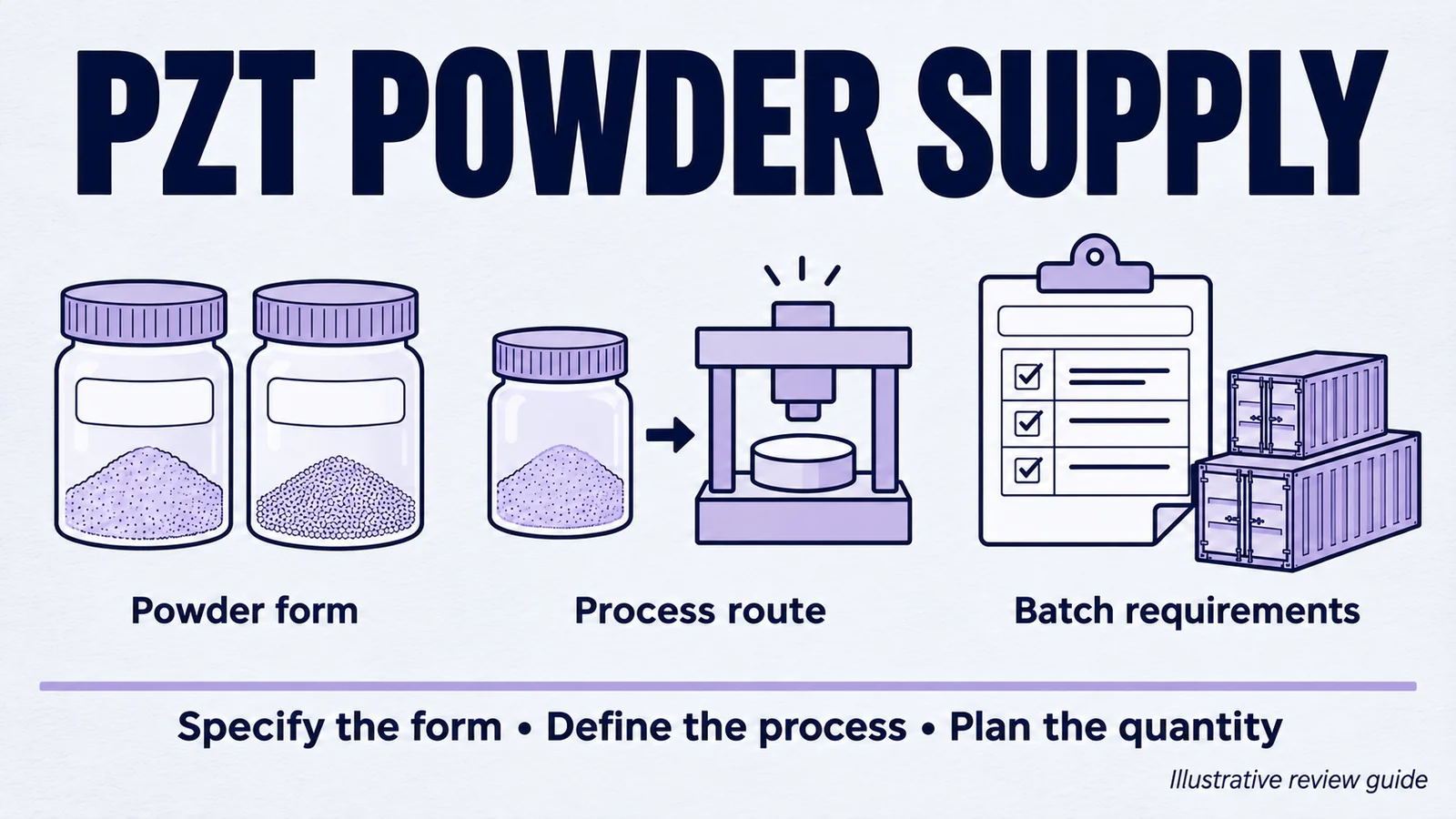
A purchasing request for “PZT powder” can leave a critical question unanswered: what processing has already been completed, and what will your factory do next?
Calcination and granulation describe different processing steps. A calcined powder can subsequently be milled and granulated. Consequently, asking whether a powder is “calcined or granulated” may produce answers that sound comparable while describing different aspects of the material.
For a production inquiry, identify the formulation and supplied condition separately. Then connect both to the process that will receive the powder.
Start at the receiving operation
Consider two illustrative buyers. One feeds a dry press and wants powder prepared for that operation. The other prepares its own slurry and needs to control the binder and other additives internally. Both may request a similar PZT material family, but their processing requirements are different.
The useful question is: what must arrive at the factory so that the next operation can begin under controlled conditions?
Record whether the delivered powder is granulated, whether it contains a binder, and which preparation steps remain at your plant. These details give your process team a defined starting point for evaluating the feedstock.
“For dry pressing” gives the supplier context, but the request still needs the supplied condition and any limits already established by your process team.
| Specification field | What to state | What to clarify if unknown |
|---|---|---|
| Material formulation | Current grade and its manufacturer, or the required material behavior | Whether the proposal is an exact requested grade or an alternative |
| Processing state | Required calcination, milling and granulation status | Which operations the supplier completes before shipment |
| Additives | Binder, lubricant or other additive requirements | Presence, identity and amount, where disclosure is available |
| Particle information | Required size distribution and measurement method | Whether the result describes dispersed particles or granules |
| Receiving process | Pressing, slurry preparation or another defined route | Any further preparation expected at your plant |
| Quantities | Evaluation quantity, production batch and annual forecast | Units and whether the forecast represents an order commitment |
Ask what a particle-size number represents
A size value without a method or sample-preparation description is difficult to use in purchasing. Before comparing reports, ask what was measured and how the sample was prepared. If one result describes granules and another describes dispersed powder, a numerical comparison alone will not answer whether the two deliveries suit the same operation.
Record the method alongside the requested distribution. Where your team has not defined a numerical limit, describe the processing requirement and ask what characterization is available. An unexplained number copied from a previous quotation is a weak basis for acceptance.
The same principle applies to additives. A request for binder-free material should be explicit. A request for prepared pressing powder should identify the binder information your process team needs before evaluating it. Do not leave these decisions to the wording on a packing label.
Use the first sample to resolve a named uncertainty
Before ordering an evaluation quantity, write down the question it must answer. Examples include whether the material can be handled by the existing feed system, whether additional preparation is required, or whether the resulting test pieces meet an agreed evaluation plan.
Keep a record of the supplied powder identity, any preparation performed after receipt, and the specimen route used for evaluation. This makes it possible to distinguish a change in the supplied material from a change introduced by your own process.
Avoid treating “sample received” as equivalent to “production approved.” A useful approval identifies the powder condition, process and component requirement that were actually evaluated. For repeat purchasing, retain that identity with the quotation and order specification.
Where YJ Piezo fits
YJ's PZT powder supply service reviews the requested material, parameters, quantity and destination for the actual project. Available powder forms, documentation, packing and shipment arrangements are confirmed during that review.
The PZT material reference can help describe the ceramic behavior you are seeking. It does not, by itself, establish the supplied powder form, binder system or the performance your factory will obtain after processing.
If your factory purchases finished elements rather than processing powder, use the piezoelectric ceramic range to identify the part instead. This helps direct the inquiry to the appropriate supply discussion.
Request a powder supply review
Discuss your PZT powder requirement with YJ Piezo. Include the information you already have:
- Current grade or datasheet, if available.
- Required powder condition and any additive restrictions.
- Your forming route and the component you intend to manufacture.
- Required measurements or documents, with test methods where defined.
- Evaluation quantity and production batch quantity in kg.
- Expected annual usage, destination and requested timing.
You can start before every field is complete. Identifying an unknown is more useful than presenting an assumed requirement as a fixed specification.
Two questions buyers often need to settle
Does “calcined” mean ready for my press?
No. It identifies a processing step. Confirm the subsequent processing, supplied condition and suitability for your forming route with the supplier.
Can a ceramic material table replace a powder specification?
It can support formulation discussions. A powder purchase still needs its own supplied-condition requirements, while the finished ceramic needs evaluation under the intended process.
Related Products
Related Guides
Discuss Your PZT Powder Supply
Share the required powder form, receiving process, evaluation quantity in kg and expected production demand.
Request a Powder Supply Review